Your team is stretched thin, deadlines keep moving, and burnout is showing up in the numbers before it shows up in conversation. That’s usually the moment someone starts searching for online resilience training, hoping to find something that actually changes how people handle pressure instead of another slide deck nobody remembers a week later.
This list answers that search directly. Below you’ll find seven programs worth your time, ranging from free resilience courses you can assign this afternoon to paid certifications built for leadership teams that want measurable, lasting change. Each one teaches practical stress management skills and coping strategies your people can use the same day, not abstract theory.
I’ve spent 20 years as a firefighter and led championship adventure racing teams through conditions that make a bad quarter look easy, so I know the difference between training that sounds good and training that holds up when things get hard. As you compare these resilience training online options, I’ll flag what each one does well, who it’s built for, and where it fits alongside the kind of work I do on building a strong team culture in my own keynotes and workshops.
1. Positive Psychology: Resilience Skills (UPenn)
This course comes out of the University of Pennsylvania’s Positive Psychology Center, home to Martin Seligman’s decades of research on learned optimism and grit training that builds mental toughness. It’s part of the broader Foundations of Positive Psychology Specialization on Coursera, and it’s one of the most academically grounded options you’ll find under the umbrella of online resilience training. If you want a program with real research behind every module instead of borrowed motivational language, this is the one to start with, and it pairs well with understanding how Master Resilience Training works.
What it covers
The course walks through the PERMA model of well-being, explains why resilience isn’t a fixed trait, and teaches specific techniques for building it, including cognitive reframing, gratitude practices, and strategies for handling adversity without spiraling into helplessness. You’ll also cover the science behind character strengths and how they show up under pressure.
Resilience isn’t something people either have or don’t. It’s a skill you build the same way you build any other habit.
Who it’s for
This program suits managers and HR leaders who want a credible, university-backed foundation before rolling training out to a wider team. It also works well for individual employees who prefer a self-paced, research-heavy approach over workshop-style exercises.
Format and time commitment
The course runs fully online through Coursera, with video lectures, quizzes, and short readings. Expect to spend roughly 8 to 12 hours total, spread across a few weeks if you go at a relaxed pace. Everything is asynchronous, so it fits around existing schedules without requiring live sessions.
Cost and certification
You can audit the course content for free, which covers the search intent behind free resilience courses if budget is the main concern. A paid track (typically $49 to $79, depending on current Coursera pricing) adds graded assignments and a shareable certificate, useful if you want proof of completion for HR records or professional development files. For a deeper dive into pricing and specialization bundling, check Coursera’s own course page directly rather than relying on secondhand summaries, since pricing structures shift periodically.
2. Build Personal Resilience (Macquarie University)
Macquarie University’s business school built this course for people who want resilience training grounded in workplace psychology rather than general self-help. It runs on Coursera as a standalone course, and it leans heavily on the idea that resilience is a resource you can actively manage, not a personality trait you either have or lack.
What it covers
Expect modules on self-awareness, self-regulation, and the habits that separate people who bounce back from setbacks from those who get stuck in them. The course spends real time on workplace-specific stressors like conflict, criticism, and change fatigue, which makes it more directly applicable to office environments than some of the broader psychology-focused options on this list.
The people who recover fastest from setbacks aren’t the toughest in the room. They’re the ones who know how to manage their own reactions.
Who it’s for
This one fits mid-level managers and team leads who deal with day-to-day interpersonal friction and want concrete tools, not just theory.
Format and time commitment
The course takes about 7 hours to complete, delivered through short video lessons and reflection exercises you can finish over a single week or spread out longer.
Cost and certification
Auditing is free. A paid certificate runs roughly $49, standard for Coursera’s individual course pricing.
3. Resilience for Everyone (Arizona State University)
Arizona State University built this course as a broader, more accessible entry point into online resilience training, and it shows in the tone. Where the UPenn and Macquarie courses lean academic, this one feels more like a coach talking you through real situations, using everyday language instead of psychology jargon.
What it covers
The course covers the basics of stress physiology, then moves into practical coping strategies like reframing negative thoughts, building support networks, and setting boundaries that actually hold under pressure. It also spends time on resilience for caregivers and students, not just office workers, which broadens who can get value from it.
Resilience training works best when it meets people where their stress actually lives, not where a textbook assumes it does.
Who it’s for
This program suits HR teams introducing resilience concepts to a mixed audience, including hourly staff, remote workers, and people outside traditional office roles who might feel alienated by academic framing.
Format and time commitment
Delivered on Coursera, the course runs about 5 to 6 hours, broken into short video segments with brief quizzes. You can finish it in a single afternoon or spread it across a week without losing momentum.
Cost and certification
Auditing is free, keeping it firmly in free resilience courses territory for budget-conscious teams. A paid certificate track runs around $49, consistent with standard Coursera individual course pricing.
4. Adaptability and Resiliency (UC Davis)
UC Davis built this course as part of its broader People Management specialization on Coursera, and it treats resilience as one piece of a larger management skill set rather than a standalone trait to develop in isolation. That framing makes it a useful pick if you’re already working through management and leadership skills training and want resilience training online that connects directly to how you manage people day to day, not a separate initiative bolted onto existing programs.
What it covers
The course focuses on adaptability under change, much like change management training for managers, teaching leaders how to help teams adjust when priorities shift, reorganizations happen, or plans fall apart mid-project. It covers resilient thinking patterns, how to model calm under pressure, and specific language for coaching a struggling employee back into productive work without dismissing what they’re going through.
Adaptable teams don’t avoid disruption. They just recover from it faster than everyone else.
Who it’s for
This one suits front-line managers and supervisors navigating frequent change, particularly in fast-growing companies or teams recovering from layoffs or restructuring.
Format and time commitment
Expect around 6 hours of video lessons and short assessments, deliverable over one to two weeks at a normal pace.
Cost and certification
Auditing is free. A paid certificate, priced around $49, adds graded work and a credential worth listing on a manager’s professional development record.
5. Stress Management and Resiliency Training (SMART)
Developed by Dr. Amit Sood at the Mayo Clinic, the SMART program takes a different angle than the university courses above. Instead of leaning on positive psychology theory, it draws on neuroscience research into attention and how the brain processes stress. This makes it one of the more clinically credible entries in online resilience training, especially for organizations in healthcare, insurance, or other high-stress fields where evidence-based methods matter to decision-makers.
What it covers
The program centers on training your attention and interpretation of events, teaching participants to shift from a reactive, scattered mind toward what Sood calls a resilient mind. Modules cover gratitude, compassion, acceptance, and meaning, all framed as trainable mental skills rather than fixed personality traits.
A resilient mind isn’t calm because nothing bothers it. It’s calm because it’s been trained to interpret events differently.
Who it’s for
SMART suits healthcare workers, first responders, and employees in emotionally demanding roles where burnout risk runs high and generic wellness content tends to fall flat.
Format and time commitment
Delivered through the Mayo Clinic’s online platform, the self-paced course typically takes 6 to 8 hours, split into short video sessions with guided practices you repeat daily.
Cost and certification
Pricing runs higher than the Coursera options, generally $150 to $200 for individual access, with completion documentation but no formal academic certificate.
6. ResilienceTraining.net’s Three-Tier Program
ResilienceTraining.net takes a different approach than the university platforms above, structuring its curriculum into three distinct tiers so organizations can scale training as needs grow. Rather than a single course, this is a full online resilience training system built by resilience specialists rather than academic institutions, which appeals to buyers who want something designed specifically for workplace rollout from day one.
What it covers
Tier one covers foundational coping strategies and stress awareness. Tier two moves into applied resilience skills like emotional regulation and recovery routines. Tier three targets organizational resilience, teaching leaders how to build systems and culture that support recovery at scale, not just individual coping.
Real resilience training scales with the organization, not just the individual sitting through it.
Who it’s for
Organizations planning a phased rollout, starting with individual contributors and expanding into leadership, get the most value here. It also suits companies that already tried a one-off webinar and want something with more structure and follow-through.
Format and time commitment
Each tier runs 4 to 6 hours, self-paced, with optional live coaching add-ons for teams that want facilitated discussion instead of solo modules.
Cost and certification
Pricing varies by tier and team size, generally $99 to $299 per person, with completion certificates issued at each level. Bulk licensing is available for larger teams, making this one of the more flexible resilience training online options for phased corporate deployment.
7. Tougher Minds Workplace Resilience Training
Tougher Minds is a UK-based psychology consultancy that built its entire business around workplace resilience, and that focus shows in how tightly the content maps to organizational life. Unlike the university courses on this list, this program comes from occupational psychologists who’ve spent years measuring resilience inside real companies, not academic labs, which gives it a practical edge for HR teams building a resilience training online rollout tied to specific business outcomes.
What it covers
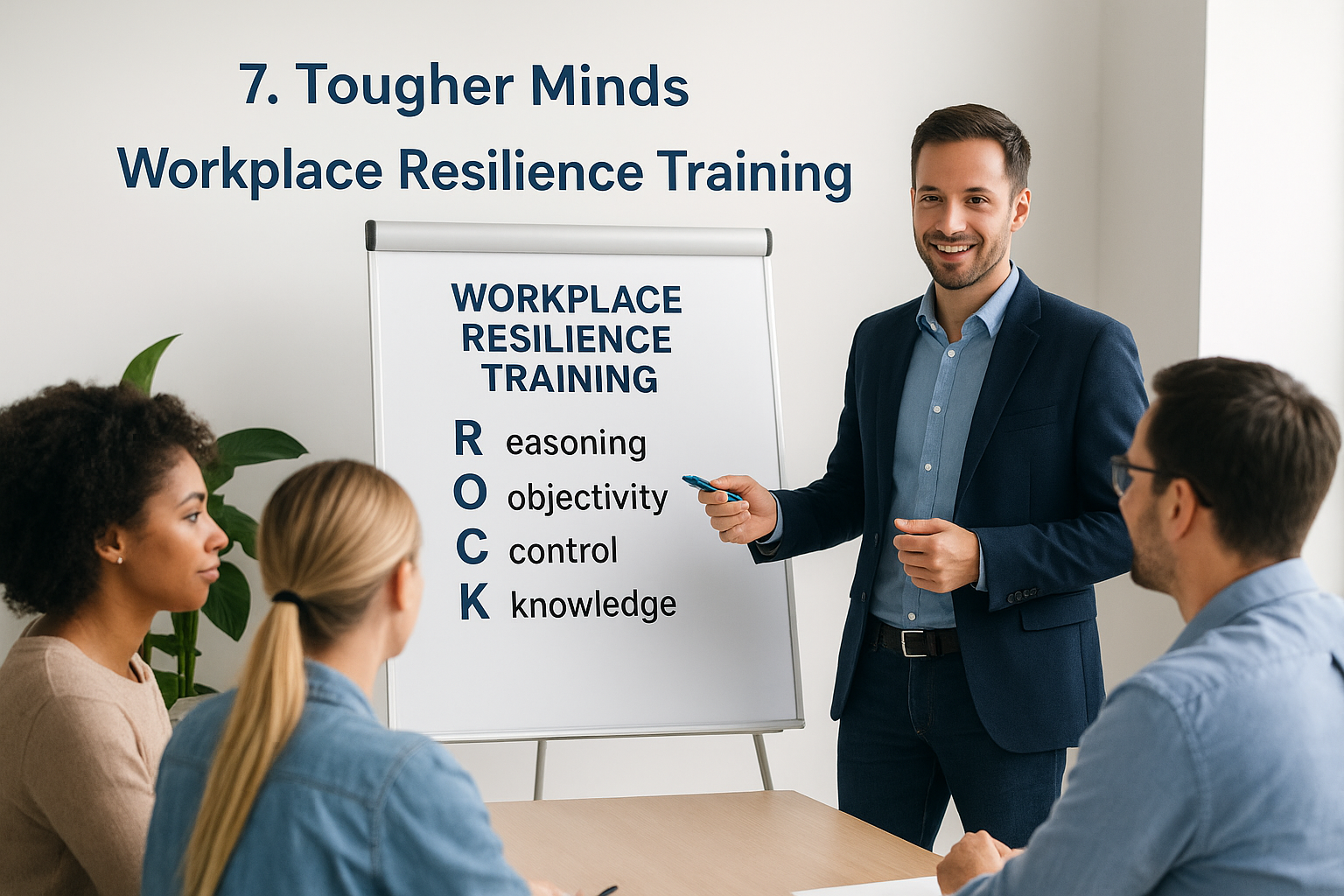
The curriculum centers on the R.O.C.K. framework, covering Reasoning, Objectivity, Control, and Knowledge, four measurable components of workplace resilience the company has validated through its own psychometric assessment. Modules address burnout warning signs, energy management, and rebuilding confidence after setbacks like restructuring or missed targets.
Resilience becomes measurable the moment you break it into components you can actually assess and track.
Who it’s for
Organizations that want data behind their training investment fit best here, particularly HR and L&D leaders who need to justify budget with pre- and post-training scores rather than anecdotal feedback.
Format and time commitment
Delivery mixes self-paced e-learning modules, roughly 4 to 5 hours total, with optional live virtual workshops facilitated by Tougher Minds consultants for teams wanting group discussion.
Cost and certification
Pricing is quote-based and scales with team size, typically landing between $150 and $400 per participant depending on whether you add live facilitation. Participants receive a resilience score report plus a completion certificate, useful documentation for compliance-heavy industries tracking employee wellbeing initiatives.
Choosing the program that fits your goals
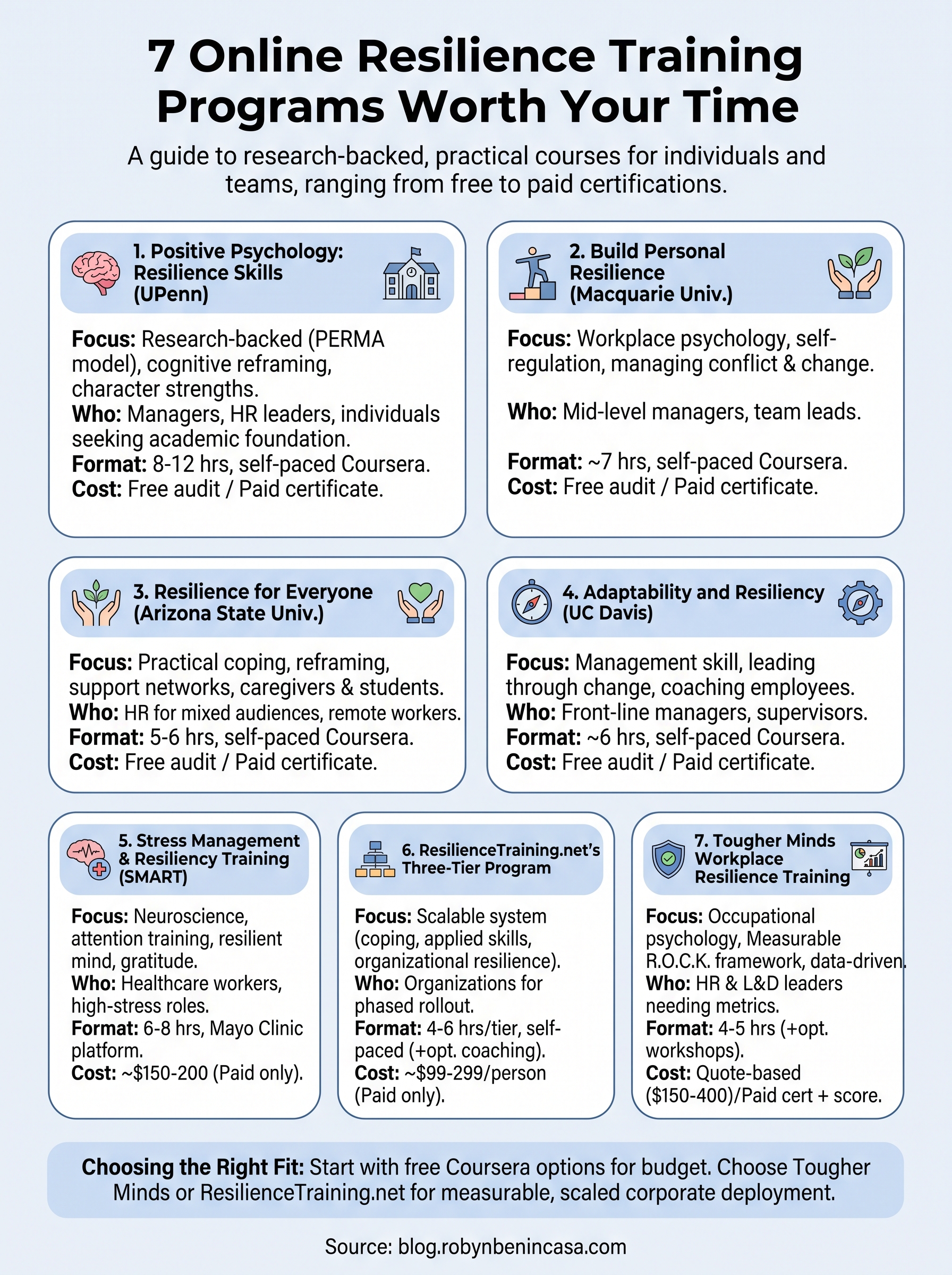
Picking the right course comes down to matching format and depth to what your team actually needs right now. If budget is tight, start with one of the free resilience courses from Coursera and see how your people respond before spending anything. If you need measurable outcomes for leadership or compliance reporting, Tougher Minds or the ResilienceTraining.net tiers give you the data trail HR wants to see.
Whatever you choose, remember that online resilience training builds individual skills, but it rarely rebuilds team culture on its own. Courses teach coping strategies one person at a time. Real resilience shows up when an entire team trusts each other under pressure, which takes more than a module and a quiz.
That’s the gap I work with organizations to close. If you want to see how this plays out in a live session with your team, here’s what working with a corporate culture keynote speaker looks like.