
Most teams don’t fail because of talent. They fail because nobody deliberately built the culture holding them together. If you’re wondering how to build culture in a team that actually performs under pressure, you already know the free-pizza-Fridays approach isn’t cutting it. Culture is built through daily decisions, not slogans on a wall, and it helps to be clear on what team culture actually is before you try to shape it.
I spent 15 years racing on world championship adventure racing teams, where a bad culture doesn’t just hurt morale, it gets people hurt in the wilderness. I’ve since spent two decades as a San Diego firefighter watching the same principles save lives in burning buildings. The teams that win aren’t the ones with the most talented individuals. They’re the ones with a shared commitment to each other that shows up when things get hard, whether that’s a canyon at midnight or a quarter with missed targets.
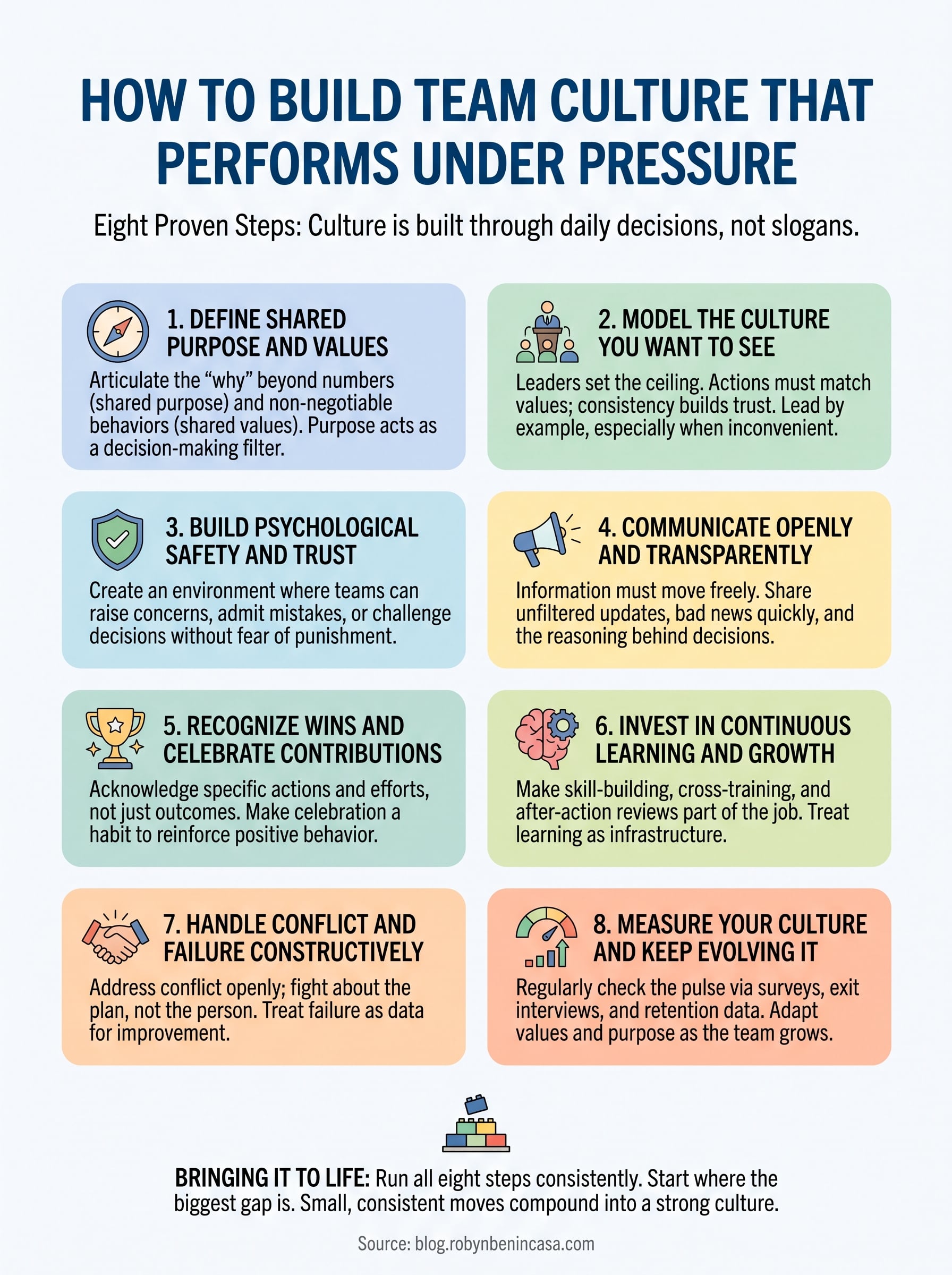
This article breaks down eight proven steps for building a strong team culture at work, drawn from those extremes and translated for boardrooms, sales floors, and remote teams alike. You’ll get specific, actionable moves you can start using this week, not vague theory about values statements.
1. Define your team’s shared purpose and values
Every world-class team I’ve raced with or worked alongside inside a firehouse could answer one question instantly: why does this team exist, beyond hitting a number or crossing a finish line? That’s the starting point for creating a strong team culture from the ground up, and most organizations skip it entirely. They write a mission statement once, hang it in the break room, and wonder why nobody references it during a tough sprint or a bad shift.
What this step looks like
Defining shared purpose means your team can articulate, in their own words, what winning looks like and why it matters to them personally, not just to the shareholders. On my adventure racing teams, our purpose was never just "finish first." It was proving that ordinary people, working as one unit, could outlast athletes with far more raw talent. That purpose shaped every decision, from who we recruited to how we handled a broken paddle at 2 a.m. Shared values work the same way. They’re the non-negotiable behaviors your team agrees to live by, like "we never leave a teammate behind" or "we surface problems immediately instead of hiding them."
Why it matters for team culture
Purpose and values act as the decision-making filter when you’re not in the room. A team with a clear purpose doesn’t need a manager micromanaging every call because everyone already knows what matters. Without that filter, teams default to self-interest the moment pressure rises, and that’s exactly when culture cracks.
A team without a defined purpose will invent one under pressure, and it’s rarely the purpose you wanted.
This matters just as much for developing team culture in a brand-new group as it does for fixing a struggling one. Early teams that skip this step tend to drift toward whoever talks loudest, rather than what the mission actually requires.
How to put it into practice
Don’t outsource this to HR or a consultant deck. Get your actual team in a room, virtual or otherwise, and work through it together, the same way you’d run exercises built for leadership teams:
- Ask each person to write down, privately, what they think the team’s purpose is. Compare answers. The gaps tell you everything.
- Identify three to five behaviors that support that purpose, stated as actions, not adjectives ("we tell each other the truth even when it’s uncomfortable" beats "we value honesty").
- Put those behaviors into onboarding, performance reviews, and team meetings, not just a poster.
- Revisit the purpose statement quarterly. Markets shift, teams change, and a purpose that fit eighteen months ago might not fit now.
If you want a structured way to walk your leadership team through this exercise, my free team building and leadership guide breaks down the exact framework I use with corporate clients before I ever step on stage.
2. Model the culture you want to see as a leader
Leaders set the ceiling for every team’s culture, not the floor. On my racing teams, if the captain complained about the mud or cut corners on gear checks, that behavior spread through the group faster than any pep talk could counter it. Building a positive team culture starts with the person in charge deciding to go first, every single time, especially when it’s inconvenient.
What this step looks like
Modeling culture means your actions match the values you asked the team to adopt in step one. If you preach transparency but hide bad news from your own team, they’ll notice within a week. If you ask for accountability but blame others when a project slips, you’ve just taught everyone that accountability is optional, which is exactly the gap accountability training is designed to close. I learned this in firehouses too: the captain who shows up first to a call and stays last to clean the rig earns a kind of trust that no memo can manufacture.
Why it matters for team culture
Teams copy behavior, not language. Your daily conduct becomes the unwritten rulebook people actually follow, regardless of what the employee handbook says.
Culture isn’t what leaders say in meetings, it’s what they do when no one’s grading them.
This is why developing a team culture stalls out in so many organizations, and why organizational culture and leadership can never really be separated. Leadership drafts great values, then exempts themselves from living them, and the team quietly does the same.
How to put it into practice
Start small and stay consistent:
- Admit your own mistakes out loud, in front of the team, before asking others to do the same.
- Show up early to the hard shifts, not just the visible wins.
- Ask for feedback on your leadership, then actually act on it publicly.
- Never let a double standard slide, even a small one, because your team is always watching for the exception that proves the values were never real.
3. Build psychological safety and trust
Psychological safety sounds like a soft HR term until you’ve watched a teammate stay silent about a cracked carabiner because they didn’t want to look weak in front of the group. Building healthy team culture depends on people believing they can raise a concern, admit a mistake, or challenge a decision without getting punished for it. Trust isn’t a nice-to-have here. It’s the mechanism that gets the truth on the table before it becomes an emergency.

What this step looks like
Safety shows up in small moments: a junior team member questioning a senior leader’s plan in a meeting, or a firefighter radioing that they’re not ready to enter a structure yet. On my racing teams, we built a rule that anyone could call a stop, no explanation required, and nobody would second-guess them later. That single rule saved us from disaster more than once.
Why it matters for team culture
Google’s own Project Aristotle research found psychological safety was the single biggest predictor of high-performing teams, ahead of skill or experience. Teams without trust hide problems until they’re too big to fix quietly.
A team that’s afraid to speak up will let small problems become disasters before anyone says a word.
Without it, you get silence in meetings, quiet resentment, and talented people who stop volunteering ideas because it’s not worth the risk.
How to put it into practice
Start building trust deliberately, not by accident:
- Respond to bad news with curiosity, not anger, especially the first time someone brings you a mistake.
- Ask for dissenting opinions by name in meetings, not just "any objections?" to the room.
- Share your own uncertainty openly instead of projecting false confidence.
- Follow through visibly when someone raises a concern, so the team sees speaking up actually changes outcomes.
4. Communicate openly and transparently
Radio silence kills teams faster than bad news ever will. On adventure races, the moment someone stopped reporting their real condition, hydration, injuries, morale, we lost the ability to make good decisions as a group. Building team culture at work requires the same discipline: information has to move freely, in both directions, even when it’s uncomfortable to share.
What this step looks like
Open communication means people hear about layoffs, budget cuts, or strategy shifts from leadership directly, not through the rumor mill. It means status updates include the real number, not the rounded-up version that looks better in a meeting. In firehouses, incident commanders give unfiltered updates over the radio because a sanitized version gets someone killed. Businesses rarely face that literal stake, but the habit of plain, honest updates should be identical.
Why it matters for team culture
Teams fill information gaps with worst-case assumptions. Silence from leadership doesn’t read as neutral, it reads as something is being hidden.
Whatever you don’t communicate, your team will invent, and their version is almost always worse than the truth.
Transparent teams move faster because nobody wastes energy decoding hidden agendas or protecting themselves from surprises.
How to put it into practice
Make transparency a habit, not a one-time announcement, and reinforce it with regular communication exercises for teams:
- Share the bad news yourself, quickly, before it leaks out sideways.
- Explain the reasoning behind decisions, not just the decisions themselves.
- Hold a regular open forum where any question gets a straight answer, including "I don’t know yet."
- Close the loop publicly once you do know, so people trust the next update too.
Get this right and you remove the guesswork that quietly erodes team trust over time, which is where the real work of building trust in a team at work happens.
5. Recognize wins and celebrate contributions
Crossing a finish line after 30 hours of racing means nothing if nobody acknowledges what it took to get there. Recognizing wins isn’t about trophies or plaques, it’s about making sure every person on the team knows their specific contribution mattered. Building a good team culture without recognition is like training for a race and never crossing the finish line, the effort just fades into the background.

What this step looks like
Genuine recognition names the specific action, not just the outcome. On my racing teams, we didn’t just celebrate the win, we called out the teammate who fixed a broken bike chain in the dark or the navigator who found the right trail after three wrong turns. In a firehouse, that looks like a captain naming the rookie who caught a mistake before it became a problem. Specific praise always beats generic applause because it proves someone actually paid attention.
Why it matters for team culture
People repeat behavior that gets acknowledged and quietly abandon behavior that gets ignored. Skip recognition and your best contributors start wondering why they bother going above the minimum.
A team that never celebrates its wins slowly stops trying to earn them.
This is a core part of building a winning team culture, and it’s the clearest link between culture and employee engagement, because recognition tells people their work is seen, not just measured against a quota.
How to put it into practice
Make recognition a habit, not an afterthought:
- Call out contributions by name and by specific action, in front of the team, not just in a private message.
- Celebrate the effort behind failed attempts, not just clean wins, especially when someone took a smart risk.
- Let peers nominate each other for recognition, since credit from a teammate often lands harder than credit from a boss.
- Keep celebrations proportional and frequent, small wins acknowledged weekly build more momentum than one big annual awards night.
6. Invest in continuous learning and growth
Stagnant teams lose their edge quietly, then all at once. On the racecourse, the teams that kept improving year after year were the ones who treated every finish, win or loss, as a debrief opportunity. Developing team culture means building an expectation that everyone is getting better at their craft, not just clocking hours until retirement.
What this step looks like
Continuous growth shows up as regular skill-building, cross-training, and honest after-action reviews, not just an annual training budget nobody uses. My racing teams reviewed every leg of every race, what worked, what nearly killed us, what we’d do differently next time. Firehouses run drills constantly even after decades on the job, because competence erodes the moment you stop practicing. Ongoing skill development should feel like part of the job, not an extra assignment squeezed in when things slow down.
Why it matters for team culture
People stay engaged with teams that invest in their future, and they disengage fast from teams that treat them as replaceable. Growth signals that leadership sees a long-term relationship, not just short-term output.
A team that stops learning together starts drifting apart, even if nobody notices right away.
This is central to creating a high-performance culture, because skills gaps compound quietly until a crisis exposes them all at once.
How to put it into practice
Treat learning as infrastructure, not a perk:
- Run a short after-action review after every major project, win or lose, asking what to repeat and what to change.
- Pair newer team members with veterans for real mentorship, not a one-time orientation session.
- Budget time, not just money, for skill-building, since a training budget nobody can use during work hours gets ignored.
- Rotate stretch assignments so people grow into new capabilities before you desperately need them.
7. Handle conflict and failure constructively
Conflict isn’t the enemy of a strong culture, avoidance is. On my racing teams, the crews that imploded weren’t the ones who argued, they were the ones who stayed quiet while resentment built until someone quit mid-race. Creating team culture that lasts means training your team to fight about the right things, the plan, the process, the decision, without it turning personal.
What this step looks like
Constructive conflict looks like two people disagreeing loudly about strategy in a meeting, then grabbing coffee together an hour later. It looks like a firehouse crew doing a blunt post-incident review where nobody softens the truth to spare feelings. Failure gets treated as data, not a verdict on someone’s worth. When my team blew a navigation call and cost us six hours, we didn’t hunt for someone to blame, we asked what the map, the timing, and the communication broke down and how to fix all three.
Why it matters for team culture
Teams that suppress conflict don’t eliminate it, they just push it underground where it festers longer and does more damage, which is the heart of Patrick Lencioni’s team dysfunctions model. Unresolved tension shows up later as passive resistance, missed deadlines, or quiet quitting.
A team that never argues isn’t peaceful, it’s just hiding a problem that hasn’t exploded yet.
Handled well, conflict actually strengthens trust because people learn disagreement won’t cost them the relationship.
How to put it into practice
Build the habit deliberately:
- Separate the person from the problem in every disagreement, attack the plan, never the individual.
- Run a blameless post-mortem after failures, focused on systems and decisions, not fault.
- Address tension within 48 hours instead of letting it simmer through another meeting.
- Ask the quieter voice in the room what they see differently before closing the discussion.
8. Measure your culture and keep evolving it
Culture isn’t a project you finish, it’s a system you monitor. On my racing teams, we debriefed after every leg because a culture that worked at hour ten might crack by hour thirty. Building a positive team culture at work demands the same discipline: you check the pulse regularly instead of assuming last year’s values statement still fits this year’s team.

What this step looks like
Measuring culture means gathering real signals, not just gut feel from the leadership team. Pulse surveys built on the right culture survey questions, exit interviews, retention numbers, and honest one-on-ones all tell you something a quarterly all-hands never will. In firehouses, we track near-misses the same way, small warning signs that predict bigger failures if ignored. Tracking these signals consistently is how you catch culture drift before it shows up in your attrition report.
| Signal | What it reveals |
|---|---|
| Pulse survey scores | Trust and engagement trends over time |
| Voluntary turnover | Whether people want to stay and grow here |
| Exit interview themes | Recurring, unresolved cultural gaps |
| Peer recognition volume | Whether wins are actually being noticed |
Why it matters for team culture
What gets measured gets managed, and culture is no exception. Teams that never check their own health tend to discover problems only after their best people have already quit.
A culture you never measure is a culture you’re only guessing about.
Evolving deliberately beats reacting to a crisis every time.
How to put it into practice
Build a simple, repeatable rhythm:
- Run a short, anonymous pulse survey quarterly using a simple organizational culture assessment tool, and actually share the results with the team.
- Track voluntary turnover and exit interview themes as culture data, not just HR paperwork.
- Revisit your purpose and values from step one annually, adjusting language as the team grows.
- Bring in outside perspective when you’re too close to see your own blind spots, whether that’s a mentor, consultant, or a keynote that resets the whole room’s thinking.
Bringing these steps to life on your team
None of these eight steps work in isolation. Purpose without psychological safety collapses under pressure. Recognition without honest conflict resolution turns hollow fast. Building a strong team culture means running all eight at once, consistently, not picking your favorite and hoping it carries the rest. Start with whichever step exposes your biggest gap right now, then layer in the others over the next few quarters.
Your team is watching what you do this week, not what you posted about culture last year. Pick one practice from this list and put it into action tomorrow morning. Small, consistent moves compound into the kind of culture that holds together when things get hard, whether that’s a missed quarter or a canyon at midnight.
If you want help translating these principles into a live session for your leadership team or sales force, see what a corporate culture keynote speaker can do for where your team stands today.