You’ve probably heard the term tossed around in military circles or maybe in a leadership book, and now you want a straight answer: what actually is master resilience training? It’s fair to ask. The Army built this program to solve a real problem, soldiers and units cracking under sustained stress, and it turned to psychology research instead of guesswork to fix it.
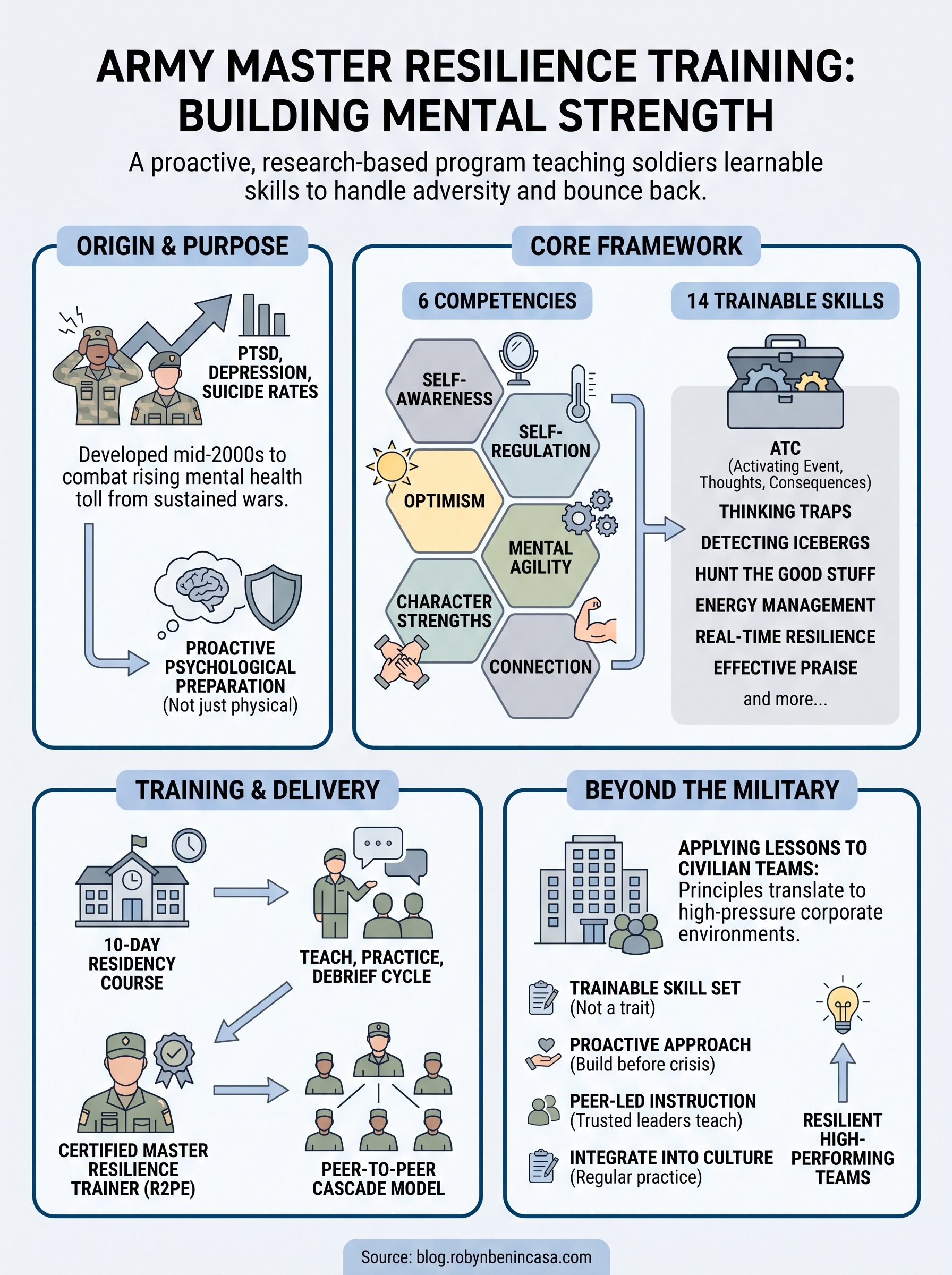
Here’s the direct answer. Army master resilience training is a course the U.S. Army developed with the University of Pennsylvania to teach soldiers specific, learnable skills for handling adversity, controlling reactions under pressure, and helping their teams bounce back from setbacks faster. It’s not a pep talk. It’s a structured master resilience training program built on cognitive techniques, and soldiers who complete it become certified to train others.
In this article, I’ll walk you through what the course covers, how the training actually runs from classroom to practice, and the core skills it drills into soldiers. I’ve spent two decades leading teams through genuinely brutal conditions, firefighting and endurance racing, so I’ll also point out where these same principles show up in high-performing civilian teams and why that matters if you’re building resilience anywhere outside the military.
Why the Army developed master resilience training
The backstory here matters, because it explains why this program looks the way it does. In the mid-2000s, the Army was running two grinding wars at once, and the toll on soldiers went far beyond physical injury. Post-traumatic stress, depression, and suicide rates climbed among troops cycling through repeated deployments, and commanders realized that traditional discipline and toughness training weren’t stopping the bleeding. Something had to change in how the Army prepared soldiers mentally, not just physically, for what they’d face.
A crisis that demanded a new approach
General George Casey, the Army Chief of Staff at the time, pushed for a solution that treated psychological strength the same way the Army treated physical fitness: as something you train deliberately, not something you either have or don’t. That thinking led to the Comprehensive Soldier Fitness program, a broader Army initiative aimed at building strength across physical, emotional, social, family, and spiritual dimensions. Master resilience training became the flagship piece of that effort, the part specifically designed to teach mental skills soldiers could actually practice and measure.
The Army stopped treating mental toughness as a personality trait and started treating it as a trainable skill.
Partnering with psychology researchers instead of guessing
Rather than build the curriculum in-house, the Army turned to Dr. Martin Seligman and his team at the University of Pennsylvania, pioneers in the field of positive psychology. Seligman had spent decades studying learned helplessness and, more importantly, how people learn optimism and resilience through specific cognitive habits. This wasn’t a random pick. His research on cognitive behavioral techniques gave the Army something it needed badly: an evidence-based framework instead of another motivational seminar. You can read more about the foundational research behind this approach through the American Psychological Association, which has documented much of Seligman’s work on resilience and learned optimism.
The partnership formalized around 2008 and 2009, and the resulting curriculum drew directly from Penn’s Resilience Program, which had already been tested in schools and with at-risk populations before the Army adapted it for soldiers. This is worth pausing on. Master resilience training in the US Army wasn’t invented from scratch by military planners. It was adapted from psychology research that had already shown results in civilian settings, then reshaped for the specific stresses of combat deployment, family separation, and the unpredictable pace of military life.
Building resilience before the crisis, not after
Here’s the piece that separates this program from typical stress management training: it’s proactive, not reactive. Most military mental health resources at the time kicked in after a soldier was already struggling, after a diagnosis, after a crisis. The Army wanted something upstream of that. Leaders designed the master resilience training course to reach soldiers before deployment, before the traumatic event, so the mental skills were already in place when things got hard.
Officials framed this shift plainly, arguing that resilience skills should be as routine as marksmanship or physical conditioning. That comparison shows up constantly in Army literature on the program, and it’s not just messaging. It reflects a genuine change in how the institution viewed psychological preparation. Soldiers train their bodies for combat for months before deployment. Why not train their minds the same way?
The scale of the rollout tells its own story
Quickly, this expanded from a pilot into a resilience initiative touching hundreds of thousands of soldiers. Numbers here give a sense of how seriously the Army committed to it:
- Comprehensive Soldier Fitness launched Army-wide starting in 2009
- Master resilience training became a required course for select non-commissioned officers
- Certified trainers went on to teach the material to soldiers in their own units, creating a cascading model rather than relying on outside instructors
- The program eventually reached well over a million soldiers through direct training or unit-level instruction
Ultimately, the Army wasn’t just adding another training block to an already packed schedule. It was making a bet that mental skills, taught systematically and reinforced by peers rather than outside experts, could reduce the human cost of sustained operational stress. That bet is the reason the program still exists today, and it’s the reason its methods have since traveled well beyond military bases into corporate leadership programs and team-building initiatives.
How master resilience training works
Structurally, the master resilience training course runs as a 10-day residency, usually held at one of the Army’s designated training sites, where selected non-commissioned officers and soldiers attend full-time. This isn’t a lecture series you half-listen to between other duties. Attendees leave their regular unit responsibilities behind and focus entirely on the curriculum, which mixes classroom instruction with hands-on practice, small group discussion, and role-playing exercises that force soldiers to apply concepts in real time rather than just memorize them.
The classroom-to-practice pipeline
Generally, each day builds on the last, starting with a psychological concept, say, identifying automatic negative thoughts, and then moving into structured drills where soldiers practice catching those thoughts in themselves and in scenarios modeled after real deployment stressors. Instructors use case studies pulled from actual military experiences: a soldier struggling after a difficult deployment, a unit dealing with a leadership failure, a family coping with repeated separations. Soldiers work through these cases in small groups, applying the specific technique taught that day, then debrief as a full class. This cycle of teach, practice, debrief repeats throughout the course, which is deliberate. Seligman’s research showed that resilience skills stick when people rehearse them under realistic conditions, not when they just hear about them once.
Resilience isn’t taught in a single lecture. It’s built through repetition until the skill becomes automatic under pressure.
From student to certified trainer
Completion of the course doesn’t just mean a soldier understands the material. It means they’re certified to teach it to others, which is the mechanism that lets the master resilience training program scale without an army of outside psychologists. Graduates return to their units as Master Resilience Trainers, responsible for running shorter sessions with their own soldiers, embedding the skills into regular training cycles rather than treating resilience as a one-time event.
Here’s a simplified breakdown of how the format typically flows:
| Phase | What Happens | Purpose |
|---|---|---|
| Days 1-3 | Core concepts introduced (thinking traps, ATC model) | Build foundational vocabulary and self-awareness |
| Days 4-7 | Skill-specific practice sessions (hunt the good stuff, energy management) | Reinforce techniques through repetition |
| Days 8-9 | Small group teaching practice | Prepare soldiers to instruct others |
| Day 10 | Certification and unit application planning | Finalize readiness to train peers |
Institutionally, this peer-to-peer model matters more than it might seem at first glance. It means resilience training doesn’t depend on scarce clinical resources. A sergeant who’s been through combat can teach a technique to a private in language that lands, because the instructor has lived the same pressures the material is meant to address. That credibility gap, between a civilian consultant and a fellow soldier, is part of why the Army built the program to cascade this way instead of centralizing it.
The six competencies and 14 skills at its core
Underneath the training schedule sits a specific framework, six competencies that organize everything soldiers learn, and 14 distinct skills that put those competencies into practice. Every case study, every role-play, every worksheet in the master resilience training program ties back to one of these six pillars. Understanding this structure helps explain why the course covers what it does instead of feeling like a grab bag of feel-good exercises.
The six competencies
Each competency addresses a different piece of how a person responds to stress, from noticing your own reactions to managing relationships under pressure. Here’s the breakdown:
| Competency | What It Targets |
|---|---|
| Self-Awareness | Recognizing your own thoughts, emotions, and physical reactions in real time |
| Self-Regulation | Controlling impulsive reactions and managing emotions constructively |
| Optimism | Building realistic, hopeful thinking rather than catastrophizing |
| Mental Agility | Considering multiple explanations for events instead of jumping to one conclusion |
| Character Strengths | Identifying and using personal strengths to solve problems |
| Connection | Building and maintaining strong relationships within a team |
Resilience isn’t one skill. It’s six trainable competencies working together under pressure.
The 14 skills soldiers actually practice
Beneath those six competencies, the curriculum breaks resilience down further into 14 concrete techniques, each one drilled through repetition rather than discussed abstractly. This is where master resilience training stops being theory and starts looking like a toolkit. Some of the most emphasized skills include:
- ATC (Activating Event, Thoughts, Consequences), a model for tracing how thoughts drive emotional reactions
- Thinking Traps, recognizing distorted patterns like jumping to conclusions or mind-reading
- Detecting Icebergs, uncovering deep-seated beliefs that trigger outsized reactions
- Hunt the Good Stuff, deliberately noticing positive events to counter negativity bias
- Energy Management, regulating physical and mental energy before high-stakes moments
- Real-Time Resilience, catching and reframing negative thoughts in the moment
- Effective Praise, giving specific, behavior-based feedback that builds confidence
- Building Character Strengths, matching individual strengths to team roles
Additional skills round out the list, covering problem-solving accuracy, avoiding overreaction, and strengthening trust between teammates.
Collectively, this structure explains why the master resilience training course takes 10 full days rather than an afternoon workshop. Soldiers aren’t just hearing about optimism or self-awareness once. They’re practicing each of the 14 skills across multiple scenarios until the response becomes closer to instinct than effort. That repetition, tied to a clear framework of six competencies, is what separates this program from a generic resilience seminar and gives certified trainers something specific to teach when they return to their units.
Who can attend and how to become a certified trainer
Access to this course isn’t open to just anyone wearing a uniform. The Army built the master resilience training course primarily for non-commissioned officers, sergeants and above, since these are the soldiers who lead squads and platoons day to day and have the most direct influence on how junior soldiers handle stress. Officers attend too, particularly those in leadership development pipelines, but the backbone of the program has always been the NCO corps. That choice wasn’t accidental. The Army wanted resilience skills taught by the people soldiers already trust and take direction from, not by outsiders parachuting in for a single briefing.
Basic eligibility requirements
Getting a seat in the course usually depends on a unit commander nominating a soldier, rather than a soldier signing up independently. Requirements typically include:
- Active duty, National Guard, or Reserve status
- Recommendation from a commanding officer or senior NCO
- No major disciplinary flags that would interfere with attending a full 10-day residency
- Willingness to serve as a unit-level trainer after certification, since the Army expects a return on the investment
Quotas for each course cycle are limited, so units often prioritize soldiers heading toward leadership roles or units preparing for deployment, where the payoff from resilience training shows up fastest.
The path to certification
Completing the 10-day course is the first hurdle, but certification isn’t automatic just for showing up. Instructors evaluate soldiers on their grasp of the six competencies and 14 skills, and on their ability to teach the material convincingly during the small group practice sessions near the end of the course. Soldiers who pass leave as certified Master Resilience Trainers, a designation that goes on their record and qualifies them to run sessions back at their home unit.
Certification isn’t a participation trophy. It means the Army trusts you to teach these skills to soldiers under your command.
Once certified, trainers don’t just check a box and move on. Many attend refresher training periodically, and some go on to instruct at the Army’s Master Resilience Trainer schools, effectively becoming trainers of trainers. This layered structure is why master resilience training in the US Army has managed to reach such a large population of soldiers without needing a massive standing corps of outside psychologists. A single certified sergeant can run resilience sessions for dozens of soldiers a year, and that sergeant’s own trainer likely did the same thing a few years earlier.
Worth noting, civilians occasionally encounter adapted versions of this certification path too, since some corporate resilience programs borrow directly from the Army’s model and train internal facilitators the same cascading way. The core idea travels well outside a military context: teach the people already leading teams, then let them teach everyone else.
Is master resilience training still used today
Yes, though the name and structure have evolved since the original rollout. The Army folded the program into a broader initiative called Ready and Resilient (R2), which absorbed Comprehensive Soldier Fitness around 2013 and expanded the mission to cover physical, emotional, and social readiness under one umbrella. If you search for master resilience training program materials today, you’ll often find them referenced under the R2 banner rather than the original CSF branding, but the core curriculum, the six competencies and 14 skills, remains largely intact.
From MRT to R2 Performance Experts
Today, certified instructors go by a slightly different title: R2 Performance Experts, sometimes shortened to R2PEs. These are the direct descendants of the original Master Resilience Trainers, and they still run through the same case study, small-group, debrief cycle that defined the 2009 course. The rebrand reflected a shift toward integrating resilience with physical performance and readiness metrics, not a rejection of the original psychology-based approach. Soldiers still learn ATC, Hunt the Good Stuff, and Real-Time Resilience under this newer name.
The skills survived the rebrand. What changed was how the Army packages and delivers them.
Where the program stands now
Units across active duty, National Guard, and Reserve components continue to send NCOs through resilience certification courses, and the Army’s official Ready and Resilient resources confirm the program is still funded and staffed. A few things distinguish the current version from the early 2009 rollout:
- Delivery has broadened beyond the original 10-day residency, with shorter refresher modules built into routine training cycles
- Digital resources now supplement in-person instruction, letting soldiers review concepts like thinking traps or energy management between sessions
- Family programs have expanded, extending resilience concepts to military spouses and children, not just the soldier
- Data tracking has improved, with the Army collecting more consistent metrics on unit-level resilience outcomes than it could in the program’s first few years
Ongoing demand also keeps the model relevant. Deployment tempo has shifted since the height of the Iraq and Afghanistan wars, but the underlying stressors, family separation, unpredictable schedules, high-consequence decision-making, haven’t disappeared. That’s kept resilience training a standing requirement rather than a wartime-only measure.
Worth flagging: some critics have questioned whether the program’s early research base held up under later scrutiny, and the Army has adjusted messaging accordingly, framing resilience skills as complementary to clinical mental health care rather than a replacement for it. That distinction matters. Master resilience training in the US Army was never meant to substitute therapy for soldiers dealing with PTSD or severe trauma. It’s a preventive layer, built to reduce how often soldiers reach that point in the first place, and that framing has only gotten sharper as the program matured into its current R2 form.
Applying MRT’s lessons beyond the military
Outside the Army, the same six competencies show up wherever teams face sustained pressure, tight deadlines, high stakes, and constant change. I’ve watched this firsthand leading adventure racing teams through multi-day expeditions and running into burning buildings during my firefighting career. The mental skills that keep a soldier steady during deployment are the same ones that keep a sales team steady during a brutal quarter or a hospital staff steady during a crisis. Master resilience training was never designed to stay locked inside a military base. Its framework translates because stress doesn’t care what uniform you’re wearing.
Why corporate teams borrow the framework
Companies facing layoffs, mergers, or aggressive sales targets deal with a version of the same problem the Army faced in the mid-2000s: people cracking under weight they weren’t trained to carry. Executives increasingly recognize that resilience isn’t a personality trait some employees happen to have. It’s a trainable skill set, much like training grit and mental toughness, and that recognition is exactly what pushes HR leaders and event planners toward keynotes and workshops built on this same research. Skills like Hunt the Good Stuff and Real-Time Resilience work in a conference room the same way they work in a barracks, because the underlying psychology, catching distorted thoughts before they spiral, doesn’t change based on the industry.
A team that hasn’t practiced resilience will crack the first time real pressure hits, no matter how talented its members are.
Turning military-grade resilience into a team culture
Building a strong team culture around this takes more than a slogan on a wall. It takes the same structure the Army used: teach it deliberately, practice it under realistic pressure, and let people closest to the team lead the training rather than outsourcing it entirely. A few practical moves that echo the master resilience training program:
- Start with team building training for managers, since they influence day-to-day team culture the same way NCOs do in a unit
- Build in short, repeatable practice sessions rather than a single all-day workshop
- Normalize naming thinking traps out loud during high-stress projects, the same way soldiers do in small groups
- Track morale and performance metrics before and after training, not just attendance numbers
Speaking on this exact intersection, between elite team performance and psychological resilience, is the core of what I do in my keynotes. Companies like Allstate and Northrop Grumman have brought me in specifically because the parallel between adventure racing teams pushing through exhaustion and corporate teams pushing through market pressure isn’t a metaphor. It’s the same mechanism. My T.E.A.M.W.O.R.K. keynote draws directly on these same principles, translated from firefighting, racing, and yes, plenty of research adjacent to what the Army built with Seligman’s team.
Ultimately, organizations that treat resilience as optional rather than core infrastructure, part of the same investment as high performance culture training, tend to find out the hard way, during the layoff, the merger, the missed quarter, that their people weren’t ready. The lesson from master resilience training in the US Army is blunt: build the mental skills before the crisis, not after. That timing is the whole point.
Resilience as a skill worth building
Strip away the acronyms and the Army jargon, and master resilience training comes down to one idea: people can learn to handle pressure the same way they learn to shoot straight or run a marathon, through deliberate practice, not luck of temperament. The Army proved this at scale with soldiers facing combat stress. I’ve proved it in burning buildings and multi-day expedition races. Neither of us stumbled onto tough people by accident. We built resilient ones on purpose.
Your team faces its own version of deployment stress, whether that’s a brutal sales quarter, a merger, or constant change. Waiting for a crisis to teach resilience is a bad bet. Train it now, the same way the Army does, deliberately and before you need it.
If you want to bring these principles into your organization, see how the best motivational keynote speakers to hire deliver them to a room, and let’s build that culture together.