Nonprofit leaders wear more hats than almost anyone in the workforce. You’re running programs, managing donors, supervising staff, and reporting to a board, often with a fraction of the budget a corporate executive would have for the same responsibilities. Finding nonprofit leadership development training built for that reality, rather than generic corporate management courses, isn’t easy. Most search results either skew academic or ignore the fundraising and mission-driven pressures unique to your world.
This article gets straight to what you’re looking for: a curated list of leadership programs and certificates designed specifically for nonprofit executives, directors, and rising managers. Each entry covers who the training is for, what it costs, and what kind of results past participants have seen, so you can compare options without digging through a dozen separate websites.
I’ve spent two decades building teams under pressure, first as a San Diego firefighter and then leading world championship adventure racing teams where survival depended on shared leadership, not one hero calling every shot. Those same principles, accountability and collective ownership, show up again and again in the strongest nonprofit training programs below. Whether you’re leading a five-person team or overseeing a statewide organization, you’ll find a program here that fits your stage and your budget.
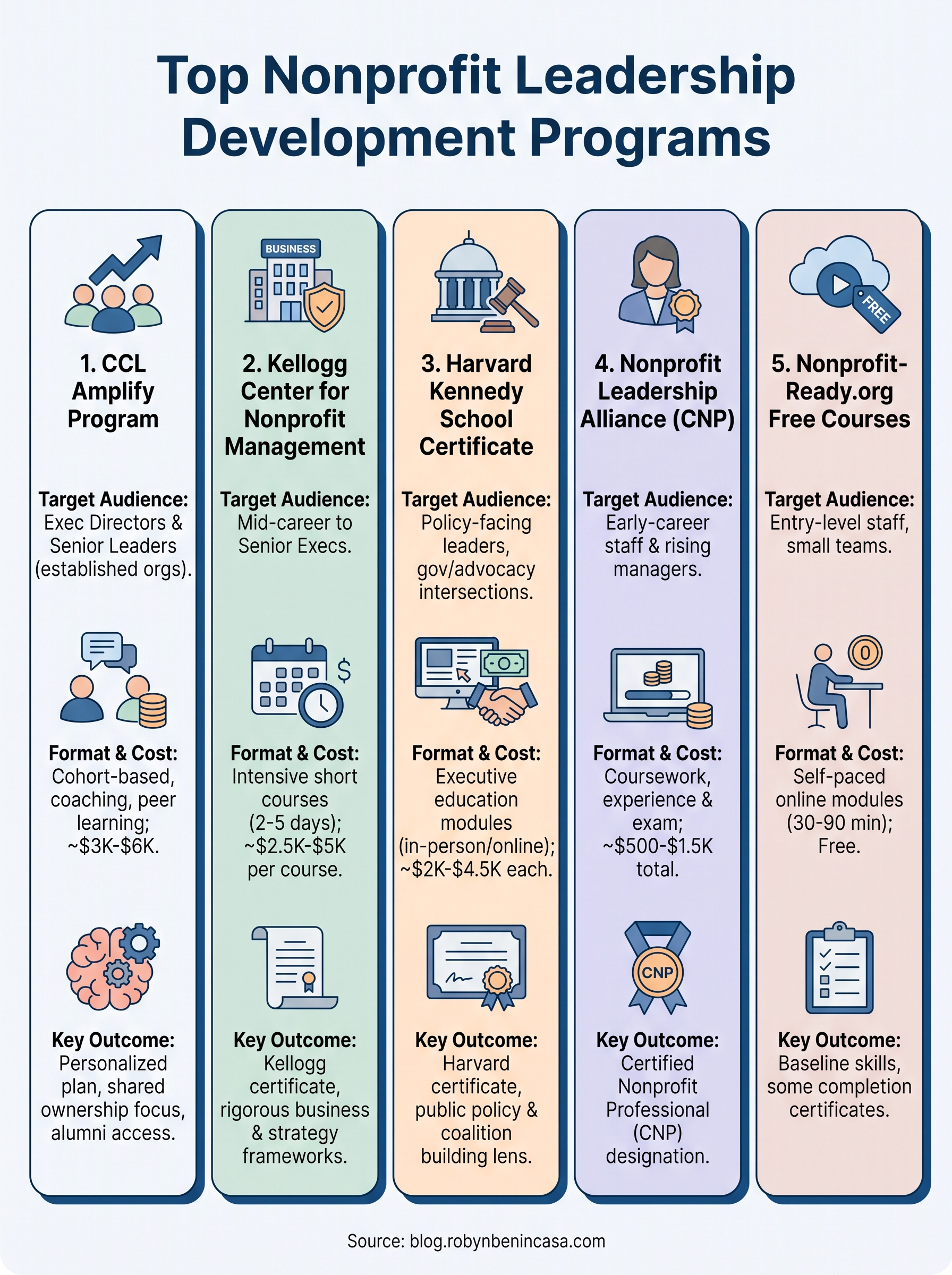
1. Center for Creative Leadership’s Amplify program
The Center for Creative Leadership (CCL) built its Amplify program specifically for nonprofit executives who need to scale their impact without burning out their teams. CCL has spent over 50 years researching leadership development, and Amplify applies that research to the specific pressures of running a mission-driven organization on a tight budget. This isn’t a repackaged corporate course with the word "nonprofit" bolted on. It’s a distinct curriculum built around collective leadership, the idea that your organization’s success depends on distributed decision-making rather than one director carrying every burden.

How it works
Participants move through a cohort-based format that blends live virtual sessions, one-on-one coaching, and peer learning groups over several months. You’ll work through real challenges from your own organization, not hypothetical case studies, and get direct feedback from a CCL coach between sessions. Each cohort caps enrollment to keep group discussions focused and personal.
Who it’s for
Amplify targets executive directors and senior program leaders at nonprofits with established staff structures, typically organizations with annual budgets above $1 million. If you’re a solo founder or leading a brand-new organization, you’ll likely get more value from a less intensive program further down this list.
Cost
CCL doesn’t publish flat pricing online since costs vary by cohort size and format, but past programs have run in the range of $3,000 to $6,000 per participant. Many nonprofits cover this through professional development budgets or foundation-funded capacity-building grants, so it’s worth checking with your program officer before assuming the cost is out of reach.
Outcomes and certification
Graduates don’t walk away with a formal certification, but they do leave with a personalized leadership development plan and ongoing access to CCL’s alumni network. Past participants report clearer delegation habits and stronger board communication within months of finishing. CCL has documented these shifts across its broader research on leadership, published through its Center for Creative Leadership research page.
The strongest nonprofit leadership training doesn’t hand you a title, it hands you a team that runs without you standing over every decision.
If your organization values coaching and long-term skill-building over a quick credential, Amplify is worth the investment.
2. Kellogg School of Management’s Center for Nonprofit Management
Northwestern’s Kellogg School of Management runs its Center for Nonprofit Management out of one of the top-ranked business schools in the country, and the program leans into that pedigree. Rather than softening business strategy for a nonprofit audience, Kellogg applies rigorous management frameworks, finance, marketing, and strategic planning, directly to mission-driven organizations. This suits leaders who want their nonprofit leadership development training to feel as demanding as an MBA elective, not a weekend workshop.
How it works
Courses run as short, intensive sessions, typically two to five days, held on Kellogg’s campus or through select virtual formats. You’ll sit alongside a cohort of 20 to 40 nonprofit peers from different sectors, working through case studies pulled from real organizational turnarounds. Faculty are the same professors teaching Kellogg’s MBA programs, not adjunct instructors brought in solely for the nonprofit track.
Who it’s for
This program fits mid-career to senior nonprofit executives who already understand day-to-day operations and want sharper strategic and financial tools. It’s less useful for first-time managers still learning basic supervision skills.
Cost
Individual courses generally range from $2,500 to $5,000 depending on length and format, with multi-course certificate tracks costing more.
Outcomes and certification
Participants who complete a set number of courses earn a Kellogg certificate of completion, a credential that carries weight given the school’s reputation.
A credential from a top business school signals to your board that you’re serious about running the organization like the enterprise it actually is.
Boards and funders often recognize the name immediately, which can help when you’re pushing for buy-in on a new strategic direction.
3. Harvard Kennedy School’s Nonprofit Leadership Executive Certificate
Harvard Kennedy School built its Nonprofit Leadership Executive Certificate for leaders who want the Harvard name attached to their nonprofit leadership development training, and who want the public policy lens that comes with it. Unlike Kellogg’s business-school framing, this program pulls from public administration and civic leadership research, which fits nonprofits working closely with government funding, advocacy, or public sector partnerships.
How it works
You’ll complete a series of executive education modules, some in-person at Harvard’s Cambridge campus and others delivered online, covering topics like public narrative, coalition building, and adaptive leadership. Sessions are led by Kennedy School faculty who also teach in the school’s public policy graduate programs, and you’ll work alongside government and nonprofit leaders in the same cohort.
Who it’s for
This certificate suits executive directors and policy-facing leaders at nonprofits that intersect heavily with government agencies, advocacy coalitions, or public funding streams. If your organization operates purely in private philanthropy without policy exposure, you may find less direct application here.
Cost
Modules run individually priced, generally between $2,000 and $4,500 each, with the full certificate requiring multiple modules completed within a set timeframe.
Outcomes and certification
Completing the required modules earns you the official Harvard Kennedy School certificate, which many funders and government partners recognize on sight.
A Harvard credential opens doors in rooms where policy and funding decisions get made, not just the boardroom.
That name recognition alone can strengthen your position in coalition negotiations.
4. Nonprofit Leadership Alliance’s Certified Nonprofit Professional credential
The Nonprofit Leadership Alliance takes a different approach than the university-backed programs above, building a credential specifically for people who want a portable, sector-wide qualification rather than a single school’s brand attached to their resume. Its Certified Nonprofit Professional (CNP) credential has been around for decades and focuses on the practical competencies nonprofits actually hire for, not academic theory.
How it works
Candidates complete coursework through one of the Alliance’s partner universities, log documented nonprofit work or internship experience, and pass a competency-based exam covering fundraising, board governance, and program management. Much of the coursework runs online, so you can work through it alongside a full-time job.
Who it’s for
This credential suits early-career staff and rising managers who want a recognized qualification before they’ve accumulated a decade of executive experience. It’s a common choice for people transitioning into the sector from another field.
Cost
Total cost typically falls between $500 and $1,500, depending on which partner university you go through and whether coursework is bundled with a degree program.
Outcomes and certification
Graduates earn the official CNP designation, recognized across the sector as a baseline standard for nonprofit management competency.
A credential built for the whole sector carries weight precisely because it isn’t tied to one employer’s idea of leadership.
Many hiring managers list it as a preferred qualification in job postings, which makes it a practical stepping stone toward director-level roles.
5. NonprofitReady.org’s free leadership courses
NonprofitReady.org fills a gap the other programs on this list can’t touch: cost. Backed by the Salesforce Foundation, this platform offers free online leadership courses covering everything from board development to volunteer management, built for organizations that can’t justify spending thousands on nonprofit leadership training when every dollar is earmarked for programs.

How it works
Courses run as self-paced online leadership modules, typically 30 to 90 minutes each, covering topics like strategic planning, fundraising basics, and supervisory skills. You create a free account, pick a learning path based on your role, and work through video lessons and downloadable templates on your own schedule. There’s no cohort, no live coaching, and no application process.
Who it’s for
This resource fits entry-level staff and small nonprofit teams who need practical skills fast and don’t have a training budget. It also works well as a supplement for organizations already investing in a paid program elsewhere, since staff can fill knowledge gaps between formal sessions.
Cost
Every course on the platform is free, with no hidden fees or premium tier.
Outcomes and certification
Some learning paths issue a completion certificate, though it carries less external recognition than the CNP or a university credential.
Free training won’t replace deep coaching, but it removes every excuse for a team that’s still operating on outdated management habits.
Use it to build baseline competency across your whole staff, then reserve paid programs for your top decision-makers.
Finding the right fit for your team
No single program on this list fits every nonprofit. A solo founder needs NonprofitReady.org’s free courses far more than a Harvard certificate, while an executive director running a $5 million operation needs the coaching depth of CCL’s Amplify program more than a self-paced module. Match the training format to your organization’s size, budget, and how much hands-on coaching your team can actually use right now. Start by asking which gap costs you the most: strategic thinking, fundraising skill, or the essential leadership skills your staff still lack.
Whatever program you choose, remember that nonprofit leadership development training only sticks when it builds a culture of shared ownership, not a single hero holding the whole mission together. That’s the same lesson that kept my adventure racing teams alive and winning for fifteen years. If you want that message delivered directly to your team or board retreat, start with these team building activities for leadership teams and reach out to talk through what fits your organization.