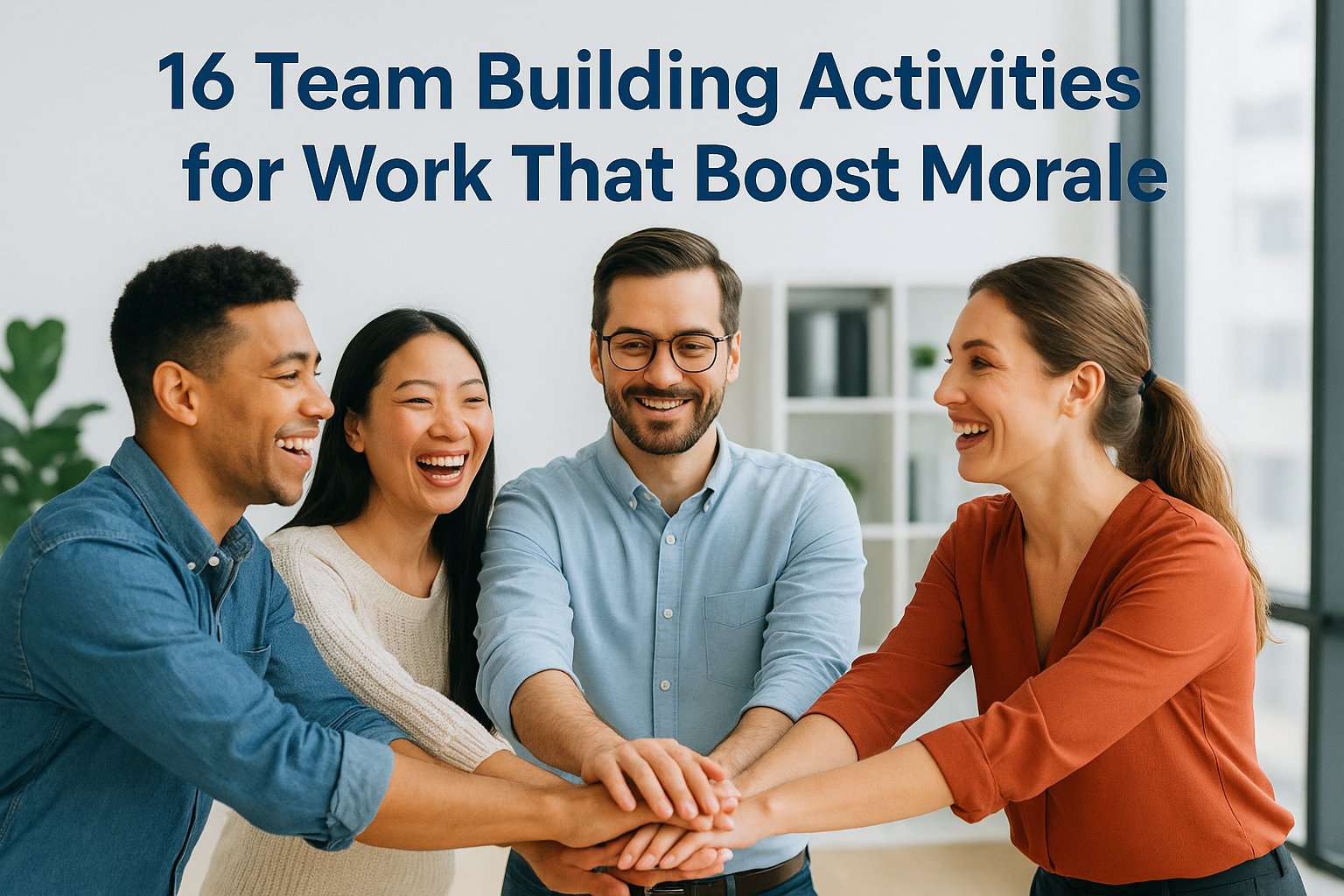
Most team building activities for work end up feeling forced. Everyone shows up, does the trust fall or the awkward icebreaker, and goes right back to the same silos and the same disengagement the next morning. If you’ve planned events like this before, you already know a fun afternoon doesn’t automatically translate into a stronger team.
What actually works is different. You need activities that mirror real teamwork, where people have to communicate under pressure, rely on each other, and solve something that matters, even in a low-stakes setting. Below you’ll find 16 team building activities that do exactly that, ranging from quick 20-minute exercises for a Monday meeting to full offsite challenges built for remote and in-person teams alike.
I’ve spent 15 years racing on world championship adventure racing teams and another two decades as a San Diego firefighter, and both taught me the same lesson: culture beats talent every time. Every activity in this list is chosen because it builds the habits that carry over into daily work, not just a good memory from one afternoon.
1. Book a keynote-led team experience with Robyn Benincasa
Before you jump into games and icebreakers, consider starting with something that actually reframes how your team thinks about teamwork itself. A keynote-led team experience gives your group a shared language and a real framework for collaboration, drawn from environments where failure isn’t an option, like adventure racing teams crossing 500 miles of wilderness together or firefighters running into buildings other people are running out of. I built my talks around those lessons because they translate directly into boardrooms, sales floors, and cross-functional teams under deadline pressure.
How it works
You bring me in for a keynote, either live or virtual, built around your organization’s specific challenges: a merger, a sales slump, a culture reset, or simply a team that’s grown too fast to stay connected. I don’t do generic motivational speeches. Every talk uses real stories from world championship racing and two decades of firefighting to teach the specific behaviors that separate high-performing teams from the rest. Many organizations pair the keynote with a hands-on workshop segment afterward, so the lessons get practiced immediately instead of forgotten by Monday.
A great keynote doesn’t just entertain your team, it gives them a shared framework they’ll reference for years.
Skills it builds
This format is built to install habits, not just deliver inspiration. Depending on which signature topic you choose, your team walks away with tools for:
- Building trust fast, even across departments that rarely interact
- Communicating clearly under pressure and deadline stress
- Recognizing and using each teammate’s strengths
- Committing to shared goals instead of individual wins
- Leading through change without losing morale
Best for
Organizations kicking off a leadership offsite, sales kickoff, or annual conference get the most value here, especially when a bigger cultural shift is on the table. It also works well for teams recovering from a rough stretch, layoffs, reorgs, missed targets, where morale needs a genuine reset rather than a surface-level activity. Companies like Allstate, Northrop Grumman, and Boston Scientific have used this format specifically because it addresses measurable business outcomes, not just a feel-good afternoon.
Time and group size
A standard keynote runs 45 to 60 minutes and scales from a department of 20 to a full conference of several thousand, live or virtual. If you want the deeper impact, extend it into a half-day or full-day workshop with breakout exercises. You can book Robyn for your next event directly and get a program built around your team’s actual goals, not a one-size-fits-all script.
2. Human knot
The human knot is the classic team building activities for work exercise for a reason: it forces physical cooperation and problem-solving in a way that words alone never do. Everyone stands in a circle, reaches across, and grabs two different hands until the group is a tangled mess. The only goal is to untangle without letting go, which sounds simple until arms start crossing in impossible directions.

How it works
Gather 8 to 12 people in a tight circle and have each person grab the hands of two different people across from them, never someone standing directly next to them. Once the knot forms, the group has to talk through moves, ducking under arms, stepping over others, rotating in place, until the circle untangles itself. No hands can break contact during the process.
Skills it builds
This exercise builds verbal communication under pressure and patience with slow, incremental progress. Teams also practice:
- Giving clear, specific directions instead of vague ones
- Listening before acting
- Tolerating physical closeness and mild discomfort
- Staying calm when a solution isn’t obvious
The human knot works because untangling it requires the exact same patience and communication a real project bottleneck does.
Best for
Newer teams that haven’t built much rapport yet get the most out of this one. It’s also a solid warm-up before a longer workshop, since it breaks physical distance early.
Time and group size
Budget 10 to 15 minutes for groups of 8 to 12. Larger teams should split into multiple knots running simultaneously.
3. Marshmallow challenge
The marshmallow challenge is a fast, visual test of how teams handle ambiguity, and it’s become one of the most requested team building activities for work because the results are so instantly clear. Give a small group 20 sticks of spaghetti, a yard of tape, a yard of string, and one marshmallow, then tell them to build the tallest freestanding structure that holds the marshmallow on top.
How it works
Teams get 18 minutes to design, build, and test their structure before time runs out. Most groups spend the first 15 minutes planning and the last 3 minutes realizing their plan doesn’t work, which is exactly the point. The structural failure usually happens because the marshmallow is heavier than it looks, and teams that skip early prototyping almost always lose to teams that build ugly test versions first.
Teams that prototype early beat teams that plan perfectly, every single time.
Skills it builds
This challenge exposes how a team handles early failure and iteration under a countdown. Specific skills include:
- Testing ideas quickly instead of overplanning
- Adapting when a design doesn’t hold
- Balancing speed against precision
- Learning from a failed attempt without blame
Best for
Innovation and product teams get outsized value here, since the exercise mirrors real prototyping cycles. It also works well for leadership groups who tend to over-plan and under-test in daily operations.
Time and group size
Plan for 30 minutes total, including debrief, with teams of 4 broken out from a larger group of any size.
4. Escape room challenge
An escape room puts your team inside a locked scenario with a timer, a pile of clues, and one goal: get out before time runs out. Unlike other team building activities for work on this list, this one usually happens at a commercial venue, though plenty of vendors now bring portable kits directly to your office.

How it works
Groups of 6 to 8 enter a themed room and work through a chain of puzzles, hidden codes, locks, and riddles that only unlock the next clue once solved correctly. Nobody can finish alone. Someone spots the pattern, someone else remembers a detail from ten minutes earlier, and someone has to keep track of the clock. That division of labor happens naturally, without anyone assigning roles.
The best escape rooms don’t test intelligence, they test whether your team shares information fast enough to use it.
Skills it builds
This format rewards information-sharing speed more than individual smarts. Teams also sharpen:
- Delegating tasks based on who’s already good at what
- Managing time pressure without panic
- Speaking up when you notice something others missed
- Recovering quickly from wrong guesses
Best for
Cross-functional teams that rarely work together day to day benefit most, since the puzzles force collaboration between people who don’t normally interact. It’s also a strong pick for teams heading into a high-pressure quarter, since the format mimics deadline stress in a low-stakes setting.
Time and group size
Most rooms run 60 minutes and cap groups at 8 to 10 people. Larger departments can book multiple rooms and compare completion times afterward.
5. Two truths and a lie
Two truths and a lie is the simplest icebreaker on this list, and that simplicity is exactly why it still works after decades of use in team building activities for work. Each person shares three statements about themselves, two true and one false, and the group votes on which one is the lie. It costs nothing, needs no equipment, and works just as well over video as it does around a conference table.
How it works
Go around the room or the video call and have each person share three personal statements out loud. The rest of the group discusses briefly, then votes on which statement they think is false before the person reveals the answer. Keep each round under two minutes so the energy stays high and nobody overthinks their turn.
The real value isn’t guessing the lie, it’s the follow-up questions people ask once the truth comes out.
Skills it builds
This exercise builds active listening and comfort with sharing personal details in a professional setting. It also strengthens:
- Asking genuine follow-up questions
- Remembering small details about coworkers
- Reading tone and body language for hints
- Building rapport across seniority levels
Best for
New hires and newly formed teams get the most value, since it surfaces surprising facts fast. Remote teams meeting for the first time on camera benefit especially, since it replaces the small talk that happens naturally in a hallway.
Time and group size
Budget 15 to 20 minutes for groups up to 15. Larger teams should split into breakout rooms of 6 to 8.
6. Back-to-back drawing challenge
The back-to-back drawing challenge strips away every visual cue teams normally lean on and forces pure verbal description. Two people sit facing away from each other, one holding a simple image and the other holding a blank paper and pen. This is one of the fastest team building activities for work to set up, since it needs nothing more than paper, pens, and a stack of simple shapes.
How it works
Partner up the group and give one person in each pair a basic image, like a house with a chimney or a stack of geometric shapes. That person describes the image out loud without naming it directly or looking at their partner’s paper, while the partner draws based only on the verbal description. After five minutes, pairs compare the drawing to the original and swap roles with a new image.
Miscommunication shows up on paper immediately, which is exactly why this drawing exercise beats most verbal-only debriefs.
Skills it builds
This challenge forces precise verbal instructions since there’s no pointing or gesturing to fall back on. Teams also strengthen:
- Breaking a task into small, sequential steps
- Asking clarifying questions instead of guessing
- Checking understanding before moving forward
- Staying patient when instructions aren’t landing
Best for
Teams that rely heavily on written communication, like remote workers coordinating over Slack or email, benefit most from practicing this level of clarity out loud. It also works well for managers who tend to give vague directions and need direct feedback on how their instructions actually land.
Time and group size
Budget 15 minutes for pairs, and it scales to any group size since everyone works simultaneously in twos.
7. Trust battery exercise
The trust battery exercise borrows a concept from product teams and applies it to any group that needs an honest read on how much goodwill exists between coworkers. Picture a battery icon next to each relationship on the team. Every interaction either charges it or drains it, and this exercise makes that invisible dynamic visible. It’s one of the more reflective team building activities for work on this list, built for conversation rather than competition.
How it works
Give each person a simple grid listing every teammate’s name with a battery symbol beside it. Ask everyone to privately rate how charged that relationship feels, then share observations in pairs or small groups about what charges trust and what drains it on this specific team. Close with a group discussion on one concrete behavior each person will change to keep batteries charged going forward.
Trust doesn’t build in one meeting, but naming what drains it is the fastest way to stop the bleeding.
Skills it builds
This exercise sharpens self-awareness about impact on coworkers, something most people never get direct feedback on. Teams also practice:
- Giving specific, behavior-based feedback
- Hearing critique without getting defensive
- Naming small daily actions that build goodwill
- Owning a personal commitment to change
Best for
Teams recovering from conflict or a rocky reorg benefit most, since it gives permission to name tension directly. Leadership teams also use this well, since trust gaps at the top ripple through the entire organization.
Time and group size
Budget 45 minutes for groups of 6 to 10. Larger teams should break into smaller pods to keep the conversation honest.
8. Office scavenger hunt
An office scavenger hunt turns a slow afternoon into a race for clues, and it’s one of the easiest team building activities for work to run with almost zero budget. Small teams chase down a list of items, photos, or riddles hidden around the building, and whoever finishes the full list first wins bragging rights. It works just as well in a warehouse, an open-plan office, or a hybrid setup with a few remote clues mixed in.
How it works
Break the group into teams of 4 to 6 and hand each one a list of clues that lead to specific locations, objects, or people in the office. Some clues require a photo as proof, like posing with a coworker from another department, which forces cross-team interaction along the way. Set a hard time limit, usually 30 to 45 minutes, and reconvene for a quick reveal of winning teams and favorite photos.
A scavenger hunt works because it gets people talking to coworkers they’d otherwise never approach.
Skills it builds
This format builds quick decision-making under a ticking clock and light competitive collaboration. Teams also practice:
- Dividing tasks based on who knows the building or people best
- Making fast calls instead of debating every choice
- Reaching out to unfamiliar coworkers for a photo or clue
- Staying organized under a real time constraint
Best for
Newer offices or teams that just moved buildings get real value here, since the hunt doubles as a tour. It’s also a strong pick for onboarding new hires alongside established staff.
Time and group size
Budget 45 minutes total for groups of any size split into teams of 4 to 6.
9. Egg drop challenge
The egg drop challenge takes the marshmallow concept and raises the stakes with a raw egg and a drop from height. Teams build a protective contraption using limited materials, then watch their design get tested from a balcony, ladder, or rooftop while the whole office watches. Few team building activities for work generate as much genuine cheering as this one.

How it works
Give each team of 4 to 5 people a raw egg plus a fixed kit of materials, straws, tape, cotton balls, newspaper, and a plastic bag. Teams have 20 minutes to build a casing that keeps the egg intact when dropped from a set height, usually a second-story window or a stepladder outdoors. After the build window closes, drop each team’s egg one at a time and see whose design survives.
The team that argues over every straw placement usually loses to the team that just tests something and adjusts.
Skills it builds
This challenge tests risk assessment under a hard material constraint. Teams also sharpen:
- Weighing tradeoffs between weight and cushioning
- Making group decisions fast with limited supplies
- Accepting a failed design without finger-pointing
- Celebrating a win that took real collaboration
Best for
Engineering, product, and technical teams enjoy this one most, since the physics puzzle plays to their instincts. It also works well as an afternoon energizer at a company picnic or offsite where you already have outdoor space.
Time and group size
Budget 40 minutes total for teams of 4 to 5, with the drop portion running quickly once every group finishes building.
10. Helium stick
The helium stick looks impossible to mess up until you actually try it. A lightweight rod, usually a tent pole or thin dowel, rests on the extended index fingers of everyone in a small group. The only instruction is to lower the stick to the ground together. Almost every group watches it rise instead, which makes this one of the more counterintuitive team building activities for work on this list.
How it works
Line up 6 to 10 people in two facing rows with fingers extended at waist height, then balance the pole across everyone’s fingers. Nobody can grip the stick, only keep a finger touching it, and the group has to lower it to the floor without anyone losing contact. The natural upward pressure from each person’s finger causes the stick to rise instead, and groups usually need several failed attempts before someone suggests slowing down or removing a person from the line.
The harder everyone pushes to fix the problem individually, the worse it gets, which is the whole lesson.
Skills it builds
This exercise exposes how a team handles shared responsibility for a problem nobody can solve alone. It also builds:
- Slowing down instead of forcing a fix
- Noticing when individual effort works against the group
- Testing small adjustments together
- Staying patient through repeated failure
Best for
Teams stuck in a pattern of overworking individual problems instead of collaborating benefit most here. It’s also a strong energizer before a longer planning session.
Time and group size
Budget 10 minutes for groups of 6 to 10, with multiple sticks running for larger teams.
11. Office trivia challenge
Office trivia turns everyday work knowledge into a low-pressure competition, and it’s one of the easiest team building activities for work to run over lunch or during a quiet Friday afternoon. Teams answer a mix of questions about company history, industry facts, and pop culture, scoring points for speed and accuracy. Nobody needs special equipment beyond a screen and a scorekeeper, which makes it a favorite for teams short on planning time.
How it works
Split the group into teams of 3 to 5 and run through five or six rounds covering categories like company milestones, product facts, and general knowledge. Each team submits answers on paper or through a shared form, and a live scoreboard keeps the energy up between rounds. Mix in a bonus round about coworkers themselves, favorite vacation spots or hidden talents, to blend the competitive format with genuine team facts.
Trivia works because it rewards teams that listen to every voice, not just the person who talks loudest.
Skills it builds
This format sharpens collaborative recall under a mild time pressure. Teams also practice:
- Weighing conflicting guesses before locking in an answer
- Trusting quieter teammates who know the right fact
- Staying gracious through a losing round
- Building shared knowledge about the company itself
Best for
Larger departments hosting an all-hands or a lunch-and-learn get strong engagement here, since trivia scales easily across many small teams at once. Onboarding cohorts also benefit, since company-specific rounds teach real facts.
Time and group size
Budget 30 to 45 minutes for groups of any size split into teams of 3 to 5.
12. Strength-spotting circle
The strength-spotting circle is a quieter addition to this list of team building activities for work, built around genuine appreciation instead of competition or puzzles. Each person sits in a circle while the rest of the group calls out specific strengths they’ve noticed that person bring to the team, real examples from real projects, not generic compliments. It works because most people never hear this kind of direct, specific feedback about what they’re actually good at.
How it works
Go around the circle one person at a time, giving each teammate two to three minutes in the spotlight. Everyone else contributes one observed strength, tied to a specific moment or project, rather than a vague trait like "good communicator." The person receiving feedback stays quiet and just listens, then briefly reflects on which comment surprised them most before the circle moves to the next teammate.
People remember specific praise about their strengths far longer than any generic compliment.
Skills it builds
This exercise builds self-awareness around each person’s real contributions, often revealing strengths a teammate didn’t know others noticed. Groups also practice:
- Giving specific, evidence-based praise instead of empty flattery
- Receiving recognition without deflecting or downplaying it
- Noticing quieter contributions that usually go unmentioned
- Building a shared vocabulary for what good work looks like
Best for
Established teams that have worked together for at least a few months get the most value, since the feedback needs real shared history to feel specific. It’s also a strong fit for teams recovering from a stretch of criticism-heavy feedback, where morale needs a genuine boost.
Time and group size
Budget 30 to 40 minutes for groups of 6 to 10, allowing roughly three minutes per person.
13. Team purpose and values workshop
A team purpose and values workshop takes a step back from games and puzzles to answer a bigger question: why does this team exist, and what do we actually stand for when nobody’s watching? Unlike the quicker team building activities for work on this list, this one produces a document the team keeps referencing, not just a memory of a fun afternoon. It works especially well for teams that have grown fast or merged with another group and never agreed on shared standards.
How it works
Gather the team for a facilitated session where everyone first writes down, individually, what they believe the team’s purpose is and which values actually show up in daily work. Compare answers openly, since the gaps between individual answers usually reveal more than the overlaps. The group then drafts a short, specific purpose statement and three to five values with real behavioral examples attached, so "integrity" becomes something like "we tell clients the truth even when it costs us the sale."
A values statement only matters if it describes behavior specific enough to call out when someone breaks it.
Skills it builds
This workshop builds shared accountability for standards the team actually chose together. It also strengthens:
- Reconciling different views of the team’s mission
- Turning abstract values into observable behaviors
- Committing publicly to standards everyone can reference
- Holding each other accountable without a manager present
Best for
Growing teams, newly merged departments, and leadership groups setting direction after a reorg get the most out of this session.
Time and group size
Budget 90 minutes for groups of 8 to 15, ideally facilitated by someone outside daily reporting lines.
14. Minefield communication challenge
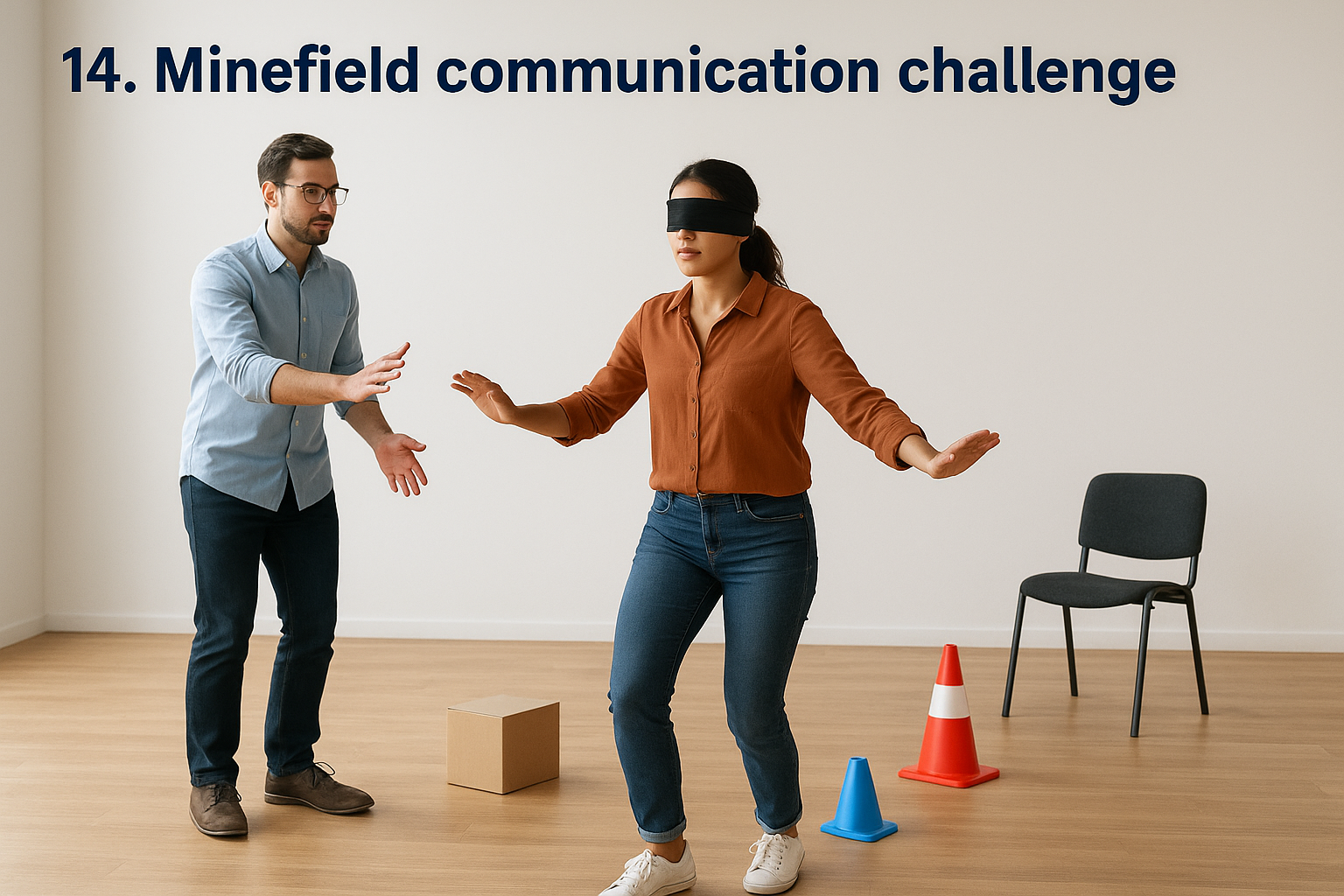
The minefield communication challenge blindfolds one partner and asks the other to guide them safely through a floor scattered with obstacles, cones, boxes, chairs, using nothing but spoken directions. Of all the team building activities for work on this list, this one puts trust and precise language under the most direct physical test, since one bad instruction sends someone straight into a chair leg.
How it works
Set up an open space with 10 to 15 obstacles spread randomly across the floor, then pair people up with one blindfolded and one sighted. The sighted partner stands at the edge and calls out step-by-step directions while the blindfolded partner navigates from one side to the other without touching anything. Run a second round after swapping roles, then raise the difficulty by adding multiple pairs crossing at once so voices compete for attention.
Trust gets built the moment someone closes their eyes and follows a voice they can’t see.
Skills it builds
This challenge forces precise, real-time direction-giving since vague language causes immediate, visible mistakes. Teams also strengthen:
- Trusting a teammate’s guidance completely
- Adjusting instructions on the fly when something changes
- Staying calm while relying on someone else’s judgment
- Filtering out noise from competing voices
Best for
Teams with a trust deficit or a history of micromanagement benefit most, since the exercise forces genuine reliance on someone else’s word. New managers also gain from playing the sighted role, since it exposes how clearly they actually communicate.
Time and group size
Budget 20 minutes for pairs, scaling to any group size running simultaneously.
15. Community give-back project
A community give-back project takes your team out of the office entirely and puts them to work on something bigger than a quarterly goal, building homes with Habitat for Humanity, packing meals for a food bank, or cleaning up a local park. Compared to the other team building activities for work on this list, this one leaves a mark outside the company, which tends to stick with people longer than any indoor exercise.
How it works
Partner with a local nonprofit a few weeks ahead and confirm a project scope that matches your headcount, since a team of 40 needs a bigger task than a team of 8. Split into smaller crews for specific jobs, painting, sorting, building, and rotate roles partway through so everyone experiences more than one task. Close the day with a short group reflection on what surprised people most.
Teams that sweat together for a stranger often bond faster than teams that play games for themselves.
Skills it builds
This project builds shared purpose outside normal job titles and hierarchy. Teams also strengthen:
- Working alongside people they rarely collaborate with day to day
- Taking direction from a nonprofit coordinator instead of a manager
- Finding satisfaction in physical, tangible results
- Talking honestly about impact during the debrief
Best for
Established teams looking for meaning beyond another indoor exercise get the most value here, especially companies building a stronger community reputation alongside internal culture.
Time and group size
Budget a half day, roughly four hours, for groups of any size split into task-based crews of 6 to 10.
16. Remote team icebreaker session
A remote team icebreaker session solves a problem the other 15 activities on this list don’t always address: distributed teams that rarely see each other’s faces outside a status update. This structured video call replaces hallway small talk with quick, guided prompts designed for screens instead of conference rooms. It rounds out this list of team building activities for work because remote and hybrid teams need intentional connection, not another meeting disguised as one.
How it works
Schedule a dedicated 20 to 30 minute video call separate from any status meeting, and open with a low-stakes prompt like sharing your home office setup or a recent small win. Rotate through three or four quick prompts, keeping each person’s turn under two minutes, and use breakout rooms if the group is larger than 10 so everyone actually gets to talk. Close with a lightning round where people share one thing nobody on the call knows about them.
Remote teams don’t lack talent, they lack the small moments that build familiarity in person.
Skills it builds
This session builds camera comfort and a habit of casual conversation that remote work naturally strips away. Teams also strengthen:
- Recognizing coworkers as people beyond their job function
- Speaking up on video without waiting to be called on
- Building familiarity that makes async messages read warmer
- Reducing hesitation before reaching out with questions
Best for
Fully remote and hybrid teams benefit most, especially new hires who’ve never met coworkers in person. It also works well as a recurring monthly ritual rather than a one-time event.
Time and group size
Budget 20 to 30 minutes for groups up to 15, splitting into breakout rooms of 5 to 6 for anything larger.
Choosing the right activity for your team
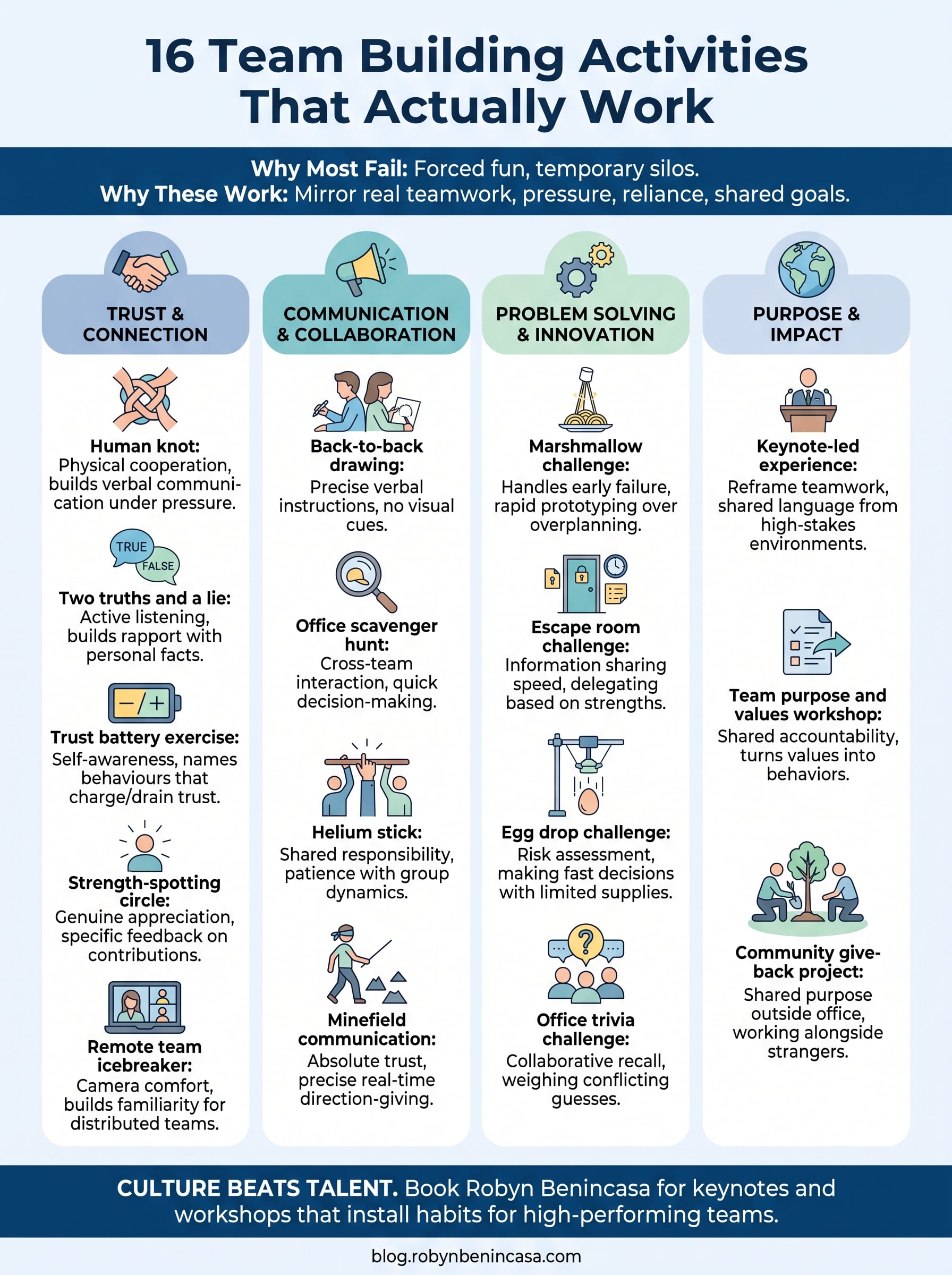
Match the activity to the actual problem, not the calendar slot you need to fill. A team recovering from a reorg needs the trust battery exercise or a give-back project more than another round of trivia. A team that’s never met in person needs icebreakers before it needs an escape room. Skip the temptation to pick whatever looks most fun in a vendor catalog and start instead with what your team is actually struggling with: communication, trust, or shared purpose.
The activities on this list work because they mirror real teamwork under real pressure, not because they’re clever games. That’s the same principle behind every keynote I build: give people a framework drawn from environments where the stakes are real, then let them practice it together before the pressure hits at work. If you want that shift to start with a shared experience your whole team remembers, book Robyn for your next event and build a program around what your team actually needs.