You’ve watched it happen: a meeting starts, everyone stares at their laptop, and the first ten minutes disappear into awkward silence before anyone actually engages. Icebreakers team building activities fix that problem fast, but only if you pick ones that fit your group instead of recycling the same tired "two truths and a lie" every quarter. The right activity opens people up in minutes and sets the tone for real collaboration.
This list gives you 15 tested icebreakers you can run in five minutes or fifty, in person or on a video call, with a sales team, a leadership offsite, or a cross-department group that barely knows each other’s names. Each one is built to do more than fill time. They’re designed to spark genuine connection that carries into the actual work.
I’ve spent 15 years building world championship adventure racing teams and two decades as a San Diego firefighter, and both jobs taught me the same lesson: teams that trust each other perform better under pressure. These icebreakers reflect that same principle on a smaller scale. Below, you’ll find activities organized by group size and setting, so you can match the right one to your next meeting, kickoff, or offsite without guessing.
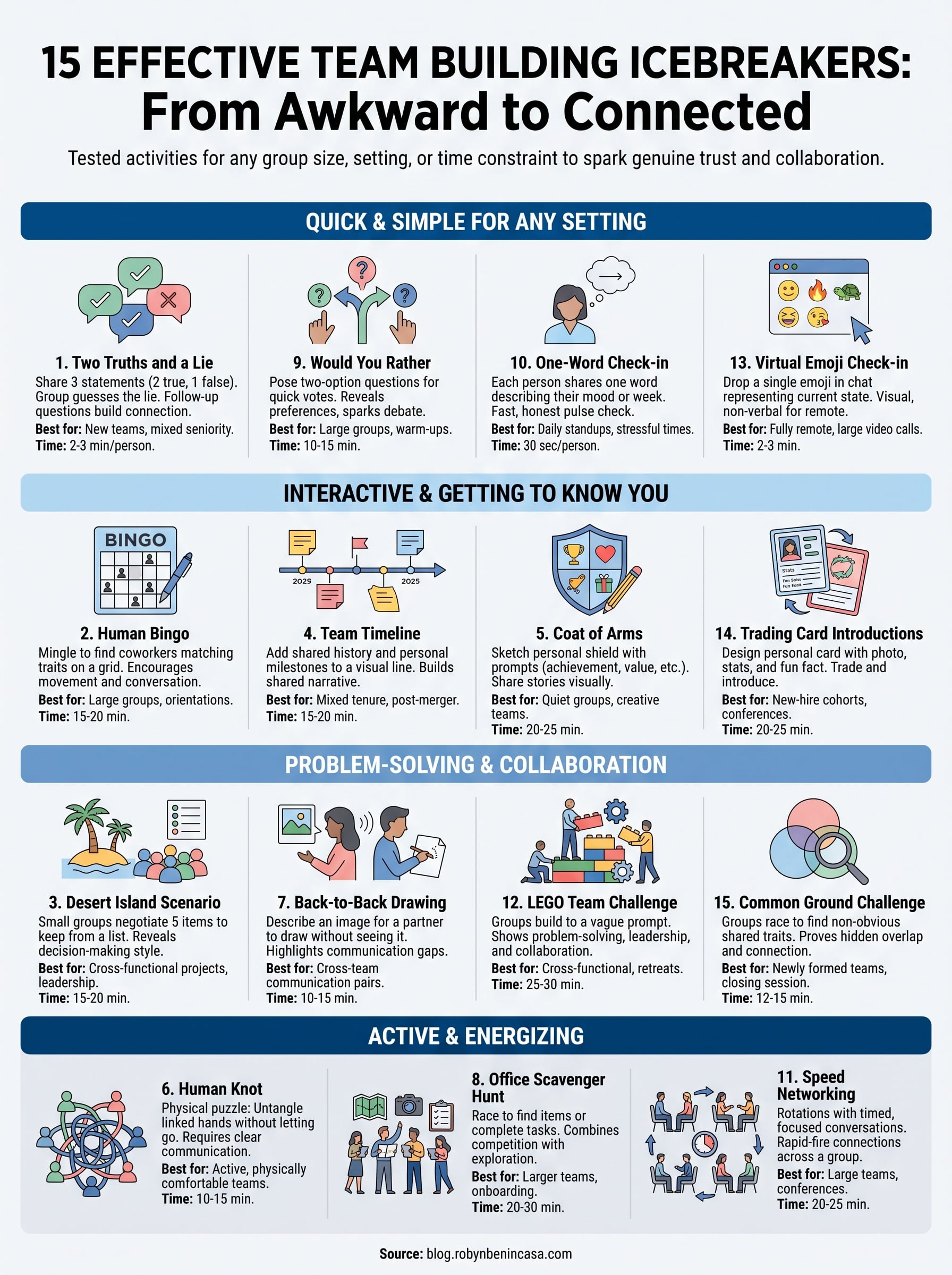
1. Two truths and a lie
This is the classic for a reason. It costs nothing to run, needs zero props, and works whether you have 5 people in a conference room or 50 people on a video call. The trick isn’t the game itself, it’s how you facilitate it, and most teams never get past the surface-level version.
How it works
Each person shares three statements about themselves: two true, one false. The group votes on which statement they think is the lie, then the person reveals the answer. Simple setup, but the payoff comes from the follow-up conversation, not the guessing.
- Give people 60 seconds to think of their three statements before starting
- Go around in a fixed order so nobody stalls the group
- After each reveal, let the group ask one follow-up question about the true statements
- Keep a tally of correct guesses if you want a light competitive element
Best for
This works best for new teams or groups where people have worked together for months but never actually learned much about each other. It’s also a smart choice for mixed-seniority groups, since a director and a new hire are on completely equal footing when it comes to guessing a colleague’s secret triathlon habit.
Time needed
Budget 2 to 3 minutes per person, including the reveal and a quick follow-up question. For a group of 10, plan on 25 to 30 minutes total. If you’re tight on time, cap it at five volunteers instead of forcing the whole room through it.
Facilitator tips
The biggest mistake I see leaders make with this icebreaker is treating it as filler before the real meeting starts. Don’t. Model the exercise yourself first, and make your "lie" genuinely hard to spot. If you go first with something forgettable, the rest of the group follows your lead and phones it in too.
The moment people learn something surprising about a coworker, the room’s energy shifts from polite to genuinely curious.
Push people toward specific, unexpected details instead of generic ones like "I have a dog" or "I like hiking." A statement like "I once got lost for three days on a solo backpacking trip" generates way more conversation than a vague hobby mention. If your group has done this activity before, raise the stakes by requiring statements tied to a theme, like a work achievement, a travel story, or a childhood memory. That small constraint keeps veterans of the game from phoning in the same three facts they’ve used for years.
2. Human bingo
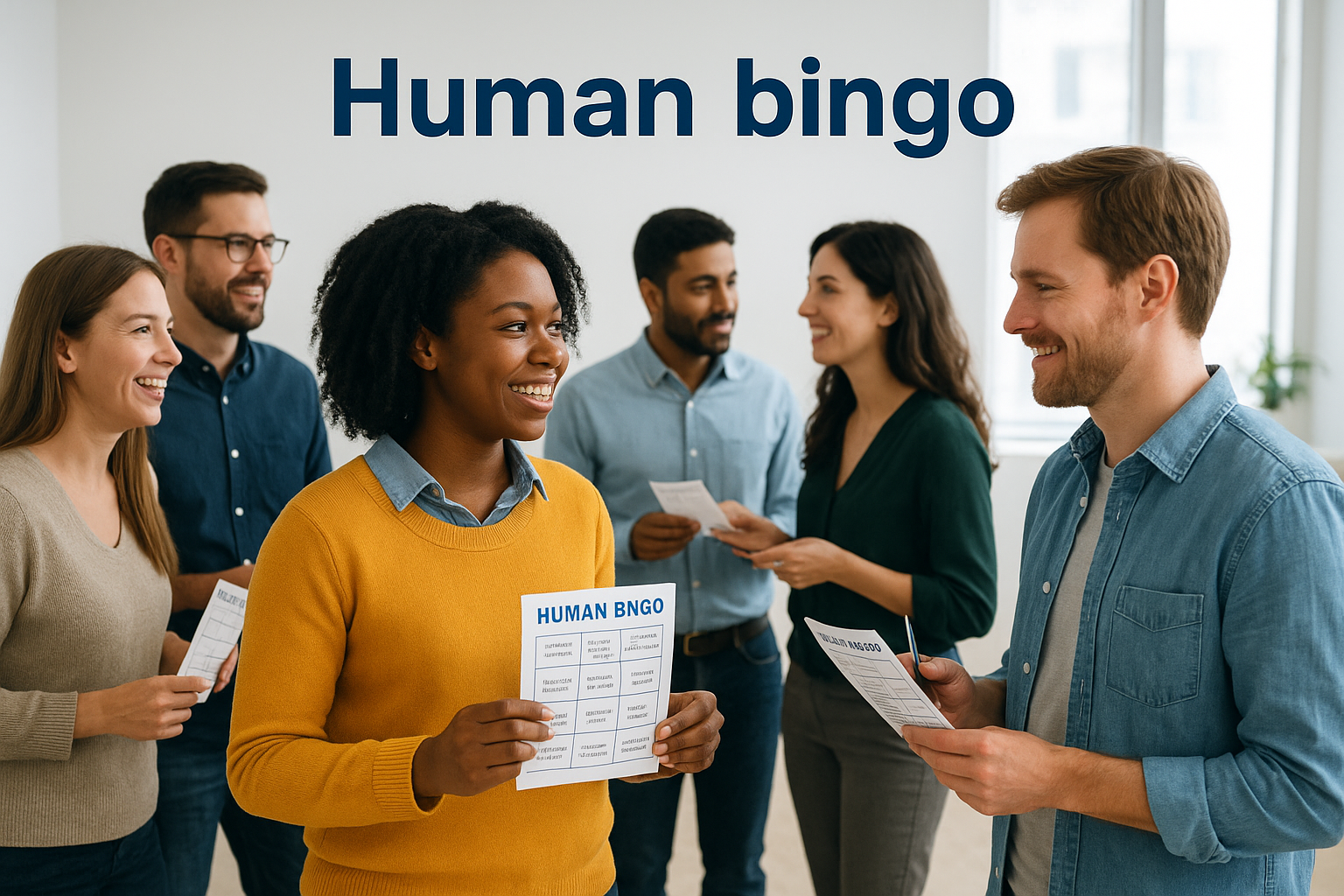
Human bingo turns introductions into a scavenger hunt. Instead of standing up and talking about themselves, people move around the room hunting for coworkers who match specific traits, and that movement alone breaks the stiffness that comes with a static icebreaker.
How it works
Before the session, build a bingo grid with squares like "has run a marathon," "speaks three languages," or "worked at a startup before this job." Hand out one card per person, then give the group 10 to 15 minutes to mingle and collect signatures for squares that apply to each coworker they meet. Whoever fills a row, column, or full card first wins.
- Customize the grid to your team so the squares actually fit the group
- Require a full conversation, not just a signature, before moving to the next square
- Mix in a few work-related traits alongside personal ones
Best for
This fits large groups best, think all-hands meetings, conference sessions, or new-hire orientations where dozens of people need to meet quickly. It’s especially useful when attendees come from different departments and rarely interact otherwise.
Time needed
Plan for 15 to 20 minutes total, including setup instructions and a short debrief where the winner shares a surprising match they found.
Facilitator tips
Skip generic squares like "has a sibling." Build your grid around traits specific to your organization or industry.
A well-built bingo card turns a room of strangers into a web of small, real conversations in under 15 minutes.
Circulate yourself during the activity instead of standing at the front. Your presence signals that mingling is genuinely encouraged, not optional.
3. Desert island scenario
This icebreaker forces small groups to negotiate, prioritize, and reveal how they think under constraints, all through a simple hypothetical. It works well when you want to see natural leaders and collaborators emerge without staging a formal exercise.
How it works
Split the room into groups of four or five and give them a scenario: they’re stranded on a desert island and can only keep five items from a list of ten. Each group has to debate and agree on their final five, then explain their reasoning to the larger room. The group negotiation matters more than the actual answer, since it exposes how people argue, compromise, and build consensus under pressure.
Best for
This suits teams preparing for cross-functional projects or any group that needs practice making decisions together fast. It also works well for leadership groups where you want to observe who naturally steps into a facilitation role during the debate.
Time needed
Budget 15 to 20 minutes: five minutes to explain and split into groups, eight to ten minutes for debate, and five minutes for each group to share their final list and reasoning.
Facilitator tips
Keep the item list deliberately odd. Include practical picks alongside a wildcard like a guitar or a deck of cards, since those forced trade-offs generate better debate than an obvious survival list.
How a group argues over a hypothetical island reveals more about their real decision-making style than any survey ever will.
Listen for who dominates the conversation and who goes quiet. That pattern often mirrors how the same group behaves in actual project meetings.
le, timeline traces the history of your team or organization on a shared visual line, running from a founding date to the present day, with peopleployees adding events they remember along the way. It works especially well when you want people to see how much shared history already exists, even in teams that feel newly formed…a wall, whiteboard, or shared slide, and give people sticky notes to add milestones: launches, big wins, tough stretches, or personal moments (like joining the team). Give each person 2-3 minutes to place their notes and explain what they mean, then step back and look at the full picture together.
Best for
This fits teams with mixed tenure best, groups where some people have been there five years and others five weeks. It also works surprisingly well after a merger or reorg, when…actually let me just write clean prose without trying to force list where not needed. Let’s write final.Wait I need to actually write the final text properly, not stream-of-consciousness. Let me compose properly now.systematically.original..done thinking, now write actual content.Now writing final answer.The team timeline activity has each person add a memorable moment to a shared visual timeline of the team or company’s history, creating a shared narrative in the process.Let me write clean version below within word budget 264 (max 294).Keep bullet list optional but not required for every section; earlier sections had lists in some, not others. I’ll include a short list for
5. Coat of arms
This icebreaker asks people to sketch a personal shield divided into sections representing different parts of their life, then share the drawing with the group. It sounds simple, but a hand-drawn shield pulls out stories that a verbal introduction never would, especially from people who freeze up when asked to "just tell us about yourself."
How it works
Hand out paper divided into four or five sections, or draw the template on a shared slide for virtual groups. Each section gets a prompt: a proud achievement, a core value, a hobby outside work, and something people would be surprised to learn. Give everyone 8 to 10 minutes to draw, then go around and let each person explain their shield in under a minute.
- Keep the drawing low-pressure. Stick figures are fine.
- Use consistent prompts so shields are easy to compare across the group.
- Post finished shields on a shared wall or slide deck afterward.
Best for
Quiet groups benefit the most here, since drawing gives introverts a script to follow instead of putting them on the spot to talk unprompted. It also works well for creative teams and workshops where visual thinking is already part of the culture.
Time needed
Plan for 20 to 25 minutes with a group of eight to ten: 10 minutes to draw, then roughly 90 seconds per person to share.
Facilitator tips
Share your own shield first, and pick a genuinely personal detail for the surprise section.
A crude drawing of a campfire tells you more about a coworker than a polished elevator pitch ever will.
Resist the urge to rush the sharing round. The value lives in the stories, not the artwork.
6. Human knot
Few icebreakers team building activities get people laughing and grumbling in the same breath like the human knot. It’s a physical puzzle disguised as a game, and it forces a group to communicate clearly or stay tangled for a lot longer than they’d like.

How it works
Gather 8 to 12 people in a tight circle, shoulder to shoulder. Everyone reaches across and grabs two different hands that don’t belong to the person directly next to them. Once every hand is linked, the group has to untangle itself into a full circle without letting go.
- Form the circle and grab hands as described
- Assign one person to call out suggested moves if the group stalls
- Untangle by stepping over, under, or through linked arms
- Stop and reset if the knot becomes truly impossible
Best for
Active, younger, or physically comfortable teams get the most out of this one. Skip it for groups with mobility limitations or anyone uneasy with close physical contact, since forced closeness can backfire fast with the wrong crowd.
Time needed
Budget 10 to 15 minutes, including the setup instructions and a couple of failed attempts before the group finds its rhythm.
Facilitator tips
Resist jumping in to solve it for them. The value comes from watching the group problem-solve out loud, not from a fast finish.
A tangled circle of coworkers talking their way free teaches more about communication than any slide deck on the subject.
Set a loose time cap so a stubborn knot doesn’t eat the whole meeting, and debrief afterward by asking who took charge and who followed.
7. Back-to-back drawing
Pairs sit or stand back-to-back, and one person describes a simple image while the other tries to draw it based purely on the verbal description. Nobody sees the other’s paper until the reveal, which makes this one of the more entertaining icebreakers team building activities on this list, since the mismatch between instructions and results almost always gets a laugh.
How it works
Give one partner a printed image (a house, a robot, a simple shape pattern) and the other a blank sheet and pencil. The describer explains the image using words only, no gestures, while the artist sketches based on what they hear. After a few minutes, compare the original to the drawing.
- Ban words like "square" or "circle" for an added challenge
- Set a strict five-minute timer per round
- Swap roles and repeat with a new image
Best for
This fits pairs or small groups working on cross-team communication, especially teams that rely heavily on written instructions or handoffs, like engineering and support, or sales and operations. It’s also a fun midday reset for any group that’s been sitting through back-to-back presentations.
Time needed
Budget 10 to 15 minutes for two rounds per pair, including a two-minute debrief on what made instructions clear or confusing.
Facilitator tips
Pick images with a few tricky details, like an object at an odd angle, so the exercise actually tests precision instead of resolving itself.
A bad drawing built from clear instructions teaches a team more about communication gaps than any feedback survey.
Debrief by asking what specific phrasing helped versus confused the artist. That detail carries directly back into how the team writes real instructions at work.
8. Office scavenger hunt
A scavenger hunt turns a plain office or virtual workspace into a puzzle, sending small teams off to find specific items, complete odd tasks, or snap photos as proof. Groups race the clock, and the mix of competition and movement makes this one of the more energizing icebreakers team building activities for teams that spend most of their day sitting still.

How it works
Build a list of 10 to 15 items or tasks, mixing the practical with the absurd, like "find a coworker’s desk with a plant" or "get a photo of someone doing their best superhero pose." Split the group into teams of three or four, hand out the list, and set a strict time limit. Teams check in with photos or physical items when time runs out.
- Mix office-specific finds with silly, low-stakes tasks
- Require a team photo for each completed item
- Set a clear finish line so teams don’t wander past the deadline
Best for
This works well for larger teams split across departments or floors, and it’s a strong choice for new-hire onboarding since it forces people to explore spaces and meet coworkers they’d otherwise never encounter.
Time needed
Plan for 20 to 30 minutes, including five minutes to explain rules, 15 to 20 minutes for the hunt, and a short debrief where teams share their favorite find.
Facilitator tips
Scout your list ahead of time so every item is actually findable within the space you’re using.
A scavenger hunt works because it hides connection inside competition, and nobody notices they’re bonding until it’s over.
Keep remote teams included by adding virtual-friendly tasks, like screenshotting a specific app or finding an object in their home office.
9. Would you rather
This one thrives on quick, low-stakes decisions that reveal how people think without demanding much vulnerability. It’s one of the easiest icebreakers team building activities to run cold, since nobody needs prep time or props, just a good list of questions.
How it works
Pose a two-option question, like "Would you rather have unlimited vacation days or unlimited budget for one project?" and have people vote by raising hands, typing in chat, or moving to opposite sides of the room. After the vote, ask a few people from each side to explain their pick. Run through five to eight questions, moving quickly so momentum doesn’t stall.
- Mix work-related questions with purely fun ones
- Alternate between physical voting and verbal explanations
- Let people change sides if a good argument sways them
Best for
This fits large groups and mixed audiences especially well, since voting requires zero preparation and works the same whether you’ve got 10 people or 200. It’s also a solid warm-up before a brainstorming session, because it gets people talking out loud early.
Time needed
Budget 10 to 15 minutes for a full round of questions, including brief explanations after each vote.
Facilitator tips
Write your questions ahead of time instead of improvising, since weak questions kill momentum fast.
A good "would you rather" question does more work in ten seconds than a slow icebreaker does in ten minutes.
Save your most divisive question for last. Ending on a split vote keeps the energy high right as you transition into the actual meeting.
10. One-word check-in
Sometimes the fastest way to read a room is the simplest one. A one-word check-in asks each person to sum up how they’re feeling, or how their week is going, in a single word before the meeting moves into its real agenda. It takes under a minute per person, but it’s one of the most useful icebreakers team building activities for surfacing a team’s actual mood instead of assuming everyone’s fine.
How it works
Go around the room, or the video call, and ask everyone to share one word describing their current state, whether that’s their energy level, their week, or how they feel about an upcoming project. No explanations required unless someone wants to add one. The facilitator goes last, which keeps the exercise from feeling like a top-down prompt.
Best for
This fits daily standups and recurring meetings best, since it’s fast enough to run every single time without eating into the agenda. It’s especially valuable for teams under stress, like after a tough deadline or during a reorg, where a quick pulse check surfaces problems before they show up in the actual work.
Time needed
Budget 30 seconds per person. A team of 10 finishes in under five minutes, including a beat of silence for people to think of their word.
Facilitator tips
Don’t skip the exercise just because it feels too small to matter.
A single honest word from every voice in the room tells a leader more than a long status update ever will.
If someone’s word signals real trouble, like "exhausted" or "overwhelmed," follow up privately after the meeting instead of putting them on the spot in front of the group.
11. Speed networking
Speed networking borrows the format of speed dating and applies it to coworkers who rarely interact. Pairs get a set amount of time to talk, then rotate to a new partner when a timer goes off, which forces rapid-fire connection across a whole room in a fraction of the time a mingling session would take.
How it works
Set up two rows of chairs facing each other, or pair people randomly in breakout rooms for virtual groups. Give each pair two to three minutes to answer a prompt or just chat freely, then signal the rotation. Repeat for six to eight rounds so everyone meets a meaningful chunk of the room.
- Use a loud bell or chat message to signal rotations
- Provide one prompt per round so conversations don’t stall
- Track who’s met whom with a simple grid if the group is large
Best for
This suits large teams or newly merged departments where most people have never spoken directly. It also works well at conferences and multi-day offsites, where attendees need to build a wider network fast instead of sticking with the same three familiar faces all week.
Time needed
Budget 20 to 25 minutes for eight rounds at two and a half minutes each, plus a few minutes for rotation logistics.
Facilitator tips
Rotate prompts throughout the session instead of repeating the same question every round, since variety keeps energy from flattening out by round five.
Speed networking compresses months of casual hallway chats into twenty minutes of focused conversation.
For virtual sessions, test your breakout room settings ahead of time so rotations happen automatically instead of eating into conversation time.
12. LEGO team challenge
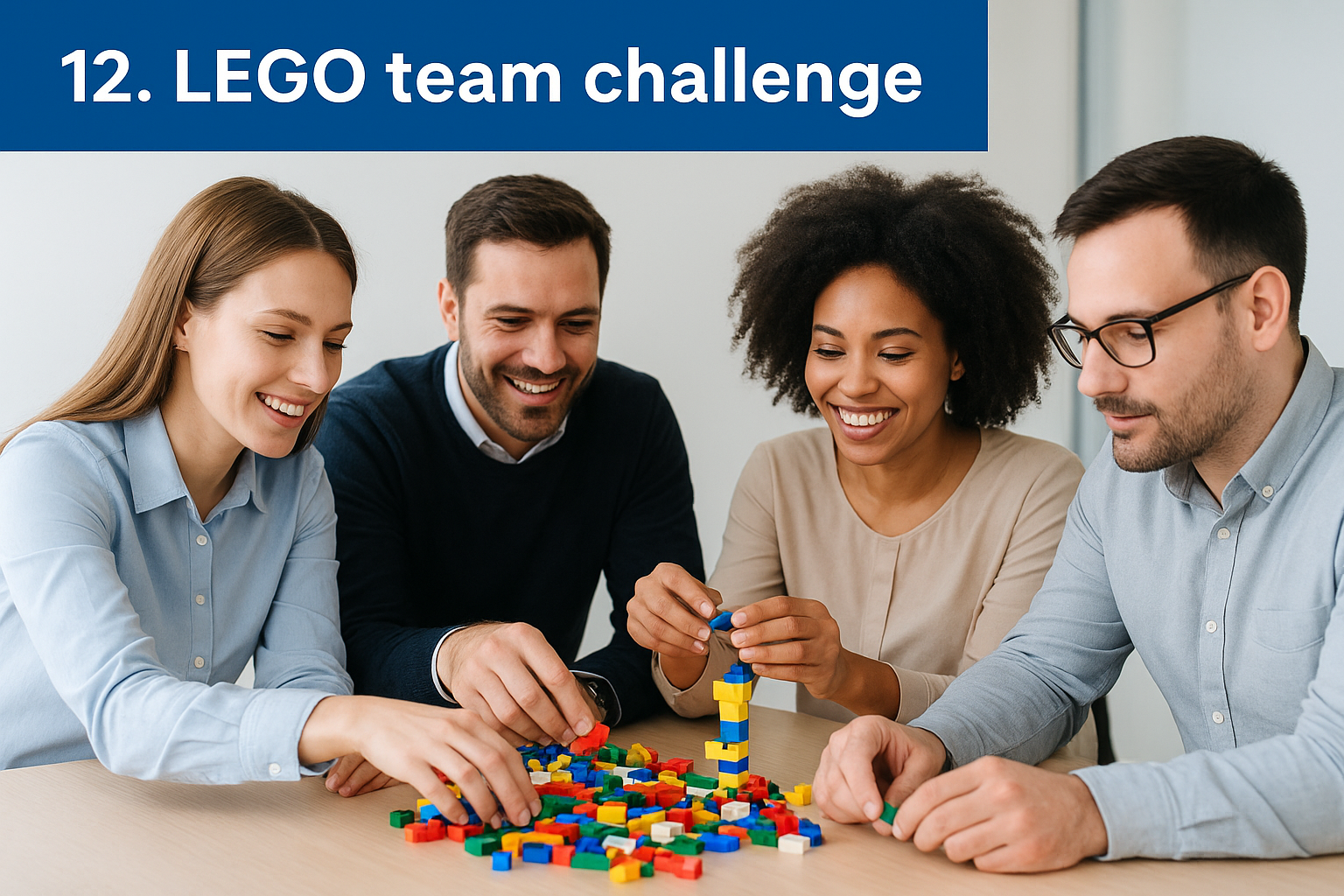
Hand a group a pile of LEGO bricks and a vague instruction, and you’ll see personalities surface fast. This hands-on icebreaker turns building blocks into a lens for problem-solving styles, and it works because everyone, from the CFO to the newest hire, ends up equally uncertain about which piece goes where.
How it works
Split people into teams of three or four and give each team an identical bag of mixed bricks. Assign a build challenge, like "construct something that represents your team’s biggest strength" or a blind copy task where one person describes a hidden model and the rest build it from description alone. Give teams 10 minutes to build, then have each group present their creation and explain the choices behind it.
Best for
This fits cross-functional teams working through a merger, restructure, or new project kickoff, since the build process naturally surfaces who leads, who organizes pieces, and who steps back and watches. It also works well for leadership retreats where you want a lighter, tactile break between heavier strategy sessions.
Time needed
Budget 25 to 30 minutes total: five minutes for setup and instructions, 10 minutes to build, and 10 to 15 minutes for presentations and debrief.
Facilitator tips
Buy a basic bulk set instead of a themed kit, since generic bricks force more creative interpretation than pieces that already look like something specific.
Watching a team argue over LEGO bricks reveals more about their real collaboration habits than a personality assessment ever will.
Ask each team to name one decision they made together during the build. That question ties the playful exercise back to how they actually work.
13. Virtual emoji check-in
Remote meetings lose the visual cues you’d catch in person, like a slumped posture or a tired sigh before someone speaks up. An emoji check-in replaces those cues with a quick, visual signal everyone can read at a glance, making it one of the simplest icebreakers team building activities built specifically for video calls.
How it works
Ask everyone to drop a single emoji into the chat that represents their current mood, energy level, or how their week is going. Give people 15 seconds to think before posting, then scroll through the reactions together as a group. Invite one or two people to explain an unusual choice, like a fire emoji after a rough Monday or a turtle after a slow start to the week.
Best for
This fits fully remote teams and hybrid meetings where video fatigue makes long verbal check-ins feel draining. It also works well for large virtual all-hands, since a chat window can capture 50 reactions faster than any spoken round ever could.
Time needed
Budget two to three minutes total, including a short scroll through the chat and a couple of follow-up questions.
Facilitator tips
Keep the prompt fresh by rotating the theme weekly, asking for a weather emoji one week and a food emoji the next.
A single well-chosen emoji can say more about someone’s week than a paragraph of polite small talk.
Watch for repeated negative signals from the same person across multiple meetings, and follow up privately rather than calling it out live on the call.
14. Trading card introductions
Everyone remembers swapping trading cards as a kid, and this icebreaker borrows that format to make introductions feel like a keepsake instead of a chore. Each person designs a personal trading card with their photo, a few stats, and a fun fact, then the group trades and collects cards like a mini deck of the whole team. It’s a favorite among icebreakers team building activities for onboarding cohorts, since new hires walk away with an actual reference for who’s who.
How it works
Give everyone a template, either printed or digital, with sections for a photo, job title, a fun stat (like years at the company or favorite vacation spot), and one unexpected fact. Give people 10 minutes to fill out their card, then set up a trading round where people swap cards and briefly introduce themselves to whoever they trade with.
Best for
This fits new-hire cohorts and onboarding groups best, since it doubles as a lightweight directory people can reference later. It also works well for conferences where attendees want a memorable way to recall new contacts after the event ends.
Time needed
Budget 20 to 25 minutes: 10 minutes to design cards, 10 minutes to trade and chat, and a few minutes to wrap up.
Facilitator tips
Provide a simple digital template so remote employees can join the same activity without needing a printer.
A trading card turns a forgettable introduction into something people actually keep on their desk.
Collect scanned copies afterward and compile them into a shared team directory nobody has to build from scratch later.
15. Common ground challenge
Small groups race to find things they all share beyond the obvious, like the same job title or the same office. This closing exercise works well as the last icebreaker in a longer session because it builds on the openness people have already shown, and it ends the list of icebreakers team building activities on a note of genuine connection rather than pure novelty.
How it works
Split people into groups of four or five and give them five minutes to write down as many things as they can find in common, with a twist: obvious answers like "we all work here" or "we’re all in this room" don’t count. Groups have to dig past job title and department to find real overlap, like a shared hometown, the same favorite show, or an identical hidden talent. Whichever group finds the longest list of genuine matches shares their findings with the room.
Best for
This suits newly formed teams and groups coming off a reorg or merger, where people assume they have nothing in common simply because they haven’t worked together before. It also closes out a longer workshop well, since it sends people back to their desks having just proven how much overlap already exists in the room.
Time needed
Budget 12 to 15 minutes: a minute to explain the rules, five minutes for groups to dig for matches, and the remainder for each group to share their best finds.
Facilitator tips
Push groups to keep digging once they hit the easy answers, since the real value shows up after the third or fourth obvious match gets ruled out.
The things a team has in common matter less than the effort they put into finding them.
Close the activity by asking one group to share their most surprising match with the full room.
Making connection part of your team culture
None of these 15 activities will fix a broken culture on their own. What they do is create small, repeated moments where people see each other as humans first and coworkers second, and that habit compounds over time. Pick two or three from this list, run them consistently, and pay attention to which ones actually loosen up your specific group instead of assuming one size fits every meeting.
Over two decades of building championship adventure racing teams and working alongside firefighters under real pressure, I’ve watched small connection habits turn into the trust that carries teams through the hard stretches. Icebreakers are the entry point, not the whole strategy.
If you want to go deeper on building that kind of culture across your whole organization, explore Robyn Benincasa’s keynote topics and see how a live session can turn these small moments into lasting team performance.