Most training on leadership ends the same way. People sit through a workshop, nod along, fill out a feedback form, and go right back to the habits that were causing problems in the first place. If you’re an HR leader or executive trying to fix real team dysfunction, that kind of training wastes budget and burns goodwill with employees who are already skeptical of "another leadership seminar."
This list skips the generic options and focuses on programs that actually change how teams work together, whether that’s an in-person offsite, a certification course, or a virtual keynote your whole leadership bench can attend at once. You’ll find options built for different budgets, team sizes, and skill gaps, from communication and conflict resolution to building the kind of accountability that shows up in your quarterly numbers.
I’ve spent 20 years leading firefighting crews and world championship adventure racing teams, so I judge these programs by one question: do they build a culture that holds up under pressure? Below are nine programs worth your consideration, including where each one shines and who it’s actually built for.
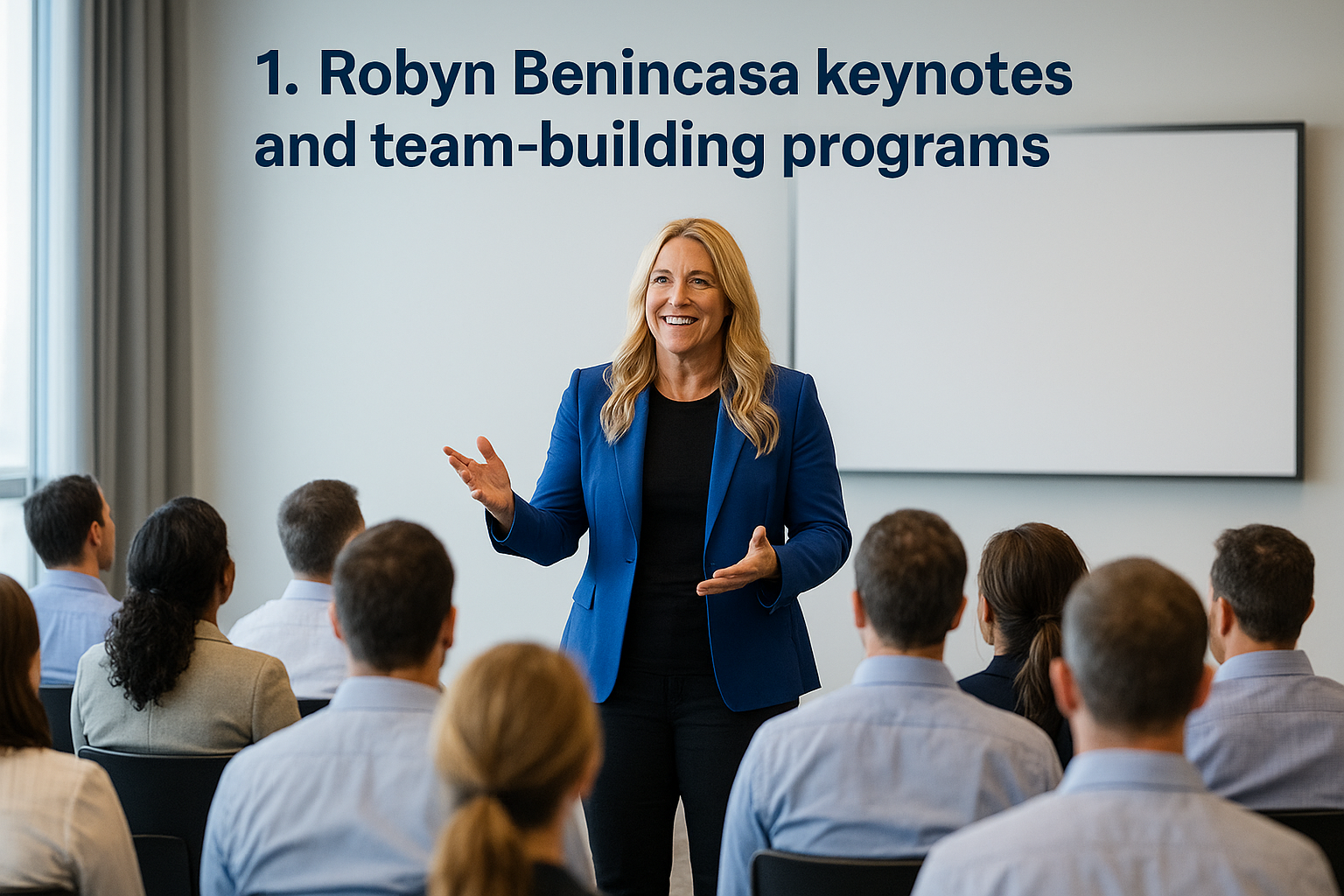
1. Robyn Benincasa keynotes and team-building programs
Robyn Benincasa built her approach to training on leadership from two decades on the fireline and 15 years winning world championship adventure races, not from a textbook. Her keynotes and follow-on team-building sessions translate lessons from high-stakes, high-pressure environments into frameworks executives and HR leaders can apply immediately. The signature talk, T.E.A.M.W.O.R.K., breaks down the eight elements she watched separate championship teams from the ones that fell apart under stress, and it’s paired with practical exercises so the message doesn’t evaporate the day after the event.
How it works
Engagements typically start with a keynote (live or virtual) built around one of her core frameworks, such as WIN AS ONE or INSPIRING GREATNESS THROUGH G.R.I.T. From there, many organizations extend the engagement into workshops or offsites where teams apply the concepts to their own conflicts and silos. Every talk draws on real case studies, including sales teams that moved from 17th to 1st nationally after adopting her culture-building principles, so audiences see the framework tested against actual business results, not hypotheticals.
A leadership talk only matters if the team still uses it three months later under real pressure.
Who it’s for
This format suits executives, HR leaders, and event planners at mid-size to large organizations navigating mergers, sales slumps, or cultural fractures between departments. Companies like Allstate, Boston Scientific, and Northrop Grumman have booked Robyn specifically because their teams needed measurable culture change, not just morale boost for a day. It also works well for sales kickoffs and leadership offsites where the goal is aligning a diverse group around one shared standard.
Format and cost
Engagements range from a single 60-minute keynote to multi-day team-building programs, available both in-person and virtually. Pricing varies by format, audience size, and whether you add workshop sessions, so most organizations start with a direct conversation through the booking page. A free 18-page guide summarizing her leadership principles is also available for teams wanting a preview before committing budget.
2. Center for Creative Leadership
The Center for Creative Leadership (CCL) is a nonprofit research and training institution that’s been studying management behavior since 1970. Unlike a single keynote, CCL builds its curriculum around decades of published research on how leaders actually develop, which makes it a solid fit for organizations that want data behind their training on leadership investment rather than a motivational push.
How it works
Participants typically start with a 360-degree assessment that surfaces blind spots in communication, delegation, and decision-making. From there, cohorts move through workshops covering topics like influence, resilience, and navigating organizational change, often spread across several months rather than a single event. The pacing suits leaders who need repeated practice, not a one-day jolt.
Research-backed training works best when leaders get months to practice, not one afternoon to absorb it.
Who it’s for
CCL fits mid-level and senior managers at large organizations, especially those in regulated industries like healthcare, finance, or government, where structured, evidence-based development carries weight with compliance and HR departments.
Format and cost
Programs run in-person at CCL campuses, virtually, or as blended cohorts, and most last several weeks to a few months. Costs typically range from a few thousand dollars per participant for open-enrollment courses to significantly more for custom organizational programs.
3. Dale Carnegie leadership training for managers
Dale Carnegie’s leadership training traces back to a 1912 public speaking course, but the modern version focuses squarely on first-time and mid-level managers learning to lead people instead of just tasks. The brand name carries weight with HR departments, and the curriculum leans heavily on interpersonal skills like giving feedback, building trust, and handling conflict without avoiding it.
How it works
Classes combine short lectures with heavy role-play, so managers practice difficult conversations in the room before they have them with actual employees. Sessions run weekly over several weeks rather than a single intensive day, which gives participants time to try new habits at work and report back on what happened.
Managers change behavior faster when they rehearse hard conversations before having them for real.
Who it’s for
This program suits new managers and supervisors who need practical people skills, not strategic frameworks. It’s also common as a first step for organizations building an internal leadership pipeline.
Format and cost
Courses run in-person, live online, or blended, typically spanning eight to twelve weeks. Public course pricing generally lands between $1,500 and $3,000 per participant, with custom corporate pricing available for larger cohorts.
4. Harvard division of continuing education leadership programs
Harvard’s Division of Continuing Education offers certificate programs in leadership through Harvard Professional Development, built for professionals who want the credibility of the Harvard name attached to their training on leadership. Unlike a single workshop, these programs pull from Harvard faculty research on organizational behavior and management strategy, packaged into courses you can complete alongside a full-time job.
How it works
Courses run as a mix of live online sessions and self-paced modules, covering topics like strategic decision-making, influence without authority, and leading through change. Most programs stack into a certificate of leadership excellence once you complete a set number of courses, so participants build toward a credential rather than attending a one-off event.
A credential only means something if the coursework changes how you lead the next day.
Who it’s for
This fits individual professionals more than entire teams, particularly mid-career managers and directors who want a resume-worthy credential alongside real skill development. It suits self-motivated learners comfortable studying independently between live sessions.
Format and cost
Individual courses run three to eight weeks and typically cost $1,600 to $3,000 each. Full certificate tracks require multiple courses, pushing total investment past $8,000 depending on how many credentials you pursue.
5. American Management Association leadership courses
The American Management Association (AMA) has run management training since 1923, and its leadership catalog covers everything from first-time supervisor basics to executive-level strategy. Where AMA stands apart from a single keynote or certificate track is breadth: dozens of discrete seminars let you build training on leadership around one specific skill gap, like delegation or difficult conversations, instead of committing to a long program upfront.
How it works
You pick individual seminars, most running one to three days, rather than enrolling in a fixed curriculum. Each seminar mixes short lectures with case studies and small-group exercises, and AMA also offers a broader Certified Professional in Management credential for participants who want to stack several courses into a formal qualification.
A leadership program built from a-la-carte seminars only works if you’re honest about which specific skill gap you’re closing.
Who it’s for
AMA suits HR departments filling specific skill gaps across a workforce, like getting a batch of new supervisors trained on feedback and delegation within a quarter. It also works for individual managers whose companies reimburse professional development but don’t have a formal internal program.
Format and cost
Seminars run in-person, live online, or on-demand, and single-course pricing generally runs $2,000 to $2,500. AMA membership, priced around $259 annually, lowers per-course costs for organizations sending multiple employees through the catalog each year.
6. Free online leadership courses from LinkedIn Learning and edX
LinkedIn Learning and edX both offer self-paced leadership courses at no cost (or low cost for a certificate), making them the easiest entry point if you want to test the waters on training on leadership before committing budget to a bigger program. Neither platform builds a cohort experience or live coaching, so they work better as a supplement than a replacement for structured team development.
How it works
You browse a catalog of video-based courses covering topics like emotional intelligence, delegation, and leading remote teams, then work through them on your own schedule. edX partners with universities like Harvard and MIT for some of its leadership content, so a few courses carry academic rigor beyond typical corporate training videos.
Free courses build individual knowledge fast, but they rarely change how a whole team behaves under pressure.
Who it’s for
This option suits individual learners on a tight budget, new managers wanting a quick primer, or HR teams building a resource library employees can dip into between formal training sessions.
Format and cost
Most LinkedIn Learning courses require a subscription, typically $20 to $40 monthly, though many libraries offer a free trial. edX courses are free to audit, with paid certificates ranging from $50 to $300 per course.
Finding the right fit for your team
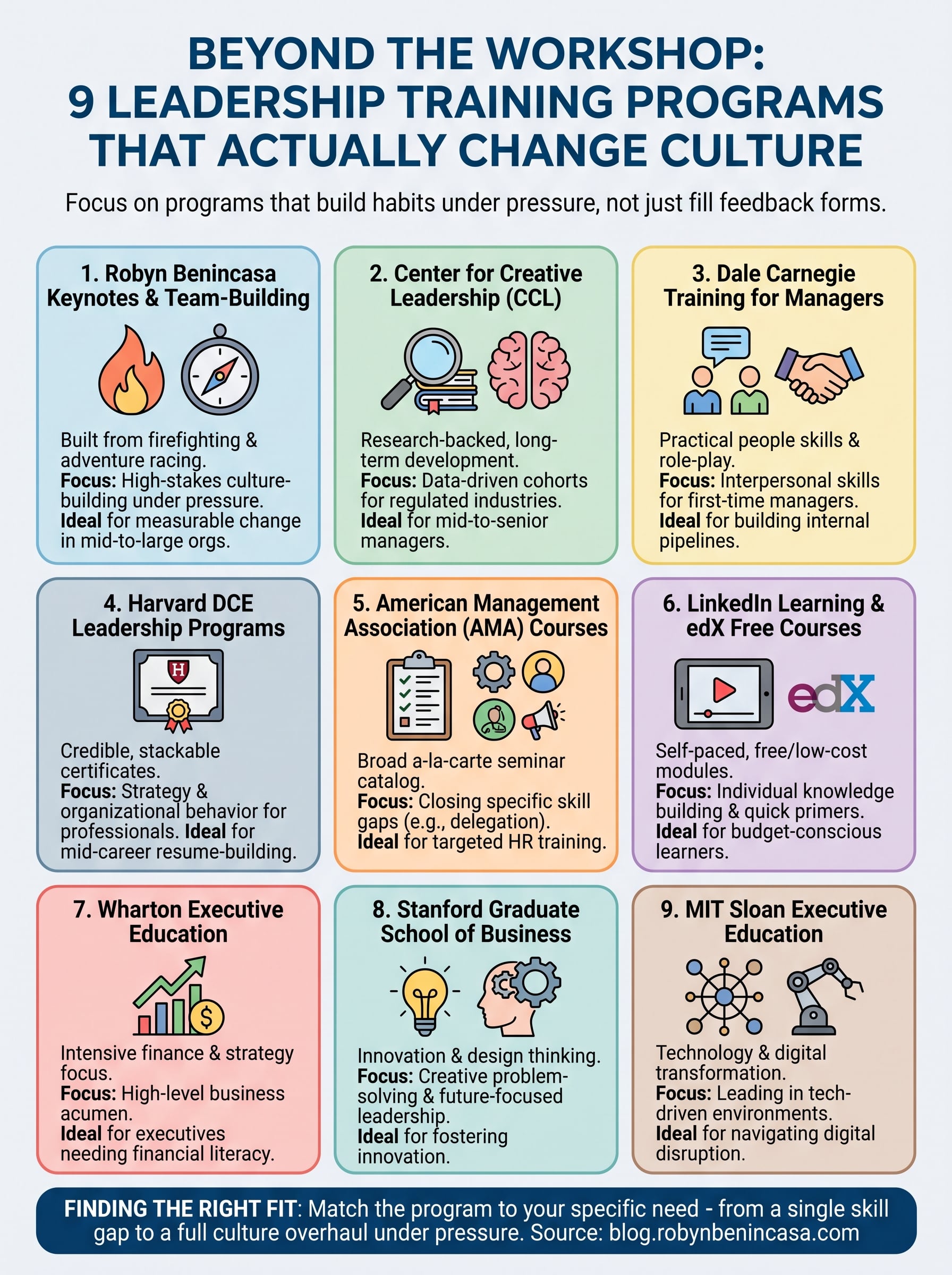
The right program depends on what’s actually broken. If you need one manager to sharpen delegation skills, a self-paced course from edX or an AMA seminar will do the job cheaply. If your whole leadership bench needs a shared language for handling conflict, a research-backed cohort like CCL or a credential track through Harvard makes sense over several months. But if your team is facing real pressure right now, a merger, a sales slump, a culture split between departments, you need something that hits harder and faster than a video course or a slow-moving certificate program.
That’s the gap Robyn Benincasa’s keynotes and team-building sessions fill. Her frameworks come from teams that had to perform under genuine stakes, not case studies borrowed from someone else’s org chart. If your leadership team needs that kind of proof, not just another workshop, book Robyn for your next event and see what a battle-tested framework does for your culture.