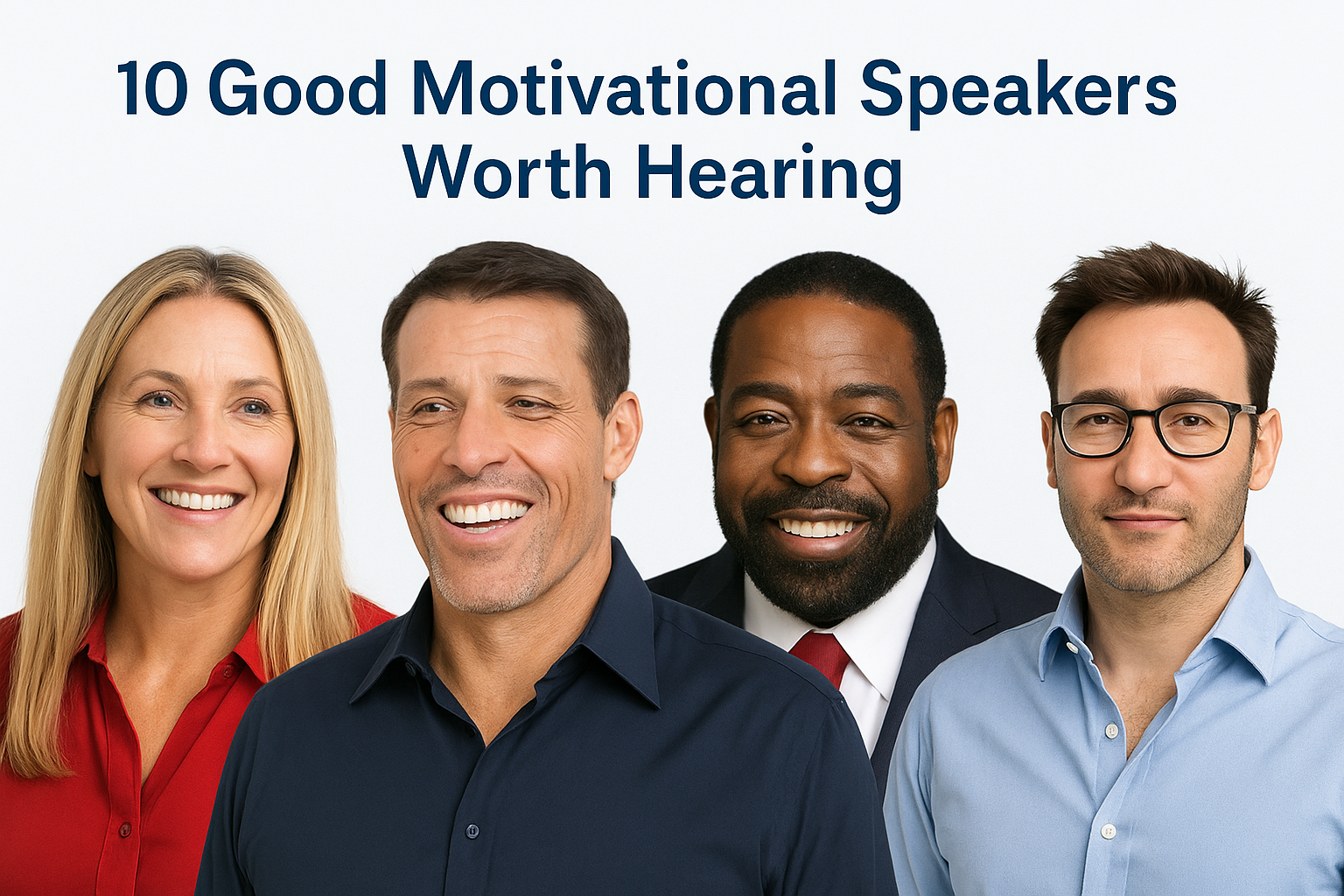
You’ve got a conference to plan, a sales kickoff that needs energy, or a leadership offsite that can’t fall flat. Finding good motivational speakers shouldn’t mean scrolling through vague bios and recycled quotes. You need names with real track records, stories that actually land, and a message your team will still talk about six months later.
This list rounds up well known motivational speakers who’ve earned their reputations through results, not just applause. Some built their credibility in business, others in sports, the military, or firefighting, but each one brings a distinct angle on leadership and performance that translates directly to a room full of employees or executives. If you’re comparing options before you book, this gives you a real starting point instead of a generic search result.
Below, you’ll find ten speakers worth serious consideration, what makes each one stand out, and the kind of audience or event they fit best. Whether you’re weighing top 10 motivational speakers in the world for a national sales meeting or narrowing down candidates for a smaller leadership retreat, you’ll walk away with a clearer sense of who delivers and why they’ve stayed in demand.
1. Robyn Benincasa
Background
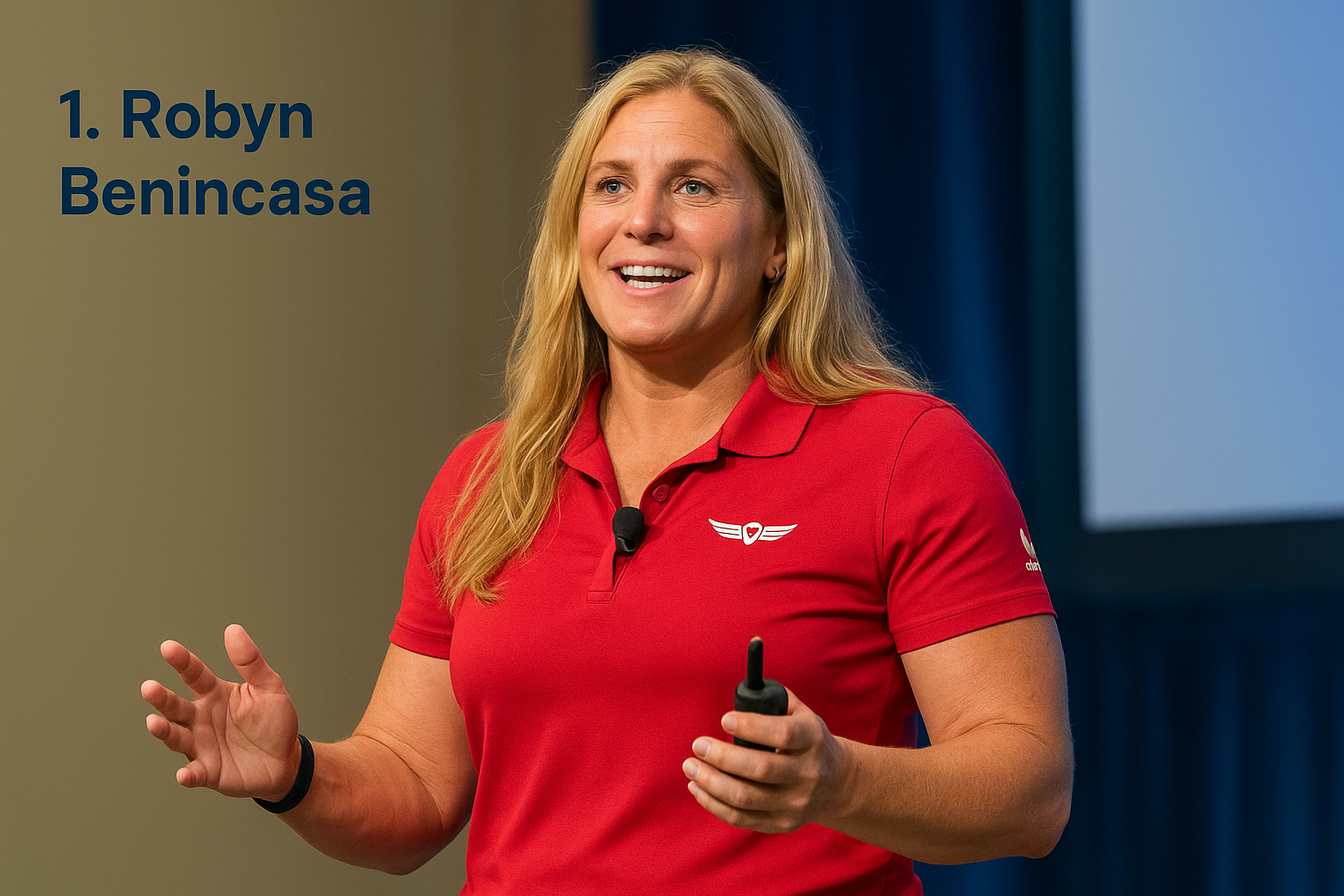
Most keynote speakers talk about teamwork from the outside looking in. Robyn Benincasa built her career from the inside, spending 15 years as a world champion adventure racer, competing in expedition races that stretch across hundreds of miles of jungle, mountains, and open water with a team of four strangers who have to become a unit fast or fail together. She paired that with a 20-plus year career as a San Diego firefighter, another job where the team succeeds or nobody goes home. That dual background, endurance sports and emergency response, gives her a rare vantage point on what actually holds a team together when things get hard. She’s also a New York Times best-selling author of How Winning Works: 8 Essential Leadership Lessons From The Toughest Teams on Earth, and she founded the Project Athena Foundation, a nonprofit that earned her recognition as a CNN Hero.
Signature message
Robyn’s core keynote, T.E.A.M.W.O.R.K., breaks down eight essential elements of a world-class team culture, drawn directly from races where the wrong attitude on a four-person team could mean a mountain summit missed or a race abandoned entirely. Her other signature talks, including WIN AS ONE, INSPIRING GREATNESS THROUGH G.R.I.T., and WHY WINNERS WIN, all circle back to the same idea: winning teams aren’t made up of the most talented individuals, they’re made up of people who’ve committed to a shared mission and trust each other enough to carry that mission through adversity.
Winning teams aren’t built from the most talented individuals, they’re built from people who trust each other enough to carry a shared mission through adversity.
What separates her from best motivational speakers who lean on theory is that she’s lived the stakes she talks about. She’s pulled teammates through jungle terrain on no sleep and pulled people out of burning buildings, and she translates both experiences into specific, actionable lessons for corporate teams navigating mergers, sales slumps, or culture problems. Companies like Allstate, Northrop Grumman, and Boston Scientific have booked her precisely because her stories aren’t abstractions, they’re field-tested strategies with measurable business outcomes, including sales teams that moved from 17th to 1st nationally after applying her framework.
Best for
Organizations facing real turning points get the most out of Robyn’s keynotes, whether that’s a merger, a leadership transition, a sales slump, or a culture that’s grown siloed and needs a shared identity again. She fits sales kickoffs, leadership offsites, and company-wide conferences equally well, and her material works whether the room holds 50 people or 5,000. She’s available for both in-person and virtual keynotes, which makes her a practical fit for hybrid conferences or geographically spread-out teams that still want the same unifying message.
- Event types: sales kickoffs, leadership offsites, all-company conferences, association meetings
- Formats: in-person and virtual keynotes
- Audience size: scales from small leadership groups to arena-sized crowds
- Signature topics: T.E.A.M.W.O.R.K., WIN AS ONE, INSPIRING GREATNESS THROUGH G.R.I.T., WHY WINNERS WIN
HR leaders and event planners looking for proof beyond a bio should check her client testimonials and case studies, which document the kind of measurable shifts in morale and performance that separate a good motivational speaker from one who simply fills a time slot on the agenda.
2. Tony Robbins
Background
Few names come up faster when people search for greatest motivational speakers, and Tony Robbins built that reputation over four decades of seminars, books, and one-on-one coaching with everyone from Fortune 500 CEOs to professional athletes. He started with almost nothing, living out of a small apartment before a chance introduction to neuro-linguistic programming set him on a path toward personal development work. His seminars, especially the notorious "Unleash the Power Within" firewalk events, turned him into a household name, and his books like Awaken the Giant Within and Money: Master the Game extended his reach well beyond the stage.
Signature message
Robbins built his career on the idea that state management, controlling your emotional and physical state in the moment, determines whether you take decisive action or freeze. His talks push audiences toward immediate, visible change: standing up, moving, breathing differently, committing out loud to a specific action before leaving the room. He calls this concept "psychology of achievement," and it’s less about slow strategic planning and more about breaking old patterns fast.
Change your state, change your results, that’s the entire engine behind a Tony Robbins keynote.
Corporate clients hire him when they want a jolt of energy that shakes people out of complacency, particularly around sales performance and personal accountability. His delivery style is high-volume and physical, closer to a stadium rock concert than a boardroom presentation, and that intensity is exactly what some audiences need to break out of a rut.
Best for
Large-scale sales conferences and high-energy company events fit Robbins best, especially organizations wanting a speaker known well beyond the corporate world. His fee sits at the very top of the market, often six figures per engagement, so he suits companies with substantial keynote budgets rather than smaller leadership retreats. Executives who want a name that instantly signals prestige to a large audience, and who have the budget to match, will get real value from booking him.
3. Les Brown
Background
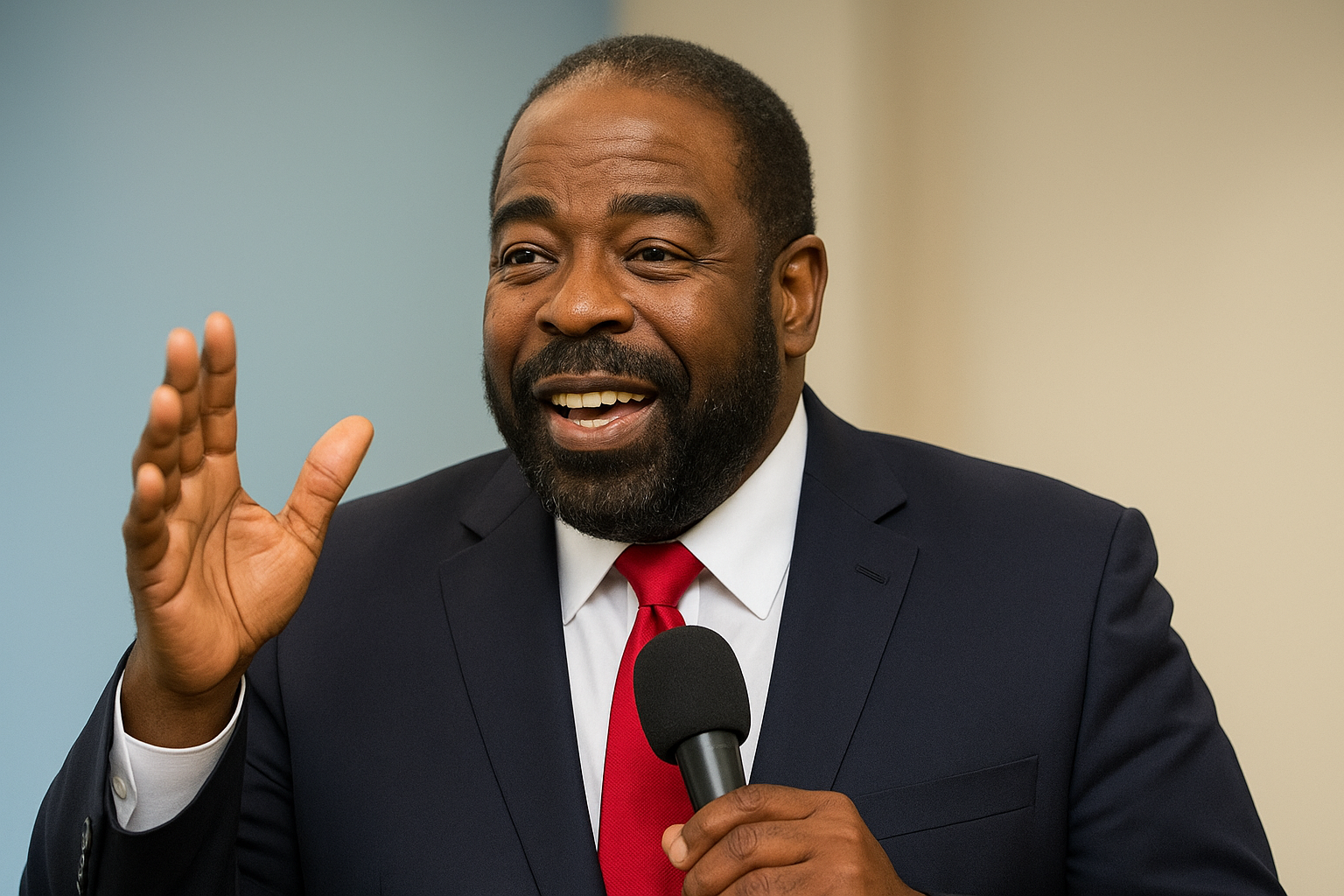
Les Brown grew up in Liberty City, Miami, given up for adoption as an infant and labeled "educable mentally retarded" in school, a label that stuck with him until a teacher pulled him aside and told him that other people’s opinions of him didn’t have to become his reality. That single moment shaped everything that followed. He went on to work as a radio DJ, win a seat in the Florida House of Representatives, and eventually become one of the most popular motivational speakers in the country, earning a spot in the National Speakers Association Hall of Fame. Toastmasters International once named him one of the top five speakers in the world, a distinction few in the industry can claim.
Signature message
Brown’s talks center on a phrase he’s repeated in arenas and boardrooms for decades: "You have greatness within you." He doesn’t deliver that line as a throwaway platitude, he builds his entire keynote around helping audiences identify the specific excuses keeping them stuck and replacing those excuses with concrete next steps. His storytelling pulls directly from his own setbacks, including a cancer diagnosis he faced head-on, which gives his message about resilience a lived-in quality rather than a rehearsed one.
Other people’s opinions of you don’t have to become your reality, that’s the line that turned Les Brown’s life around.
Audiences respond to him because he mixes preacher-style cadence with plain, direct language, so the message lands with people who might tune out a more academic speaker.
Best for
Companies looking to reignite personal accountability among employees who feel stuck, whether due to layoffs, restructuring, or a plateau in performance, get strong value from booking Brown. He works well for sales teams needing a mindset reset and for conferences focused on personal development alongside business strategy. Organizations with a diverse workforce spanning different backgrounds and starting points often find his underdog story resonates broadly, since it’s built on overcoming circumstances rather than natural advantage.
4. Zig Ziglar
Background
Before he ever stepped on a stage, Zig Ziglar spent years selling cookware door to door, a grind that taught him more about persistence and rejection than any classroom ever could. He turned that sales floor experience into a speaking career spanning over four decades, delivering thousands of talks and writing more than 30 books, including the classic See You at the Top. Ziglar became one of the best speakers motivational circuits have ever produced, largely because he never abandoned his Southern, folksy delivery even as his audiences grew from small sales offices to international arenas. He passed away in 2012, but his organization continues training speakers and sales professionals under his name, and his recorded talks still circulate widely in corporate training programs today.
Signature message
Ziglar’s core belief, that attitude determines altitude, shaped nearly every talk he gave, and he backed that idea with concrete sales techniques rather than vague encouragement. He blended faith, family values, and hard-nosed sales strategy into a single package, insisting that character and competence had to work together for lasting success. Unlike speakers who focus purely on hype, Ziglar spent real stage time teaching specific closing techniques and objection-handling frameworks that sales teams could apply the next morning.
Attitude determines altitude, and no amount of skill compensates for the wrong one.
His humor and homespun stories made dense sales training feel like a conversation with a trusted mentor rather than a lecture.
Best for
Sales organizations still lean on Ziglar’s recorded material and the speakers trained through his organization when they want proven, practical selling frameworks paired with a values-driven message. Companies building onboarding programs for new sales reps find his structured approach easier to implement than pure motivation, since it comes with repeatable steps. Retail, insurance, and direct sales industries in particular continue to reference his methods decades after he first developed them, a testament to how well his frameworks hold up outside a live keynote setting.
5. Simon Sinek
Background
Simon Sinek built his reputation as a marketing consultant and author before he ever stepped onto a keynote stage, and that consulting background shows in how methodically he builds an argument. His 2009 TED Talk, "How Great Leaders Inspire Action," became one of the most viewed TED Talks of all time, a milestone that pushed him from niche business author to one of the great motivational speakers companies actively compete to book. He followed that talk with Start With Why, then expanded his thinking in Leaders Eat Last and The Infinite Game, each book digging deeper into the same central question about what separates organizations people commit to from ones they simply work for.
Signature message
Sinek’s entire framework rests on a simple distinction: people don’t buy what you do, they buy why you do it. He argues that lasting motivation comes from a clearly articulated purpose, not from perks, bonuses, or slogans painted on a break room wall, and he backs that argument with examples ranging from Apple’s product launches to the leadership structure inside the U.S. Marine Corps. Where some speakers rely on personal anecdotes, Sinek leans on organizational case studies and behavioral research, giving his talks a more analytical, almost professorial tone.
People don’t buy what you do, they buy why you do it, and that single distinction reshapes how leaders build loyalty.
His calm, deliberate delivery style stands in sharp contrast to the high-energy speakers on this list, and that contrast is exactly why some audiences prefer him.
Best for
Executive teams and leadership offsites focused on strategy, culture, and long-term vision get the most value from Sinek, particularly organizations wrestling with employee retention or a fuzzy sense of purpose after rapid growth. He fits conferences with a thoughtful, white-collar audience more than high-volume sales rallies, since his pacing rewards close listening rather than crowd energy. Companies rebuilding their mission statement or trying to align leadership around a shared purpose often find his framework gives them language they didn’t have before.
6. Brené Brown
Background
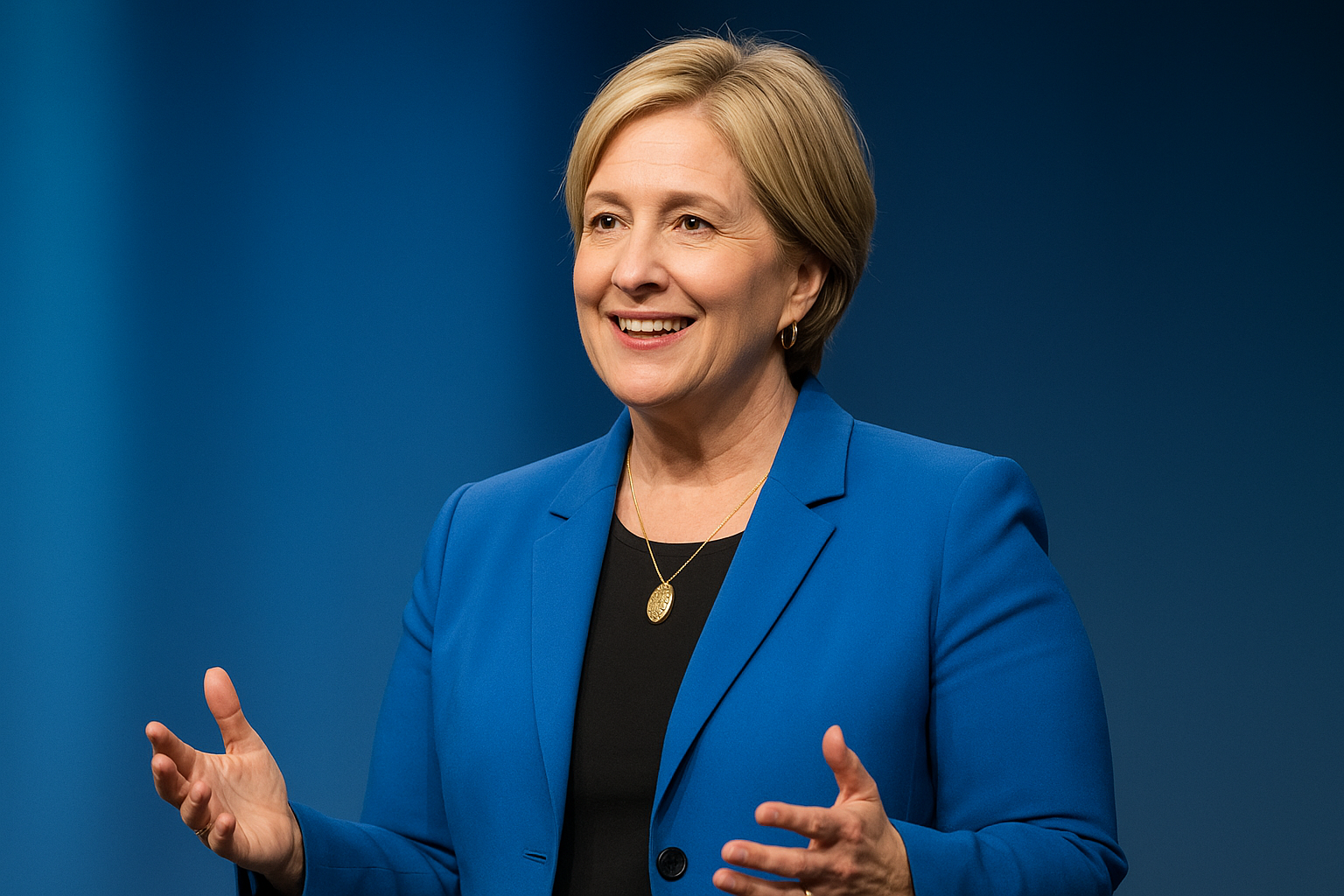
Brené Brown spent two decades as a research professor at the University of Houston before her 2010 TEDxHouston talk, "The Power of Vulnerability," turned her academic work into a cultural phenomenon. That talk now ranks among the most viewed TED talks ever, and it launched a career that includes five #1 New York Times bestsellers, among them Daring Greatly and Dare to Lead. Unlike many top ten motivational speakers in the world, she arrived at the stage through fifteen years of qualitative research on shame, vulnerability, and courage, not through a personal rags-to-riches story. That research background gives her talks a grounded, data-backed structure rather than pure inspiration.
Signature message
Brown’s central argument flips a common assumption in corporate culture: vulnerability isn’t weakness, it’s the birthplace of courage, creativity, and connection. She pushes leaders to trade armor and posturing for honest conversations, arguing that teams who can name a problem out loud fix it faster than teams pretending everything’s fine. Her Dare to Lead framework gives executives specific language for tough conversations, values clarification, and rebuilding trust after failure, which makes her material more of a leadership curriculum than a single burst of energy.
Vulnerability isn’t weakness, it’s the birthplace of courage, creativity, and connection.
Her delivery is conversational and unhurried, closer to a trusted colleague thinking out loud than a hype-driven performer, and that tone builds credibility with audiences skeptical of typical motivational polish.
Best for
Leadership teams working through trust issues, feedback avoidance, or a culture where people hide mistakes get the clearest payoff from booking Brown. She suits mid-size leadership retreats and HR-driven culture initiatives better than massive sales rallies, since her material rewards a quieter, more reflective room. Organizations rebuilding psychological safety after layoffs, reorganizations, or a toxic leadership exit often find her framework gives managers the exact vocabulary they were missing, and companies that want research-backed credibility alongside emotional resonance tend to rank her among the best speakers motivational programs bring in year after year.
7. Mel Robbins
Background
Mel Robbins spent years as a CNN commentator and legal analyst before a personal rut, stalled career, strained marriage, financial stress, pushed her toward the idea that eventually made her famous. She stumbled onto a simple trick: counting backward from five and physically moving before her brain could talk her out of it. That habit became the 5 Second Rule, the subject of her bestselling book of the same name, and it turned her into one of the most popular motivational speakers working today. Her TEDx talk on the topic has been viewed tens of millions of times, and she’s since built a media career spanning a nationally syndicated talk show, a podcast, and multiple bestselling books, including The High 5 Habit.
Signature message
Robbins argues that motivation is a myth, you’ll never feel like doing the hard thing, so waiting to feel ready guarantees you stay stuck. Instead, she teaches audiences to interrupt hesitation with a physical action within five seconds, before overthinking can talk them out of it. This isn’t abstract encouragement, it’s a repeatable mental trick backed by research on brain activation patterns, which is part of why she’s earned a reputation among best speakers motivational program planners keep rebooking.
Motivation is a myth, action comes first and feeling ready follows, not the other way around.
Her delivery is candid and self-deprecating, built on admitting her own failures rather than projecting flawless success, and that honesty makes her advice feel usable rather than aspirational.
Best for
Sales teams and individual contributors struggling with procrastination, hesitation, or fear of rejection respond well to Robbins, since her framework gives them a concrete tool rather than a pep talk. She fits corporate wellness initiatives, sales kickoffs, and leadership development programs aimed at building personal accountability at every level of an organization. Companies wanting a speaker who blends science-backed psychology with an approachable, TV-tested delivery style often find her material sticks with employees long after the event ends, since a five-second habit is easy to remember and even easier to practice the next morning.
8. Eric Thomas
Background
Eric Thomas spent part of his teenage years homeless, sleeping in abandoned houses and bouncing between friends’ couches after dropping out of high school. That period shaped the raw, unfiltered energy he later brought to speaking, first as a pastor, then as a doctor of education, and eventually as one of the greatest motivational speakers working the college athletics and corporate circuit today. He built his following the hard way, posting videos to YouTube long before anyone booked him for a paycheck, and those clips, especially the one titled "How Bad Do You Want It," turned him into a name college football programs and NBA teams request by name.
Signature message
Thomas preaches a single relentless idea: your desire for success has to outweigh your fear of failure, or you’ll settle for average every time. He calls himself "the hip hop preacher" for a reason, his delivery borrows the cadence and urgency of a sermon, building volume and intensity until the room feels the same hunger he’s describing. Where some best motivational speakers lean on calm analysis, Thomas leans on confrontation, pushing audiences to admit where they’ve been coasting rather than grinding.
Your desire for success has to outweigh your fear of failure, or average becomes the ceiling.
His stories draw directly from his homeless years, giving phrases like "you gotta want it" a weight that a polished, comfortable background couldn’t produce.
Best for
Organizations wanting a jolt of raw intensity rather than a measured strategy session get the most out of booking Thomas, particularly sales teams before a major push or athletic programs before a season. He fits younger, high-energy audiences especially well, since his delivery style resembles a locker room speech more than a boardroom presentation. Companies that want their team walking out fired up and ready to outwork the competition, rather than reflecting quietly on culture, tend to find him among the top 10 motivational speakers in the world worth the investment for that specific kind of moment.
9. John Maxwell
Background
John Maxwell spent seventeen years as a pastor before he ever wrote a leadership book, and that pastoral background shows in how he structures his material, always pointing toward practical application rather than abstract theory. He’s since written more than 70 books, including the widely used The 21 Irrefutable Laws of Leadership, and founded the John Maxwell Company, a training organization that certifies coaches around the world to teach his frameworks. Among well known motivational speakers, few have built as much infrastructure around a single body of work, and that scale is part of why corporations, nonprofits, and government agencies keep bringing him back decades after his first bestseller.
Signature message
Maxwell argues that leadership is influence, nothing more and nothing less, which means anyone in an organization, regardless of title, can and should develop it. His talks break leadership into learnable laws and stages, moving audiences away from the idea that leaders are born and toward the idea that leadership is a skill built through intentional daily habits. That structured, almost textbook approach separates him from best motivational speakers who rely mainly on personal story, since Maxwell spends more stage time on frameworks people can teach to their own teams the following week.
Leadership is influence, nothing more and nothing less, and that means anyone can learn to lead.
His delivery is warm and conversational, closer to a respected mentor walking through a lesson plan than a performer working a crowd, which suits audiences who want substance they can implement immediately.
Best for
Organizations building internal leadership pipelines or investing in manager development programs get the clearest return from booking Maxwell, since his material translates easily into training curricula rather than staying confined to a single event. He fits leadership conferences, association meetings, and multi-day corporate retreats where attendees expect to leave with a framework, not just energy. Companies wanting a speaker whose books and coaching programs extend the keynote’s value well past the day of the event often rank him among the top ten motivational speakers in the world for building leadership bench strength across every level of management.
10. Nick Vujicic
Background
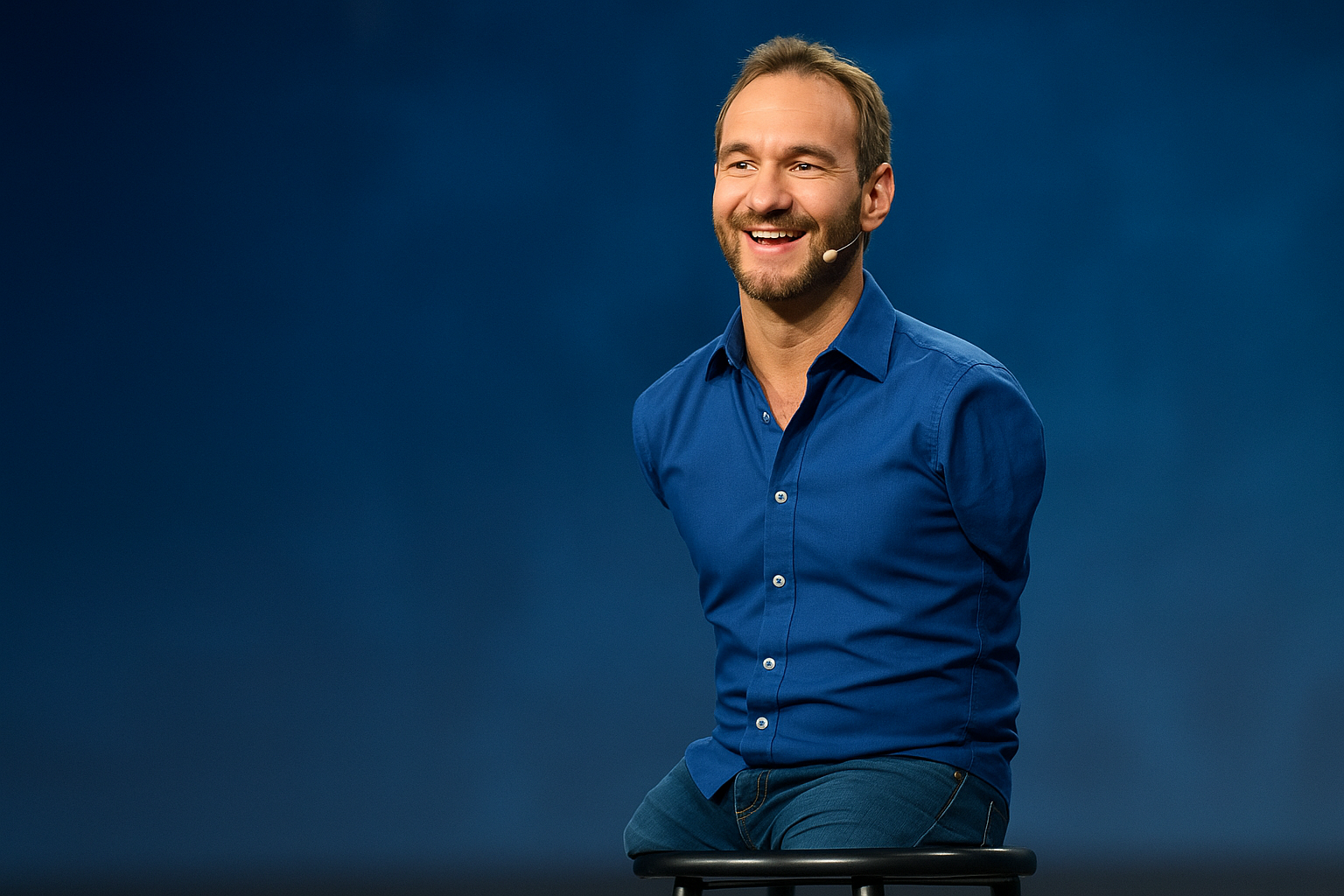
Nick Vujicic was born in Australia in 1982 with tetra-amelia syndrome, a rare disorder that left him without arms or legs. School years brought bullying and isolation, and by age ten he’d attempted suicide, a detail he shares openly on stage rather than glossing over. Faith and a shift in mindset pulled him back from that low point, and by his early twenties he’d founded Life Without Limbs, a nonprofit that eventually launched his speaking career. Today he’s addressed audiences in more than 60 countries, and among greatest motivational speakers working the global circuit, few carry a physical story that communicates resilience before he even says a word.
Signature message
Vujicic centers his talks on a phrase he’s repeated to millions: focus on what you have, not on what you don’t. He walks audiences through his own lowest moments, the bullying, the despair, the suicide attempt, then pivots to the daily choices that rebuilt his sense of purpose, marriage, and career. His approach favors faith-driven optimism over pure business strategy, though he tailors corporate keynotes to speak directly to resilience, adaptability, and gratitude in the workplace.
Focus on what you have, not on what you don’t, and limits stop being the whole story.
What makes him stand apart from other popular motivational speakers is that his message needs no exaggeration. The visual alone, a man without limbs delivering a high-energy talk with humor and warmth, does work that no slide deck or statistic could match.
Best for
Companies planning conferences with a strong wellness, resilience, or gratitude theme find Vujicic’s story lands hard, particularly after layoffs, health crises, or a season of low morale. He suits large general sessions where a visual, emotional reset matters more than tactical frameworks, and he works well alongside a second speaker who handles the strategic, how-to portion of the day. Nonprofits, healthcare organizations, and faith-based groups book him often, though plenty of corporate planners bring him in specifically because his story cuts through cynicism faster than almost anyone else on a stage.
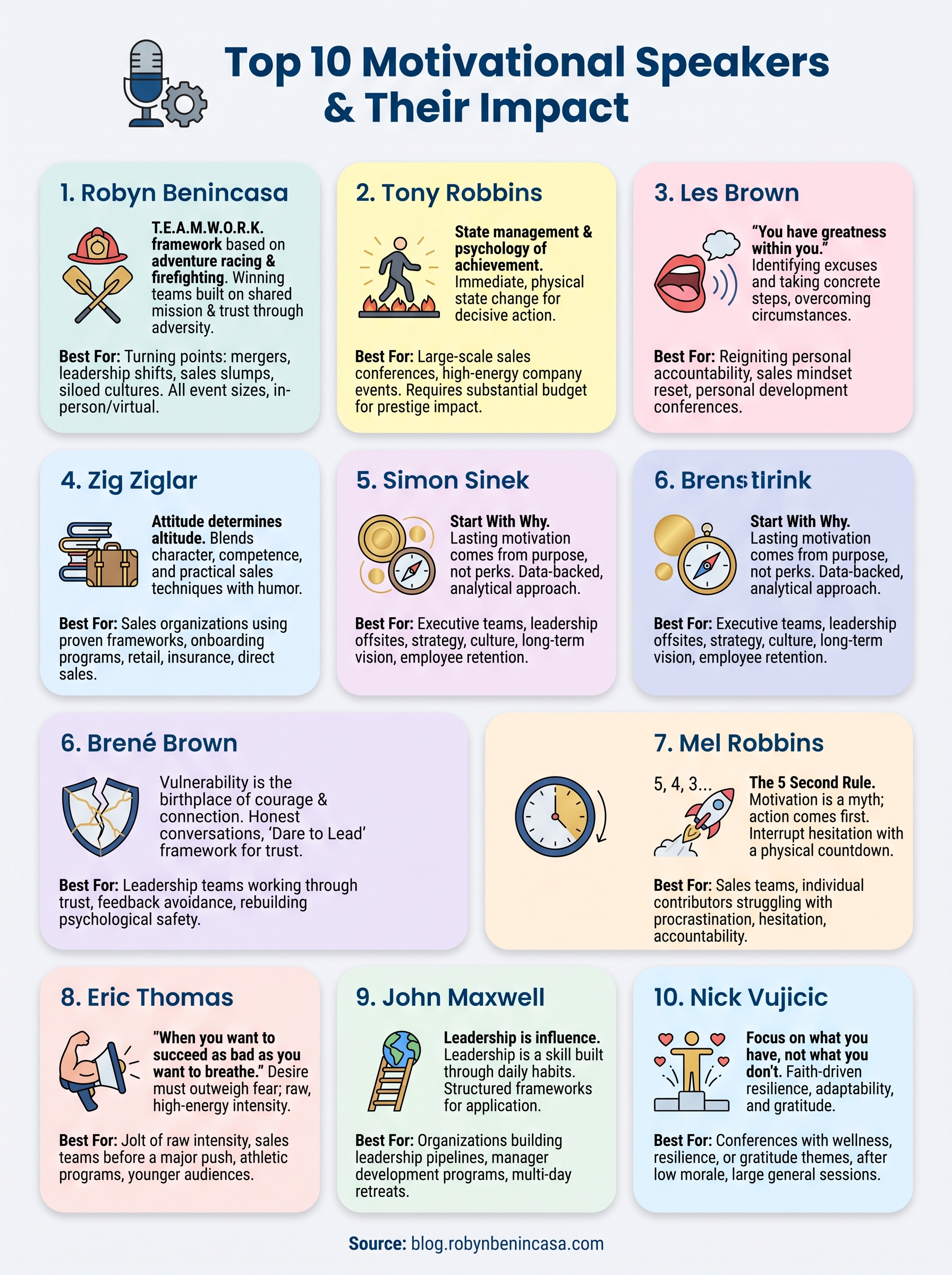
Choosing the right voice for your audience
Every name on this list earned its place, but the right fit depends on your room, not a ranking. A stadium sales rally calls for different energy than a leadership retreat working through trust issues after a rough year. Good motivational speakers deliver more than applause, they leave your team with language and habits that outlast the event itself, whether that’s Sinek’s clarity on purpose or Robbins’s five-second trick for beating hesitation.
If your organization is navigating a merger, a sales slump, or a culture that’s grown siloed, few speakers translate real stakes into actionable team lessons the way Robyn Benincasa does. Her firsthand experience racing and firefighting gives audiences a framework built on trust and shared mission, not theory. Visit Robyn Benincasa’s blog to explore her keynote topics and see which one fits your next event.