Most leadership failures trace back to one thing: people not saying what they actually mean, or saying it in a way nobody hears. You’ve probably watched a talented manager lose their team’s trust because feedback felt harsh, or an executive’s vision fall flat because nobody could translate it into action. That’s why communication leadership training keeps showing up on HR priority lists year after year, and why finding the right leadership training program matters more than checking a box.
If you’re comparing options right now, you want programs that actually change behavior, not just deliver a nice framework and a certificate. The best leadership communication training blends real practice, direct feedback, and lessons pulled from environments where miscommunication has real consequences, not just theoretical business scenarios.
This list covers five standout programs worth your time and budget, including approaches built from experience leading teams under genuine pressure, like adventure racing crews and firefighting units, where clear communication and shared commitment aren’t optional. Whether you’re planning a leadership offsite or building a longer development track, you’ll find options here that fit different team sizes, budgets, and goals.
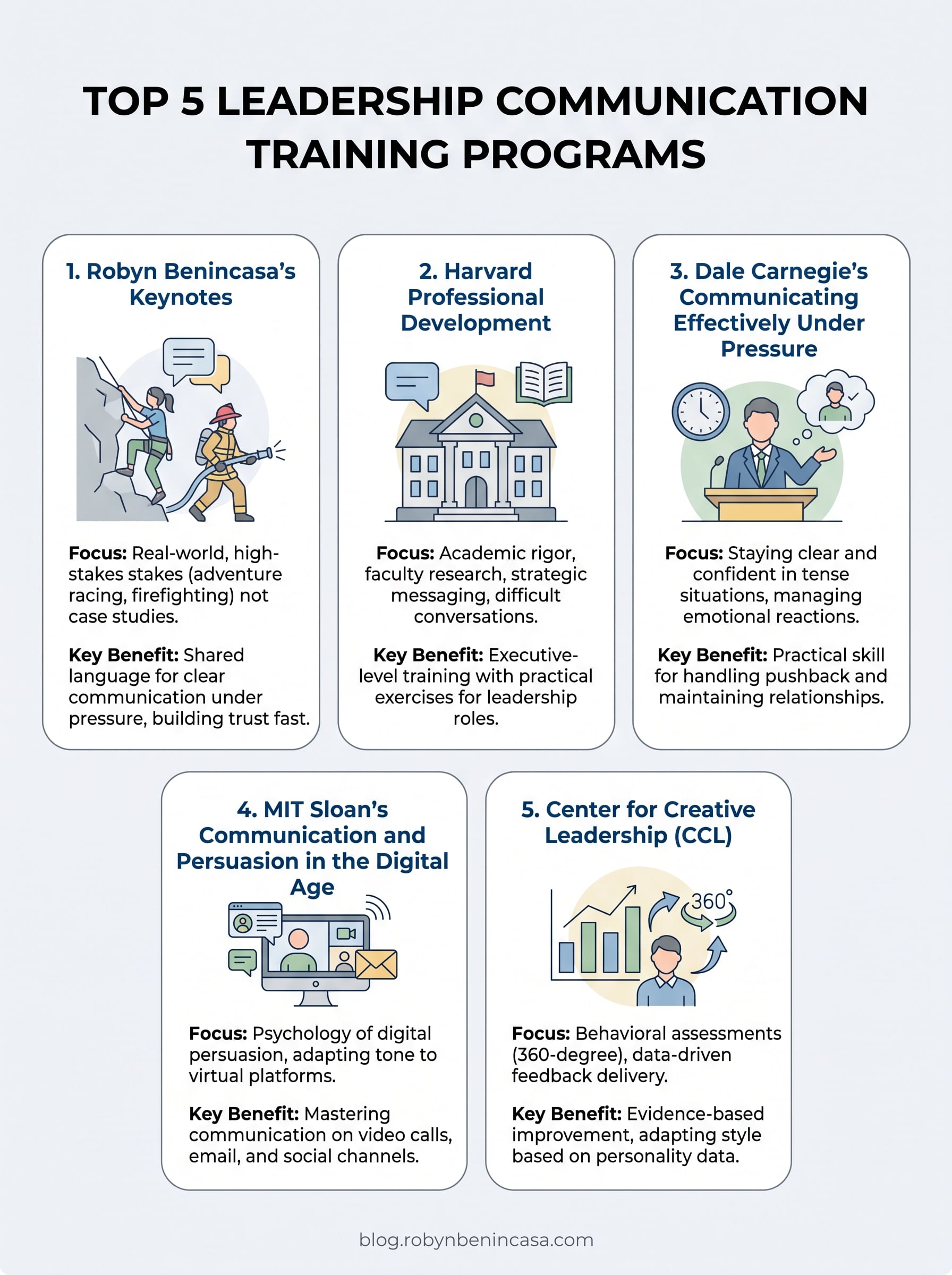
1. Robyn Benincasa’s leadership communication keynotes
Robyn Benincasa built her communication philosophy in places where a garbled radio call or a vague instruction could cost lives, not quarterly numbers. As a 20-plus year San Diego firefighter and world champion adventure racer, she teaches leadership communication training grounded in real stakes, not hypothetical case studies pulled from a textbook.

What it covers
Her keynotes, including T.E.A.M.W.O.R.K. and WIN AS ONE, dig into how top teams communicate under pressure: giving feedback that lands, building trust fast with people you barely know, and keeping a shared mission clear when everything around you is chaotic. She draws on stories from multi-day expedition races and firefighting calls to show what clear communication actually looks like when failure isn’t an option.
When the stakes are real, vague communication stops being a bad habit and becomes a liability.
Who it’s for
This program suits executives, sales leaders, and HR teams facing silos at work, mergers, or performance slumps who need more than another slide deck. It’s a strong fit for organizations that want their leaders to leave energized and equipped, not just entertained.
Format and delivery
Robyn delivers keynotes in-person and virtually, scaling for leadership offsites, sales kickoffs, and full conferences. Many clients pair the keynote with her book, How Winning Works, or her free 18-page guide to extend the lessons beyond the event itself.
Cost
Pricing varies by format, event size, and location, so the fastest way to get an accurate quote is to reach out directly through her booking page, though it helps to know what a keynote speaker typically costs first. Past clients like Allstate and Northrop Grumman have found the investment pays off in measurable culture shifts, not just a memorable hour.
2. Harvard professional development communication programs
Harvard’s Division of Continuing Education runs a lineup of courses built for managers who need executive-level communication training without enrolling in a full MBA. These programs pull from Harvard faculty research on persuasion, negotiation, and organizational behavior, giving you academic rigor alongside practical exercises you can apply the next morning.
What it covers
Courses typically cover strategic messaging, difficult conversations, public speaking, and adapting your communication style across cultures and seniority levels. Case studies come from real companies, and cohorts often work through role-play scenarios that mirror actual boardroom tensions.
Communication training only sticks when theory gets tested against a real scenario.
Who it’s for
Mid-to-senior managers and directors who want a credentialed program suit this best, especially those preparing for bigger leadership roles.
Format and delivery
Options include in-person sessions on campus, live online leadership training cohorts, and self-paced modules, so flexible scheduling works for busy executives.
Cost
Expect to pay between $1,600 and $4,000 depending on course length and format, according to Harvard’s Professional Development course catalog.
3. Dale Carnegie’s communicating effectively under pressure course
Dale Carnegie built a name on people skills long before "soft skills" became a corporate buzzword, and this course zeroes in on a specific pain point: staying clear and confident when a conversation gets tense. It’s a practical pick for anyone whose training leadership communication search started after a meeting went sideways.
What it covers
The course tackles managing emotional reactions, structuring your message under time pressure, and reading a room fast enough to adjust your approach mid-conversation. Expect heavy role-play, since Carnegie’s method leans on repetition over lecture, much like the communication exercises for teams you’d run in-house.
Composure under pressure is a trained skill, not a personality trait.
Who it’s for
Managers who face frequent pushback, whether from clients, direct reports, or cross-functional peers, get the most out of this one. It also suits sales leaders who need to hold their ground without damaging relationships.
Format and delivery
Dale Carnegie offers this as live online sessions and in-person workshops, typically spread across a few sessions rather than a single day, giving participants time to practice between meetings.
Cost
Pricing generally falls in the $800 to $1,500 range per participant, though exact rates depend on location and group size.
4. MIT Sloan’s communication and persuasion in the digital age
MIT Sloan Executive Education built this course for leaders who feel confident in a conference room but lose their footing on video calls, Slack threads, and social platforms. It’s a research-heavy option for anyone comparing leadership communications training that specifically addresses digital channels rather than just face-to-face conversation.

What it covers
Participants study the psychology behind digital persuasion, including how tone, timing, and platform choice change how a message lands. The curriculum draws on behavioral science and MIT faculty research, covering everything from crafting a compelling email to reading engagement signals in virtual meetings.
A message that works in person can fall flat online if you don’t adjust for the medium.
Who it’s for
Executives and managers leading distributed or hybrid teams benefit most, especially those who negotiate or influence stakeholders remotely on a regular basis.
Format and delivery
Offered as a live online course over several weeks, sessions mix short lectures with small-group discussion and applied assignments between meetings.
Cost
Tuition runs roughly $2,800 to $3,200, based on rates published through MIT Sloan Executive Education.
5. Center for Creative Leadership’s communication training
Center for Creative Leadership, often shortened to CCL, has spent decades researching what actually separates effective leaders from ineffective ones, and communication sits at the center of nearly every finding. Their programs lean on behavioral assessments and data rather than generic advice, which appeals to organizations that want proof their training budget is working.
What it covers
CCL’s curriculum covers feedback delivery, listening under stress, and adapting communication style based on personality assessments like their own 360-degree tools. Sessions often include peer coaching, so participants practice on real workplace scenarios rather than scripted examples.
Communication training works best when it’s backed by data on how you actually show up, not just how you think you show up.
Who it’s for
This suits leaders who respond well to assessment-driven training, particularly those in larger organizations already using CCL’s leadership development frameworks elsewhere.
Format and delivery
CCL runs multi-day, in-person cohorts along with virtual options, often combined with one-on-one coaching follow-ups.
Cost
Programs typically range from $3,000 to $7,500 per participant, depending on length and coaching add-ons.
Finding the right fit for your team
Pick your program based on the problem you’re actually trying to solve, not the name that sounds most impressive on a training calendar, and it’s worth weighing these against the best leadership training programs for building stronger teams. Harvard and MIT Sloan suit leaders who want academic depth and credentials. Dale Carnegie and CCL work well for teams that need structured practice and measurable behavior change over time. If your organization needs a jolt of energy and a communication framework that sticks because it comes from real stakes, not a classroom exercise, that’s where communication leadership training built on lived experience earns its place.
Robyn Benincasa’s keynotes give teams a shared language for clear communication under pressure, drawn from adventure racing and firefighting rather than theory. If you’re planning a leadership offsite or sales kickoff and want your people talking differently by Monday morning, here’s how to hire a keynote speaker for your next event and see what that shift looks like firsthand.