The best resilience training exercises are short, repeatable and matched to the people doing them. For solo practice, start with paced breathing, a three good things journal and a cognitive reframing log. For groups, a story swap and a weekly micro-wins check-in do the most with the least prep. Strengths spotting, self-compassion breaks and a past adversity map sit in between. They suit adults, students and coaching clients alike. Every exercise below needs a pen, a timer and ten minutes or less.
Most people are told that resilience matters and then handed a vague list of tips. Nobody gives them instructions. That gap is why resilience programs fade after the second week. Resilience is a set of skills, not a personality trait. You build it like any other skill, with small reps, on a schedule, with a way to check progress.
This guide gives you eight exercises with exact steps, the people each one suits and the time each one takes. It ends with a six-week plan that strings them together. Robyn Benincasa spent years as a San Diego firefighter and a world championship adventure racer, and she now teaches teams how to hold up under pressure. This guide keeps that practical lens.
1. Paced breathing and a one-minute mindfulness reset
Paced breathing is one of the fastest mindfulness exercises to learn, and it works in the exact moment you need it. You slow your exhale, notice where your attention goes, and bring it back. That is the whole skill.

How to do it
Start with one minute and build to five. Sit with your feet flat and your shoulders loose, then follow these steps:
- Inhale through your nose for a count of four.
- Exhale through your mouth for a count of six.
- When your mind wanders, notice where it went without judging it, then return to your breath.
- Repeat for one to five minutes.
Why it works
Slow breathing signals your body that the threat has passed, so muscle tension and heart rate ease. Resilience programs lean on that calm because you cannot reframe a thought well while your body is in alarm.
Mindfulness adds a second skill, which is noticing a reaction without acting on it. That small gap between trigger and response is what lets you choose how to handle a setback.
Calm the body first, then work on the thinking.
Who it suits
Anyone, which makes this the best first exercise for a mixed group. Teachers use it before tests, and managers open tense meetings with it.
- Time: one to five minutes
- Frequency: daily, plus before any high-pressure moment
2. Three good things journal
The three good things journal is the simplest form of gratitude journaling, and it has research behind it. Martin Seligman and colleagues tested it in 2005 as one of several positive psychology interventions.
How to do it
Do it at night, on paper or in a notes app.
- Write down three things that went well today. Small counts: a hot coffee, a colleague who covered for you.
- Next to each one, write why it happened.
- Note your own role, if you had one.
- Repeat for seven nights, then decide whether to keep going.
Why it works
Your mind dwells on threats by default, a habit called negativity bias. Bad moments crowd out good ones unless you train your attention to look for what is working.
The "why" step matters most. It shows you what you and other people contributed, and that sense of agency is what you need during a hard stretch.
Gratitude journaling works because it asks why, not just what.
Who it suits
Adults with long workdays, older students and teams. A team can share one item each at the end of a meeting.
- Time: five minutes
- Frequency: nightly for a week, then three evenings a week
3. Cognitive reframing log
A cognitive reframing log is a written way to challenge a harsh reading of a setback. It borrows from cognitive behavioral therapy and takes about ten minutes.
How to do it
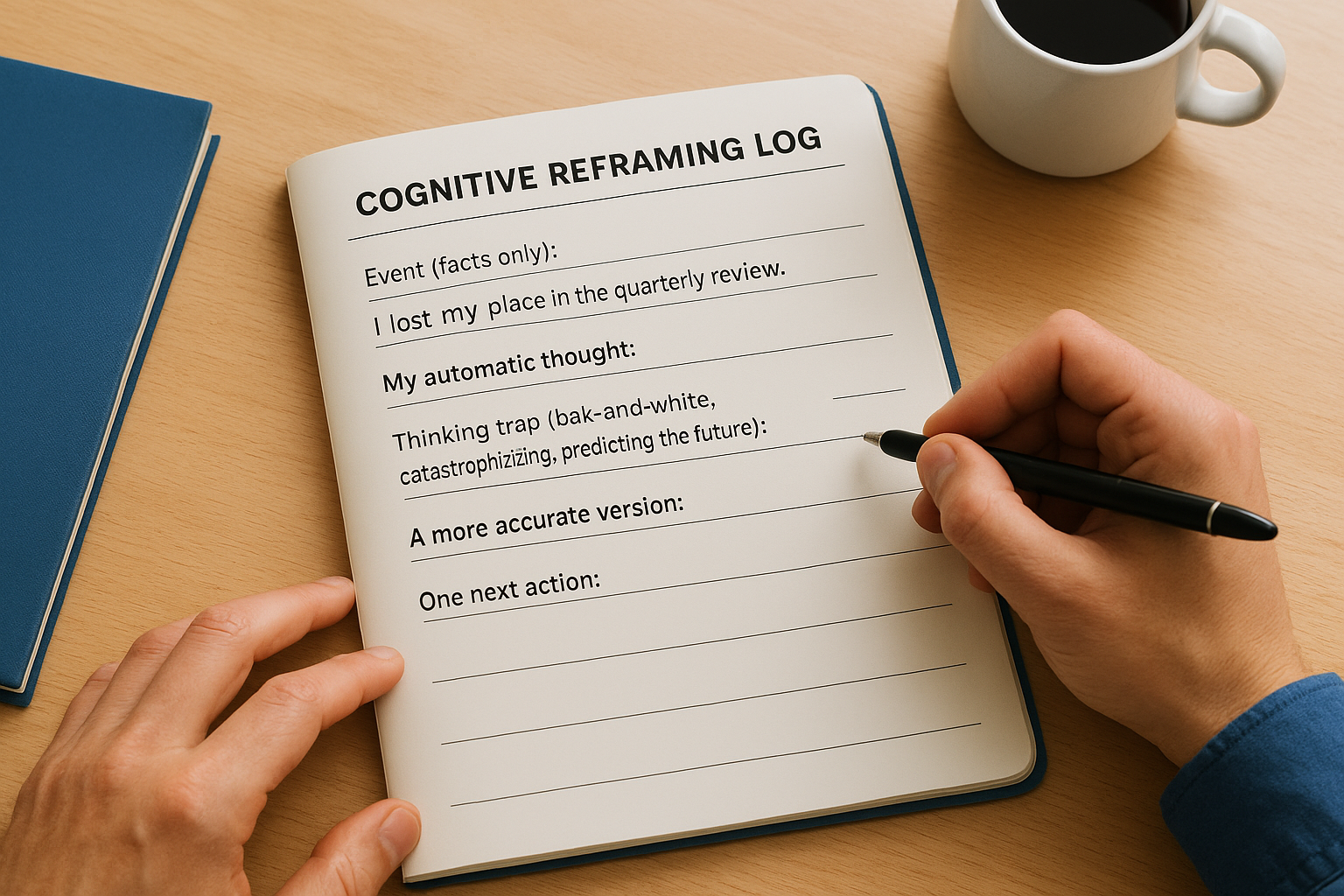
Copy this template into a notebook or a document and fill it in after any setback:
Event (facts only):
My automatic thought:
Thinking trap (black-and-white, catastrophizing, predicting the future):
A more accurate version:
One next action:
Here is a worked example. The event is "I lost my place in the quarterly review." The automatic thought is "I’m not cut out for this." The trap is black-and-white thinking. The accurate version is "The first five minutes went badly and the Q&A went well." The next action is to rehearse the opening twice.
Why it works
The log separates what happened from the story you layered on top of it. Most distress comes from the story, and naming the trap weakens its pull.
A reframe is not positive spin. The new version has to be true and specific, or you will not believe it.
A good reframe is more accurate, not more cheerful.
Who it suits
Adults, teens and clients who spiral into anxious thinking. It is a skill-building tool, not a treatment for an anxiety disorder.
- Time: ten minutes
- Frequency: after any setback, and three times a week as practice
4. Strengths spotting
Strengths spotting builds resilience by showing you the resources you already use. Take the free VIA Character Strengths survey to find your top three, or pick from a list such as curiosity, honesty, perseverance and humor.
How to do it
- Identify your top three strengths.
- Each evening, recall one hard moment from the day.
- Name the strength you used to get through it.
- Write one sentence on how you used it.
- Plan to use that strength on purpose the next time.
Why it works
Under stress, people fixate on their gaps. Naming strengths builds self-efficacy, the belief that you can handle what comes next. Peterson and Seligman’s character strengths research is the foundation for this practice.
The exercise also works at team level. When people know each other’s strengths, they delegate better, ask for help sooner and stop reading differences as weaknesses.
You get more resilient when you can name what already works.
Who it suits
Students, new managers and teams. Pairs can tell each other which strength they saw in action that week.
- Time: five to ten minutes
- Frequency: daily for two weeks, then weekly
5. Self-compassion break
A self-compassion break replaces self-criticism with the response you would give a struggling friend. Psychologist Kristin Neff’s model has three parts: mindfulness, common humanity and self-kindness.
How to do it
- Name the pain: "This is a hard moment."
- Remind yourself that struggle is shared: "Other people feel this too."
- Offer kindness. Put a hand on your chest, or write two sentences to yourself as you would to a friend.
- Ask what you need right now, then do one small thing about it.
Why it works
Harsh self-judgment feels like motivation, but it tends to produce avoidance and shame. You stop looking at the problem because looking hurts.
Kindness keeps you in contact with the problem. It also does not lower your standards. You can hold a high bar and still treat a miss as information instead of a verdict.
Kindness toward yourself is how you stay in the game after a mistake.
Who it suits
Perfectionists, caregivers, first responders and high performers who push hard and recover poorly.
- Time: three to five minutes
- Frequency: whenever you catch yourself in self-criticism
6. Past adversity map
The past adversity map turns your own history into evidence. You review a hard time you already got through and pull out the skills that worked.
How to do it
Pick one past challenge, then answer five prompts in writing:
- What happened?
- What did I do that helped?
- Who helped me?
- What did I learn?
- Which of these skills can I reuse now?
Choose one skill and apply it to a current problem within the next seven days.
Why it works
Under stress, memory narrows to what is going wrong. The map brings forward proof that you have coped before, which is stronger than any pep talk.
It also reveals patterns. You may notice that you always recover faster when you call someone, or that you stall when you try to solve everything alone.
Your history is the best resilience data you own.
Who it suits
People in transitions such as a job loss, a move, retirement or a new role. Coaches can use it as a first-session exercise with clients.
- Time: 20 to 30 minutes
- Frequency: once, then revisit every quarter
7. Challenge and growth story swap
The challenge and growth story swap is a group exercise that makes struggle normal. Pairs trade stories about a difficult time and what it taught them.

How to do it
- Split the group into pairs.
- Each person gets three minutes to describe a challenge and one lesson from it.
- The listener does not fix or advise. Afterward, they name one strength they heard.
- Swap roles.
- Regroup. Volunteers share a strength they heard in their partner’s story, with permission.
Tell people to choose a story they are comfortable sharing. Keep trauma-level stories out of workplace sessions.
Why it works
Isolation makes setbacks heavier. Hearing a colleague describe a failure shows you that struggle is ordinary, not a personal flaw.
It also builds the trust a team needs under pressure. In adventure racing, a team is only as fast as its slowest member, so hiding a struggle is expensive. Saying it out loud early costs far less.
Teams get resilient when struggle is something they can say out loud.
Who it suits
Classrooms with older students, work teams, support groups and workshops.
- Time: 20 to 30 minutes
- Group size: any even number, from 6 to 30
- Frequency: monthly
8. Micro-wins check-in for teams
A micro-wins check-in is a weekly ritual where every team member names one small win. It is the easiest resilience exercise for a workplace to sustain, because it fits inside a meeting you already hold.
How to do it
- The leader goes first and keeps the win small, such as "I finally answered the backlog of client emails."
- Each person names one win and what they did or who helped.
- Add one thank-you note for a teammate to a shared wall, physical or a chat channel.
- Keep a running list so the team can reread it during a bad week.
Why it works
Under pressure, teams track what is broken. Micro wins show visible progress and keep optimism tied to facts instead of slogans.
The thank-you notes add a second layer. Recognition builds connection between teammates, and that connection is a buffer when the next setback arrives.
Progress you can name is progress you can repeat.
Who it suits
Workplace teams, remote teams, classrooms and managers who want a low-effort routine.
- Time: ten minutes
- Frequency: weekly
How to combine them into a six-week plan
Group programs typically run six to eight weeks, with weekly sessions of 60 to 90 minutes and a short daily practice between sessions. The American Psychological Association treats resilience as something people build through learned skills, which is why a staged plan works.
A week-by-week sequence
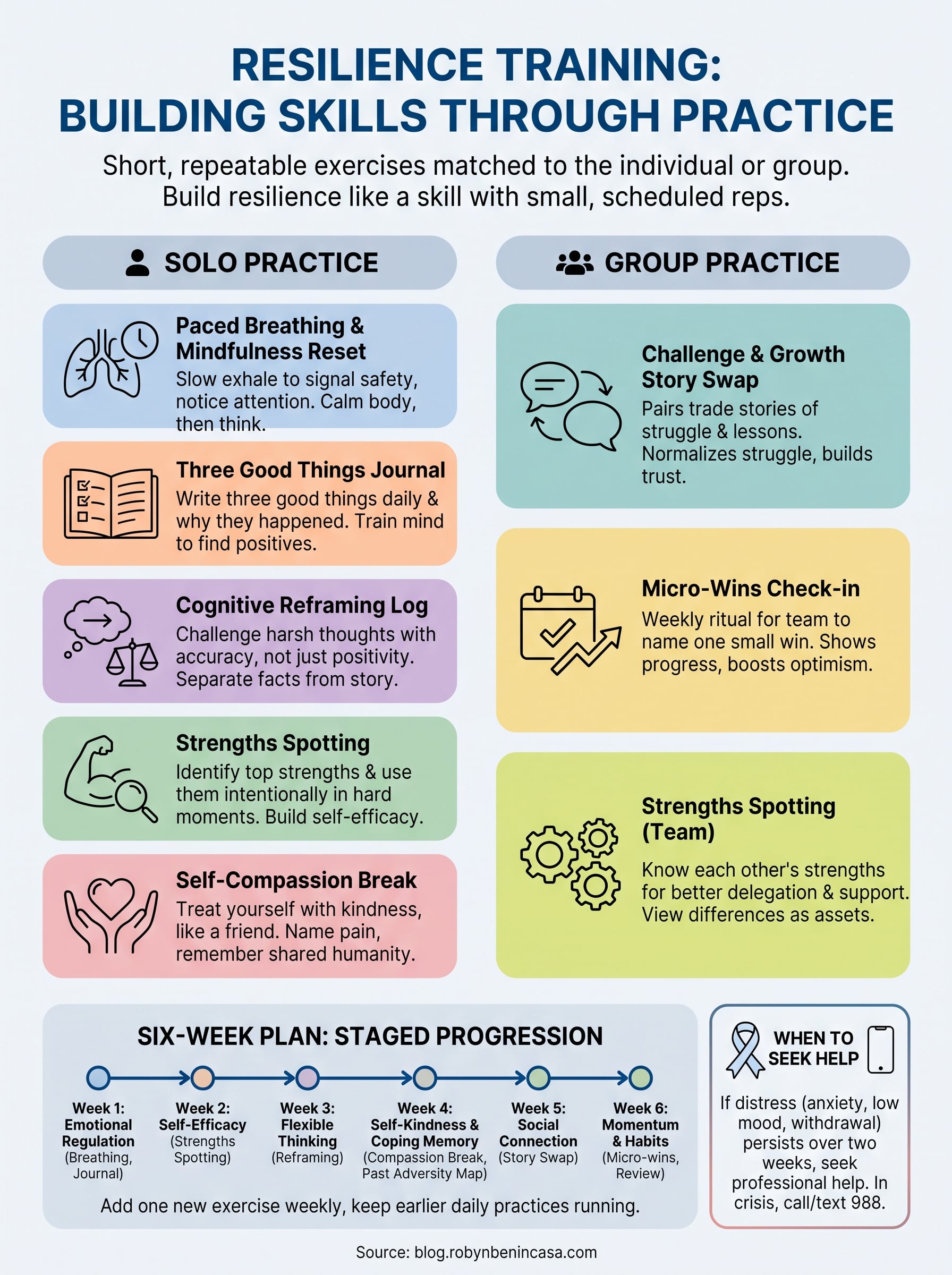
Add one new exercise each week and keep the earlier daily practices running.
| Week | Exercises | Skill it trains |
|---|---|---|
| 1 | Paced breathing, three good things | Emotional regulation, attention to what works |
| 2 | Strengths spotting | Self-efficacy |
| 3 | Cognitive reframing log | Flexible thinking |
| 4 | Self-compassion break, past adversity map | Self-kindness, coping memory |
| 5 | Story swap | Social connection |
| 6 | Micro-wins check-in, review | Momentum, lasting habits |
Ask everyone to rate their stress from 1 to 10 in week one and again in week six. At the end, each person writes a one-page plan that lists the three exercises they will keep.
Add one exercise a week and keep the earlier ones running.
Adapting the plan for students, employees and clients
For students, shorten each exercise to 10 or 15 minutes. Youth programs often use pediatrician Kenneth Ginsburg’s seven Cs: competence, confidence, connection, character, contribution, coping and control. Strengths spotting feeds competence and character, and the story swap feeds connection.
For employees, fold exercises into meetings you already hold. If a team needs a shared kickoff during a tough stretch, Robyn’s keynote Inspiring Greatness through G.R.I.T. runs 45 to 60 minutes and is built for teams facing adversity. For coaching clients, assign the solo exercises as homework and use sessions to review the written work. None of these exercises costs anything, and they need only paper and a pen.
When exercises are not enough
Exercises build skills. They do not replace care. Seek help from a mental health professional or your doctor if any of these last more than two weeks:
- Persistent anxiety, fear or low mood
- Sleep trouble or daytime exhaustion
- Withdrawing from people you normally see
- Irritability, anger or crying easily
- Increased alcohol or drug use
- Frequent illness
If you have thoughts of suicide, call or text 988 in the U.S. to reach the 988 Suicide & Crisis Lifeline, available 24/7.
Pick two and build from there
You do not need all eight exercises on day one. Pick one solo exercise and one group exercise, run them for two weeks, then add more. Paced breathing and the three good things journal cost five minutes a day. The story swap and the micro-wins check-in cost a team about a half hour a month.
Resilience grows through repetition, honest reflection and the people around you. Teams that practice it before a crisis handle the crisis better, and individuals who track their own coping skills recover faster from the next setback.
If you lead a team and want help building a culture that holds together under pressure, bring Robyn Benincasa’s keynote, Inspiring Greatness through G.R.I.T., to your next team event.