
You can feel it the moment you walk into a room. One team finishes each other’s sentences and covers for each other under pressure. Another shows up, does the minimum, and counts the minutes until the meeting ends. That difference isn’t talent or budget. It’s culture team dynamics, the shared habits and unspoken rules that decide whether a group of individuals actually pulls in the same direction.
So what is team culture, exactly? It’s the collection of values, behaviors, and expectations that shape how people treat each other, handle setbacks, and hold one another accountable, whether or not anyone ever wrote those rules down. Strong culture of a team shows up in specific, repeatable behaviors: how wins get celebrated, how mistakes get handled, how new hires get absorbed. This article breaks down exactly what to look for.
I’ve spent 15 years leading championship adventure racing teams and two decades as a firefighter, both settings where a weak culture gets people hurt, not just underperforming. Below, you’ll get a clear framework for defining team culture, real team culture examples from sports, business, and emergency services, and practical steps for building or fixing your own team’s culture starting this week.
Why team culture matters more than most leaders realize
Most executives treat culture team work as a nice-to-have, something for the HR retreat or the annual survey. That’s backwards. In my racing career, we lost world championship races not because our athletes were weaker, but because our support crews and navigators didn’t trust each other enough to speak up when a decision looked wrong. The same pattern shows up in boardrooms every day: a strong strategy executed by a fractured team loses to a mediocre strategy executed by a unified one.
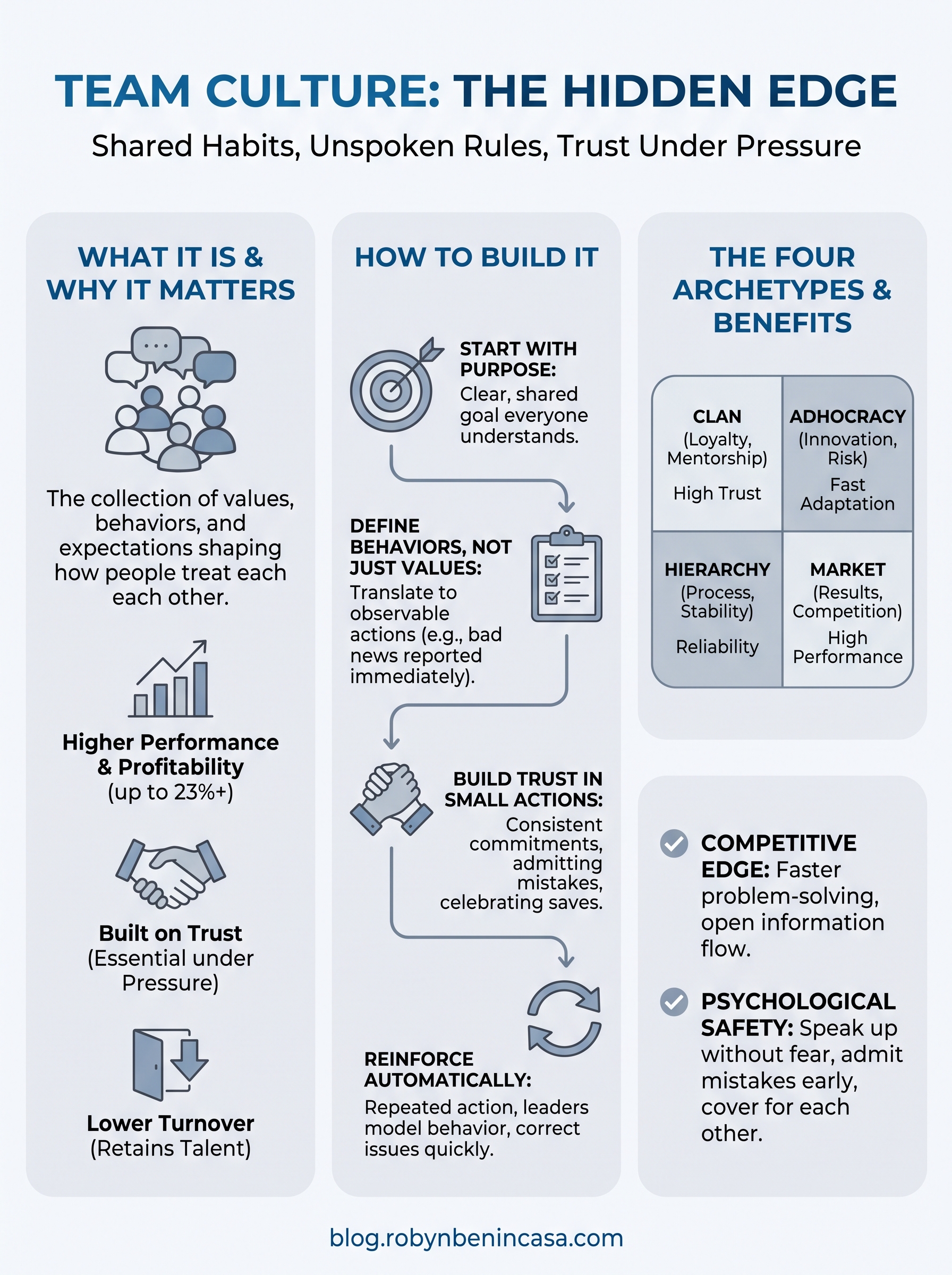
Gallup’s research backs this up outside of adventure racing too. Their meta-analysis of business units found that those in the top quartile for employee engagement, which is heavily driven by culture, showed 23% higher profitability and 18% lower turnover than those in the bottom quartile, according to Gallup’s State of the Global Workplace report. Turnover alone should get every HR leader’s attention. Replacing a mid-level employee typically costs six to nine months of their salary once you count recruiting, onboarding, and lost productivity.
Culture decides what happens under pressure
Here’s what most leaders miss: culture doesn’t matter when things are calm. It matters when things go sideways. Anyone can look like a great teammate during a routine Tuesday meeting. The real test is a missed deadline, a botched handoff, or a client blowup at 4:45 on a Friday. Teams with a culture of a team built on trust lean into each other during those moments. Teams without it start assigning blame and covering their own positions.
A team’s culture isn’t what happens on the easy days. It’s what happens on the worst ones. (For more lines like this, see these quotes about team culture.)
I saw this firsthand on the fire department. Nobody trains for the fire that goes exactly as planned. You train, and you build culture, for the one that doesn’t. The crews that performed best under real pressure weren’t the ones with the most individually talented firefighters. They were the ones who’d built enough trust that nobody hesitated to call out a problem or admit they needed help.
The measurable business impact
Skeptical leaders often ask for numbers before they’ll invest time in culture work. Fair enough. Here’s a quick comparison of what shows up in organizations with strong versus weak team culture, based on patterns I’ve seen across the corporate audiences I speak to and the case studies referenced on my client results page:
| Metric | Strong Team Culture | Weak Team Culture |
|---|---|---|
| Employee turnover | Below industry average | Above industry average |
| Response to setbacks | Fast, collaborative problem-solving | Blame, delay, finger-pointing |
| New hire ramp-up | Faster, mentorship-driven | Slower, sink-or-swim |
| Cross-team communication | Proactive, transparent | Siloed, defensive |
| Sales or performance trends | Steady or improving | Volatile or declining |
One insurance client I worked with moved their sales division from 17th to 1st nationally within a couple of years, and the shift started with culture changes, not a new sales script. That’s not a coincidence. When people trust their teammates and believe leadership has their back, they take more risks, share more information, and recover faster from mistakes.
Why this gets overlooked
Leaders overlook culture because it’s harder to measure than revenue or headcount. You can’t put
How to build a strong team culture step by step
Team culture building doesn’t happen through a poster in the break room or a one-time offsite. It happens through repeated, deliberate action from leadership, reinforced until it becomes habit. I’ve watched teams transform their culture in six months and I’ve watched teams try for years and get nowhere, and the difference always comes down to whether leadership treated culture as a project with steps or as a vague aspiration.
Start with a clear, shared purpose
Every high-performing team I’ve raced with or led knew exactly why they were there and what winning looked like. Vague mission statements don’t cut it. You need a purpose specific enough that a new hire could repeat it back after their first week. Ask your team right now: can everyone articulate, in their own words, what we’re actually trying to accomplish together? If the answers vary wildly, that’s your starting point, not your team-building event.
Define the behaviors, not just the values
Most companies list values like "integrity" or "teamwork" on a wall and call it done. That’s defining team culture in name only. Instead, translate each value into observable behavior. "Teamwork" might mean: nobody finishes a meeting without confirming who owns the next step. "Integrity" might mean: bad news gets reported the same day, not buried until the quarterly review.
Build trust through small, consistent actions
Building trust in a team at work doesn’t happen through a single trust fall exercise. It builds through hundreds of small moments where people do what they said they’d do. Here’s a practical sequence I recommend to the organizations I speak with:
- Set one clear commitment per person per week, and track whether it’s kept.
- Create a low-stakes forum, a weekly huddle or Slack channel, where people can flag problems before they become crises.
- Have leaders admit mistakes publicly first. Culture shifts downward from the top faster than any memo.
- Celebrate the save, not just the win. Recognize the teammate who caught a problem early, not only the one who closed the deal.
Trust isn’t built in the big moments. It’s built in the hundreds of small ones nobody’s watching.
Reinforce it until it’s automatic
Once is not a program. Repeat the behaviors, retell the stories of when the culture worked, and correct the moments when it doesn’t, quickly and directly. Leaders who let a culture violation slide because the person is a top performer send a louder message than any speech they’ll ever give. Reinforcement is what separates a culture of a team that sticks from one that fades the week after the offsite ends, and it’s the core of creating a high performance culture.
Types of team culture and how to spot yours
Not every strong culture team looks the same. A elite sales floor and a hospital surgical unit both build trust and accountability, but the daily rhythm looks completely different. Researchers Cameron and Quinn mapped four common archetypes in their Competing Values Framework, one of several ways to map an organizational culture framework, and I’ve seen all four play out on teams I’ve coached, raced with, or served alongside on the fire department.

The four common archetypes
Each type solves a different problem well, and each has a failure mode if it goes unchecked. Here’s how they break down:
| Culture Type | Core Focus | Strength | Risk if Unchecked |
|—|—|—|
| Clan | Loyalty, mentorship, family feel | High trust, low turnover | Avoids hard conversations |
| Adhocracy | Innovation, risk-taking | Fast adaptation | Chaos, burnout |
| Market | Results, competition | High performance | Cutthroat, low collaboration |
| Hierarchy | Process, consistency | Reliability, safety | Slow, rigid |
My fire crews leaned hierarchy for good reason: when a structure is burning, you want a clear chain of command, not a brainstorm. My racing teams leaned adhocracy, because the terrain changed every mile and rigid process would have gotten us lost or hurt.
How to identify your team’s dominant type
Before reaching for an organizational culture assessment tool, listen to how your team talks about a missed deadline. A clan culture apologizes and offers help. A market culture asks who’s accountable and what the numbers say. A hierarchy culture points to the process that broke down. An adhocracy culture is already three ideas into the fix before anyone assigns blame. None of these reactions is wrong. The problem shows up when your team’s actual work demands one type and your habits reflect another, like a compliance-heavy insurance claims department running on pure adhocracy chaos, or a product innovation team stuck in hierarchy paperwork.
The best team cultures aren’t the loudest or the friendliest. They’re the ones that match how the team actually needs to work.
Blended cultures are the norm, not the exception
Most real teams I’ve worked with are blends, not pure types. A strong sales division might run market culture on quota days and clan culture during onboarding. That’s healthy. Trouble starts when the blend is accidental rather than chosen, when leadership never decided which values matter most in which moments, and people are left guessing. Naming your dominant type, and the one you’re drifting toward, is the fastest way to catch defining team culture on paper before it’s actually built into daily habits.
What strong team culture looks like in real teams
Theory is easy to nod along to. Watching culture team dynamics play out in a real group under real pressure is where the concept becomes believable. Below are three team culture examples I’ve seen up close, in three completely different settings, that all share the same underlying pattern of trust and accountability even though the work looks nothing alike, much like the broader examples of organizational culture I point audiences to.

Team culture examples from three different worlds
A championship adventure racing team I led spent four days navigating jungle terrain with almost no sleep, and the culture held because every teammate was allowed to say "I think we’re off course" without fear of being overruled by ego. A fire crew I served with for two decades ran the same way: the newest rookie could flag a safety concern to the captain mid-call, and it got heard, not dismissed. And an insurance sales division I worked with rebuilt their culture of a team around a simple rule, that closing a deal mattered less than helping a teammate close theirs, and their national ranking jumped from 17th to 1st within two years.
- Adventure racing team: open dissent respected, decisions made fast, ego set aside for the map
- Fire crew: rank exists, but junior voices get heard on safety calls without hesitation
- Insurance sales division: individual quotas took a back seat to team wins, and results followed
Strong culture doesn’t mean everyone agrees. It means everyone feels safe enough to disagree out loud.
What these teams have in common
None of these three examples share an industry, a skill set, or even a comparable level of physical risk. What they share is a pattern: information moved fast, mistakes got surfaced early instead of hidden, and nobody worried that admitting a problem would cost them status on the team. That pattern is what separates a genuinely strong culture team from one that just looks good in a company brochure. Robyn’s book, How Winning Works, digs into eight specific lessons pulled from teams like these, and the common thread across all of them is that culture got built on purpose, not left to chance.
Leaders sometimes assume strong culture requires a laid-back, feel-good atmosphere. That’s not accurate. The fire crew example above ran on strict hierarchy and life-or-death stakes, yet the culture was just as strong as the loose, fast-moving racing team. Structure and warmth aren’t opposites. What matters is whether people trust that speaking up will help the team, not hurt them personally.
Warning signs your team culture needs attention
Most broken cultures didn’t break overnight. They eroded through small compromises that nobody flagged in time. A culture team in decline rarely announces itself with a dramatic blowup. It shows up in quieter ways first: meetings that used to run 30 minutes now run 90 because nobody trusts anyone else to follow through, or a top performer who used to mentor new hires now keeps their head down and does their own numbers. If you’re waiting for an obvious crisis before you address defining team culture problems, you’re already behind.
The early signs leaders miss
Watch for these patterns before they calcify into habit:
- People stop volunteering information in meetings and only answer direct questions
- Mistakes get hidden or minimized instead of reported quickly
- Cross-team requests get slower responses than they did six months ago
- New hires ask, "Is this normal here?" more than once in their first month
- The same two or three people carry every hard conversation
Any one of these on its own might be nothing. Two or three together, sustained over a month or more, means your culture of a team is drifting and needs direct attention, often accountability training rather than another survey.
Diagnosing whether it’s a culture problem or a process problem
Sometimes what looks like a culture issue is actually a broken process, and fixing the wrong thing wastes months. Ask a simple question: if you gave the team a perfect process tomorrow, would the trust issue disappear? If yes, it’s process. If people would still hide problems, avoid hard conversations, or protect their own turf even with better tools, it’s culture.
If better tools wouldn’t fix it, you’re not looking at a process problem. You’re looking at a culture problem.
Going after the wrong root cause is how organizations spend a year rolling out new software or restructuring reporting lines and wonder why morale never improves.
Acting before it becomes permanent
Early-stage culture problems are cheap to fix, usually a direct conversation, a change in how leadership responds to bad news, or a reset of what gets rewarded. Late-stage culture problems, the kind where your best people have already started quietly job hunting, take far longer to reverse, demand a real plan for changing organizational culture, and often cost you the very people you needed to lead the turnaround. Treat early warning signs the way a good crew chief treats a strange noise in the engine: worth stopping for, before it strands you somewhere much more expensive.
Turning culture into your team’s competitive edge
Every team you compete against has access to the same technology, the same talent pool, and often the same budget. What they don’t all have is a culture team that trusts each other enough to speak up when something’s wrong, admit mistakes fast, and cover for one another under real pressure. That gap is the edge. It’s not built through a poster or a single offsite. It’s built through the small, repeated actions this article laid out: shared purpose, behaviors instead of buzzwords, and leaders who model the trust they want to see.
Strong culture isn’t a soft add-on to strategy. It’s the thing that determines whether your strategy survives contact with a bad quarter. If you’re ready to build that edge in your own organization, bring in a corporate culture keynote speaker who has led teams under real pressure, and see what changes when culture stops being an afterthought.