You’ve got a budget line for a keynote speaker and no idea if it’s realistic. Ask five event planners about keynote speaker fee ranges and you’ll get five different answers, because the number depends on who you’re booking, what format you need, and what they actually deliver once they’re on stage. That uncertainty makes budgeting harder than it should be, especially when you’re trying to justify the spend to a CFO or a board.
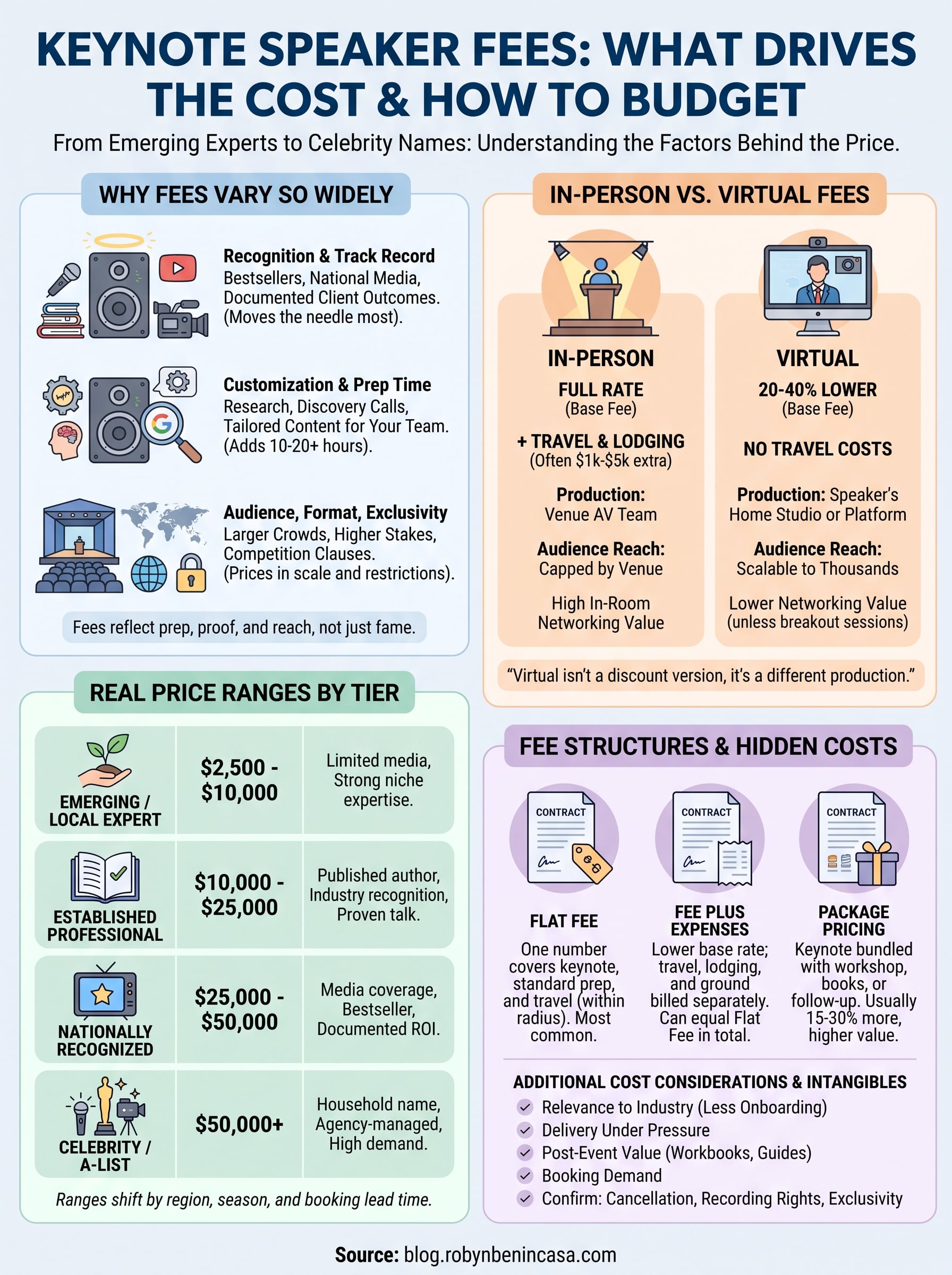
Here’s the direct answer: fees typically run from a few thousand dollars for emerging speakers to $50,000 or more for nationally recognized names, and a virtual keynote speaker fee usually lands 20 to 40 percent lower than an in-person booking. Factors like experience, audience size, travel, and customization all move that number up or down, whether you’re comparing virtual speaker fees across vendors or negotiating a speaker fee for virtual event formats specifically.
This article breaks down real price ranges by speaker tier, explains what drives those numbers, and shows you what separates a $5,000 speaker from a $50,000 one in actual audience impact. You’ll walk away knowing exactly what to budget and what questions to ask before you sign a contract.
Why keynote speaker fees vary so widely
A keynote speaker fee isn’t a random number pulled from thin air, and what rates look like and why comes down to a handful of concrete inputs. It reflects a mix of name recognition, content development time, travel logistics, and the actual business results a speaker has delivered for past clients. Two speakers can stand on the same stage for 45 minutes and charge fees $40,000 apart, and both prices can be justified once you understand what’s baked into them.
Recognition and track record drive the biggest swings
Name recognition is the factor most planners assume matters most, and it does move the needle, but it’s not the whole story. A speaker with a New York Times bestselling book, national media appearances, or a documented history of measurable client outcomes commands more than someone with a great story and no third-party validation, which is why the best keynote speakers worth booking rarely sit at the bottom of the price range. Robyn Benincasa’s fee, for example, reflects both her recognition as a CNN Hero and the fact that her frameworks, like those of other sales motivational speakers, have moved actual sales teams from 17th to 1st place nationally. That kind of proof point changes the conversation from "can we afford this speaker" to "can we afford not to."
A speaker’s fee is really a bet on how much the room changes after they leave it.
Customization and prep time add real cost
Generic keynotes cost less because they require no extra work. Speakers who take a discovery call, interview your leadership team, and weave your company’s specific challenges into the talk are spending 10 to 20 hours of unpaid prep before they ever get on stage. That customization is often what separates a forgettable talk from one your team quotes back to you six months later, and it’s a legitimate reason a fee runs higher.
Audience size, format, and exclusivity matter too
A 200-person regional sales meeting and a 5,000-person national conference are different jobs, even with the same speaker delivering similar content, since the role of a keynote speaker at a conference carries different expectations entirely. Larger audiences often mean higher production stakes, more Q&A demand, and sometimes exclusivity clauses that block the speaker from working with competitors in your industry for a set window. All of that gets priced into the fee.
Here’s a rough breakdown of how these factors typically stack up by tier:
| Speaker Tier | Typical Fee Range | Common Traits |
|---|---|---|
| Emerging / local expert | $2,500 to $10,000 | Limited media presence, strong niche expertise |
| Established professional | $10,000 to $25,000 | Published author, industry recognition, proven talk |
| Nationally recognized | $25,000 to $50,000 | Media coverage, bestselling book, documented ROI |
| Celebrity / A-list | $50,000+ | Household name, agency-managed, high demand |
These ranges shift depending on region, season, and how far in advance you book, and the top tier moves fastest once you start looking at celebrity speakers to book for your event, but they give you a starting point for comparison shopping.
The intangibles that don’t show up on an invoice
Beyond the visible factors, a few intangibles quietly push fees up or down. Consider these before you assume the cheapest quote is the best deal:
- Relevance to your industry: a speaker who’s worked with insurance or pharma sales teams before will need less onboarding than one starting from scratch.
- Delivery skill under pressure: someone who’s spoken to hostile or distracted crowds and still landed the message is worth more than a polished but untested presenter.
- Post-event value: workbooks, follow-up resources, or a free downloadable guide extend the talk’s impact well past the day of the event.
- Booking demand: a speaker with a packed calendar for the next 18 months can charge more simply because supply is limited.
Once you see the fee this way, as a reflection of preparation, proof, and reach rather than pure fame, it gets a lot easier to compare quotes and figure out where your budget actually needs to go.
How to budget for a keynote speaker fee
Budgeting starts with a number most planners forget: the fee is rarely the whole cost. Travel, lodging, ground transportation, and sometimes a speaker’s team all sit on top of the quoted rate, and skipping that math is how a "$15,000 speaker" turns into an $18,500 line item. Build your budget around what you’ll really pay to hire a keynote speaker, not just the headline keynote speaker fee, and you’ll avoid the awkward conversation with finance three weeks before the event.
Set your ceiling before you start calling
Decide on a maximum spend before you request a single quote. Anchor that number to what the event needs to accomplish, not just what similar companies have paid in the past. A sales kickoff meant to reset culture after a rough quarter justifies a bigger investment than a standard department all-hands, even if both are technically "keynotes."
The right budget question isn’t "what do speakers cost," it’s "what is this outcome worth to us."
Build a simple checklist before you request quotes
Run through this before you contact any speaker or agency:
- Confirm your total attendee count, since fees often scale with audience size and reach.
- Decide in-person or virtual, because a speaker fee for virtual event formats can free up 20 to 40 percent of your budget for other line items.
- List must-have topics, so you’re not paying for customization you don’t actually need.
- Check exclusivity requirements, particularly if competitors will attend or if the content will be recorded and reused.
- Ask about travel and lodging policy upfront, since some speakers build it into the fee and others bill separately.
Where the extra dollars actually go
Extras rarely show up as one lump sum, so ask for a line-item breakdown before you sign anything. Speaker agencies typically itemize the fee, travel, and any add-ons like a book bulk order or a post-event workshop separately. Requesting that breakdown early lets you trim costs without renegotiating the core fee, which is usually the least flexible number in the whole quote.
Compare quotes on outcomes, not just price
Quotes that look similar on paper can differ enormously in what’s included. One $20,000 quote might cover a 45-minute keynote with no customization, while another at the same price includes a discovery call, a tailored talk, and copies of a bestselling book for attendees. When you’re comparing options, ask each speaker’s team what’s bundled into the number, then weigh that against your original goal for the event. Robyn Benincasa’s team, for instance, walks planners through exactly what’s included before any contract goes out, so there are no surprises once the invoice arrives.
Virtual keynote speaker fees vs in-person rates
Switching to a virtual format doesn’t just cut travel costs, it changes the entire fee structure. Most speakers price a virtual keynote speaker fee at 20 to 40 percent below their in-person rate, since there’s no flight, no hotel, no ground transportation, and often less setup time. That discount is real money you can redirect toward production quality, breakout sessions, or a longer Q&A block with the same speaker.
Why virtual costs less but isn’t cheap
Virtual doesn’t mean discount-bin pricing, and planners who expect a 70 percent markdown are usually disappointed. Speakers still spend the same hours researching your industry, customizing content, and rehearsing delivery for a screen instead of a stage. Delivering a compelling talk through a webcam is its own skill, and the top virtual keynote speakers often invest in professional lighting, sound, and a producer to run the technical side. Those production costs get folded back into the speaker fee for virtual event bookings, even though the top-line number is lower than an in-person quote.
Virtual isn’t the discount version of a keynote, it’s a different production with its own costs baked in.
Comparing the two formats side by side
Here’s how the two formats typically stack up once you account for both the fee and the hidden costs around it:
| Factor | In-Person | Virtual |
|---|---|---|
| Base fee | Full rate | 20 to 40% lower |
| Travel and lodging | Often $1,000 to $5,000 extra | None |
| Production needs | Venue AV team | Speaker’s home studio or your platform |
| Audience reach | Capped by venue size | Scalable to thousands |
| Networking value | High, in-room connection | Lower unless paired with breakouts |
When virtual actually saves you money and when it doesn’t
Savings show up fastest when your audience is spread across multiple offices or countries, since you’re not paying to fly one speaker to five cities. Organizations running a single regional meeting sometimes find the math less favorable, because the fee drop doesn’t offset what you lose in engagement without a skilled virtual presenter. Planners booking a speaker fee for virtual event should also confirm whether the quote includes a rehearsal call and tech check, since skipping that step is the most common reason virtual keynotes fall flat.
Ask about hybrid options too
Some speakers now offer a hybrid rate: one live audience in the room plus a livestream feed to remote offices. This can land between the pure virtual and full in-person numbers, and it’s worth asking about if part of your team is on-site and part is remote. Compare virtual speaker fees across at least two or three vendors before locking in a format, since pricing philosophy varies more between speakers than the format itself does.
How speaker fees are structured and what to call them
Terminology trips up more first-time buyers than the actual dollar amount does. A keynote speaker fee can be quoted as a flat rate, an honorarium, or a package price that bundles the talk with a workshop or meet-and-greet, and each label carries different expectations about what’s included. Knowing the vocabulary before you get on the phone with an agent, starting with what a keynote speaker actually is, keeps you from agreeing to something narrower, or pricier, than you thought.
The three most common fee structures
Most speakers price their work one of three ways, and it’s worth asking which model you’re getting before you request a number:
- Flat fee: one number covers the keynote, standard prep, and travel within a set radius. This is the most common structure and the easiest to budget against.
- Fee plus expenses: a lower base rate with travel, lodging, and ground transportation billed separately. This can look cheaper upfront but often lands close to a flat fee once expenses land on the invoice.
- Package pricing: the keynote bundled with an add-on like a breakout workshop, a signed copy of a bestselling book for attendees, or a follow-up virtual session. Package deals usually run 15 to 30 percent above the standalone keynote fee but deliver more retained value per dollar.
Ask what structure you’re being quoted before you compare numbers, because a low flat fee and a low fee-plus-expenses number rarely mean the same total cost.
Where "honorarium" fits in
Honorarium is a term borrowed from academic and nonprofit circles, and it typically signals a lower, negotiated fee rather than a market rate. Nonprofits and universities often use this language when budgets are tighter, and many established speakers will offer a reduced honorarium for causes they care about, separate from their standard corporate rate. If you’re a nonprofit planner, it’s worth asking directly whether a speaker offers an honorarium rate rather than assuming their public fee is fixed.
What to check in the contract itself
Before signing, confirm these details in writing so the structure matches what you were quoted:
- Cancellation and rescheduling terms, including any deposit that’s non-refundable
- Recording and reuse rights, since some fees don’t include permission to repost the talk internally
- Additional session fees, if you want the same speaker for a breakout or panel on the same day
- Exclusivity language, spelled out clearly rather than assumed
Getting these terms in writing upfront turns a vague quote into a real budget line you can defend to finance.
Choosing a speaker within your budget
At this point, you’ve got the numbers, the terminology, and the questions to ask before you sign anything. The keynote speaker fee you settle on should reflect what you actually need: a proven track record, real customization, and a format that fits your audience, not just the lowest quote in your inbox. Budgeting well means comparing total cost and outcomes, not just headline rates, whether you’re booking in-person or negotiating a speaker fee for virtual event format.
Finally, remember that the right speaker pays for themselves in what your team does differently after the event. Robyn Benincasa’s talks are built on exactly that premise, turning championship team-building principles into measurable results for sales teams, leadership groups, and entire organizations. If you’re ready to see what that looks like for your event, walk through how to hire a keynote speaker for your next event and book a talk that fits your budget and your goals.