
Most leadership programs get built the same way: someone grabs a generic slide deck, adds a few icebreakers, and calls it development. Then six months later, nobody remembers a single lesson because the content never connected to how teams actually perform under pressure. If you’re an HR leader or executive planning your next offsite, you already know a weak agenda wastes budget and burns goodwill with managers who are skeptical of "training" to begin with.
This article gives you leadership development training topics that hold up in real organizations, not just in theory. Each one comes from what actually moves the needle when teams are navigating change, tight deadlines, or growth. Whether you’re building a program for first-time supervisors or refreshing content for seasoned directors, these are leadership training topics for managers worth prioritizing over filler exercises.
I’ve spent 20 years leading teams under real stakes, first as a San Diego firefighter, then as captain of a world champion adventure racing team, and now helping corporations apply those lessons. Below you’ll find ten training topics for leadership development that consistently produce stronger, more accountable teams, along with practical ideas for putting each one into action with your own leadership pipeline.
1. Building a winning team culture
What it covers

This topic trains managers to see culture as a system they build on purpose, not something that just happens. It covers the shared values, unwritten rules, and daily habits that determine whether a team pulls together or pulls apart when things get hard. In my keynotes, I break this down using the T.E.A.M.W.O.R.K. framework, the eight elements I saw separate championship adventure racing teams from the ones that fell apart in the wilderness. Corporate teams face the same fork in the road, just with spreadsheets instead of mountains.
Why it matters
Organizations rarely fail because of a bad strategy. They fail because the people executing that strategy stopped trusting each other. Team culture determines whether your best people stay through a merger, a leadership change, or a brutal quarter, and it’s the single biggest predictor of whether a group performs above or below the sum of its individual talent.
A team with a strong culture will outperform a team of stars every single time.
When I raced with teammates who had less raw talent than our competitors, we still won world championships because we’d built a culture where nobody let anyone else fail. That’s not a metaphor for business, it’s the same mechanism.
How to build it into training
Most programs talk about culture in the abstract. Skip that. Give managers concrete tools they can use in their next team meeting.
- Run a culture audit where teams identify their current unwritten rules versus the ones they want, the same starting point used in high performance culture training
- Assign a shared mission statement exercise, written by the team, not handed down from leadership
- Practice recognition rituals, like a five-minute weekly huddle where wins get named out loud
- Introduce accountability partners so peers, not just managers, reinforce standards
- Debrief real setbacks as a group instead of assigning blame privately
Particularly for new managers, this topic works best when it’s paired with a real story of a team overcoming adversity together. Stories stick in a way that bullet points never do, and they give managers language to use when they’re rebuilding trust after a rough project. Build this into the first module of any leadership program, because every other topic on this list works better once a team already trusts each other.
2. Emotional intelligence and self-awareness
What it covers
This topic teaches managers to recognize their own emotional triggers before those triggers show up in a meeting or a tense one-on-one. It covers reading body language, naming emotions accurately, and understanding how personal stress spills into team dynamics. Good emotional intelligence training also asks managers to solicit honest feedback about their blind spots, since most people rate their own self-awareness far higher than their teams do.
Why it matters
Underneath most leadership development training ideas, this one gets skipped first and needed most. A manager who can’t regulate their own frustration will pass that frustration downstream, whether they mean to or not, which is why leadership training for middle managers so often starts here. I watched this play out on fire calls, where a captain’s composure under pressure either steadied the crew or spread panic through it.
The way a leader manages their own emotions sets the ceiling for how the whole team performs under pressure.
Employees don’t quit companies, they quit managers who make them feel small, unheard, or unpredictable. Self-awareness is the fix that prevents that pattern from forming in the first place.
How to build it into training
Skip the personality quiz and go straight to practice:
- Use 360-degree feedback so managers hear how their behavior actually lands with direct reports
- Run trigger-mapping exercises identifying what situations spike stress responses
- Practice pausing techniques, a simple ten-second reset before responding in a heated moment
- Assign reflection journals after difficult interactions to build the habit of self-review
Pair this training with real scenarios pulled from your own workplace, not hypothetical case studies, so the lessons transfer immediately.
3. Communication and active listening
What it covers
This topic trains managers to communicate with clarity and to actually hear what their team is telling them, not just wait for their turn to talk. It covers structuring a message so it lands the first time, asking follow-up questions instead of assuming you understood, and reading what someone means beneath what they say. Strong leadership communication training also tackles the basics that get skipped in busy workplaces, like giving direct feedback without burying it in vague language, and running meetings that end with clear ownership instead of confusion.
Why it matters
Most of the friction I saw between rescue teams, or between racing teammates on hour thirty of an expedition, traced back to a message that got sent but never got heard. On a fire scene, a mumbled instruction costs seconds you don’t have. In an office, it costs a project deadline or a client relationship. Poor communication is rarely one dramatic failure. It’s a hundred small misunderstandings compounding until a team stops trusting each other’s intentions.
A team can survive almost any obstacle except a leader who talks past them instead of to them.
How to build it into training
Run exercises that force managers to practice listening, not just discuss its importance in theory:
- Pair up for reflective listening drills, where one person paraphrases what they heard before responding, one of many communication exercises for teams worth running live
- Practice giving feedback using a specific, observable, impact structure instead of vague praise or criticism
- Record and review a real meeting to spot interruptions, filler words, or unclear asks
- Assign a one-week no-assumptions challenge, where managers must ask a clarifying question before responding to any request
This topic pairs naturally with the emotional intelligence work from earlier, since managers who understand their own reactions communicate with far more precision under pressure.
4. Conflict resolution and difficult conversations
What it covers
This topic trains managers to walk toward friction instead of avoiding it. It covers how to identify the real issue underneath a disagreement, how to separate the problem from the person, and how to structure a hard conversation so it ends with a resolution instead of resentment. Conflict resolution training also teaches managers to recognize when a disagreement is actually healthy debate that shouldn’t be shut down too early.
Why it matters
Unresolved tension doesn’t disappear, it goes underground and shows up as missed deadlines, gossip, or quiet quitting. I’ve seen expedition teammates who avoided a two-minute conversation about a navigation disagreement end up losing hours later because nobody wanted to be the one to speak up. Managers face the same trap constantly, especially first-time supervisors who worry that addressing conflict will make them unpopular.
A team that avoids conflict doesn’t have peace, it has a problem waiting to surface at the worst possible time.
These are some of the most practical leadership training topics for new managers, since younger leaders often default to silence rather than confrontation.
How to build it into training
Build scenarios that mirror real workplace tension, not abstract case studies:
- Run role-play exercises using actual (anonymized) conflicts pulled from your organization
- Teach a simple script for opening a hard conversation without blame
- Practice separating facts from stories, so managers address behavior, not assumptions
- Debrief past conflicts as a group to identify what resolution actually looked like
This skill compounds fast once managers stop dreading the conversation and start expecting it.
5. Coaching and mentoring for growth
What it covers
This topic shifts a manager’s job from directing tasks to developing people. It covers how to ask questions that help someone find their own answer instead of just handing over a solution, how to set growth-oriented goals with direct reports, and how to give feedback that builds capability rather than just correcting mistakes. Real coaching skills also include knowing when to step back entirely and let someone struggle productively, because growth rarely happens when a manager rescues someone from every hard moment.
Why it matters
Managers who never learn to coach end up doing their team’s thinking for them, which caps how far that team can go. I saw this constantly with newer racers: the ones who got coached through their mistakes, rather than just told the right move, became the teammates I trusted on the toughest legs of a race. Businesses run into the exact same ceiling when managers solve every problem themselves instead of building essential leadership skills into daily interactions.
A manager who solves every problem for their team is quietly training that team to stop solving problems.
Organizations that build coaching into their culture also retain talent longer, since people stay where they see a clear path to growing.
How to build it into training
Give managers a repeatable framework, not just encouragement to "coach more":
- Teach a simple coaching model, like asking what happened, what they’d try differently, and what support they need
- Assign monthly growth conversations separate from performance reviews
- Practice active reflection questions instead of default advice-giving
- Pair new managers with a mentor who models this style firsthand
This topic builds directly on the listening skills from earlier modules.
6. Strategic thinking and decision-making
What it covers

This topic trains managers to step back from daily fires and see the bigger pattern before they act. It covers how to weigh tradeoffs under incomplete information, how to separate urgent from important, and how to make a call without waiting for perfect data that will never arrive. Solid strategic thinking also means teaching managers to ask what problem they’re actually solving, since plenty of teams execute fast on the wrong priority.
Why it matters
Speed without direction just gets you lost faster. On an expedition, the fastest team in the wrong direction still loses the race, and I’ve watched sharp, capable racers burn hours because nobody paused to check the map. Corporate teams do the same thing when a manager reacts to every fire drill instead of asking whether the fire needed fighting at all. Strong decision-making under pressure separates managers who steady a team from ones who just add motion without progress.
A leader who moves fast without direction just gets the team lost more efficiently.
How to build it into training
Give managers a repeatable process instead of vague advice to "think bigger picture":
- Run scenario-planning exercises where teams map three possible outcomes before committing to a path
- Teach a decision framework, like weighing reversible versus irreversible calls differently
- Practice pre-mortems, imagining a decision failed and working backward to find the risk
- Assign a weekly priority filter, forcing managers to rank tasks against actual strategic goals
Pair this training with real business tradeoffs your managers are currently facing, not textbook cases, so the judgment they build transfers immediately to their next tough call.
7. Change management and resilience
What it covers
This topic trains managers to lead through disruption instead of just surviving it. It covers how to communicate a change before all the details are finalized, how to read who on the team is adapting well versus who’s quietly struggling, and how to keep performance steady while the ground shifts underneath everyone. Real change management training for managers also teaches managers to model resilience themselves, since a team takes its emotional cues from whoever is standing in front of them during uncertainty.
Why it matters
I’ve led teams through white-out conditions where the plan we started with became useless within an hour, and the teams that survived weren’t the ones with the best original plan. They were the ones who adapted fastest without falling apart. Corporate reorganizations, leadership turnover, and market shocks work the same way when you’re leading teams through change. A merger announcement or a sudden budget cut tests a manager’s resilience far more than any quarterly review ever will, and teams remember exactly how their leader handled it.
A team doesn’t need a leader who has all the answers during change, it needs one who stays steady while the answers are still forming.
These are essential leadership training topics for managers navigating any kind of organizational transition, since the skill rarely gets taught until a crisis is already underway.
How to build it into training
Build practice around real disruption, not hypothetical shifts:
- Run change simulations using a scenario pulled from your industry’s recent history
- Teach a communication cadence for updating teams before every detail is confirmed
- Practice identifying resistance early, coaching managers to name it rather than ignore it
- Debrief a past organizational change to extract what worked and what didn’t
Managers who build this muscle stop treating disruption as an emergency and start treating it as part of the job.
8. Delegation and accountability
What it covers
This topic trains managers to hand off real ownership, not just tasks they’re too busy to do themselves. It covers how to match work to someone’s skill level and stretch goals, how to set clear expectations upfront so nobody guesses at what "done" looks like, and how to build follow-through systems that don’t require micromanaging every step. Genuine delegation skills also mean teaching managers to let go of the outcome looking exactly like it would if they’d done it themselves.
Why it matters
Great teams rarely fail from a lack of talent. They fail because one person, usually the manager, is holding onto too much and becoming the bottleneck for everything else. I saw this in racing constantly: the captain who tried to navigate, ration food, and fix gear all at once burned out fast, while the ones who trusted teammates with real ownership finished stronger. Weak accountability habits create the same drag in an office, where a manager quietly redoes work instead of holding someone to a standard, and that’s exactly what a culture of accountability prevents.
A leader who won’t delegate isn’t protecting quality, they’re capping how much their team can grow.
How to build it into training
Give managers concrete tools for handing off ownership, not just permission to "trust their team more":
- Teach a delegation matrix matching task complexity to a person’s current skill and confidence level
- Practice setting clear success criteria before assigning any project
- Run accountability check-ins that focus on outcomes, not activity
- Assign a "stop doing" list where managers identify tasks they should hand off this month
This topic reinforces the coaching work from earlier, since delegation only works when a manager already trusts the people receiving it.
9. Leading remote and hybrid teams
What it covers

This topic trains managers to build trust and accountability when they can’t rely on hallway conversations or a glance across the office to know how their team is doing. It covers running meetings that respect time zones, setting communication norms so nobody wonders whether a message needs an instant reply, and reading engagement through work output instead of visible hours at a desk. Strong remote leadership training also addresses the loneliness that creeps into distributed teams, since isolation kills morale faster than any workload ever will.
Why it matters
Uncertainty travels faster on a hybrid team because there’s less context to fill the gaps. A curt Slack message can read as anger when it was just someone typing fast between meetings, and a manager who never checks in gets read as absent rather than busy. I’ve led teams scattered across a mountain range with no line of sight to each other, and the ones that held together had leaders who over-communicated on purpose, not by accident.
Distance doesn’t break a team, silence does.
How to build it into training
Give managers habits that work across a screen, not just in person:
- Set explicit response-time norms so urgency gets communicated clearly, not assumed
- Run virtual check-ins focused on wellbeing, not just status updates
- Practice async communication, writing updates clear enough that no follow-up meeting is needed
- Build intentional connection time into the calendar with team building activities for hybrid teams, since it won’t happen by accident
Managers who master this topic keep culture intact no matter where the team logs in from.
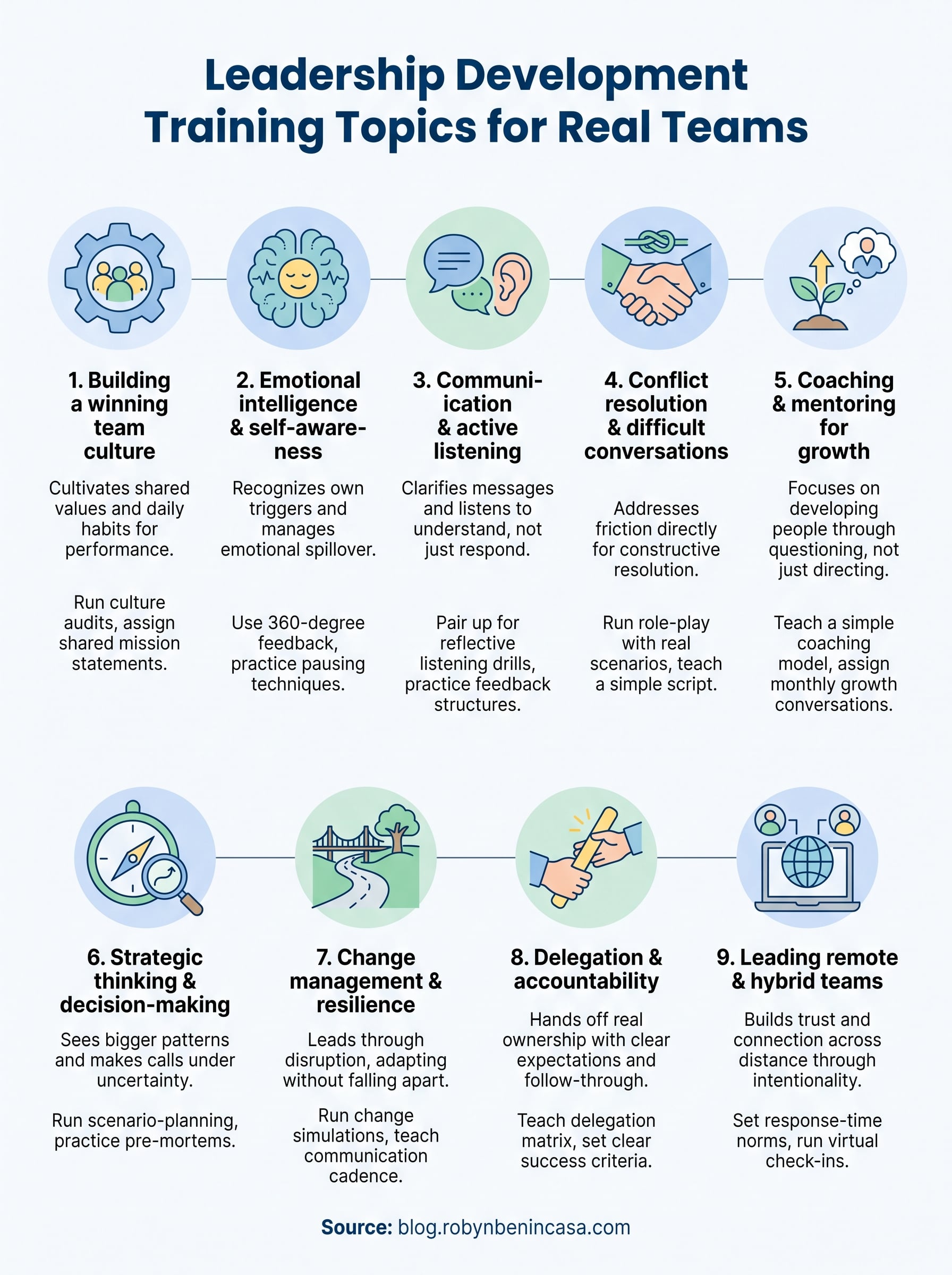
Choosing the right mix for your team
No team needs all ten topics at once. Start with what’s actually breaking down, whether that’s silent conflict, managers who won’t delegate, or a hybrid team drifting apart from lack of contact. Pick two or three topics that match your organization’s real pain points, then build the rest into your training calendar over the next year with team building activities for leadership teams rather than cramming everything into a single offsite.
Good leadership development training topics work because they connect to what your managers face on Monday morning, not because they check a box on a slide deck. Culture, communication, and accountability aren’t separate initiatives, they reinforce each other once a team starts practicing them together.
If you’re ready to build a program around lessons tested under real pressure, from wildland fires to world championship expeditions, see how the right leadership keynote speaker can bring these principles to your next event and start building a team culture that holds up when it matters most.