Your team hits a rough stretch, a merger, a brutal sales quarter, constant change, and some people bounce back while others stay stuck. That difference isn’t luck or personality. It’s a skill you can build, and that’s exactly what training in resilience teaches. If you’ve searched for this term, you’re probably trying to figure out whether it’s a mindset seminar, a stress-management workshop, or something with actual measurable impact on performance.
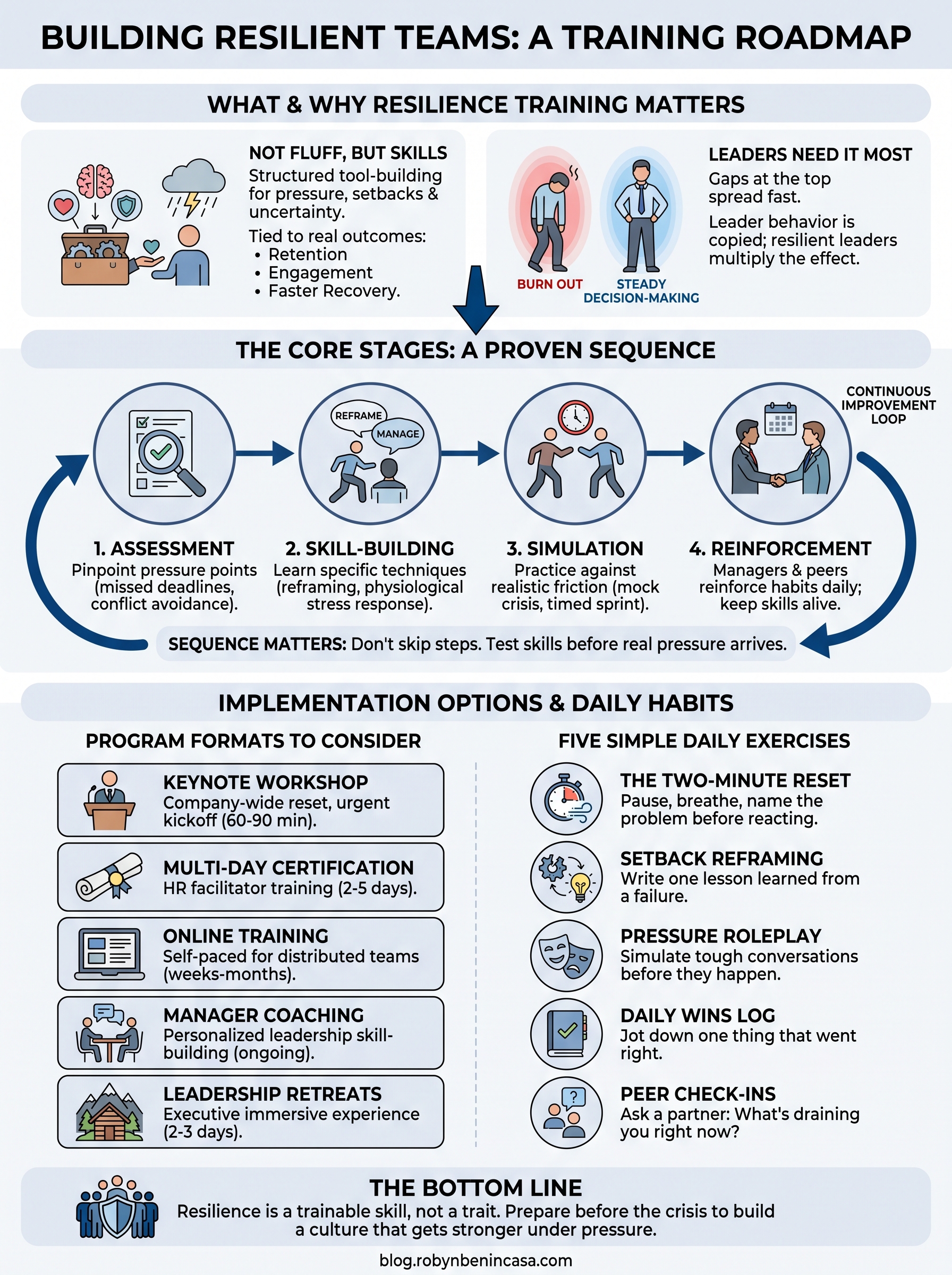
Here’s the direct answer: resilience training is a structured way to build the mental and emotional tools people need to handle pressure, setbacks, and uncertainty without losing focus or motivation. Done right, it’s not fluffy self-help. It’s practical, repeatable, and tied to real outcomes like retention, engagement, and how fast a team recovers after a hard hit. Workplace resilience training works because it targets specific habits and thinking patterns, not just morale in the moment.
In this article, I’ll break down what resilience training actually involves, what separates a solid resilience training program from a shallow one, and why the best programs borrow lessons from high-stakes teams, the kind I led through 15 years of world championship adventure racing and two decades as a firefighter.
Why resilience training matters for teams and leaders
Picture two sales teams hit with the same brutal quarter. One team spends weeks in a slump, missing calls, avoiding hard conversations, and losing people to burnout. The other team adjusts fast, keeps its numbers moving, and comes out sharper on the other side. I’ve watched this exact split happen on expedition teams racing through hundreds of miles of jungle with broken gear and no sleep. The teams that finished strong weren’t the most talented. They were the ones who’d trained for adversity before they ever needed it. That’s the case for resilience in the workplace training: it’s not a reaction to a crisis, it’s preparation for the next one.
Costs pile up fast when resilience is missing. Gallup has tied chronic burnout directly to absenteeism, lower confidence in performance, and higher turnover intent, and none of that shows up on a P&L line until it’s already expensive. Employee resilience training addresses this at the source instead of patching it after the fact with wellness perks that never touch the real problem, which is how people process pressure in real time.
A team that hasn’t trained for adversity will crack the first time it shows up. A team that has will barely break stride.
What resilience training changes in a team’s day-to-day
Nothing about resilience training is abstract once you see it working. Teams that go through solid stress resilience training show up differently in meetings, in how they handle a missed deadline, and in how quickly they stop blaming each other and start solving problems. Here’s what typically shifts:
- Faster recovery time after setbacks, with projects back on track in days instead of weeks
- Fewer defensive reactions in feedback conversations, so problems surface earlier
- Higher engagement scores, because people feel equipped rather than overwhelmed
- Lower attrition during high-change periods like reorgs or leadership turnover
- Stronger peer support, since resilient individuals model calm under pressure for the rest of the team
Quantifying this matters to anyone signing off on a training budget. A team of insurance sales reps I worked with went from 17th to 1st nationally after building the exact habits I teach as one of the sales motivational speakers companies bring in, not because the market got easier, but because the team’s response to pressure got sharper.
Leaders need it more than anyone else
Resilience gaps at the top spread fast. Underneath every disengaged team, you’ll usually find a leader who’s running on fumes, reacting instead of steering. Mental resilience training for leaders isn’t a nice-to-add extra, it’s the multiplier that determines whether resilience training for the rest of the organization actually sticks. When a leader models steady decision-making under stress, that behavior gets copied. When a leader spirals, that spreads too.
Organizations leading teams through change like mergers, layoffs, or aggressive growth targets feel this most acutely. The American Psychological Association has documented how chronic workplace stress erodes decision quality and physical health over time, which is exactly why forward-thinking companies build resilience into leadership training programs instead of treating it as a personal problem employees should solve on their own.
Training doesn’t erase hard quarters or difficult mergers. It changes how fast your people and your leaders come back from them, and that speed is what separates teams that survive disruption from teams that use it as fuel.
How resilience training works, step by step
Good resilience training follows a sequence, not a single pep talk. It starts by identifying where people currently break down under pressure, then builds specific skills to close that gap, then tests those skills against real friction so they actually hold under stress. I’ve watched this same arc play out on expedition teams: assess weaknesses before the race, drill the specific skill that’s missing, then throw the team into a simulated crisis to see if the fix holds. Training on resilience that skips any of these steps, including formal approaches like master resilience training, tends to produce good intentions and no lasting change.
The core stages of a resilience training program
Most effective resilience training programs move through four stages, whether they’re delivered in a single workshop or spread across months.
- Assessment: Surveys, interviews, or performance data pinpoint where stress currently derails the team, missed deadlines, conflict avoidance, burnout signals.
- Skill-building: Participants learn specific techniques, reframing setbacks, managing physiological stress responses, structured problem-solving under pressure.
- Simulation: Teams practice those skills against a realistic challenge, a mock crisis, a timed project sprint, or a difficult feedback scenario.
- Reinforcement: Managers and peers reinforce the new habits in daily work, so the training doesn’t stay confined to a single session.
Resilience training only works if the skills get tested under real pressure before the real pressure arrives.
Why the sequence matters more than the content
Organizations often ask about specific frameworks or exercises, but the sequence itself is what determines whether workplace resilience training produces lasting change. Skipping the assessment step means teams practice skills they don’t actually need. Skipping simulation means the skills stay theoretical, something people nod along to in a conference room but never use when a real deadline collapses. Reinforcement is the step most programs cut for budget reasons, and it’s exactly the step that determines whether the training shows up three months later or fades by Friday.
Quality control belongs in every stage too. A program without a feedback loop, some way to measure whether recovery times are actually shrinking or engagement is actually climbing, is just a workshop with good intentions. The programs that hold up over years build in check-ins at 30, 60, and 90 days, treating resilience the same way an athlete treats conditioning: something you measure, adjust, and keep training, not something you finish once and file away.
Types of resilience training programs to consider
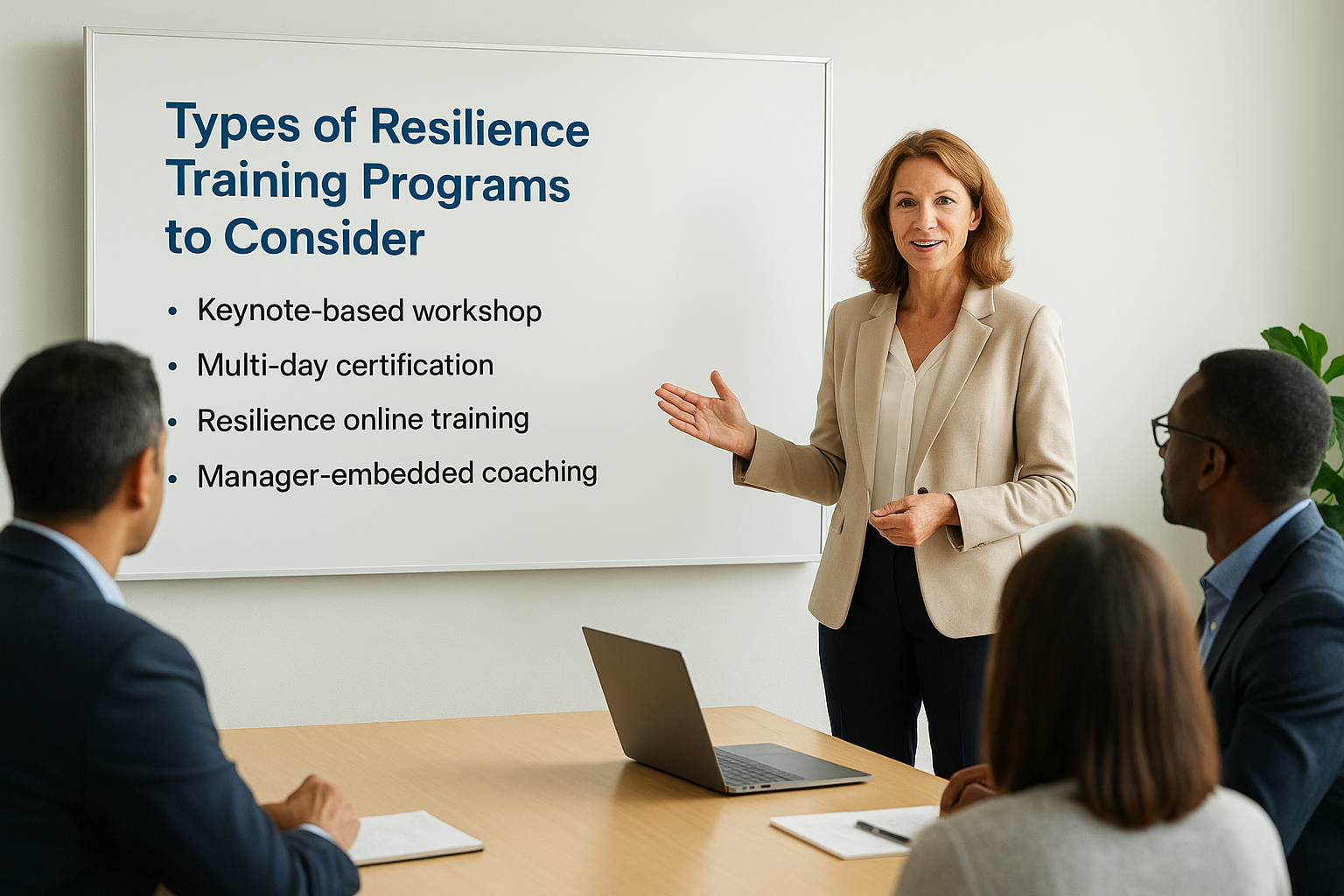
Not every "resilience training program" is built the same way, and picking the wrong format wastes budget and momentum. Some programs work best as a single keynote-driven event that ignites urgency across an entire company, while others need to run over months as ongoing coaching. Knowing which format fits your team’s actual problem determines whether the training becomes a memorable one-off or a habit that reshapes how people handle pressure.
Common formats you’ll encounter
Organizations typically choose from a handful of proven formats, each suited to different budgets, timelines, and team sizes.
| Program Type | Format | Best For | Typical Duration |
|---|---|---|---|
| Keynote-based workshop | Live or virtual talk plus takeaway tools | Company-wide culture reset, kickoff events | 1 session, 60-90 min |
| Multi-day certification | In-depth training with practice modules | HR teams building internal facilitators | 2-5 days |
| Resilience online training | Self-paced digital modules | Distributed teams, ongoing reinforcement | Weeks to months |
| Manager-embedded coaching | 1-on-1 or small group sessions | Leaders needing personalized skill-building | Ongoing, monthly |
| Leadership retreats | Off-site immersive experience | Executive teams facing major transitions | 2-3 days |
Matching the program to your team’s real problem
Choosing between these formats starts with naming the specific gap you’re trying to close. A team drowning in constant reorgs needs different resilience training workplace support than a sales floor trying to shake off a bad quarter. If leadership burnout is the core issue, a staff resilience training rollout aimed at individual contributors won’t move the needle nearly as fast as executive coaching paired with a keynote that resets the whole leadership team’s mindset at once.
The best resilience training program is the one built around your team’s actual failure points, not a generic template.
Programs that combine formats tend to outperform single-format efforts. A keynote that sets the vision, followed by online resilience training programs that reinforce specific skills, followed by manager coaching that keeps the habits alive, covers the assessment-skill-simulation-reinforcement sequence I described earlier far better than any single format alone. That’s the model I use when I design training in resilience for client teams: start with a keynote that gets buy-in fast, then hand off tools and follow-up resources so the shift outlasts the room. If you’re evaluating options for your organization, my programs are built around exactly this kind of layered approach, the same way you’d weigh the best keynote speaker for a corporate event.
Simple resilience exercises you can start today
You don’t need a certification or a big budget to start building resilience this week. Small, repeatable exercises done daily beat a single big workshop that never gets revisited. These are the same kinds of drills I used with expedition teams before a race, quick, low-cost, and built to work under real pressure rather than in a calm classroom setting.
Five exercises worth trying with your team
Start with these five, and rotate them into one-on-ones or use them as quick team building activities for meetings so they become habits instead of one-time activities.
- The two-minute reset: When something goes wrong, pause for two minutes before reacting. Breathe slowly, name the actual problem out loud, then respond. This breaks the automatic panic-and-blame cycle.
- Setback reframing: After a missed goal, ask each person to write one sentence on what the setback taught them. This trains the brain to search for lessons instead of looping on failure.
- Pressure roleplay: Simulate a hard conversation, an angry client, a missed deadline explanation, before it happens for real. Teams that rehearse tough moments handle the real ones with far less friction.
- Daily wins log: Have people jot down one thing that went right each day. This sounds simple, but it rebuilds confidence that erodes during long stretches of stress.
- Peer check-ins: Pair people up to ask each other one honest question weekly: what’s draining you right now? Naming stress early keeps it from compounding into burnout.
Resilience isn’t built in one big moment. It’s built in five-minute habits repeated until they hold under real pressure.
Making the exercises stick
Consistency matters more than intensity here. A stress resilience training habit done for five minutes daily beats an hour-long session done once a quarter, because training grit happens through repetition, not intensity. Managers should model these exercises openly, since teams copy what leadership actually does, not just what gets announced in a memo.
Finally, treat these exercises as the entry point, not the whole program. Resilience training for employees works best when these small daily habits connect back to the bigger sequence: assessment, skill-building, simulation, and reinforcement. Used alone, they build awareness. Layered into a full program, they build the kind of resilience that shows up when a real crisis hits, not just when things are calm enough to practice.
Building resilience that lasts beyond the training room
Resilience isn’t a personality trait some people got lucky with. It’s a trainable skill, built the same way an expedition team builds endurance: through deliberate practice before the crisis, not scrambling after one hits. Training in resilience works when you treat it like conditioning, not a one-time event. Assess where your team breaks down, build the specific skills that close that gap, test them under real pressure, then reinforce them until they’re just how people operate.
The teams that come out of a brutal quarter sharper instead of shattered aren’t more talented. They prepared. If you’re ready to give your organization that same edge, whether that’s a company-wide reset or ongoing coaching for your leaders, learn how to hire a keynote speaker for your next event and let’s build a culture that gets stronger under pressure instead of cracking.