Most leadership development training activities you find online are recycled icebreakers dressed up as skill-building. They feel good for an hour, then nothing changes back at the office. If you’re an HR leader or executive planning a leadership offsite, you already know the difference between an activity that entertains and one that actually shifts how people lead.
This list gives you training activities for leadership development that produce real behavior change, the kind you can measure in team performance, not just post-event survey scores. Each one is built around a specific leadership muscle: decision-making under pressure, communication across silos, accountability, trust. No filler exercises, no trust falls for the sake of tradition.
I’ve spent 15 years leading world championship adventure racing teams and 20 years as a San Diego firefighter, both environments where weak leadership gets exposed fast. What follows are 12 leadership training activities for managers drawn from that experience and from working with companies like Allstate and Northrop Grumman. Whether you’re planning a single workshop or a full leadership program, you’ll find leadership training ideas for managers here that hold up once the offsite ends.
1. An experiential leadership keynote and workshop
Before you get to rope courses and marshmallow towers, start with the format that actually reframes how a room thinks about leadership: a live keynote paired with a hands-on workshop. This is the format I use most with clients like Allstate and Boston Scientific, because a talk alone rarely changes behavior, and an activity alone rarely sticks without the framework behind it. You need both the story and the structure.
How it works
A facilitator (often one of the leadership keynote speakers worth booking who has real leadership stakes, not just theory) opens with a keynote that reframes leadership through a high-stakes story: adventure racing across a jungle, running into a burning building, whatever context makes the stakes visceral. Then the room breaks into small-team exercises that apply the framework immediately, so people aren’t just nodding along, they’re testing the ideas on a real problem their team faces. My own T.E.A.M.W.O.R.K. keynote works this way: eight elements of world-class team culture, then a working session where teams identify which element is weakest in their own group and build an action plan around it.
A keynote without a workshop is entertainment. A workshop without a keynote is a tactic with no reason to believe in it.
Who it’s for
This format suits executives and HR leaders planning a leadership offsite, sales kickoff, or annual conference where you need something bigger than a breakout session but more actionable than a motivational speech. It works especially well when an organization is navigating a merger, a leadership transition, or a performance slump, situations where people need both a jolt of energy and a concrete next step. If your audience spans multiple departments or seniority levels, this format bridges that gap better than most single-purpose activities.
Time and materials needed
Most keynote-and-workshop combinations run 60 to 120 minutes total, though full-day leadership programs are common for larger initiatives.
| Component | Typical duration | What you need |
|---|---|---|
| Keynote | 30-45 minutes | Stage, AV setup, speaker |
| Workshop | 30-75 minutes | Breakout tables, worksheets, facilitator guide |
| Debrief | 15-20 minutes | Flip charts or shared doc for action items |
Virtual formats work too. I run this same structure remotely for teams that can’t gather in person, using breakout rooms in place of tables, much like the virtual team building activities for corporate teams that keep distributed groups engaged. If you’re planning an event and want the keynote built around your organization’s specific challenges, you can book Robyn directly to design that pairing.
Leadership skills it builds
This format targets big-picture skills that smaller icebreakers can’t touch: aligning a team around a shared culture, translating a compelling story into a personal leadership commitment, and giving managers language they’ll actually use back at their desks. It’s the difference between telling people to build trust and showing them, through story and immediate practice, exactly what that looks like under pressure. Because it combines inspiration with application, it tends to produce the highest retention of any format on this list, especially when the follow-up activities below reinforce it in the weeks after.
2. The Marshmallow Challenge
After the big-picture format above, you need something fast and concrete to test whether teams actually apply what they heard. The Marshmallow Challenge is the classic for that: give small teams 20 sticks of spaghetti, one yard of tape, one yard of string, and a single marshmallow, then challenge them to build the tallest freestanding structure that holds the marshmallow on top. It exposes planning habits in about 18 minutes flat.

How it works
Teams get 18 minutes to design and build, no more materials allowed mid-build. Most groups spend the first 15 minutes planning and arguing over the perfect design, then panic-build in the last few minutes and watch the structure collapse. The teams that succeed usually start prototyping immediately, testing small structures before committing to one design. That gap between planners and builders is the entire lesson.
Teams that talk the longest about the perfect plan usually run out of time before they test anything.
Who it’s for
This exercise fits new managers and cross-functional teams who need a quick, low-stakes way to see their own decision-making patterns exposed, and it slots neatly into broader team building training for managers. It also works well as an opener before a longer workshop, since it warms up a room fast and gives you a shared reference point to call back to later in the day.
Time and materials needed
- 20 sticks of uncooked spaghetti per team
- One yard of masking tape
- One yard of string
- One standard marshmallow
- A tape measure and a timer
- 20 to 30 minutes total, including debrief
Leadership skills it builds
The challenge builds rapid prototyping and iterative decision-making, skills managers rarely get to practice in a safe setting. It also surfaces who defaults to control versus collaboration under a ticking clock, which makes for a sharp discussion afterward. Because failure is cheap here (nobody loses a client over a collapsed marshmallow tower), teams tend to be honest about what went wrong, which is exactly the kind of reflection that transfers back to real projects.
3. The Blind Square Rope Game
Once a team has felt the sting of poor planning in the Marshmallow Challenge, the Blind Square Rope Game pushes them into a harder problem: communicating without sight. Blindfold the entire group, hand them a long rope in a loop, and ask them to form a perfect square using only verbal instructions. No peeking, no exceptions. It’s a favorite in my workshops because it strips away every visual shortcut a team normally leans on and forces them to build shared understanding through words alone.
How it works
Participants put on blindfolds, grab the rope with both hands, and drop it on the ground in a loose pile. Someone (either assigned or self-appointed) has to organize the group into calling out distances, directions, and positions until the rope forms a square everyone agrees on. Set a time limit of 10 to 15 minutes, then have the group remove their blindfolds together to see the result. Most groups discover their square looks nothing like they imagined, which opens up a real conversation about what got lost in translation.
A team that can’t communicate without sight will struggle even more when the stakes are real and nobody can see the full picture.
Who it’s for
This game suits teams that rely heavily on remote or cross-departmental communication, where information passes through multiple people before it reaches a decision-maker, and it pairs well with other communication exercises for teams. It’s also a strong fit for new leaders learning to give instructions clearly instead of assuming their team already understands the context they’re picturing in their own head.
Time and materials needed
- One long rope, at least 25 feet, tied or looped for a group of 8 to 12
- Blindfolds for every participant
- An open, obstacle-free space
- 15 to 25 minutes total, including debrief
Leadership skills it builds
Running this exercise sharpens verbal clarity and active listening, two skills that quietly break down in most organizations without anyone noticing until a project misses its mark. It also reveals who naturally steps into a coordinating role under ambiguity, giving you real data on emerging leaders long before a formal promotion decision comes up.
4. The Human Knot
After an exercise built on words alone, The Human Knot flips the challenge back to the physical: a group tangles itself into a knot of arms, then has to think and negotiate its way out without letting go. Have 8 to 12 people stand in a circle, reach across, and grab two different hands that aren’t the person directly next to them. Once every hand is paired, the group has to untangle itself into one large circle (or sometimes two smaller ones) without ever breaking a grip. Like the best icebreaker team building activities, it looks ridiculous for the first five minutes and then gets serious fast.

How it works
Once the knot forms, someone in the group has to start directing traffic, calling out who steps over whom, who ducks under an arm, and who needs to let go and reconnect if the knot proves impossible. Groups that appoint a single voice to call the moves untangle far faster than groups where everyone shouts instructions at once. Give the exercise 15 to 20 minutes; most groups solve it, but the ones that don’t learn just as much from the attempt.
A knot only comes undone when the group agrees on one voice to guide it, not when everyone pulls at once.
Who it’s for
This exercise works well for intact teams that already know each other, since the physical closeness requires a baseline of comfort that strangers rarely have on day one. It’s a strong choice for teams stuck in silo behavior, one of several team building activities to break down silos, since it forces cross-departmental hands to literally connect before the group can move forward together.
Time and materials needed
- No equipment required beyond an open floor space
- Group size of 8 to 12 works best; larger groups can split into two knots
- 20 to 30 minutes total, including debrief
Leadership skills it builds
Untangling the knot builds patience under frustration and shared problem-solving, since no single person can solve it alone no matter how confident they are. It also exposes who steps up to coordinate versus who waits for someone else to take charge, a pattern that maps directly onto how the same team handles a stalled project back at the office.
5. Minefield Navigation
With trust already tested by a knot of tangled arms, Minefield Navigation raises the stakes by putting one person’s safety entirely in another’s hands. Scatter cones, water bottles, or foam blocks across an open space to create an obstacle field, then blindfold one teammate while a partner stands at the edge and calls out verbal directions to guide them through without touching a single obstacle. It’s simple to set up and brutal at exposing whether a leader’s instructions actually make sense to someone who can’t see what the leader sees.

How it works
Pair participants up, blindfold one, and give the sighted partner two minutes to walk the field first and plan a route. Then the blindfolded partner enters the field and relies entirely on verbal cues, left, right, small step, stop, to cross without knocking anything over. Touch an obstacle and the pair starts over from the beginning. Rotate roles so everyone experiences both giving and receiving instructions under pressure.
A leader who can’t translate their own clear picture into someone else’s steps isn’t leading yet, they’re just watching.
Who it’s for
Managers who default to vague direction, the "just figure it out" style that leaves teams guessing, benefit most from this exercise. It also works well for teams preparing for a handoff or delegation-heavy project, where one person’s clarity of instruction determines whether the other succeeds or stumbles.
Time and materials needed
- Cones, bottles, or soft obstacles, 15 to 20 per field
- Blindfolds for half the group at a time
- An open space roughly 20 by 20 feet
- 20 to 30 minutes total, including role rotation and debrief
Leadership skills it builds
Navigating blind exposes precision in instruction-giving, forcing leaders to drop vague language for specific, sequential direction. It also shows how to build trust in a team at work from the other side, since the blindfolded partner has to believe the instructions enough to actually move. That combination, clear direction paired with earned trust, is exactly what separates managers who delegate well from those who just assign tasks and hope.
6. Playing with Status
After exercises that expose trust and communication, Playing with Status targets something leaders rarely examine directly: how power shows up in a room before anyone says a word. Give each participant a playing card, face down, and have them tape it to their forehead without looking at it. That number, ace low, king high, becomes their status for the exercise. Teams then run a simple task, planning a mock project, negotiating a budget, while treating each other according to the status they see on everyone else’s forehead, not their actual job title.

How it works
Participants mingle and interact based purely on the number they can see on other people’s foreheads, deferring to high cards and dismissing low ones, without anyone confirming their own rank out loud. After 10 minutes of interaction, stop the group and have everyone guess their own card based on how people treated them. Pull the cards and compare guesses to reality, then run the same task again with cards revealed so people can contrast unconscious status behavior against conscious awareness of it.
People read status off each other in seconds, long before job titles ever get mentioned.
Who it’s for
This exercise suits senior leaders and managers who supervise former peers, since it surfaces how subtle status cues shape who gets listened to in a meeting. It also helps mixed-seniority groups see how junior voices get talked over regardless of the quality of their ideas.
Time and materials needed
- A deck of playing cards, one per participant
- Tape or sticky notes to attach cards to foreheads
- A simple group task or discussion prompt
- 30 to 40 minutes total, including both rounds and debrief
Leadership skills it builds
This exercise sharpens self-awareness around unconscious bias and shows leaders exactly how their own behavior shifts based on assumed rank rather than actual merit. Watching yourself defer to a high card or dismiss a low one, then learning it was arbitrary, tends to stick with people longer than a slide about inclusive leadership ever could. It also builds a shared vocabulary for calling out status dynamics when they show up later in real meetings back at the office.
7. The Leadership Coat of Arms
Status games expose how people read power in a room, but the Leadership Coat of Arms exercise turns the lens inward and asks a quieter question: what do you actually stand for as a leader? Each participant sketches a personal shield divided into four or five sections, then fills each section with a symbol or short phrase answering a prompt, a moment they led well, a value they won’t compromise, a failure that taught them something, how they want their team to describe them. It sounds like a classroom activity, but in a room full of managers who’ve never had to articulate their leadership identity out loud, it lands harder than expected.
How it works
Hand out paper and markers, then give the group five prompts, one per shield section, with about three minutes to sketch each before moving to the next. Speed matters here because it forces instinct over overthinking. Once the shields are done, break into pairs or small groups and have each person explain their coat of arms to the others, out loud, no notes. The facilitator closes by asking the room what values kept repeating across different shields, since that pattern usually points straight at the culture already forming, whether anyone planned it or not.
A leader who can’t explain what they stand for in one drawing usually can’t explain it to their team either.
Who it’s for
This exercise suits new managers still forming their leadership identity and seasoned leaders who’ve never had to put their values into words. It’s a strong fit for leadership training programs for new managers and first-time supervisors, since it gives them language for decisions before they’re forced to make one under pressure.
Time and materials needed
- Blank paper or printed shield templates, one per person
- Markers or colored pencils
- A discussion prompt sheet with four or five value questions
- 30 to 45 minutes total, including small-group sharing
Leadership skills it builds
Drawing forces self-reflection and values clarification, skills that rarely get scheduled time in a normal workweek. Sharing the shield out loud also builds vulnerability and trust, since a leader who names a real failure in front of peers sets a tone the whole team tends to follow.
8. Circles of Influence Mapping
Once a leader has named their values in the Coat of Arms exercise, Circles of Influence Mapping shows them where to actually spend energy. Draw three concentric circles on a whiteboard or worksheet: the center labeled Control, the middle ring Influence, and the outer ring Concern. Each participant lists their current work stressors, a missed deadline, a difficult peer, a budget cut, and sorts every item into the correct ring based on how much real power they have over it.
How it works
Give the group 10 minutes to brainstorm a list of frustrations or open problems, then another 10 to sort each item into one of the three circles. Most first attempts pile everything into Concern, since venting feels easier than categorizing. The facilitator pushes back on that instinct, asking what one action, however small, would move an item from Concern into Influence. That single question usually reframes the whole exercise from complaining into planning.
Leaders who spend their energy on what they can’t control burn out managing everything except what actually moves.
Who it’s for
This mapping exercise suits managers feeling stretched thin across too many priorities, especially during a reorg, budget crunch, or any stretch where morale sags because problems feel bigger than anyone’s authority to fix them. It also works well one-on-one in coaching sessions, not just group workshops.
Time and materials needed
- A printed or hand-drawn three-circle template per person
- Sticky notes for sorting items, if working in groups
- 30 to 40 minutes total, including individual work and group discussion
Leadership skills it builds
Mapping builds focus and energy management, a staple of management and leadership skills training, teaching leaders to stop treating every problem as equally solvable. It also strengthens delegation, since items that land in a peer’s or manager’s circle of control need to move there instead of sitting on one person’s plate out of habit.
9. The GROW Coaching Model
While the previous exercises run in a workshop setting, the GROW Coaching Model is built for the one-on-one conversations that happen every week between a manager and their direct report. GROW stands for Goal, Reality, Options, Will, and it gives leaders a simple structure to follow instead of winging every coaching conversation from memory. Managers who default to giving advice too fast tend to skip straight to solutions; GROW forces a pause at each stage before anyone jumps to a fix.
How it works
Sit down with a direct report and walk through four questions in order:
- Goal: What outcome are you trying to reach?
- Reality: Where do things stand right now, honestly?
- Options: What could you try, even the options you’re hesitant about?
- Will: Which option will you commit to, and by when?
Train managers on this sequence in pairs, with one person playing the coach and the other bringing a real work problem, so the model gets practiced on something that matters rather than a hypothetical.
A manager who asks four good questions in order coaches better than one who has ten quick answers.
Who it’s for
This model suits managers moving from individual contributor to people-leader, since it replaces the instinct to solve every problem personally with a repeatable way to draw out someone else’s thinking. It also works well as a refresher in leadership training for middle managers who’ve drifted back into giving orders instead of coaching.
Time and materials needed
- A printed GROW question sheet, one per participant
- A real or realistic work scenario for practice
- Pairs or trios for role-play
- 45 to 60 minutes for initial training, including two rounds of practice
Leadership skills it builds
Practicing GROW sharpens structured coaching and disciplined listening, since the model only works if the manager resists jumping to Options before Reality gets fully explored. It also builds accountability, because the Will stage forces a specific commitment instead of a vague intention to "think about it."
10. Start, Stop, Continue Feedback
GROW gives managers a structure for one-on-one coaching, but Start, Stop, Continue gives whole teams a simple language for feedback that usually stays unspoken until a performance review forces it out. Each person, or each team member about a peer or manager, answers three prompts: what should this person start doing, what should they stop doing, and what should they keep doing because it’s working. The format strips away the vague, cushioned feedback most workplaces default to and replaces it with three concrete buckets nobody can hide inside.
How it works
Hand out three columns, on paper, a whiteboard, or a shared doc, labeled Start, Stop, and Continue. Give the group 10 minutes to write feedback for a specific person, a project, or the team as a whole, one sticky note per idea. Then read the notes aloud together, grouping similar ones, and let the person receiving feedback respond only after everyone has spoken, not defend themselves mid-read.
Feedback that hides behind "good job, keep it up" never changes anyone’s next move. Three clear buckets do.
Who it’s for
This format suits teams building a regular feedback rhythm, especially ones coming out of a project retrospective or a rocky quarter where issues have piled up unaddressed. It also works well for managers new to giving feedback, since the three-bucket structure removes the guesswork of how to open a hard conversation.
Time and materials needed
- Sticky notes or a shared digital doc with three columns
- A facilitator to keep the reading focused and non-defensive
- 30 to 45 minutes total for a team of 6 to 10
Leadership skills it builds
Running this exercise regularly builds directness and receiving feedback gracefully, two skills that atrophy fast in teams that avoid friction. It also normalizes feedback as routine maintenance rather than a rare, dreaded event, a habit that marks a genuine culture team and changes how quickly small problems get named before they turn into bigger ones.
11. The What I Need From You Exercise
Start, Stop, Continue fixes feedback between individuals, but The What I Need From You Exercise fixes something bigger: the unspoken assumptions between departments that never get named until a project stalls. Pair up two people or two teams that depend on each other but rarely talk directly, sales and operations, marketing and product, and have each side state plainly what they need from the other to do their job well. No hedging, no diplomatic softening, just a direct request.
How it works
Each side gets five minutes to write down three specific things they need from the other group, framed as requests rather than complaints. "We need budget numbers by the 3rd of each month" works. "We need better communication" doesn’t, since it gives the other side nothing to act on. Groups then take turns reading their list aloud while the other side listens without responding, and only after both lists are out does the conversation open up into negotiation over what each side can realistically commit to.
A team that finally says what it needs out loud stops guessing why the other side keeps missing the mark.
Who it’s for
This exercise suits cross-functional teams stuck in low-grade friction, the kind where nobody’s angry enough to escalate but everyone’s quietly frustrated, and it works as a first step toward real cross-functional collaboration training. It’s especially useful after a reorg or merger, when two groups that used to operate independently suddenly have to rely on each other and haven’t built the habit of asking directly.
Time and materials needed
- Paper or a shared doc for each side to draft their list
- A neutral facilitator to keep the reading phase from turning into a debate
- A whiteboard to capture agreed commitments at the end
- 45 to 60 minutes total, including negotiation and follow-up planning
Leadership skills it builds
This exercise builds direct communication and cross-functional accountability, replacing vague resentment with specific, trackable commitments. It also teaches leaders to ask for what they need instead of hoping someone eventually notices, a habit that saves months of quiet friction once it becomes routine.
12. Team Canvas Goal Setting
While the previous exercise fixes what teams say to each other, Team Canvas Goal Setting fixes what a team agrees on together in the first place. Borrowed from the business model canvas world, this exercise gives a team one shared worksheet, divided into sections like purpose, goals, values, roles, rules of engagement, and needs, and forces the whole group to fill it out together instead of each person carrying their own private version of what the team is for. It’s a strong closer for a leadership offsite because it turns everything practiced in the earlier exercises into one written document the team actually owns.
How it works
Post a large canvas on the wall or share a digital template, then walk the team through each section one at a time, spending 10 to 15 minutes per box. Start with purpose (why does this team exist beyond its task list), move to goals, then values, then roles and rules for how the team will handle conflict or missed deadlines. Every section needs full agreement before the group moves to the next, not just a vote that leaves a third of the room unconvinced.
A team that writes its goals down together stops arguing later about what it agreed to.
Who it’s for
This exercise suits newly formed teams or teams resetting after a reorg, where old assumptions about roles and goals no longer apply, and it’s one of the clearest starting points for how to build a high performing team. It also works well as a capstone activity following a longer leadership training activities program, since it consolidates the values, feedback habits, and communication skills practiced earlier into one lasting reference.
Time and materials needed
- A large printed canvas or digital whiteboard template
- Markers, sticky notes, or shared editing access
- A facilitator to keep sections moving and ensure full agreement
- 90 to 120 minutes total for a complete canvas session
Leadership skills it builds
Building the canvas together strengthens collective ownership and alignment, since a goal the team wrote itself sticks harder than one handed down from above. It also builds the habit of naming rules of engagement before conflict hits, so disagreements later have an agreed process instead of turning personal.
Making leadership development stick
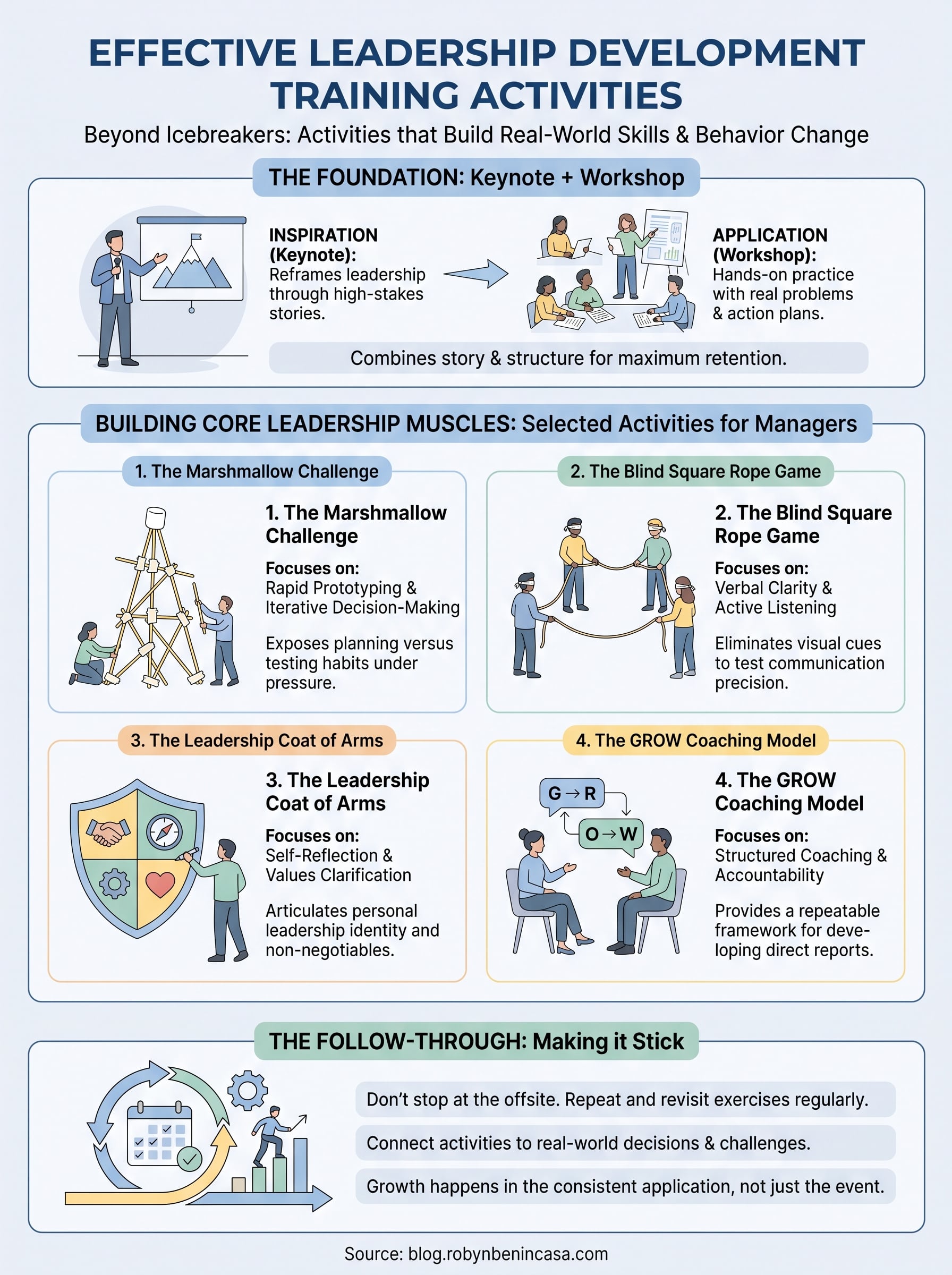
None of these twelve exercises work as one-off events. Leadership development training activities only change behavior when you repeat them, revisit them, and connect them to real decisions your managers face the following week. Pick two or three that match your team’s actual gap, whether that’s vague delegation, buried feedback, or misaligned goals, build them into your wider leadership development training topics, and run them on a recurring cadence instead of cramming all twelve into a single offsite and calling it done.
Growth happens in the follow-through, not the workshop itself. The teams I’ve watched improve fastest are the ones that pair a structured exercise with a real framework and a facilitator who’s actually led under pressure, not just read about it. If you’re planning a leadership offsite, sales kickoff, or team-building day and want a keynote and workshop built around your organization’s specific challenges, see who the best keynote speaker for a corporate event would be for your team and start building a culture that holds up long after the event ends.