
You’re planning a conference or sales kickoff, and someone on your team says, "Let’s just call a speaker bureau." If you’re not sure what that means or whether it’s the right move, you’re not alone. Most event planners hear the term long before anyone explains it clearly.
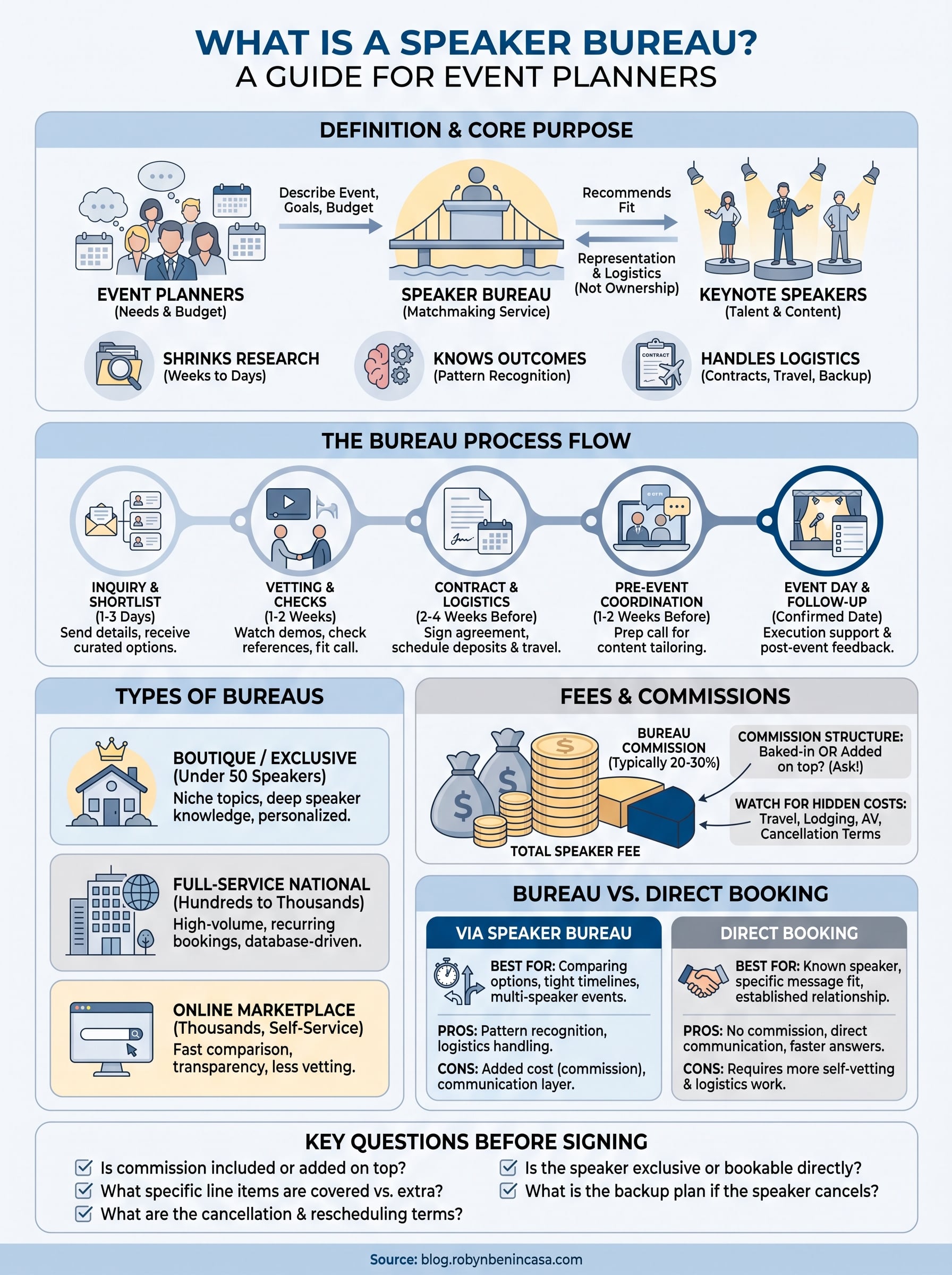
So what is a speaker bureau? In plain terms, it’s an agency that represents keynote speakers and connects them with organizations looking to book talent for events. Think of it as a matchmaking service: you describe your event, your budget, and your goals, and the bureau recommends speakers who fit. The speaker bureau meaning boils down to representation and logistics, not ownership of the speaker’s schedule or message.
This article breaks down how bureaus actually operate, what they charge, how they differ from booking a speaker directly, and what event planners need to know before signing a contract. Whether you’re weighing a bureau against a direct booking with a speaker like Robyn Benincasa, you’ll walk away knowing exactly how the process works and what to expect.
Why speaker bureaus matter for event planners
Event planners don’t call a speaker bureau because they’re lazy. They call one because vetting keynote speakers is a specialized skill most people only need once or twice a year. A good bureau has already screened hundreds of speakers for stage presence, audience fit, and reliability, so you’re not starting from a blank Google search and a pile of YouTube clips. That head start matters when you’re juggling catering, AV, and a dozen other event details at the same time.
They save you from a mountain of research
Finding the right voice for a leadership conference or sales kickoff takes real digging: watching demo reels, checking references, comparing fees, and figuring out who’s actually available on your date. A bureau does that legwork daily, which means they can hand you three or four solid options in a day or two instead of the two weeks it might take you to sort through the noise yourself. If you’ve got a tight timeline, that turnaround alone justifies the call.
A speaker bureau exists to shrink your search from weeks to days.
They know what actually works for your event
Bureaus track outcomes across hundreds of events, so they know which speakers land well with a room of insurance executives versus a sales team fresh off a rough quarter. That pattern recognition is hard to replicate on your own, especially if you’re booking a keynote speaker for the first time. A speaker bureau meaning something more than a directory becomes clear here: it’s a filter built on experience, not just a list of names and headshots.
They handle contracts, insurance, and logistics
Booking talent involves more than agreeing on a fee. Contracts need to cover cancellation terms, travel expectations, AV requirements, and liability, and getting any of that wrong can leave you scrambling days before the event. A bureau typically manages:
- Contract negotiation and standard rider terms
- Travel and lodging coordination
- Backup plans if a speaker cancels
- Coordination between your internal team and the speaker’s team on content and timing
That’s a meaningful chunk of administrative work off your plate, especially if you’re planning the event alone or as part of a small committee.
When a bureau isn’t the right fit
Here’s the honest counterpoint: bureaus add a layer between you and the speaker, and that layer comes with a cost, both in dollars and in how much direct input you get into the speaker’s message. If you already know exactly who you want, say you’ve seen Robyn Benincasa speak before or you’ve read her book and know her T.E.A.M.W.O.R.K. framework fits your culture goals, going straight to the speaker’s own booking page often gets you faster answers and a more tailored conversation about your event.
Organizations turn to bureaus most often in three situations: they’re booking a speaker for the first time and don’t know where to start, they need to compare multiple options quickly against a set budget, or they’re planning a large multi-speaker event and need one point of contact managing several bookings at once. If none of those describe your situation, a direct relationship with the speaker may serve you better, and we’ll walk through that comparison in more detail later in this article.
Understanding why bureaus exist sets up the rest of the picture. Once you know what problem they’re solving, it’s easier to judge whether the fee and the added layer of communication are worth it for your specific event, or whether a direct booking gets you the same result with less friction.
How speaker bureaus work, from inquiry to event day
Once you decide to work with a speaker bureau, the process follows a fairly predictable path. Knowing the sequence ahead of time helps you spot delays early and keeps you from getting blindsided by a step you didn’t expect, like a rehearsal call two weeks before your event.

The initial inquiry and shortlist
You start by contacting the bureau with your event details: date, location, audience size, budget range, and the general theme you’re going for, whether that’s leadership, sales performance, or team culture on stage. A booking agent then sends back a shortlist, usually three to six speakers who could be the best keynote speaker for a corporate event like yours, along with demo reels, sample topics, and fee ranges. This step typically takes anywhere from a few hours to a few days depending on how specific your request is and how many speakers fit your criteria.
Vetting and reference checks
From that shortlist, you narrow things down by watching more footage, checking references from past clients, and sometimes hopping on a call with the speaker or their team to talk through your event’s specific goals. This is where you find out if a speaker’s style actually matches your room. A speaker who kills it at a 200-person sales conference might not land the same way at an intimate 40-person leadership offsite, so ask pointed questions about audience size and format during this stage.
Contract and logistics
Once you pick a speaker, the bureau drafts a contract covering fee, cancellation terms, travel and lodging arrangements, AV requirements, and any content customization the speaker will build for your event. This is also when deposits get scheduled, usually a percentage upfront with the balance due closer to the event date. A typical timeline looks like this:
| Stage | Typical timeframe |
|---|---|
| Initial inquiry to shortlist | 1-3 days |
| Vetting and reference checks | 1-2 weeks |
| Contract signed | 2-4 weeks before event |
| Speaker prep call | 1-2 weeks before event |
| Event day | Confirmed date |
Pre-event coordination
In the weeks leading up to the event, the bureau usually facilitates a prep call between your team and the speaker so the speaker can tailor examples and language to your industry or company culture. This is the point where a speaker like Robyn Benincasa might ask about your recent wins, challenges, or team dynamics so her T.E.A.M.W.O.R.K. framework lands with specifics your audience recognizes rather than generic examples.
The best speaker bureau engagements feel less like a transaction and more like a relay handoff, with everyone clear on their leg of the race.
Event day and follow-up
On event day, the bureau’s job is mostly done, though a good one stays reachable in case a flight gets delayed or a tech issue pops up. Afterward, some bureaus follow up for feedback, which helps them recommend that speaker again to future clients with similar needs.
Types of speaker bureaus you may encounter
Not every speaker bureau operates the same way, and knowing the differences helps you pick the right partner instead of the first name that shows up in a search. Some bureaus represent a small, curated roster of speakers exclusively. Others work more like open marketplaces, pulling from thousands of names across every topic imaginable. The type you choose shapes how personalized the recommendations feel and how much the bureau actually knows about the speakers it’s pitching you.

Exclusive and boutique bureaus
Exclusive bureaus represent a limited roster, often fewer than fifty speakers, and they know each one well enough to match personality and message to your specific event. Boutique agencies fall into this category too, usually focusing on a niche like leadership, sales, or wellness. Because the roster is small, the recommendations tend to be sharper, and the agent on the phone can usually answer detailed questions about a speaker’s style without having to check notes.
The smaller the roster, the deeper the bureau’s knowledge of each speaker on it.
Full-service national bureaus
Full-service bureaus work with hundreds or even thousands of speakers across every industry and topic, and they typically handle large corporate accounts with recurring booking needs. These bureaus lean heavily on databases and filters rather than personal familiarity with every name on the list, which works fine if you know exactly what topic and budget you’re targeting. Where this model can fall short is nuance: an agent juggling thousands of speakers may not know that a particular keynote speaker’s team-building framework needs a specific audience size to really land.
Online marketplaces and aggregator platforms
A newer category has emerged in the form of online marketplaces, where you search a database yourself, compare rates and reviews, and contact speakers with little or no agent involvement. This model gives you speed and transparency on pricing, but you lose the vetting layer that a traditional agent provides. It works best for planners who already know the speaker they want and just need help with logistics.
| Bureau type | Roster size | Best for |
|---|---|---|
| Exclusive/boutique | Under 50 | Niche topics, personalized matches |
| Full-service national | Hundreds to thousands | High-volume, recurring bookings |
| Online marketplace | Thousands, self-service | Fast comparison, known speakers |
Understanding what is speaker bureau structure fits your event helps you set expectations before you ever pick up the phone. A boutique agency might take longer to respond but offer sharper insight, while a marketplace gets you moving fast but leaves more of the vetting work on your plate.
How speaker bureau fees and commissions work
Money is usually the first question on an event planner’s mind, and it’s a fair one. A speaker bureau doesn’t charge you a separate invoice most of the time. Instead, it earns a commission built into what you’ll really pay to hire a keynote speaker, typically 20% to 30% of whatever the speaker charges for the engagement. So if a speaker’s standard fee is $20,000, the bureau might add its cut on top or take a percentage from that total, depending on the arrangement they have with the speaker.
Who actually pays the commission
Commission structures vary more than most planners expect, and it’s worth asking directly rather than assuming. Some speakers set one flat fee that already includes the bureau’s cut, so you never see the split. Others work on a straight percentage where the bureau adds its commission on top of the speaker’s quoted rate, meaning you pay more than you would booking directly. Neither approach is dishonest, but you deserve to know which one you’re dealing with before you sign anything.
Ask whether the bureau’s commission is baked into the fee or added on top. That single question tells you whether you’re getting a fair price.
Typical fee ranges and what drives them
Speaker fees for in-person or virtual events shift based on the speaker’s name recognition, the event’s location, and the format itself. A rough breakdown looks like this:
| Factor | Impact on fee |
|---|---|
| Speaker’s stature and demand | Higher-profile speakers command higher base fees |
| Virtual vs. in-person | Virtual is often 30-50% less than in-person |
| Travel distance | Long-haul travel adds cost for flights and lodging |
| Custom content requests | Tailored keynotes cost more than off-the-shelf talks |
Getting a speaker bureau to break down these line items upfront saves you from surprise add-ons two weeks before your event.
Negotiating through a bureau versus direct
Bureaus can sometimes negotiate a discount if you’re booking multiple speakers or committing to a multi-year relationship, since they want to keep your business coming back. But that negotiating room shrinks the commission, and some bureaus resist cutting their own cut even when it would help you close the deal. Reaching out to a speaker’s own team, the way you would through Robyn Benincasa’s booking page, sometimes opens up more flexibility because there’s no middleman commission to protect.
Watch for hidden costs
Specific line items to clarify before signing anything include travel and lodging reimbursement, cancellation and rescheduling penalties, and whether AV or recording rights carry an extra fee. None of these are unusual, but they catch planners off guard when they show up as surprises on the final invoice instead of the original quote.
Speaker bureau vs. booking a speaker directly
Once you understand how a speaker bureau operates, the real question becomes whether you need one at all. Booking a keynote speaker directly, without an agent in the middle, is a completely normal path, especially when you already know who you want on stage. The right choice depends less on which option is "better" and more on how much certainty you already have about your speaker and your event’s needs.
What you gain with a bureau
Working through a bureau makes the most sense when you’re comparing multiple speakers, booking on a tight deadline, or coordinating several speakers for one event. Agents bring pattern recognition from hundreds of past bookings, and they absorb the contract and logistics work that eats up hours you don’t have. That convenience carries a real cost, though, since the bureau’s commission gets folded into your total spend one way or another.
What you gain by booking direct
Going straight to the speaker cuts out the commission and often speeds up communication, since you’re talking to the person or team who actually knows the content inside and out. Direct booking also gives you a clearer read on customization. When you reach out through a page like Robyn Benincasa’s booking page, you’re talking to people who can immediately discuss how her T.E.A.M.W.O.R.K. framework applies to your industry, rather than relaying questions through a third party who has to check with the speaker’s team anyway.
The fewer people between you and the speaker, the fewer chances for your event’s specific needs to get lost in translation.
Side-by-side comparison
| Factor | Speaker bureau | Direct booking |
|---|---|---|
| Cost | Commission built into fee (20-30%) | No commission markup |
| Speed of first response | Fast shortlist, slower final details | Slower shortlist, faster specifics |
| Customization depth | Filtered through agent | Direct conversation with speaker’s team |
| Best for | Comparing multiple speakers, first-time bookers | Known speaker, established relationship |
| Contract handling | Managed by bureau | Managed by speaker’s team or you |
Which route fits your event
Questions about speaker bureau meaning and function usually resolve into one practical decision: do you need help finding a speaker, or do you already know who you want? If you’re still comparing five names against a budget, a bureau earns its keep. If you’ve already seen a speaker in action, read their book, or gotten a recommendation from a colleague whose event matched yours, reaching out directly usually gets you a faster answer and a lower total cost. Robyn Benincasa’s team, for example, handles contracts, travel, and content customization the same way a bureau would, just without the added layer or the commission on top.
Questions to ask before hiring a speaker bureau
Before you sign anything, a short list of pointed questions can save you from a mismatched speaker or a surprise invoice. Treat this like an interview, because you’re hiring the bureau just as much as you’re hiring the speaker they recommend. A speaker bureau that hesitates on any of these questions is telling you something worth paying attention to.
Questions about the roster and matching process
Getting clear on how a bureau builds its shortlist tells you whether you’re getting genuine matchmaking or a generic list pulled from a database. Ask directly:
- How many speakers on your roster have you personally seen perform live?
- What criteria do you use to match a speaker to our audience size and industry?
- Can you connect me with a past client who booked a similar event?
- Is this speaker exclusive to your bureau, or can I book them elsewhere for less?
That last question matters more than planners realize. If a speaker works with multiple bureaus, or takes direct bookings through their own site, you may find a lower total cost by skipping the middleman entirely.
If a speaker isn’t exclusive to the bureau, ask why you’d pay a commission to reach someone you could contact directly.
Questions about fees and contracts
Commission structures vary enough that you shouldn’t assume anything. Confirm these details before you get a formal quote:
- Is the bureau’s commission included in the quoted fee, or added on top?
- What’s covered in the base fee versus billed as an add-on, like travel, lodging, or recording rights?
- What are the cancellation and rescheduling terms, for both us and the speaker?
- Is there flexibility on price if we’re booking multiple speakers or a multi-year contract?
Having these answers in writing before you sign protects you from line items that show up on the final invoice instead of the original quote.
Questions about backup plans and guarantees
Events don’t always go according to plan, so it’s worth knowing what happens when they don’t. Wondering what a bureau does if a speaker cancels close to your event date is a fair concern, not a paranoid one. Ask about their backup process, whether they guarantee a replacement of comparable quality, and who absorbs the cost if a last-minute swap is needed. Verifying insurance and liability coverage rounds out the list, since a bureau that can’t answer basic contract questions clearly probably isn’t managing your event’s logistics as carefully as you’d want.
Running through this checklist takes maybe fifteen minutes on a call, but it separates bureaus that operate with real transparency from ones hoping you won’t ask.
Finding the right speaker for your event
A speaker bureau earns its fee when you need help narrowing options, comparing multiple names, or juggling several bookings at once. It’s a smart shortcut when you’re starting from scratch. But once you know what speaker bureau meaning actually covers, matchmaking, contracts, logistics, you can judge for yourself whether that layer adds value for your specific event or just adds cost.
If you already have a speaker in mind, or you’re drawn to someone whose message fits your team’s exact challenges right now, going direct usually gets you faster answers and a lower total spend. That’s especially true when the speaker’s team handles contracts and customization the same way a bureau would.
If leadership, culture, and team performance are on your agenda, see which motivational keynote speakers are worth hiring and reach out directly to skip the middleman altogether.