
You’ve hit a wall a lot of women hit around mid-career: you’re good at your job, you’re delivering results, but the path to the next title isn’t obvious and nobody’s handing you a roadmap. That’s exactly why women leadership training programs exist, and why so many ambitious professionals go looking for one right now. If you’re vetting options for yourself or your team, you need a shortlist that separates real, credentialed development from generic workshops with a pink logo slapped on them.
This article gives you that shortlist. I’ve pulled together eight standout programs, from university-backed executive education to focused nonprofit leadership development training and industry-specific cohorts, so you can compare format, cost, and outcomes side by side instead of digging through a dozen browser tabs. Each one is built to sharpen decision-making under pressure and strengthen the influence skills that get women promoted, not just praised.
I’ve spent two decades building teams under extreme conditions, first as a firefighter, then as a world champion adventure racer, and I know the difference between training that changes behavior and training that just fills a day. As you read through these eight programs, think about which format matches your career stage and what specific gap you’re trying to close before your next performance review.
1. GW’s executive women’s leadership program
George Washington University runs one of the most established women leadership training programs in the country through its School of Business, and it’s built for women who already manage people but want the strategic fluency to sit at the executive table. This isn’t a motivational seminar. It’s structured around real organizational challenges: negotiating for resources, managing up, and building influence in rooms where you’re often the only woman present.
What it covers
The curriculum leans heavily on negotiation tactics and executive presence, taught through case studies pulled from GW’s own faculty research rather than generic leadership theory. You’ll work through modules on strategic decision-making, managing organizational politics, and building a personal brand that carries weight in performance reviews. Small group coaching sessions push you to apply each concept to a live situation from your own job, which is what separates this from a lecture-style course.
The program works because it forces you to practice the hard conversation before you have to have it for real.
Who it’s for
This program suits mid-to-senior level managers who are already leading teams but haven’t yet cracked the director or VP tier, the same audience served by leadership training for middle managers. If you’ve been told you’re "not quite ready" for the next promotion without a clear explanation why, this is the kind of leadership development program designed to close that gap. It’s less useful for early-career professionals who haven’t managed anyone yet; the case discussions assume you’ve already navigated team conflict and budget decisions firsthand.
Format and cost
GW offers the program both in-person on its Washington, D.C. campus and as a live virtual cohort, typically running over three to four days. Tuition runs in the $3,000 to $4,500 range depending on format and whether you book early. Details and current dates are listed on the GW School of Business executive education site. Many companies cover this through professional development budgets, so check with HR before you pay out of pocket. If you’re weighing this against other options, ask whether your organization prioritizes a credential from a known university or a more customized, culture-specific approach, since that distinction matters more than the price tag.
2. CCL’s women’s leadership development program
The Center for Creative Leadership has been researching leadership behavior for over 50 years, and its women’s program reflects that research base rather than trendy frameworks. Unlike a lot of women leadership training programs built around theory, CCL leans on data pulled from thousands of 360-degree assessments to show you exactly where your leadership style helps or hurts you.
What it covers
Participants get a personalized 360 assessment before the program even starts, so the sessions address your actual blind spots instead of generic leadership traits. The curriculum covers assertiveness, resilience under pressure, and how to build a support network that survives a promotion, which maps closely to the essential leadership skills most managers are measured on. Coaches walk you through your results one-on-one, which is rare at this price point.
Data-driven feedback beats a workshop full of feel-good affirmations every time.
Who it’s for
This fits women who want hard evidence before changing how they lead, not just encouragement. It works well for mid-career professionals moving into their first director-level role, especially those who’ve never received structured feedback on their management style. If you already know your weaknesses and just want tactics, this program might feel slower than you need.
Format and cost
CCL runs this as a multi-day, in-person cohort, with virtual options added in recent years. Pricing typically falls between $4,000 and $5,500, covering the assessment, coaching, and materials. Full details live on the Center for Creative Leadership site.
3. Yale’s women’s leadership program
Yale School of Management brings its academic weight to this program, and it shows in how the sessions are structured. Rather than a loose collection of tips, Yale organizes the curriculum around behavioral science, pulling from research on decision-making and persuasion that its faculty actually publish. It’s one of the more rigorous women’s executive education options on this list, and it draws a global cohort of professionals who want a credential that carries weight beyond the room.
What it covers
Expect deep work on negotiation strategy and how cognitive bias shapes the way women’s ideas get received in meetings. Sessions also cover conflict management and how to reframe setbacks as data rather than personal failure. Faculty use Yale’s case method throughout, so you’re debating real scenarios instead of absorbing slides.
Understanding the psychology behind why your ideas get dismissed matters more than any speaking trick.
Who it’s for
This program suits women already operating at a senior manager or director level who want an Ivy League credential attached to their leadership training. It’s a strong fit if your organization values pedigree when evaluating internal candidates for VP roles. Early-career professionals will likely find the material too abstract without prior management experience to anchor it.
Format and cost
Yale runs the program as a short, intensive on-campus session, usually two to three days, with tuition landing between $3,500 and $5,000. Check the Yale School of Management executive education page for current cohort dates.
4. MIT’s women in leadership online program
MIT Sloan takes a different approach than the campus-based programs above: this one runs entirely online, built for women who want an MIT credential without blocking off a week of travel. It’s a self-paced-meets-cohort model, structured around short video lectures from Sloan faculty paired with live discussion sessions, making it one of the more flexible online leadership training programs on this list.
What it covers
The curriculum focuses on systems-level thinking, teaching you to diagnose organizational dysfunction the way an engineer diagnoses a broken process rather than relying on personality-based leadership advice. Modules cover negotiation, digital-era team management, and building influence remotely, which matters if you’re leading a hybrid team. Peer discussion boards connect you with other participants working through the same case studies in real time.
A credential you can earn between meetings still counts if the material actually changes how you lead.
Who it’s for
This fits remote-first managers and women who can’t take a week away from the office for an in-person cohort. It also suits participants outside major metro areas who still want access to top-tier faculty. If you learn best through in-person debate and networking, the online format will feel isolating compared to Yale or GW.
Format and cost
The program runs six to eight weeks, a few hours weekly, with tuition around $2,800 to $3,200. Check the MIT Sloan Executive Education site for current cohort dates.
5. AMA’s women’s leadership certificate program
The American Management Association built this certificate program for women who want a credential recognized across industries, not tied to one university’s name. It’s practical by design, favoring workshop repetition over academic theory, which makes it one of the more accessible women’s leadership training programs for someone who wants tools she can use the following Monday.
What it covers
Sessions focus on assertive communication and conflict resolution, with heavy role-play so you practice pushback in real time instead of just discussing it. The curriculum also covers time management, delegation, and building credibility with peers who outrank you on paper. AMA layers in a strengths assessment early on, then ties every later module back to your specific results.
Practice under pressure sticks longer than any slide about assertiveness ever will.
Who it’s for
This program suits new and aspiring managers, women stepping into their first supervisory role who need concrete scripts more than strategic frameworks, and it sits alongside other strong training options for first-time managers. It’s a weaker fit for senior executives who’ve already mastered the basics of team management and want boardroom-level strategy instead.
Format and cost
AMA runs this as a two-day workshop, offered both in-person in several U.S. cities and live online. Tuition typically runs $2,000 to $2,500, with member discounts available. Current schedules are posted on the American Management Association site.
6. The leadership institute’s women’s leadership program
The Leadership Institute runs a lesser-known but well-regarded cohort aimed squarely at operational leaders, the women managing budgets, shift schedules, and cross-functional teams rather than sitting in a corner office yet. Compared to the university programs above, this one skips the academic framing and gets straight to the mechanics of running a team well under real deadline pressure.

What it covers
Sessions center on conflict resolution and building accountability systems that don’t require you to micromanage every task, the same ground covered by dedicated leadership communication training. You’ll also work through modules on delegation, giving feedback that actually changes behavior, and reading team dynamics before they turn into a morale problem. The program pairs each concept with a workplace scenario you bring in yourself.
A leadership program only earns its price tag if you leave with a system, not just a pep talk.
Who it’s for
This fits frontline and mid-level supervisors who inherited a team but never got formal training in how to lead one. It’s a strong choice among women’s leadership training programs for someone managing people day-to-day in operations, retail, or healthcare settings rather than steering enterprise strategy.
Format and cost
The program runs as a two-day, in-person workshop offered in regional cities throughout the year, with tuition typically landing between $1,800 and $2,400. Group discounts apply when an employer sends more than one participant, which makes it a practical pick for HR teams training several supervisors at once.
Finding the right program for your next step
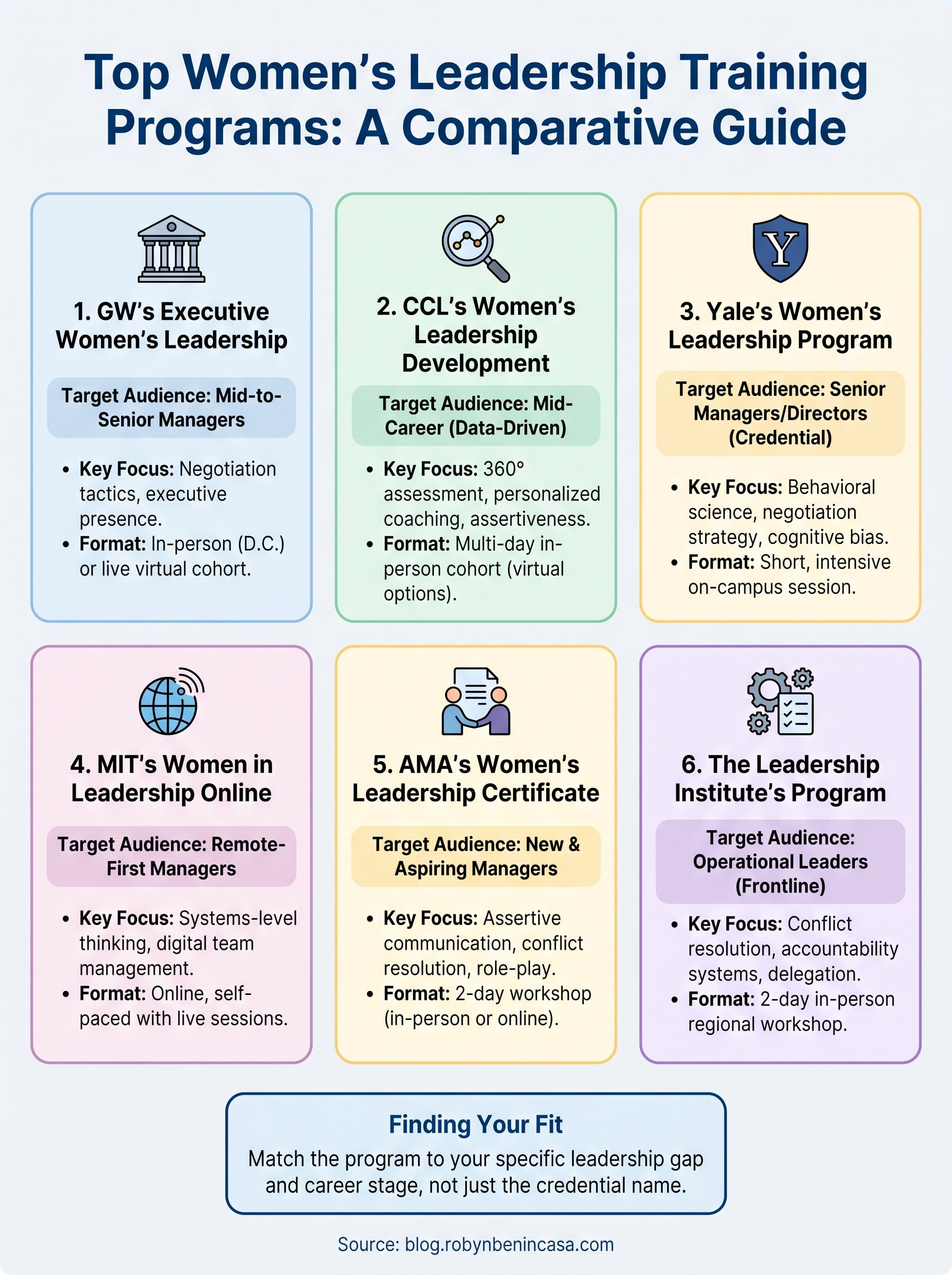
Picking from these women leadership training programs comes down to one honest question: what specific gap is holding you back right now? A director who needs boardroom credibility belongs at Yale or GW, not in a two-day workshop built for new supervisors. A frontline manager drowning in scheduling conflicts needs the Leadership Institute’s practical systems, not academic case studies. Match the program to the actual problem, not the name on the certificate, and understand how leadership training programs actually work before you commit a budget to one.
Beyond enrolling in a course, real growth happens when you keep learning from people who’ve actually led teams through pressure and change. That’s the same reason organizations bring me in to speak, to give teams a shared language for building trust fast and performing when it counts. If you’re planning a leadership offsite or sales kickoff and want that conversation started for your team, see which female keynote speakers are worth booking and what fits your next event.