Picking a leadership program for yourself or your executive team is a real investment. You’re looking at tuition costs that run into five figures, weeks away from the office, and a bet that the curriculum actually changes how your leaders show up at work. Search around and you’ll find dozens of options that all claim to be the best executive leadership training programs, with little to help you tell them apart.
This article cuts through that noise. We reviewed executive leadership development training from top business schools and institutions, looking at curriculum depth, faculty credentials, format, cost, and the kind of measurable outcomes companies like Allstate and Northrop Grumman actually care about. Whether you’re an HR leader vetting corporate leadership development training for your whole bench or a director evaluating options for your own growth, you’ll find a program here that fits.
Below, we break down seven standout programs, what makes each one worth considering, who it’s built for, and what you can expect to pay. If you’re also weighing outside speakers and workshops as part of your leadership strategy, knowing how to hire a keynote speaker is exactly the kind of complementary investment worth exploring alongside formal coursework.
1. Robyn Benincasa’s leadership and team culture keynotes
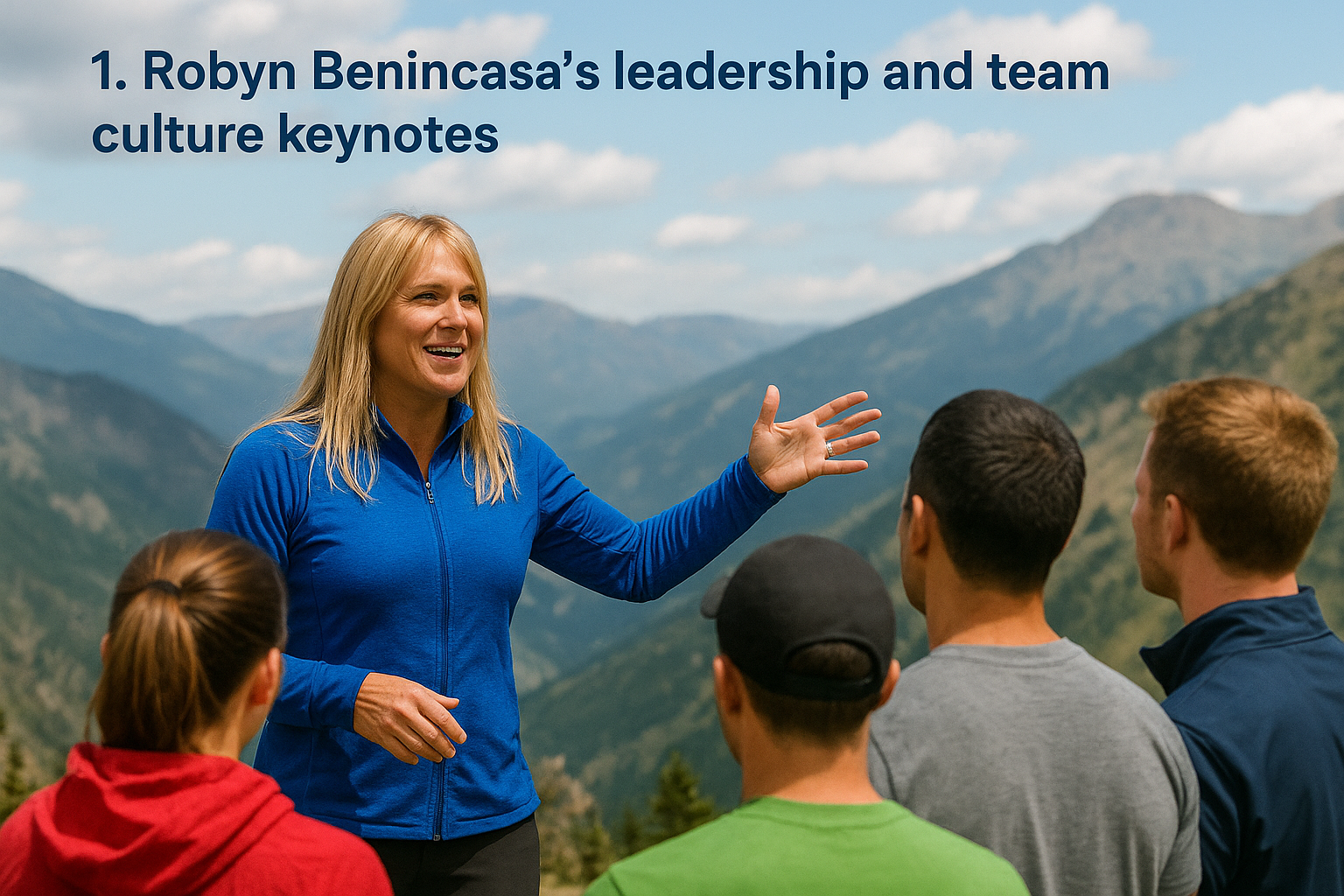
Most executive leadership training programs teach frameworks from a whiteboard. Robyn Benincasa teaches them from a mountain ridge at mile 200 of an adventure race, where a team either pulls together or falls apart. As a world champion adventure racer and 20-plus year San Diego firefighter, she built her reputation leading teams through conditions where individual talent means nothing without trust and shared commitment. Her work as a corporate culture keynote speaker translates that hard-won field experience directly into corporate settings, making her one of the more distinctive entries among top executive leadership training programs on this list.
How it works
Robyn structures her sessions around signature frameworks like T.E.A.M.W.O.R.K. (the 8 Essential Elements of a World-Class Team Culture) and WIN AS ONE, both built from real case studies of teams she led to championship results. She pairs storytelling from her racing and firefighting careers with concrete, actionable takeaways that leaders can apply the following Monday, not abstract theory that stays in the conference room.
A team culture built on trust and shared commitment beats individual talent every time.
Who it’s for
These programs suit HR leaders and executives at mid-size to large organizations who need to unify teams around a common goal, especially during mergers, market pressure, or performance slumps. Companies like Allstate, InterWest Insurance, and Northrop Grumman have booked Robyn specifically to break down silos between teams and rebuild sales and operations culture from the ground up.
Format and duration
Engagements run as in-person or virtual keynote sessions, typically 45 to 90 minutes, and slot easily into sales meetings, leadership offsites, or full conferences. Organizations wanting deeper engagement often pair a keynote with team-building activities that actually strengthen teams or her book, "How Winning Works," for a longer cultural shift.
Cost
What a keynote speaker costs varies by format, location, and event length, so the best step is to request a custom quote directly through the booking page. Every organization also gets access to Robyn’s free 18-page leadership guide as a starting point before committing to a full engagement.
2. Harvard’s executive leadership training programs
Harvard Business School’s Executive Education division runs some of the most recognized executive leadership training programs in the world, built on the same case-method teaching that fills its MBA classrooms. Programs like the General Management Program and Advanced Management Program pull from decades of Harvard research on strategy, finance, and organizational behavior, giving participants a rigorous academic foundation rather than a single speaker’s point of view.
How it works
Sessions rely heavily on the Harvard Business School case method, where small groups debate real business dilemmas before faculty weigh in. Cohorts work through modules on negotiation, finance, and strategic decision-making, with heavy peer interaction built into every session.
Rigorous case debate forces leaders to defend their thinking, not just absorb it.
Who it’s for
These executive training programs in leadership target senior executives, general managers, and C-suite candidates who already carry P&L responsibility and want a credential that signals top-tier strategic training.
Format and duration
Most programs run in-person on Harvard’s Boston campus, ranging from two-week intensives to the Advanced Management Program’s eight-week residency, with limited hybrid options.
Cost
Tuition typically runs from $15,000 for shorter programs to over $80,000 for the full Advanced Management Program, not including travel and lodging.
3. Center for Creative Leadership’s executive programs
The Center for Creative Leadership (CCL) takes a different angle than the big business schools. Instead of case studies, it built its reputation on decades of behavioral research into what actually makes leaders effective, then packaged that research into hands-on leadership training programs for directors and senior managers navigating real organizational change.

How it works
CCL leans on 360-degree feedback assessments, one-on-one coaching, and simulation-based exercises rather than lectures. Participants get direct, sometimes uncomfortable, feedback from peers and direct reports, then work with coaches to build a personal leadership development plan they carry back to the job.
Feedback from the people you actually lead teaches more than any case study ever will.
Who it’s for
These programs suit directors and senior managers who need to sharpen self-awareness and influence skills, particularly those stepping into broader leadership roles or managing through organizational change. CCL also runs custom cohorts for companies wanting to train an entire management layer at once.
Format and duration
Most flagship programs, like the Leadership Development Program, run five to six days in person at CCL’s campuses in Colorado Springs, Greensboro, or San Diego. Virtual and blended formats are available for teams that can’t travel, spreading the same content across several weeks of shorter sessions.
Cost
Expect to pay between $6,000 and $12,000 per participant for flagship programs, depending on format and location, according to CCL’s own program listings.
4. Wharton’s advanced management program
Wharton’s Advanced Management Program (AMP) leans hard into finance and analytics, reflecting the school’s reputation as one of the top executive leadership training programs for leaders who need to speak fluently to boards and investors. Where Harvard debates cases, Wharton runs the numbers, pairing strategic leadership content with deep dives into valuation, risk, and data-driven decision-making.
How it works
Faculty structure the curriculum around modules in corporate finance and strategic leadership, blending lectures with small-group simulations that force participants to model real business scenarios under pressure. Executive coaching sessions run alongside the coursework, helping each participant translate financial insight into a personal leadership plan.
Numbers convince a boardroom faster than a good story ever will.
Who it’s for
Wharton built this program for senior executives and general managers who already understand strategy but want sharper financial fluency before stepping into a C-suite or board-facing role. It suits leaders from finance, operations, and general management backgrounds equally well.
Format and duration
The flagship residency runs about four weeks on Wharton’s Philadelphia or San Francisco campus, split into two two-week sessions with a break between them. A shorter, condensed version exists for executives who can’t commit to a full month away.
Cost
Tuition for the full Advanced Management Program runs roughly $70,000, covering materials, most meals, and campus housing, though travel costs sit outside that figure.
5. MIT Sloan’s executive program in general management
MIT Sloan built its Executive Program in General Management (EPGM) around a simple premise: leaders who understand systems thinking and technology strategy outperform those who only know finance and operations. Given MIT’s reputation in engineering and analytics, this program stands out among executive leadership development training options for leaders managing technical teams or digital transformation projects.
How it works
Faculty combine systems thinking frameworks with real-time business simulations, pushing participants to model how decisions ripple across an entire organization rather than just one department. Sessions also cover innovation strategy and organizational design, taught by researchers who consult directly with Fortune 500 companies on digital transformation.
Leaders who see the whole system make fewer decisions that backfire elsewhere.
Who it’s for
General managers and functional leaders transitioning into broader operational roles get the most from this program, especially those overseeing technology-heavy or engineering-driven businesses. It also suits directors who need to speak credibly with technical teams while still owning bottom-line results.
Format and duration
The program runs about three weeks in person on MIT’s Cambridge campus, structured as an intensive residency with limited breaks. Some cohorts split the schedule into two shorter sessions for executives who can’t leave the office for a full month.
Cost
Tuition runs approximately $18,000, according to MIT Sloan Executive Education’s published pricing, with housing and meals available at additional cost.
6. Kellogg’s executive development program
Kellogg School of Management built its Executive Development Program (EDP) around relationship-driven leadership, reflecting the school’s reputation for marketing and organizational behavior research. Among corporate leadership development training options, Kellogg stands out for pushing participants to master persuasion and cross-functional influence, skills that matter as much as strategy once you’re leading peers who don’t report to you.
How it works
Faculty build the curriculum around negotiation simulations and team-based projects, forcing participants to practice influence tactics in real time rather than just discuss theory. Sessions also cover change management and personal branding, taught by professors who consult with Fortune 500 marketing and operations teams.
Influence without authority is the skill that separates good managers from great leaders.
Who it’s for
Kellogg designed this program for directors and general managers who lead cross-functional teams and need buy-in from stakeholders outside their direct chain of command, much like dedicated cross-functional collaboration training does. It also draws marketing and sales executives looking to sharpen their strategic storytelling.
Format and duration
The flagship residency runs three weeks on Kellogg’s Evanston campus, with a hybrid track available that splits content across shorter in-person modules and virtual coursework.
Cost
Tuition runs approximately $24,000, according to Kellogg Executive Education’s program listings, excluding travel and lodging expenses.
Finding the right fit for your leaders
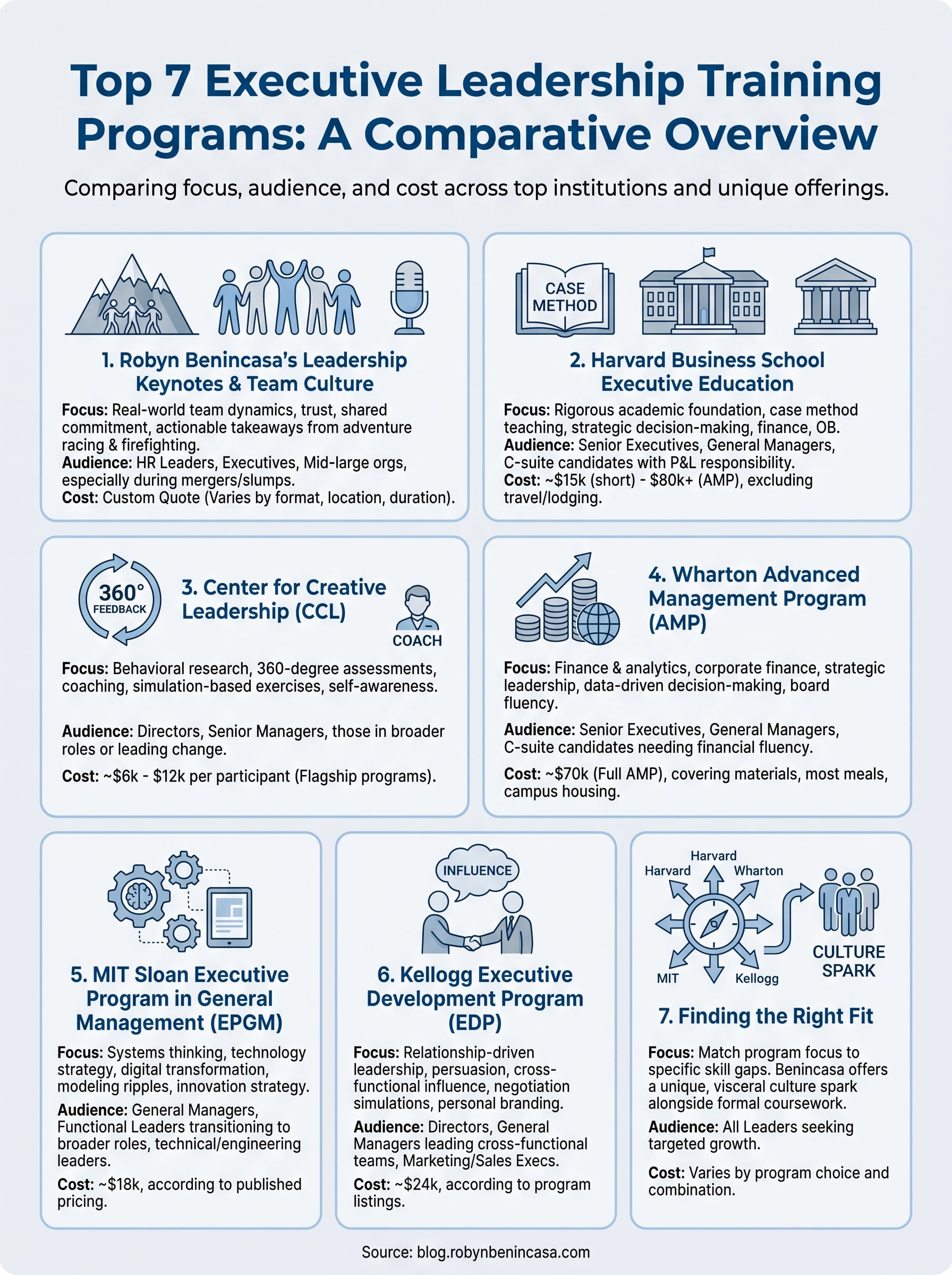
The seven programs above tackle leadership from different angles, and that’s the point. Harvard sharpens strategic debate, Wharton builds financial fluency, MIT Sloan teaches systems thinking, and Kellogg trains influence without authority. CCL digs into self-awareness through direct feedback. Each one works well for a specific gap in a leader’s skill set, but none of them replace the visceral, team-first culture shift that comes from hearing what actually happens when a team faces real stakes and no shortcuts.
That’s where Robyn Benincasa’s approach stands apart from typical executive leadership training programs. Her keynotes and team-building sessions give organizations the cultural spark that formal coursework often skips, the kind that gets a sales team talking about trust and shared commitment the next morning instead of filing a binder away. If your leaders need that jolt alongside their formal training, see which leadership keynote speakers are worth booking and find out what a battle-tested team culture actually looks like.