The best women in business speaker for your event is the one who has run something real, boils that experience down to a few usable ideas, and speaks to the problem your audience actually has. Our top picks split by need: Robyn Benincasa for team culture, Erica Dhawan for remote and hybrid collaboration, Liz Wiseman for leadership programs, Annie Duke for decision making, Juliet Funt for overloaded teams, and Carla Harris or Jamie Kern Lima for women’s career and confidence events.
Most bureau pages and "top 100" lists hand you a wall of names with a two-line bio each. That works for browsing, but it does not tell you who will hold a ballroom of 400 salespeople or a room of 30 first-time managers. This article gives you ten speakers with the same facts for each, so you can compare them quickly and shortlist with confidence.
This blog belongs to Robyn Benincasa, an award-winning keynote speaker on leadership and teamwork, so she sits at number one and we say so openly. The other nine earned their places on the same criteria, which we lay out first. After the list you will find a side-by-side table, a comparison of booking routes, and a plain look at what keynotes cost.
How to judge a women in business speaker
Judge a women in business speaker on three things: what she has actually built or led, what your audience will do differently afterward, and whether she works in your format. Résumé prestige and social following rank a distant fourth.
Operating experience over title
Start with what she has actually run. A founder who sold a company, an executive who grew a division, or a leader who held a team together under pressure tells stories with real numbers and real mistakes in them. Those stories hold a room far better than general advice does. Test each candidate with three questions:
- Can she name the specific result, such as a sales rank, a revenue figure, or a sale price?
- Does she describe what went wrong, not only the win?
- Can she translate her field to yours, even if she has never worked in your industry?
Takeaways your audience can use
Ask every candidate for the three things attendees will do differently on Monday morning. A speaker who answers in one sentence each has a framework, not just a story. A book behind the framework also gives your people something to read afterward, and that is where lasting change happens.
Mismatch is the most common failure. A powerful story of overcoming adversity is wrong for a finance team that needs better decisions, and a decision-science talk is wrong for a room that needs energy after a merger. Match the speaker to the problem first, then to the personality.
Hire for the problem your audience has, not for the biggest name on the list.
Format and logistics
Confirm format before you fall in love with anyone. Most speakers on a list of women in business speakers deliver in person, virtually, or in a hybrid setup, but the experience differs sharply. A virtual keynote needs shorter segments and more interaction, and a speaker who has not adapted will lose the screen. Clarify these points early:
- Delivery: in person, virtual, or hybrid
- Length: 30, 45, or 60 minutes, with or without Q&A
- Add-ons: breakout workshop, book signing, or leadership session
- Prep: a call with your leadership before the event so the talk uses your real language
1. Robyn Benincasa: teamwork and leadership
Background
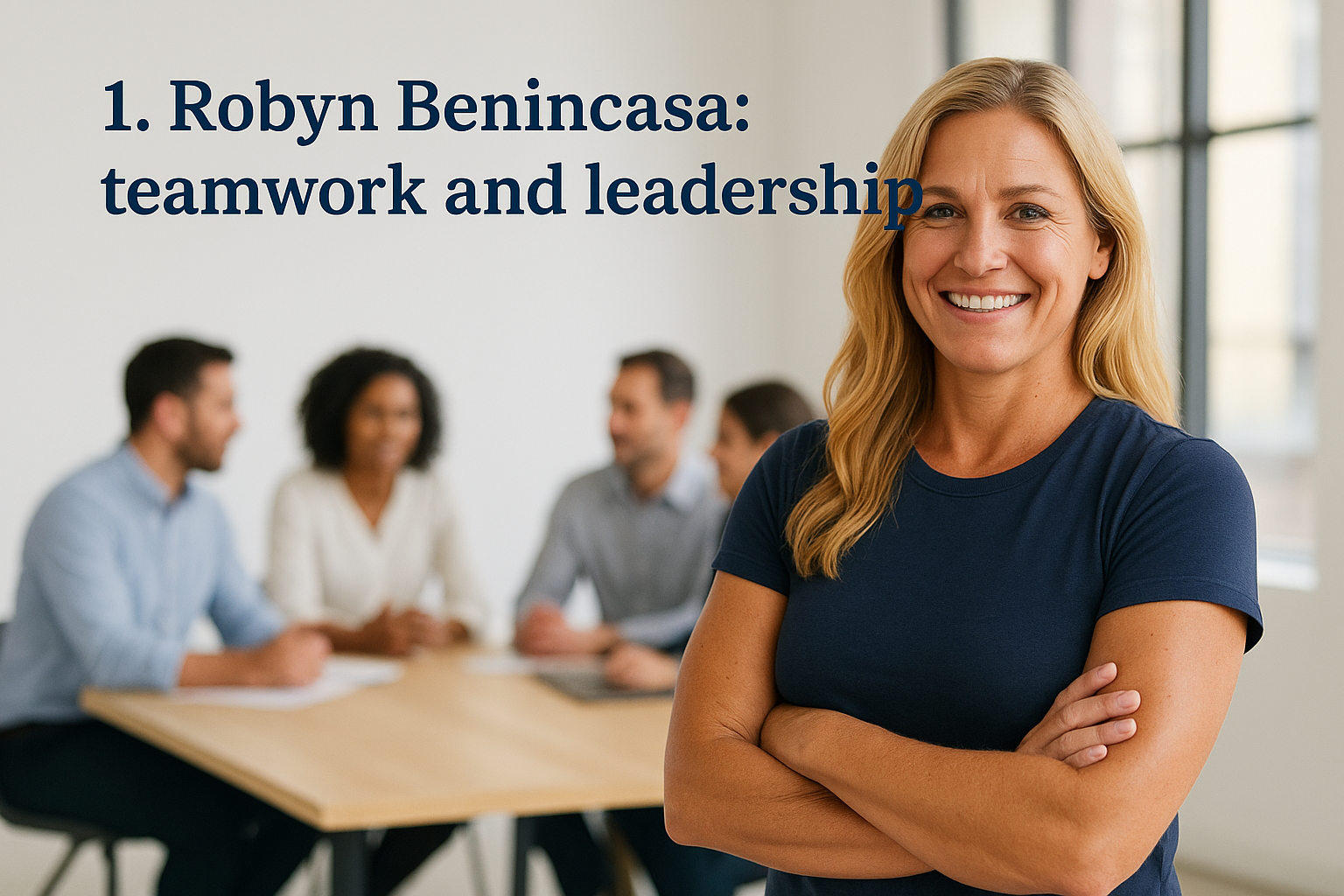
Robyn Benincasa led adventure racing teams to world championship dominance over 15 years while working as a San Diego firefighter for more than two decades. That combination matters. In adventure racing, the team finishes together or it does not finish, so the slowest member sets the pace. She turned those lessons into a model for business teams, and her earlier years as a pharmaceutical and hospital supply sales rep give her credibility with sales rooms.
- World champion adventure racer and 20+ year San Diego firefighter
- New York Times best-selling author of How Winning Works: 8 Essential Leadership Lessons From The Toughest Teams on Earth
- Founder of The Project Athena Foundation, a nonprofit, and a CNN Hero
Signature topics
Robyn offers four signature keynotes, and each one draws on lessons from the toughest teams on Earth. Most organizations start with the first, which lays out eight essential elements of a world-class team culture. The others suit narrower goals, such as aligning a group after a merger or building toughness in a team under pressure.
- T.E.A.M.W.O.R.K.: 8 Essential Elements of a World-Class Team Culture
- WIN AS ONE
- Inspiring Greatness Through G.R.I.T.
- Why Winners Win
Best fit and format
Robyn suits sales kickoffs, leadership offsites, and post-merger integration events, along with any group that needs to break down silos. She works well with teams of mixed tenure and experience because the message centers on shared commitment, not individual talent. One sales team she worked with moved from 17th to 1st nationally, and her clients span insurance, pharmaceutical, defense, and retail, including Allstate, Boston Scientific, and Northrop Grumman.
She speaks in person and virtually, and talks stay focused on audience takeaways instead of self-promotion. If you want a keynote built around team culture, you can start by booking Robyn directly and talking through your goals before you commit to anything.
Choose Robyn when the real problem is how your people work together, not how they feel about work.
2. Erica Dhawan: digital collaboration
Background
Erica Dhawan is an expert on how people read each other through screens, and she wrote the book on it. RealLeaders named her the "#1 Female Keynote Speaker of 2020," which put her near the top of a very crowded field. Her work sits where communication, culture, and technology meet, so she resonates with leaders who manage people they rarely see.
- Author of Digital Body Language
- Author of Connectional Intelligence
- Named a top female keynote speaker by RealLeaders for 2020
Signature topics
Her core idea is digital body language: the signals that tone, response time, and message style send in email and chat. Misread signals breed distrust, so she shows teams how to be clear, warm, and fast. A second thread helps teams speak up and take risks, so people feel heard instead of judged.
- Digital body language for email, chat, and video
- Building a culture where people speak up
- Connectional intelligence for cross-team work
Best fit and format
Pick Erica when your workforce is remote, hybrid, or spread across offices. She suits HR leaders rolling out a hybrid policy, operations teams with handoff problems, and leadership meetings where half the room joins by video. She delivers live, remote, or hybrid keynotes and workshops.
Her talks are less suited to a pure motivation slot. She works best when the agenda includes a practical communication reset, since the takeaways are habits people can change the same week.
Erica fits the audience whose biggest problem is misread messages, not missing motivation.
3. Liz Wiseman: multiplying team intelligence
Background
Liz Wiseman is the CEO of The Wiseman Group and the author of the best-selling Multipliers, a book on how some leaders amplify the intelligence of everyone around them. Thinkers50 counts her among the top leadership experts, and she has worked with companies such as Apple, Disney, and Google. Her research-based approach gives her talks a different texture from personal-story keynotes.
- Author of Multipliers, Rookie Smarts, and Impact Players
- Listed by Thinkers50 among top leadership thinkers
- Keynote speaker, workshop leader, and coach
Signature topics
Her central contrast is between multipliers and diminishers. A diminisher, often with the best intentions, drains the capability of a team. A multiplier draws out more than people knew they had. Her later work covers how newcomers and fresh perspectives drive innovation and how individuals become the people leaders rely on.
- Multipliers: getting more from the talent you already have
- Rookie smarts: why beginners often outperform experts
- Impact players: what top contributors do differently
Best fit and format
Wiseman suits leadership development programs and manager cohorts. If your goal is to change how 50 or 500 managers lead, her framework gives them a shared vocabulary. It also fits innovation summits and organizations that feel they are not getting full value from their people.
She works as a keynote, webinar presenter, or workshop leader. For a program that continues after the keynote, ask whether she can pair the talk with a workshop, since the diagnostic exercises are where managers see their own habits.
Book Wiseman when you want managers to leave with a framework they can name and use.
4. Annie Duke: decision making under uncertainty
Background
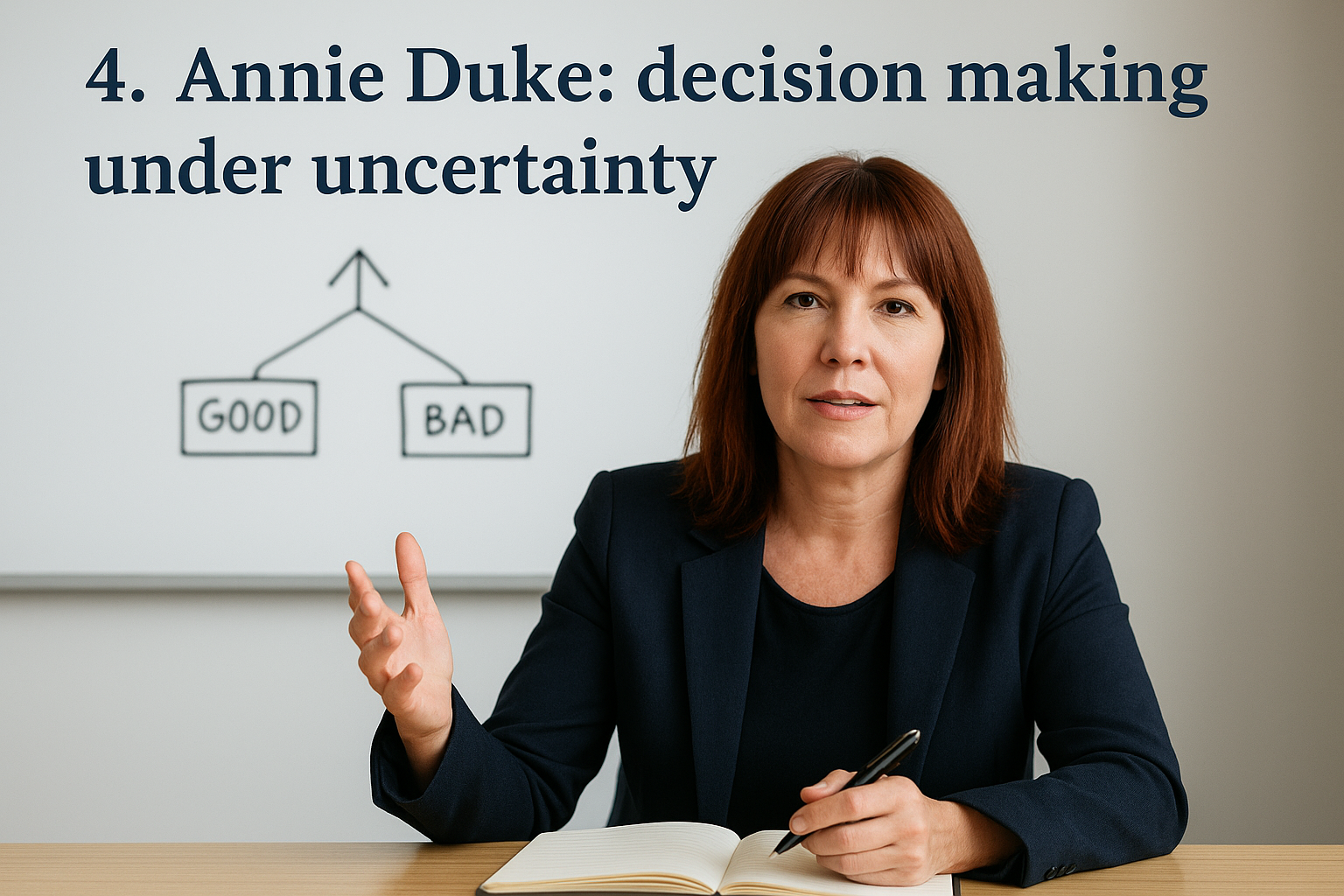
Annie Duke won her first World Series of Poker bracelet in 2004 and retired from the game in 2012. Before poker she had earned a master’s in cognitive psychology, and that pairing is her edge. She explains how professionals make good decisions when information is incomplete, and she writes it up in books such as Thinking in Bets.
- World Series of Poker bracelet winner
- Master’s in cognitive psychology
- Coach to senior executives and author of Thinking in Bets
Signature topics
Her key idea is that good decisions and good outcomes are different things. A leader who judges choices only by results will punish sound calls that were unlucky and reward reckless ones that paid off. She teaches teams to separate quality of decision from quality of outcome and to use probabilities instead of certainty.
- Thinking in bets: treating decisions as wagers
- Separating luck from skill in results
- Knowing when to quit and when to persist
Best fit and format
Duke fits strategy, risk, finance, and product audiences. She is a strong choice for an executive offsite where the agenda is how the leadership team decides, and for sales or investment groups that review results constantly. She has coached executives at companies such as Citibank.
She is a poor match for rooms that need a rally. Pick her for analytical audiences that want a sharper way of thinking, not an emotional lift.
Duke is the right pick when your team keeps judging decisions by how they turned out.
5. Juliet Funt: reclaiming time from busywork
Background
Juliet Funt is the founder and CEO of WhiteSpace at Work and the author of A Minute to Think. She builds her talks on one belief: busywork steals the thinking time that creativity and judgment need. She has helped organizations such as Costco, National Geographic, and Spotify raise employee satisfaction and productivity.
- Founder and CEO of WhiteSpace at Work
- Author of A Minute to Think
- Rated highly as a warm, engaging keynote speaker
Signature topics
Her method is to create space between tasks so people can think. She targets the habits that fill calendars: reflexive meetings, over-polished work, and constant reachability. Her talks give teams specific permission and tactics to stop doing low-value work.
- Eliminating busywork to free up thinking time
- Building space for strategy and creativity
- Practical team agreements about meetings and responsiveness
Best fit and format
Funt fits overloaded, burned-out, or stretched teams. If your people tell survey after survey that they have no time to think, she addresses that complaint directly. She suits annual meetings after a heavy year and productivity-focused leadership programs.
Her tone is warm and funny, which helps when the subject might otherwise feel like a scolding. She is the right choice for a broad audience at all levels, since her ideas apply from the mailroom to the boardroom.
Funt works best when the honest complaint in your organization is "we never have time."
6. Minda Harts: equity and advancement at work
Background
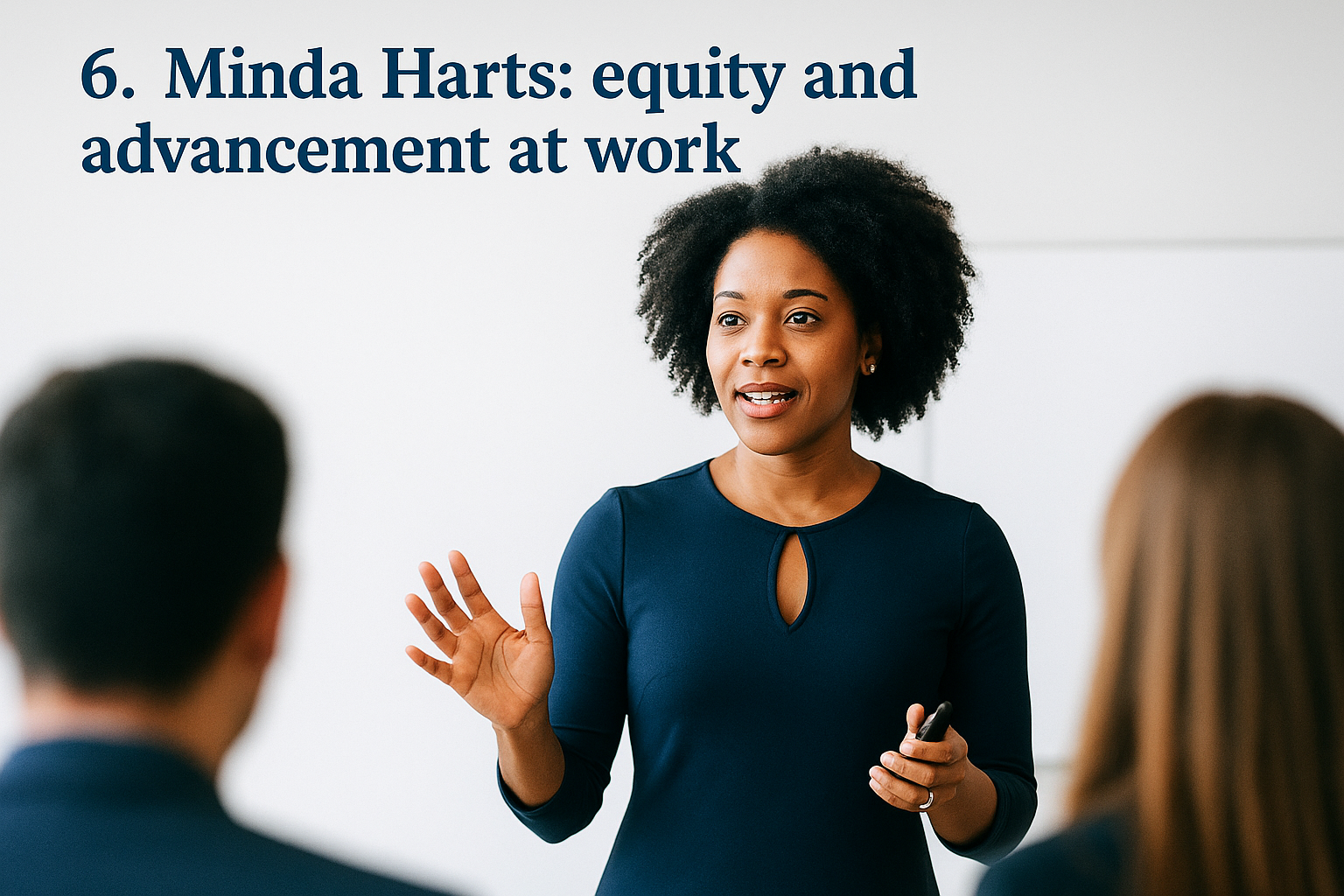
Minda Harts is the author of The Memo: What Women of Color Need to Know to Secure a Seat at the Table. Audiences value her no-nonsense approach, and she is the first to say there is no one-size-fits-all path to success in business. She focuses on management and leadership development practices that improve workplace equality.
- Author of The Memo
- Speaker on equity, advancement, and workplace inclusion
- Known for a direct, practical style
Signature topics
Her talks cover how organizations can support women of color and how women of color can navigate career advancement. She speaks to both sides of the table: employees who want a path forward and the leaders who control access. The material stays practical, with concrete actions for managers.
- Securing a seat at the table
- Management and leadership practices that improve equality
- Building sponsorship and support inside organizations
Best fit and format
Harts is a strong pick for employee resource group events, women’s leadership conferences, and inclusion programs. If you want a talk that goes beyond awareness and names what managers should change, her directness serves you well.
Be specific with her team about audience mix. A room of senior leaders needs a different emphasis than a room of early-career employees, and briefing her on who attends lets the talk land where it should.
Choose Harts when you want inclusion talk to end in specific management actions.
7. Michelle Stacy: leading growth and transformation
Background
Michelle Stacy served as President of Keurig during the years when its single-serve coffee system grew into a household name. Earlier she was Vice President and General Manager of the global professional oral care business at Gillette and Procter & Gamble. She is a business transformation expert, so she speaks about growth from the operator’s chair.
- Former President of Keurig
- Former VP and GM of global professional oral care at Gillette/P&G
- Keynote speaker on women in leadership
Signature topics
Stacy talks about workplace culture, leadership skills, and strategy and execution. Her examples come from large consumer brands, so she translates well to retail, consumer goods, and any business that has to scale quickly while protecting its culture.
- Leading a business through rapid growth
- Culture as a driver of performance
- Strategy and execution at scale
Best fit and format
She suits executive teams and senior leadership conferences where the audience wants perspective from someone who has run a major division. Women’s leadership events also benefit, since she can speak to what it took to reach a President’s seat inside large corporations.
For a company in the middle of change, her operating background offers a credible view. Ask her team how she tailors examples to your industry, because her strongest stories come from consumer products.
Stacy gives senior audiences a view of growth from someone who has been accountable for it.
8. Arlene Dickinson: entrepreneurship and investing
Background
Arlene Dickinson is a Canadian entrepreneur and investor best known from Dragons’ Den, the Canadian version of Shark Tank, where she has appeared across many seasons. She is General Partner of District Ventures Capital, and she has been inducted into the Canada’s Most Powerful Women Top 100 Hall of Fame. She speaks from the investor’s seat.
- General Partner of District Ventures Capital
- Longtime Dragons’ Den investor
- Canada’s Most Powerful Women Top 100 Hall of Fame inductee
Signature topics
Her subject matter is building and funding businesses. Because she evaluates pitches for a living, she can tell an audience what investors look for, where founders go wrong, and how to build a company people want to back. That makes her useful for both founders and corporate intrapreneurs.
- What investors look for in a founder and a business
- Building a brand and a business from scratch
- Leadership lessons from decades in entrepreneurship
Best fit and format
Dickinson fits entrepreneurship events, small business conferences, and innovation programs. Audiences recognize her from television, which helps draw attendance. She is also a good choice for corporate programs that want employees to think like owners.
Because she is based in Canada, confirm travel costs and logistics early if your event is elsewhere in North America. A virtual session is another option when budget is tight.
Dickinson is the pick when your audience wants to hear how an investor thinks.
9. Carla Harris: career strategy and confidence
Background
Carla Harris built her career on Wall Street and is a senior executive at Morgan Stanley. She is the author of Expect to Win and Strategize to Win, books of practical career advice that many professionals recommend to colleagues. She is also a gospel singer and recording artist, which brings an unusual dimension to her public presence.
- Senior executive at Morgan Stanley
- Author of Expect to Win and Strategize to Win
- Gospel singer and recording artist
Signature topics
Her advice comes in short, memorable principles she calls "pearls," each tied to a concrete career move. She speaks to how people build credibility, find sponsors, perform under pressure, and advance in organizations where few people look like them. Her message balances ambition with practical tactics.
- Expecting to win and preparing so you do
- Building the relationships that advance careers
- Leading authentically in large institutions
Best fit and format
Harris suits women’s leadership conferences, financial services events, and early-to-mid-career programs. Her style is encouraging but tactical, so attendees leave with moves to make, not only inspiration. She is also a good choice when the audience includes both employees and senior sponsors.
She is widely known, so expect higher demand and less scheduling flexibility than for emerging speakers. Start the conversation early, ideally many months before the event.
Harris works for audiences who want career strategy delivered with warmth and precision.
10. Jamie Kern Lima: self-belief and building a brand
Background
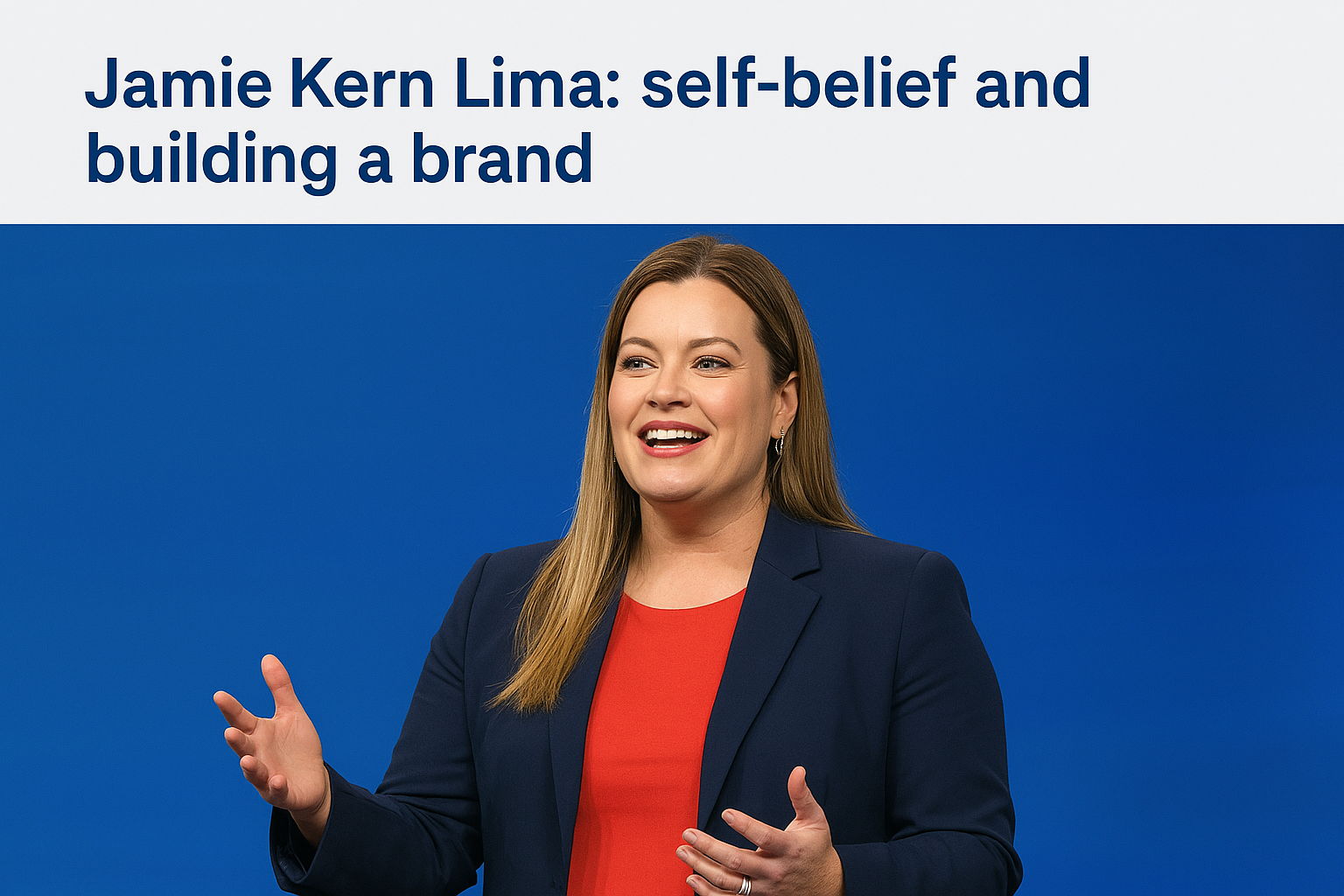
Jamie Kern Lima started IT Cosmetics from her living room and built it into a business that L’Oréal bought for $1.2 billion. She was told no many times along the way, and she tells that story without polish. She has appeared on Forbes’ list of the richest self-made women, and she mentors female entrepreneurs.
- Founder of IT Cosmetics
- Sold the company to L’Oréal for $1.2 billion
- Author of Believe It
Signature topics
Her talks center on self-doubt, resilience, and refusing to quit when the market tells you to. She links personal belief to business results, showing that the voice in your head can be as costly as a competitor. Entrepreneurs and early-career professionals connect with the honesty of her account.
- Pushing past rejection and self-doubt
- Starting a company with little money and few connections
- Building a brand that customers trust
Best fit and format
Lima fits women’s events, entrepreneurship conferences, and retail or beauty audiences. She suits a closing keynote where you want people to leave energized and ready to act. She is also strong for company-wide events that need a personal, emotional anchor.
She is a better fit for inspiration-led agendas than for technical training. Pair her with a practical workshop elsewhere in the program if you also want skills content.
Lima is the pick when you want the room to leave believing a bigger goal is possible.
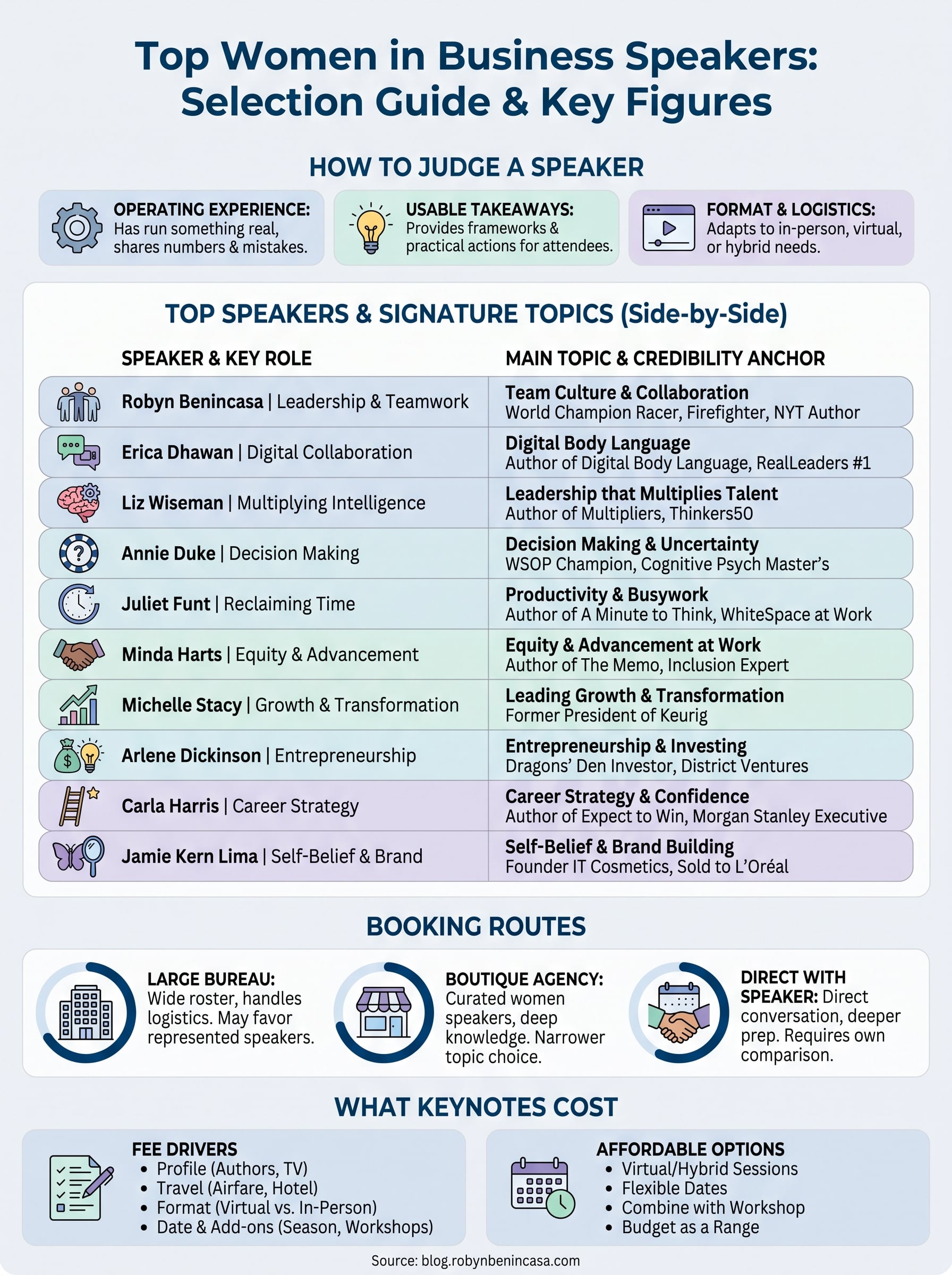
Women in business speakers compared at a glance
Use the table below to shortlist, then read each profile for detail. The main topic tells you what the talk is about, and the credibility anchor tells you why the audience should trust her.
Side-by-side comparison
| Speaker | Main topic | Credibility anchor |
|---|---|---|
| Robyn Benincasa | Team culture and collaboration | World champion adventure racer, firefighter, NYT best-selling author |
| Erica Dhawan | Digital communication and collaboration | Digital Body Language, RealLeaders 2020 ranking |
| Liz Wiseman | Leadership that multiplies talent | Multipliers, Thinkers50 |
| Annie Duke | Decision making and uncertainty | WSOP bracelet, cognitive psychology master’s |
| Juliet Funt | Productivity and busywork | A Minute to Think, WhiteSpace at Work |
| Minda Harts | Equity and advancement | The Memo |
| Michelle Stacy | Growth and transformation | Former President of Keurig |
| Arlene Dickinson | Entrepreneurship and investing | Dragons’ Den, District Ventures Capital |
| Carla Harris | Career strategy | Expect to Win, Morgan Stanley |
| Jamie Kern Lima | Self-belief and brand building | IT Cosmetics, $1.2 billion sale to L’Oréal |
Some of these names are publicly famous, such as Dickinson, Harris, and Lima. Others are better known inside corporate audiences than on television, which is often an advantage, since they tend to be more focused on teaching than on celebrity.
Matching a speaker to your event
Choose by the job the keynote must do. This list pairs common event goals with the names above:
- Sales kickoff or team offsite: Robyn Benincasa
- Remote or hybrid team reset: Erica Dhawan
- Manager development program: Liz Wiseman
- Executive strategy session: Annie Duke
- Burnout or workload problem: Juliet Funt
- Inclusion or employee resource group event: Minda Harts
- Senior leadership conference: Michelle Stacy
- Entrepreneurship summit: Arlene Dickinson
- Women’s career conference: Carla Harris
- Closing keynote with emotional lift: Jamie Kern Lima
Start with the outcome you want from the keynote, and the shortlist nearly writes itself.
Booking routes: bureau, boutique agency, or direct
You can book a women in business speaker through a large speaker bureau, a boutique agency focused on women speakers, or directly with the speaker’s team. Pick a bureau when you need to compare many names, and go direct when you already know who you want.
Three ways to book
| Route | What you get | Watch for |
|---|---|---|
| Large speaker bureau | Wide roster, side-by-side comparisons, contracts and logistics handled | Recommendations may favor speakers the bureau represents most |
| Boutique women-focused agency | Curated roster, deeper knowledge of each speaker | Narrower choice of topics and price points |
| Direct with the speaker | Direct conversation, no middle layer, deeper pre-event prep | You do your own comparison and contract review |
Bureaus earn a commission, which is usually built into the fee the speaker quotes. Ask for the all-in number in writing so you know what you are paying for.
How to decide
If you are early in your search and unsure which topic you need, start with a bureau or agency and ask for a shortlist based on your audience and goal. Give them your date, audience size, and budget range up front, since vague requests produce generic lists. Expect several names within a few days.
If you already have a name or two, go direct. Speakers who manage their own bookings often welcome a call with the event owner, which lets you shape the talk to your audience. That conversation is hard to replicate through a third party. Whichever route you pick, ask to see video of a recent talk before you commit.
What a women in business speaker costs
Fees for a women in business speaker are usually quoted on request, not published, and they commonly run from a few thousand dollars for emerging speakers to well into six figures for household names. Your final cost depends on who you book and how you structure the event.
What drives the fee
Several factors move the price. Demand and name recognition matter most, followed by the format and the distance the speaker must travel. These are the usual drivers:
- Speaker profile: bestselling authors and television figures cost more
- Travel: airfare, hotel, and ground transport are often billed on top of the fee
- Format: virtual keynotes remove travel and often cost less
- Date: peak conference season and short notice raise the price
- Add-ons: workshops, extra sessions, and meet-and-greets increase scope
Ways to keep it affordable
Affordable does not mean cheap. It means paying for the outcome you need and nothing else. The tactics below keep the total down without weakening the event:
- Book a virtual or hybrid session when travel would add a lot to the total
- Be flexible on dates and ask which weeks are lighter for the speaker
- Choose a speaker with a strong book and track record who is not yet a household name
- Ask whether combining a keynote with a workshop changes the total price
Treat budget as a range, not a number, when you contact a bureau or speaker. A range invites suggestions you would not otherwise hear.
Questions to ask before you sign
Clarify the contract terms before you commit. A short list of questions prevents most surprises:
- What is the total cost including travel and expenses?
- What is the cancellation and rescheduling policy?
- Can we record the session, and who owns the recording?
- Will the speaker do a pre-event call with our leadership?
- What happens if the speaker cannot attend?
The right fee is the one that includes everything, written down before the date is held.
Choosing your speaker
A strong women in business speaker earns her fee by changing what your people do after the event. Pick her by operating experience, concrete takeaways, and fit with your format, not by name recognition alone. The ten speakers above cover team culture, communication, leadership, decisions, productivity, equity, growth, entrepreneurship, career strategy, and self-belief.
Start with the outcome you need, shortlist two or three names from the table, and watch a recent talk from each. Then speak to the speaker’s team about your audience and goals before you decide.
If your priority is team culture building, you can talk to Robyn Benincasa about your event and see whether her keynotes match what your people need.