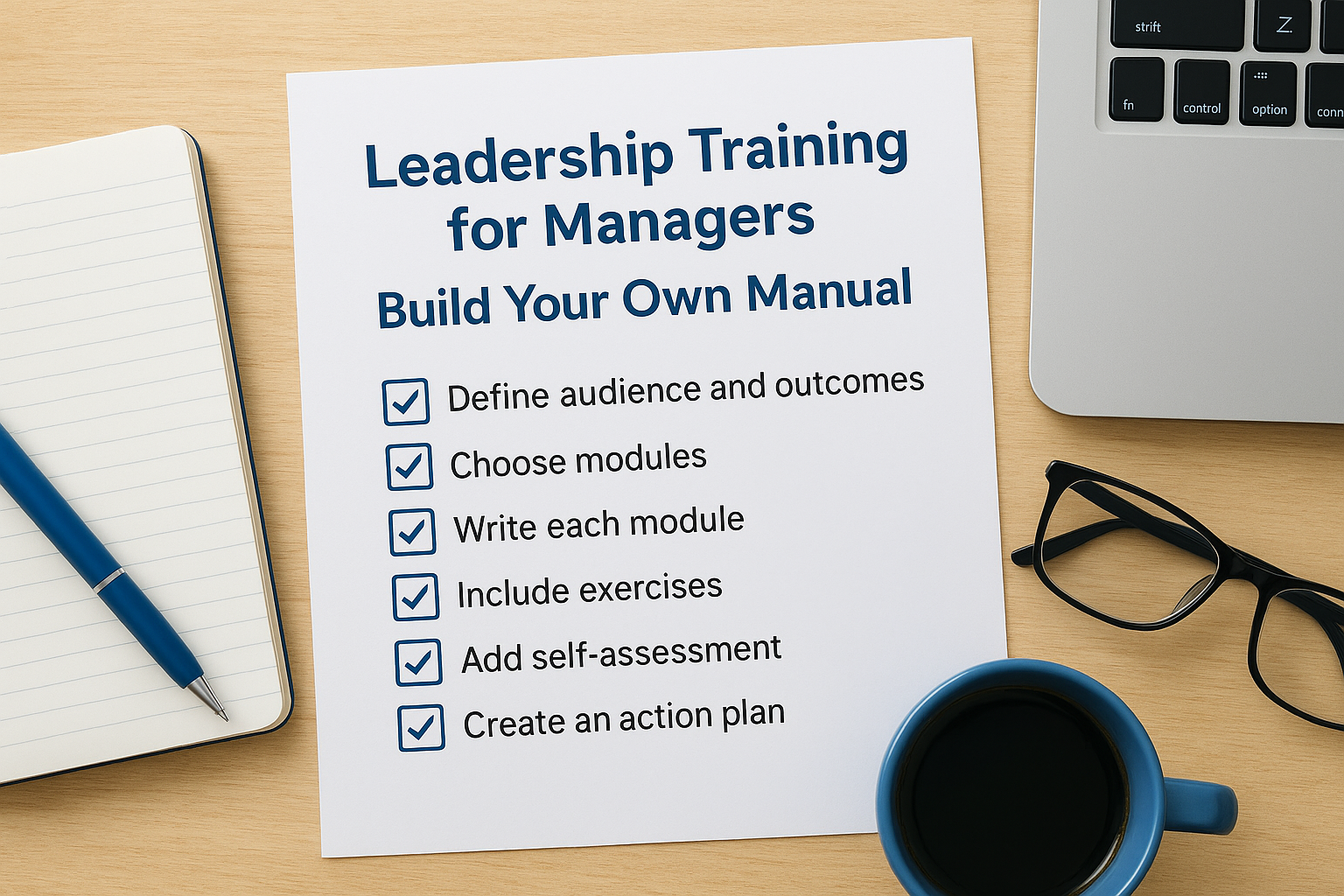
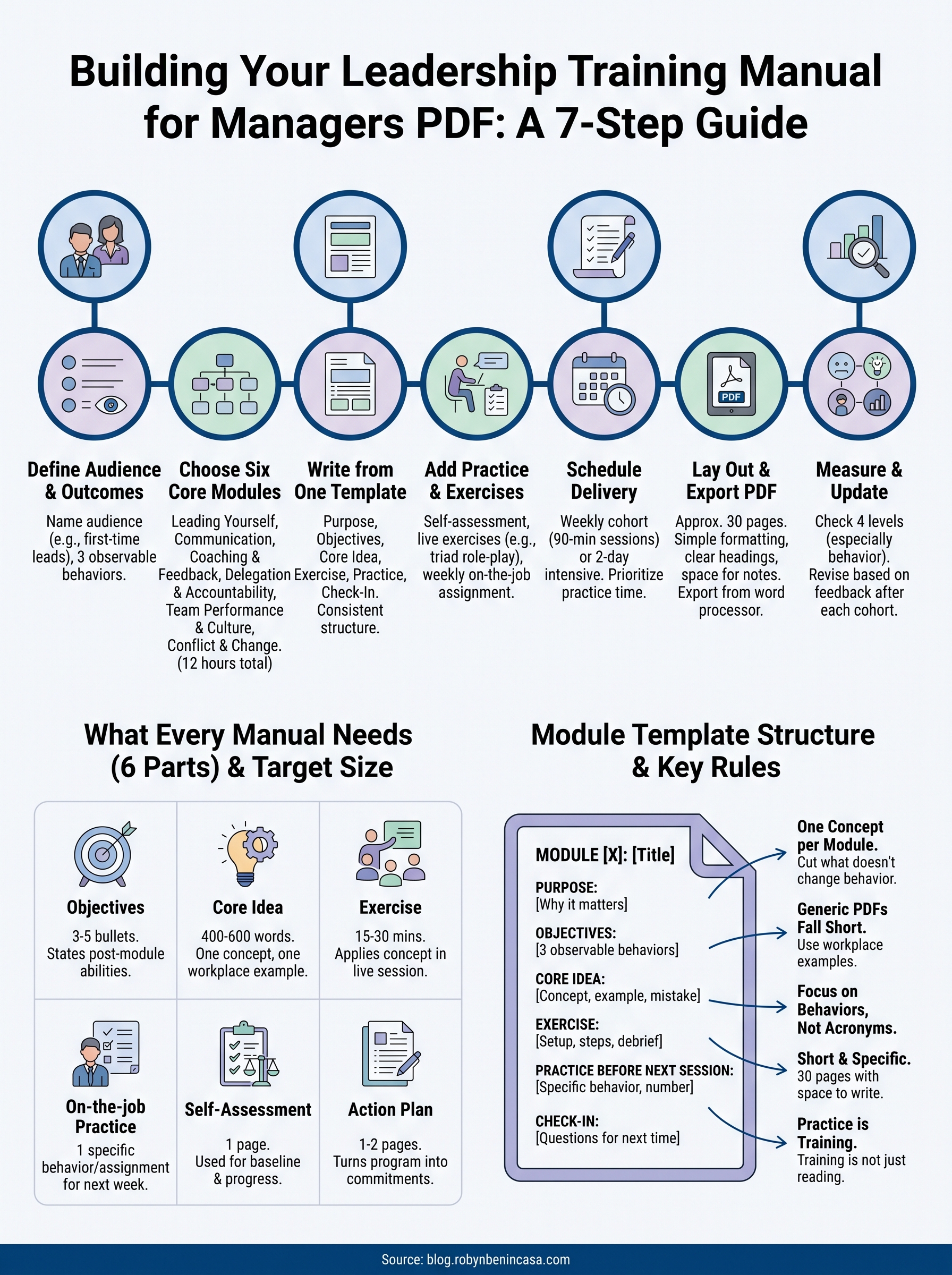
The fastest way to get a leadership training for managers PDF that fits your team is to build one yourself. Choose six core modules, write each from one repeatable template, add exercises that force practice, and export the finished manual as a PDF. A manual of about 30 pages is enough for a full eight-week program. Existing free PDFs are useful raw material, but they work best as source material rather than as the program itself.
Most managers are promoted because they were good at the work, not because anyone taught them to lead. When they search for help, they find manuals written for a school district, a pipeline crew, or a nonprofit. Those documents run long on theory and personality inventories and short on your team’s real problems. Someone hands them out, everyone nods, and nothing changes on Monday.
This guide walks you through seven steps: define the audience, pick the modules, write each one from a template, add exercises, schedule delivery, lay out the PDF, and measure results. It ends with a checklist for vetting any free PDF before you borrow from it. The advice comes from the same place as everything on this blog: years of watching how teams under pressure actually work, from adventure racing courses to firehouse kitchens.
What a leadership training manual for managers includes
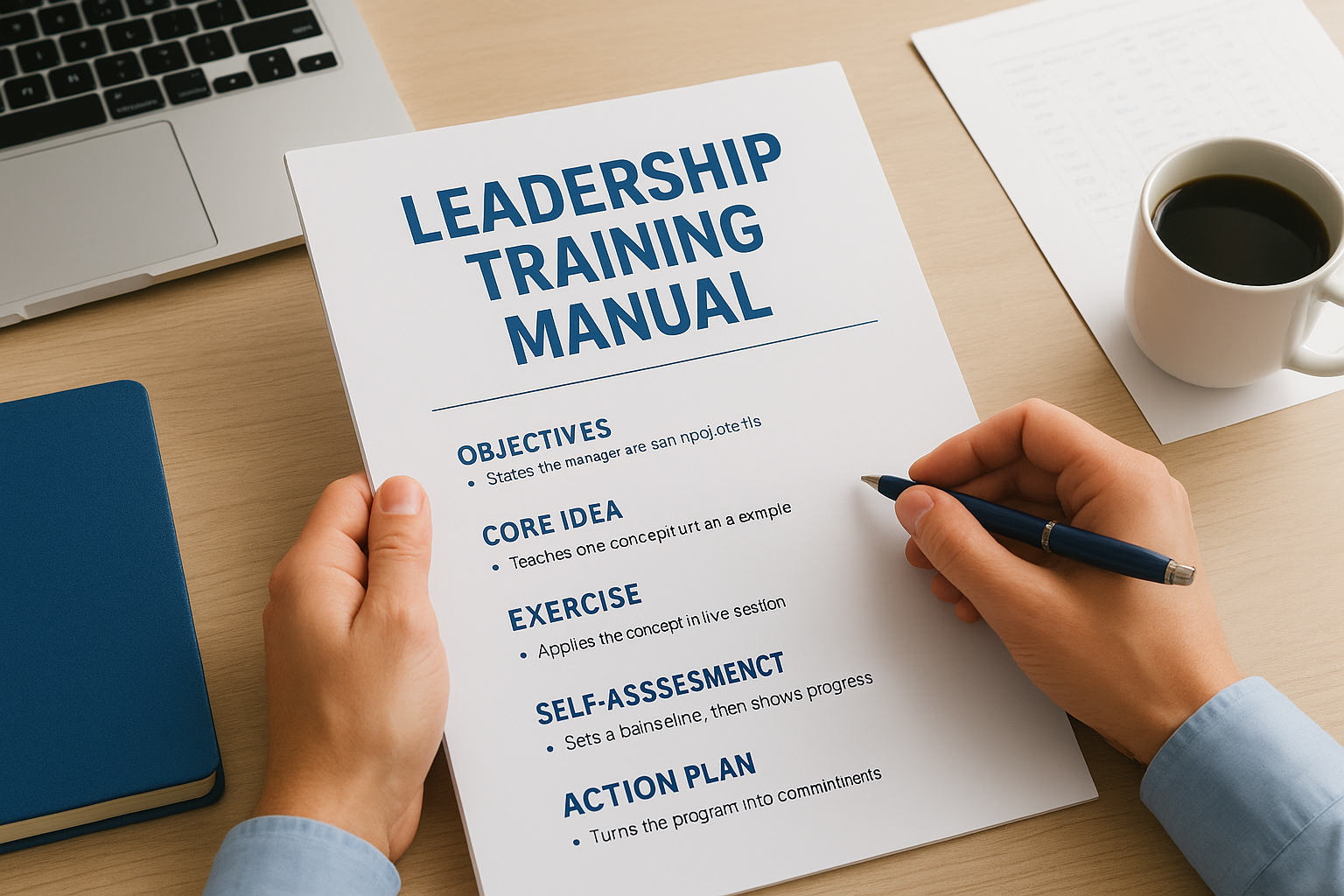
A usable leadership training manual for managers has six parts: objectives, a core idea, an exercise, on-the-job practice, a self-assessment, and an action plan. The free PDFs that circulate online follow this pattern. Each unit opens with a purpose and learning objectives, delivers a concept, and closes with something the learner does. If your manual lacks any of the six parts, managers will read it and then go back to old habits.
The parts every manual needs
Each part has a job, and each part has a size limit. Keep to the limits, because a manual that is too long does not get opened twice.
| Part | Its job | Target size |
|---|---|---|
| Objectives | States what the manager can do after the module | 3 to 5 bullets |
| Core idea | Teaches one concept, with an example from your workplace | 400 to 600 words |
| Exercise | Applies the concept in a live session | 15 to 30 minutes |
| On-the-job practice | One behavior to try before the next session | 1 assignment |
| Self-assessment | Sets a baseline, then shows progress | 1 page, used twice |
| Action plan | Turns the program into commitments | 1 to 2 pages at the end |
A manual that teaches ideas without assigning practice is a reading list, not training.
Why generic PDFs fall short
Generic manuals are written for a different audience than yours. One may teach five leadership styles to community organizers, while your managers need to run a safe crew or hit a quarterly number. The concepts transfer, but the examples do not, and managers can tell within two pages whether a document was written for them.
Another problem is the lack of follow-through. Many free manuals end with a bibliography or a glossary instead of a commitment. They also tend to bundle a scored personality inventory without a trained facilitator, which leaves managers sorting themselves into labels. Treat those inventories as conversation starters, never as verdicts about who someone is.
Skip the acronym frameworks
You will see searches for the "5 C’s," "7 C’s," or "5 P’s" of leadership. These lists vary by author. One writer’s five C’s are another’s seven, and none of them is a standard. They are memory aids, not research findings.
Build your manual around behaviors instead: holding a one-on-one, giving feedback, delegating a task, running a meeting. A manager can practice a behavior on Tuesday. A manager cannot practice "character." If your organization already uses an acronym, add it as a label on top of the behaviors rather than as the structure underneath.
Step 1. Define who the manual is for
Name one audience and three outcomes before you write a word. A manual aimed at "all managers" ends up useful to none of them. Decide whether you are training first-time team leads, experienced managers, or senior directors, because the same topic needs a different depth for each.
Pick one audience
New managers need basics: how to run a one-on-one, how to delegate, how to give feedback without damaging the relationship. Experienced managers already know the vocabulary, so they need hard cases, peer discussion, and ways to coach other managers. Mixing the two groups wastes the time of both.
Consider the most common situation: a top performer promoted to team lead. They tend to keep doing the work themselves because it feels safer. Your manual for this group should spend more time on delegation and trust than on strategy. A manual for directors should do the reverse.
Run a five-question needs check
Spend one week gathering evidence before you choose content. Ask five or six managers and ten of their direct reports the same short questions, and look for repeated answers. Copy this and adapt it:
1. What is the hardest part of leading people here right now?
2. Think of the last time a team member needed feedback.
   What happened?
3. How often do you have a one-on-one with each direct report?
4. Which tasks do you do yourself that someone else could do?
5. If you could fix one thing about how our teams work together,
   what would it be?
If three or more people name the same problem, that problem becomes a module or a major exercise.
Write three measurable outcomes
Outcomes are what you will check at 30, 60, and 90 days. Write them as observable behaviors, not feelings. For a first-time team lead program, three good outcomes are:
- Every manager holds a weekly one-on-one with each direct report.
- Every manager delegates at least two tasks with written expectations and a due date.
- Every manager gives specific feedback within 48 hours of the event it concerns.
If you cannot watch an outcome happen, it is a hope, not an outcome.
Step 2. Choose six core modules
Six modules cover what most manager programs need: leading yourself, communication, coaching and feedback, delegation, team performance, and conflict and change. This is the backbone of a leadership development training PDF that people finish. Each module below is sized to fit into an eight-week cohort of 90-minute sessions.
The six modules and their time
| Module | What it covers | Sessions | Hours |
|---|---|---|---|
| 1. Leading yourself | Self-awareness, personal style, managing your reactions under stress | 1 | 1.5 |
| 2. Communication and listening | Two-way conversation, active listening, running a one-on-one | 1 | 1.5 |
| 3. Coaching and feedback | Giving and receiving feedback, coaching questions | 2 | 3.0 |
| 4. Delegation and accountability | Handing off work, setting expectations, following up | 1 | 1.5 |
| 5. Team performance and culture | Trust, shared goals, meeting rhythm, psychological safety | 2 | 3.0 |
| 6. Conflict and change | Resolving disputes early, leading a team through change | 1 | 1.5 |
| Total | 8 | 12.0 |
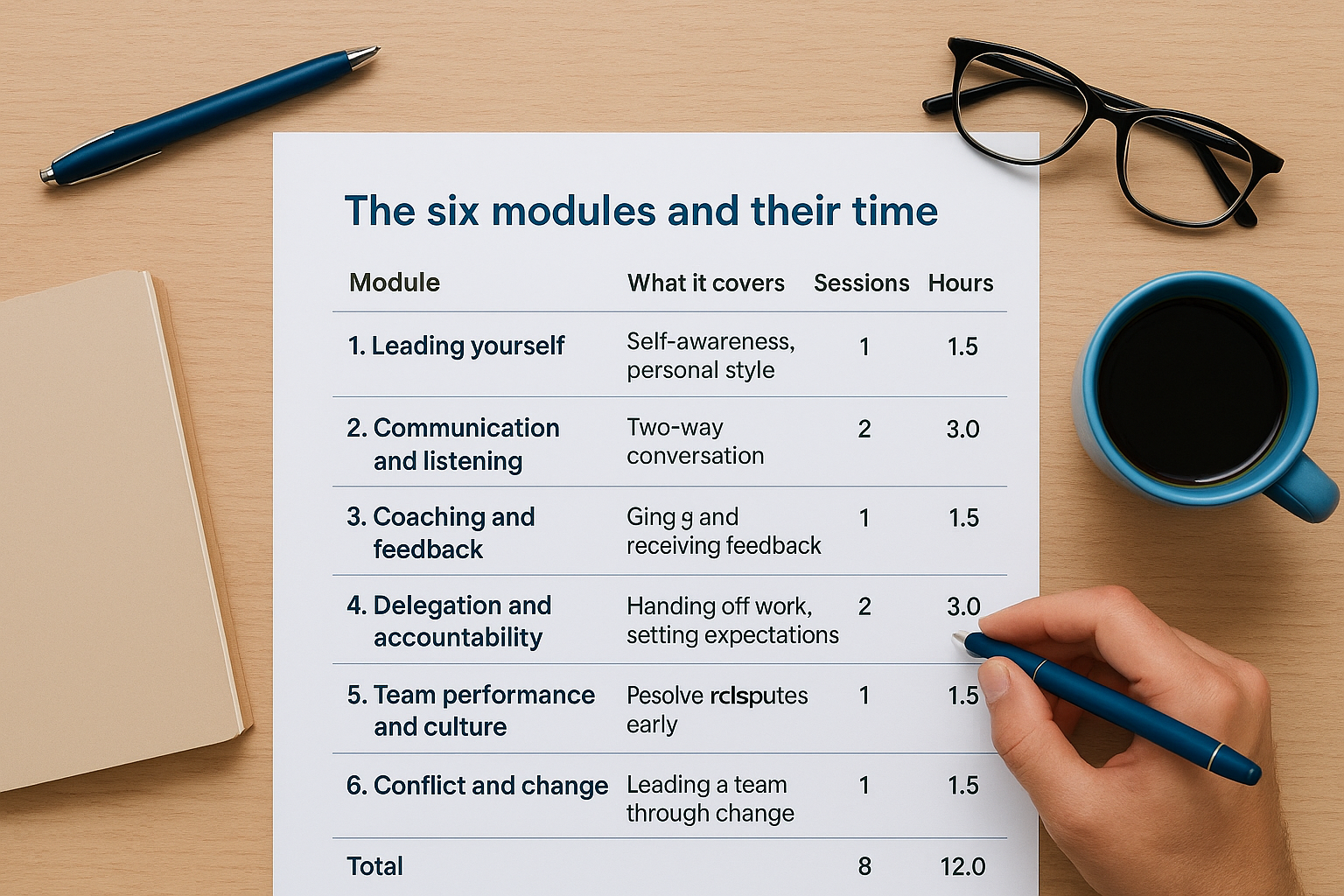
Coaching and team performance get two sessions each because they take the most practice and carry the most return.
Why this order works
Start with yourself, because managers who cannot manage their own reactions cannot manage anyone else’s. Move to communication next, since every later module depends on it. Feedback and delegation follow, because they are the daily tools of the job. Team culture and conflict come last, because they build on trust that the earlier modules create.
This order also fits how the best teams operate. In adventure racing, a team’s finish time is set by its last member across the line. Teams that win for years work on communication and shared commitment long before they work on speed. A manual should follow the same logic: relationships first, performance after.
Adjust the modules for your industry
Safety-critical teams, such as construction, utilities, or healthcare, should add a short block on speaking up and error reporting to the culture module. Sales organizations should add a block on coaching through a slump and sharing credit. A creative or technical team may need more on running meetings and protecting focus time.
Swap content inside the six modules instead of adding a seventh. Adding modules is how a 30-page manual becomes a 90-page one. If a topic truly deserves its own session, move something else out.
Six modules done with practice beat fifteen modules done with slides.
Step 3. Write each module from one template
Write every module in the same shape, so managers always know where to look and you can write faster. A consistent template also makes the PDF look professional and makes updating one module without touching the others easy. Use the template below for all six.
The module template
Copy this into a document and fill it in for each module:
MODULE [number]: [Title]

PURPOSE
One sentence on why this matters to a manager on this team.

OBJECTIVES
By the end of this module, you will be able to:
- [observable behavior 1]
- [observable behavior 2]
- [observable behavior 3]

CORE IDEA (400 to 600 words)
One concept. One example from our workplace. One common mistake.

EXERCISE (15 to 30 minutes)
Setup, steps, and debrief questions.

PRACTICE BEFORE THE NEXT SESSION
One specific behavior, with a number: "Hold two one-on-ones
this week and bring one thing you learned."

CHECK-IN
Three questions to answer at the start of the next session.
A worked example: giving feedback within 48 hours
Take the feedback module. The purpose line reads: "Feedback given late or vaguely changes nothing, so managers must give it quickly and specifically." The objective is: "Deliver feedback on one behavior within 48 hours of the event."
For the core idea, teach a simple three-part structure: the situation, the behavior you saw, and the impact it had. Many leadership programs use this approach because it keeps feedback factual. Then give managers a script they can adapt:
Situation: "In Tuesday's client call..."
Behavior:  "...you interrupted the client twice before she
            finished her question."
Impact:    "She stopped sharing details, and we lost the
            context we needed. Next time, let's wait for a
            full pause before we respond."
The exercise is a triad role-play, which Step 4 describes. The practice assignment is to give one piece of specific positive feedback and one piece of corrective feedback before the next session.
Rules for writing the core ideas
Keep the language plain, and write as if you were explaining it to a colleague over coffee. Use one concept per module, and cut anything that does not change what the manager does on Monday. Replace every generic example with one from your own organization, with names and details removed.
Aim for 400 to 600 words of core content per module, so each module fits on four pages with its exercise and practice assignment. Short is a feature. A manager with a full calendar will finish 30 pages and skim 100.
Write the exercise first, then write only as much teaching as the exercise needs.
Step 4. Add exercises that change behavior
Exercises turn a leadership training manual for managers into training instead of reading. Include a pre-program self-assessment, one live exercise per module, and one practice assignment between sessions. Without these three, completion rates look good and behavior stays the same.
Start with a self-assessment
Give managers a one-page self-rating at the start and again at the end. Use a 1 to 5 scale, where 1 means "rarely" and 5 means "almost always." Copy and adapt this version:
Rate yourself from 1 (rarely) to 5 (almost always):

__ I hold a one-on-one with each direct report every week.
__ I give specific feedback within 48 hours.
__ I delegate tasks with written expectations and due dates.
__ My team members tell me when they disagree with me.
__ I stay calm and curious when something goes wrong.
__ I know what each team member wants from their career.
__ I address conflict between team members early.
__ My team can explain our top three goals without notes.
Total possible: 40. The score itself matters less than which items score lowest. Those become each manager’s focus areas. Have managers compare their own ratings with the same questions answered by two direct reports, if your culture can handle it. That gap is often the most useful data in the program.
Five exercises that work for managers
These leadership development training activities suit most programs and need nothing but paper and a room.

- Admired leader. Each manager names a leader they would follow without question, then lists three specific behaviors that person shows. Pair up and share. Close by asking which one behavior each person will copy this month.
- Delegation audit. List everything you did last week. Mark each task: do, delegate, defer, or drop. Pick two to delegate and write expectations and a due date for each.
- Feedback triads. Groups of three rotate through giver, receiver, and observer. Each round lasts 10 minutes using the situation, behavior, and impact structure. The observer reports what was specific and what was vague.
- Start, stop, continue. Each manager asks their team to name one thing to start, one to stop, and one to continue in how the manager leads. Managers return with real answers, and the next session opens by discussing them.
- Conflict case. Write one anonymized dispute from your own organization. Small groups decide what the manager should do in the first 24 hours, then compare their plans.
Assign practice between sessions
Every module ends with one behavior and one number, such as "two one-on-ones" or "three delegated tasks." Start each session with five minutes of check-in on the last assignment. The check-in matters more than any lecture, because it tells managers that the practice is not optional.
Pair managers as accountability partners for the whole program. A short text or a 10-minute call each week is enough. Peers who struggle together tend to keep going after the program ends.
Training changes behavior only when someone asks, next week, whether you did it.
Step 5. Build the schedule and kickoff
Pick a delivery format before you finalize the manual, because it determines how much content each page can carry. The two most common formats are a weekly cohort and a two-day intensive. Both deliver the same 12 hours of instruction from Step 2.
Choose a delivery format
| Format | Structure | Instruction time | Best for |
|---|---|---|---|
| Weekly cohort | 8 sessions of 90 minutes, one per week | 12 hours | Managers who must keep working while they learn |
| Two-day intensive | 2 days with about 6 hours of instruction each | 12 hours | Teams in one location that can leave the floor |
| Self-paced with huddles | One module read per week plus a short group huddle | Varies | Distributed teams with limited shared time |
The weekly cohort usually works best because it forces managers to try behaviors between sessions. An intensive is faster but compresses practice, so build in follow-up check-ins at 30, 60, and 90 days.
Work through an example
Say you have 12 first-time team leads. Run eight weekly 90-minute sessions. Seat them at three tables of four, since groups of four to five let everyone speak, and keep the total cohort at 15 or fewer so the facilitator can watch every table.
Each manager spends 12 hours in sessions. Add roughly 30 minutes of weekly practice and check-in, which is 8 × 0.5 = 4 hours. The total is 16 hours per manager over eight weeks, or two hours a week. That is a number you can show an executive, and it is small enough to protect on a calendar.
Open with one shared story
Programs start better when managers hear one memorable story that frames the whole eight weeks. A short keynote can do that job. A 45 to 60 minute session on building a connected team culture sets the tone for the culture module. Robyn Benincasa’s Extreme T.E.A.M.W.O.R.K. keynote, which teaches the 8 elements of a winning culture, runs 45 to 60 minutes and fits this role well. For sales managers, her Why Winners Win keynote, 30 to 60 minutes, speaks to competitive teams.
A kickoff is optional. If your budget is zero, a senior leader telling the story of a time a team beat the odds works. What matters is that managers start with a reason to care, not with an agenda slide.
Schedule the practice time before you schedule the content, or the practice will not happen.
Step 6. Lay out and export the manual as a PDF
A clean, short PDF gets used, so plan for about 30 pages and export it from a word processor you already own. The layout is simple: front matter, a pre-program assessment, six modules, and an action plan. Anyone who can use Word or Google Docs can produce a professional manual without a designer.
Plan the page count
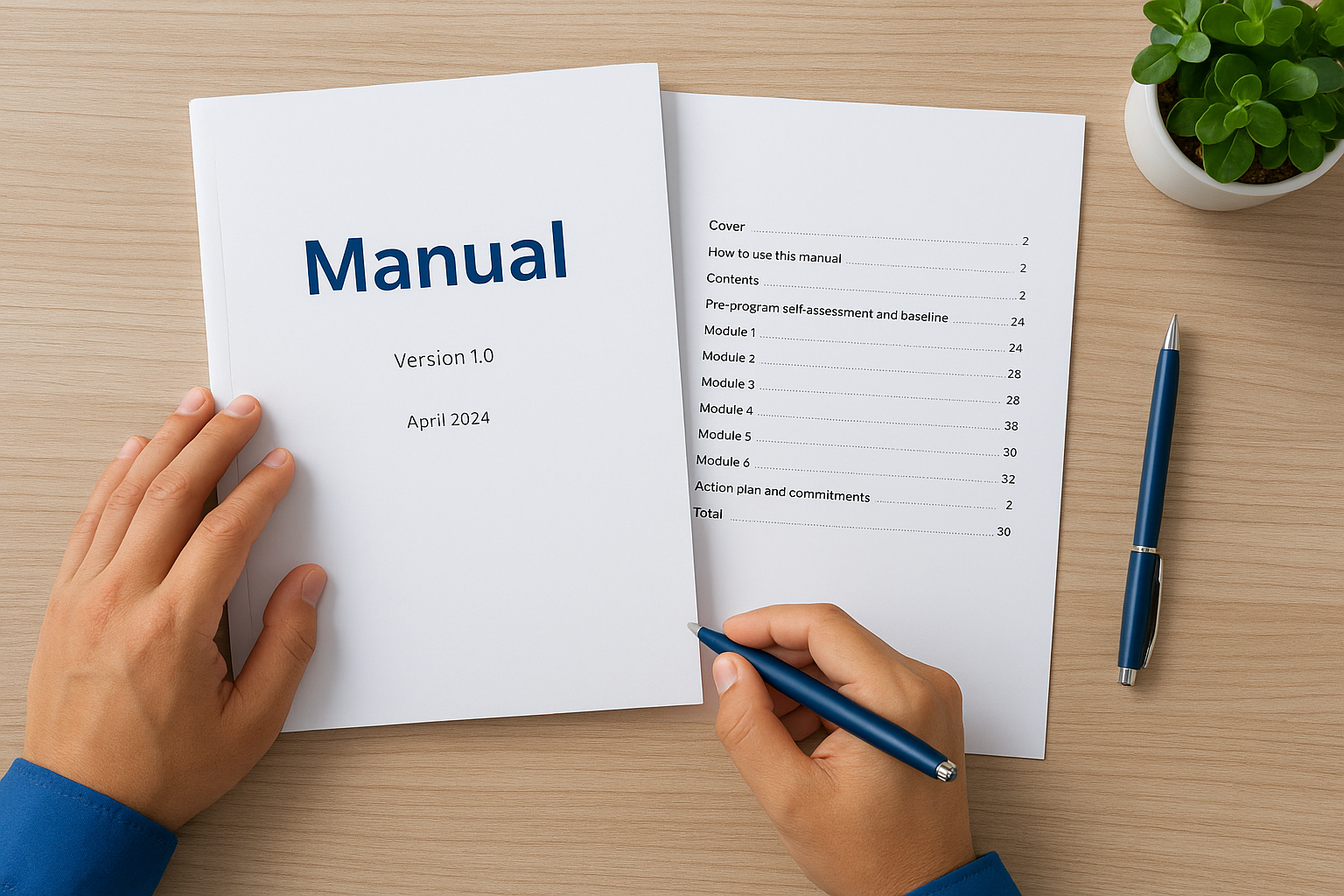
This is a leadership training module for managers laid out page by page:
| Section | Pages |
|---|---|
| Cover, how to use this manual, and contents | 2 |
| Pre-program self-assessment and baseline | 2 |
| Six modules at 4 pages each | 24 |
| Action plan and commitments | 2 |
| Total | 30 |
Each four-page module holds its purpose and objectives, the core idea, the exercise instructions, the practice assignment, and a half page of blank lines for notes. Blank space for writing is not wasted space. Managers who write in the manual remember more of it.
Format it so people read it
Use heading styles for module titles and section names, so your table of contents builds itself and the PDF gets bookmarks. Pick one readable body font at 11 or 12 points, and keep it consistent. Put exercises in a shaded box or table so they stand out from the teaching text.
Add alt text to any image and keep contrast high, so the file works for readers using screen readers. Put a version number and date on the cover, such as "Version 1.0, [month and year]," so a manager knows whether they hold the latest copy.
Export the PDF
In Microsoft Word, choose File, then Save As, then pick PDF as the file type. In Google Docs, choose File, then Download, then PDF Document. Open the exported file and check that the table of contents links work, the page breaks fall where you expected, and no table has split across pages in an awkward place.
Keep the editable source file in a shared folder, and treat the PDF as the published edition. When you revise a module, change the source, bump the version number, and export again. If you adapted any text from another document, confirm you have permission and credit the source.
A 30-page manual with space to write beats a polished 100-page binder nobody opens.
Step 7. Measure results and update the manual
Judge the program by what managers do afterward, not by how they rated the sessions. Use the four levels of the Kirkpatrick model: reaction, learning, behavior, and results. Together they show whether the manual is worth keeping, fixing, or replacing.
Check four levels
| Level | Question | How to check |
|---|---|---|
| Reaction | Did managers find it useful? | Two-question survey after each session |
| Learning | Do they know and can they do the skill? | Repeat the self-assessment at week 8 and compare scores |
| Behavior | Are they doing it on the job? | Direct reports confirm at 30, 60, and 90 days |
| Results | Did team outcomes move? | Track engagement, turnover, and a team-specific metric |
Behavior is the level most programs skip, and it is the one that matters. A simple pulse survey to direct reports works well. Ask three questions: Does your manager hold a weekly one-on-one with you? Do you get specific feedback quickly? Do you know what is expected of you?
Set a revision cycle
Review the manual after every cohort. Read the lowest-scoring self-assessment items and the comments from check-ins. If managers consistently skip an exercise, either the exercise is poor or the module that surrounds it is too long.
Cut before you add. Each revision should leave the manual the same length or shorter. Once a year, refresh the examples so they reflect your current workplace, and update the version number each time.
The manual is finished when you stop improving it after each cohort, not when you export the first PDF.
Extra: vet free leadership PDFs before you borrow from them
Free PDFs are worth borrowing from when they pass a short quality check. Look for a named author or organization, a recent date, a clear structure, and exercises. Always confirm the usage terms before copying text, since many manuals are copyrighted even when they are free to read.
Run a five-point check
Before you adapt anything from an existing document, ask:
- Who wrote it, and what is their experience with the audience you serve?
- When was it published or last revised?
- Does each unit state objectives and include an exercise, or only theory?
- Does it match the six modules you chose, or would you need to rewrite most of it?
- Does it state whether you may copy, adapt, or redistribute it?
If you cannot answer the last question, assume you may not copy it. You can still read it for ideas and then write your own version in your own words.
Know where useful ones come from
Documents written by government agencies, university extension programs, professional associations, and industry groups tend to be better sourced and more practical than anonymous documents on file-sharing sites. Industry-specific guidelines are especially useful because they use examples from your world, such as safety culture for field crews or coaching for sales teams.
Read widely, but borrow structures and ideas, not paragraphs. A five-step method for adapting your style to a team member or a framework for setting expectations can become your own module in an afternoon. What you should not borrow is a long personality inventory with a scoring sheet. Without a trained facilitator, those create labels, not behavior change.
Use free PDFs as source material, then write the manual your managers will actually use.
Start with one module this month
A good leadership training manual for managers is short, specific, and built around practice. Define your audience, choose six modules, write each from one template, add exercises and weekly assignments, schedule delivery, export a 30-page PDF, and check behavior at 30, 60, and 90 days. The structure matters more than the length.
You do not need to finish all six modules before you start. Write the first one, run it with a small group, and see what managers do the following week. If you want more on building team culture and leading under pressure, explore the leadership and team culture articles on the Robyn Benincasa blog and use them to sharpen your next module.