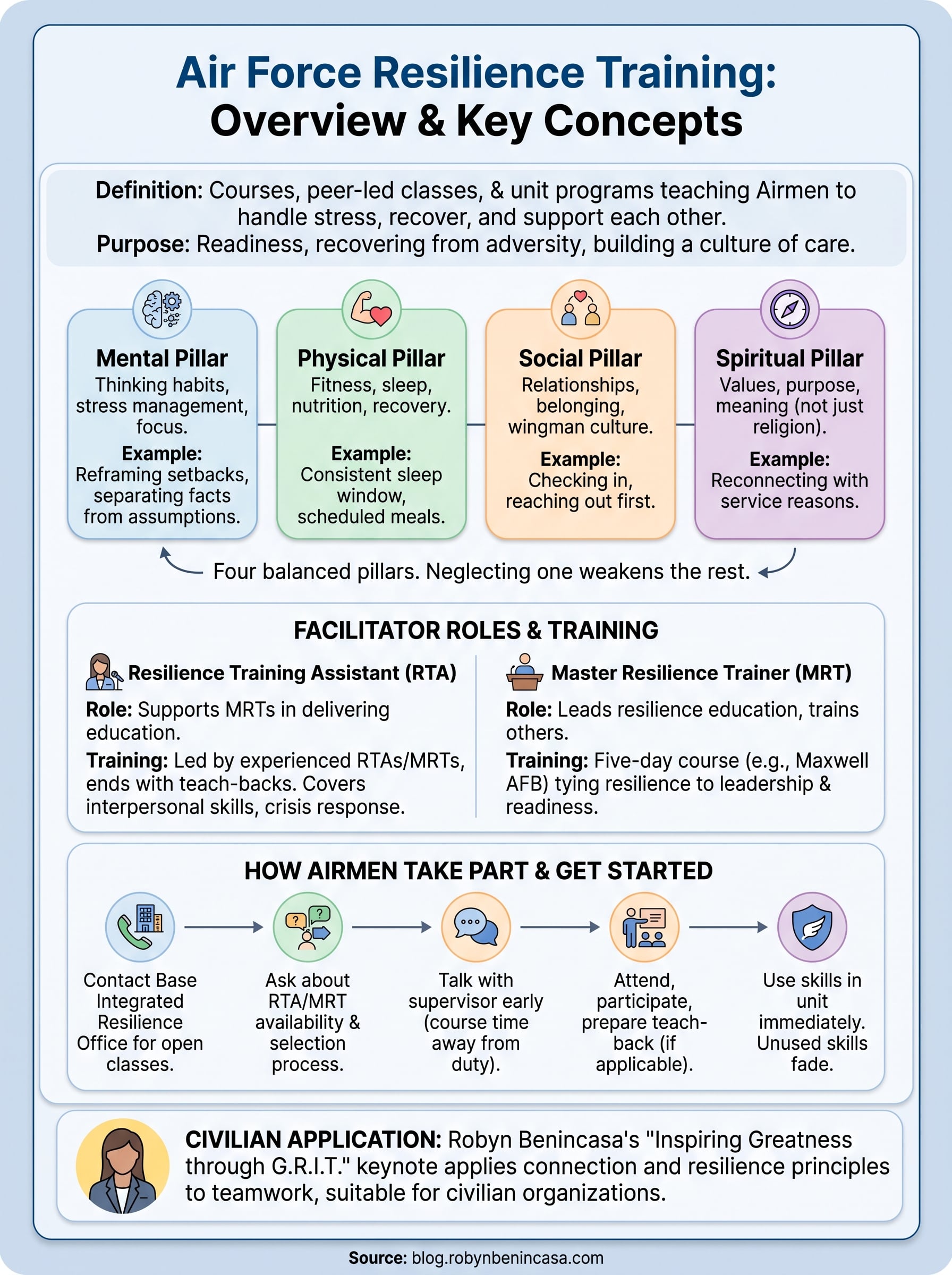
Air Force resilience training is the set of courses, peer-led classes, and unit programs that teach Airmen to handle stress, recover from setbacks, and support each other. It rests on four pillars: mental, physical, social, and spiritual. These come from the Comprehensive Airman Fitness framework. Facilitators called Resilience Training Assistants (RTAs) and Master Resilience Trainers (MRTs) deliver much of the material, and your base’s Integrated Resilience Office is the front door to it.
This guide covers why the training exists, how an Airman gets into it, what each pillar looks like in daily practice, and what civilian teams can borrow from the model. It is written for Airmen, family members, and anyone who wants to understand how the program works.
Robyn Benincasa spent more than two decades as a San Diego firefighter and led adventure racing teams through brutal conditions. She knows that resilience is a team skill, not a solo trait. We are not affiliated with the Air Force, so for current requirements and class schedules, rely on your own chain of command and resilience office.
Why resilience training matters to Airmen and units
Resilience training matters because the mission depends on people who can absorb pressure and keep functioning. The Air Force treats resilience as part of readiness, not as a wellness extra. A unit with exhausted, isolated Airmen is less ready, whatever its equipment looks like.
What the training is meant to do
The program aims to help individuals and communities withstand and recover from adversity. Integrated Resilience Offices describe the goal as building resilient, growth-oriented Airmen and families. Families are part of the design, not an afterthought.
The training also reaches past crisis response. It targets everyday strain, such as a conflict with a supervisor, a rough move, or a stressful parenting week. Airmen who have practiced these skills in ordinary moments are better placed to use them in extreme ones. The aim is a culture of care where people notice each other before a problem becomes an emergency.
The four pillars at a glance
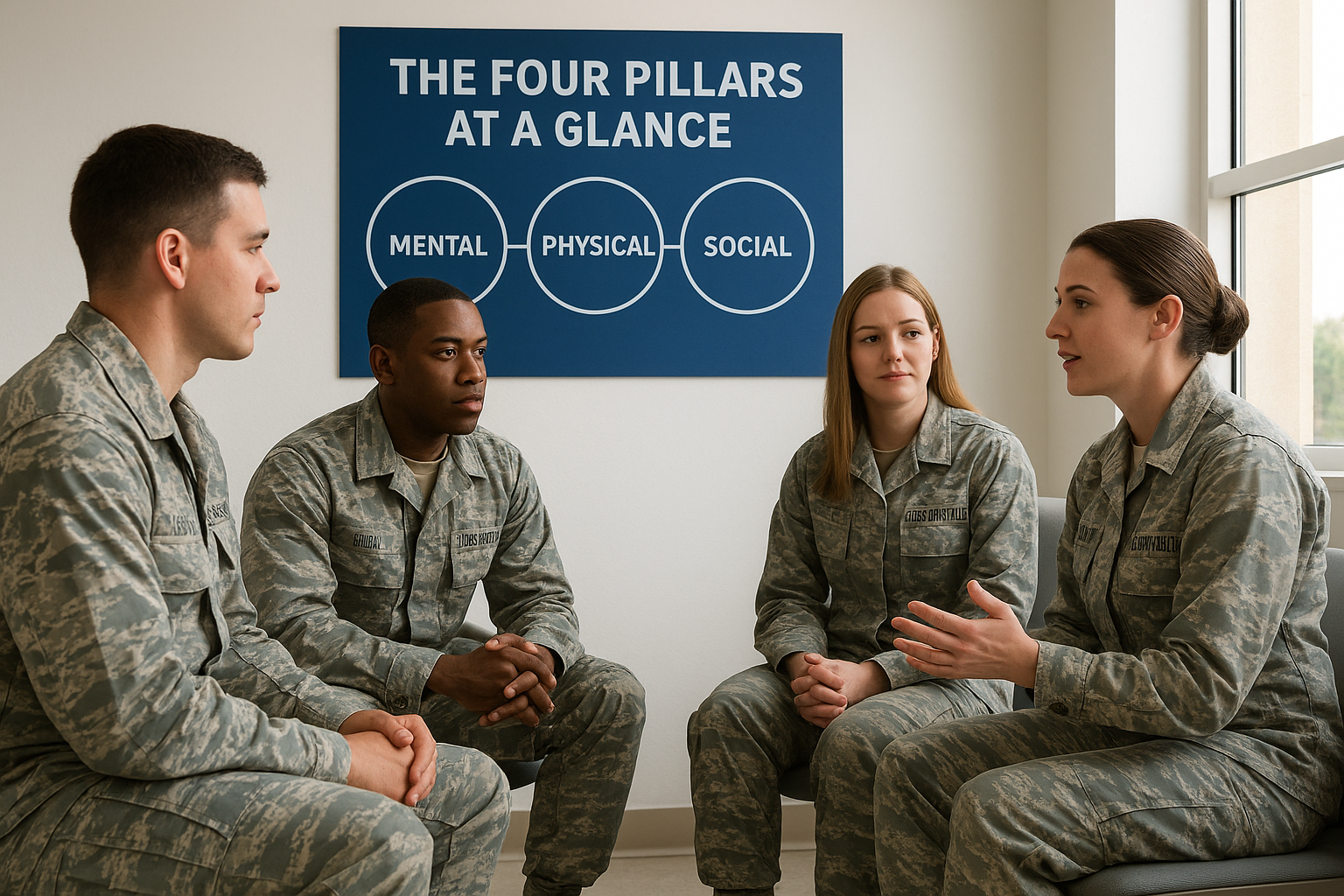
Every part of the program maps back to four domains. They are meant to be balanced, because a strong pillar in one area does not cover a weak one in another.
| Pillar | What it covers | Everyday example |
|---|---|---|
| Mental | Thinking habits, stress management, emotional control, focus | Reframing a setback instead of replaying it |
| Physical | Fitness, sleep, nutrition, recovery | Protecting sleep before a heavy workweek |
| Social | Relationships, belonging, family, wingman culture | Checking in on a coworker who seems withdrawn |
| Spiritual | Values, purpose, meaning (not limited to religion) | Reconnecting with why you serve after a hard stretch |
Resilience in the Air Force is a balance of four pillars, and neglecting one weakens the rest.
How Airmen take part in resilience training
Airmen take part through classes offered locally by their base resilience office, and a smaller group goes further by completing the RTA or MRT course to become facilitators. The right entry point depends on whether you want to receive training or help deliver it.
The Resilience Training Assistant course
The RTA course prepares participants to assist MRTs in delivering resilience education across the force. Experienced RTAs and MRTs lead it, and the modules cover interpersonal skills, crisis response, and resilience-building in different settings.
The course ends with "teach-backs." Each participant presents one module to the group, which proves they can facilitate it and not just understand it. Past participants describe using the skills in supervision and at home as parents, which shows the training is not limited to the duty day.
The Master Resilience Trainer course
The MRT course trains the people who lead resilience education in units. The Eaker Center for Leadership Development at Maxwell Air Force Base has run it as a five-day course that ties resilience to leadership and mission readiness. Here is how the two roles compare.
| Role | Main job | How the course works |
|---|---|---|
| Resilience Training Assistant | Supports MRTs in delivering resilience education | Led by experienced RTAs and MRTs, ends with teach-backs |
| Master Resilience Trainer | Leads resilience education and trains others | Five-day course, including at Maxwell AFB |
Steps to get started
Follow this sequence, and adjust it to your base.
- Contact your wing’s Integrated Resilience Office and ask which classes are open to you.
- Ask whether RTA or MRT seats are available and what the selection process looks like.
- Talk with your supervisor early, since the course takes time away from normal duties.
- Attend, take part fully, and prepare your teach-back if the course includes one.
- Use the skills in your unit right away, because unused skills fade.
If your unit assigns a computer-based resilience course, get the current version and deadline from your unit training manager. Requirements change, and answer keys circulating online are no substitute for the material.
Start with your base Integrated Resilience Office, because it knows which courses are open to you right now.
What each pillar looks like in daily practice
Each pillar turns into small, repeatable habits, and the strongest results come from using all four together. Treat the list below as examples of the idea, not an official curriculum.
Practical habits for each pillar
- Mental: Name the stressor, separate facts from assumptions, and pick one action you control.
- Physical: Keep a consistent sleep window, train regularly, and eat on a schedule during busy weeks.
- Social: Keep up with two or three people who would notice if you disappeared, and reach out first.
- Spiritual: Write down what you value and check your week against it.
Small habits matter because resilience is built before the hard day arrives. Waiting until a crisis to practice them is too late.
Example: supporting a struggling wingman
Picture a flight supervisor who notices an Airman skipping lunch, snapping at coworkers, and arriving late. The supervisor starts with the social pillar and asks directly how the Airman is doing, then listens before offering advice. Next the supervisor checks the physical pillar, asking about sleep and workload, and the mental pillar, by helping break a big problem into steps.
Some situations go further than everyday coping. The Air Force offers courses such as ASIST+ and SafeTALK to help Airmen recognize and respond to signs of suicide risk. If you or someone you know is in crisis, call or text 988. Veterans and service members can then press 1 to reach the Veterans Crisis Line.
Resilience skills work best when a trained wingman uses them before the crisis, not after.
What civilian teams can borrow from the model
Civilian organizations can borrow three ideas: train peers and not just managers, treat connection as a skill, and practice before pressure hits. You do not need a military structure to apply them.
Lessons that transfer
The Air Force does not leave resilience to the chain of command alone. It trains volunteers and facilitators at every level, so the help is nearby when someone needs it. A company can do the same by training a few trusted peers in each department to spot strain and start conversations.
The teach-back is another idea worth copying. Asking someone to teach a concept proves they understand it, and it spreads the skill faster than a slide deck. Finally, balance across domains beats pushing on one front. A sales team that only works on mindset while ignoring sleep, relationships, and purpose will plateau.
Where a keynote fits
Resilience training is a long-term system, and a keynote cannot replace it. A keynote can reset energy and give a team a shared language to start from. Robyn’s "Inspiring Greatness through G.R.I.T." keynote, which runs 45 to 60 minutes, is built for teams facing adversity, tough years, or stretch goals. It shows that real grit comes from connection, which is the same idea behind the social pillar.
Teams stay resilient when connection is treated as a skill that someone is responsible for building.
Where to start
Air Force resilience training builds readiness through four balanced pillars, delivered by trained RTAs and MRTs, and reached through your base’s Integrated Resilience Office. Learn the pillars, ask about local classes, and decide whether you want to be a participant or a facilitator.
If you lead a civilian team and want to bring the same ideas about grit and connection to your people, explore Robyn Benincasa’s Inspiring Greatness through G.R.I.T. keynote on teamwork and resilience.