The best business resilience training depends on what you need to walk away with. If you want a recognized credential, start with the BCI’s CBCI course or a DRI International program. If you want a wider view of organizational resilience, APMG’s Business Resilience Fundamentals fits. If you need a low-cost, self-paced start for employees, take a Udemy course. If you run a small business in a hazard-prone area, a four-hour disaster workshop is the fastest useful step.
The hard part is that providers use "business continuity," "business resilience," and "operational resilience" loosely. Some courses teach you to write a continuity plan. Others teach you to build an organization that absorbs shocks. Free webinars and PDF guides explain the concepts, but they do not give you a credential or a tested method.
This list compares five options by what you learn, who they suit, and what to check before you pay. Robyn Benincasa speaks to organizations about the people side of disruption, so the article also flags where process training ends and team training begins.
1. BCI Certificate (CBCI) course
What you learn

The CBCI is the Business Continuity Institute’s entry-level certification, and the CBCI 7.0 course teaches the fundamentals of implementing a business continuity management program. It follows the BCI’s Good Practice Guidelines, so you learn a full lifecycle, not just a plan template.
Expect the core stages of any program: analysis, design, implementation, and validation. Those stages apply whatever your industry.
Who it suits
This course suits newcomers to a continuity role, plus risk, IT, and operations staff who inherit the job. It also suits anyone who wants a credential from an internationally active professional body.
If you already run a mature program, aim higher. The BCI’s upper membership grades require documented experience, so the CBCI works as the first rung.
Format and what to check
Confirm the current course dates, delivery format, and exam fee on the BCI site. Training partners deliver the course, and details vary by provider.
Also ask whether the exam is bundled into the course price and whether membership fees apply. Those two items change the real cost more than the course fee does.
Start with the CBCI when you need a continuity vocabulary and a credential at the same time.
2. DRI International business continuity courses
What you learn
DRI International runs online courses, BCOE 0100 through 1000, built on its Professional Practices. Together they cover the continuity lifecycle, from program setup to risk, impact analysis, strategy, and exercises.
The courses prepare you for DRI’s certification ladder: ABCP, CFCP, CBCP, and MBCP. Each level asks for more proven experience.
Who it suits
This path suits working practitioners who want an online route to a long-established credential. It works well if your team is spread across locations.
Beginners can start at the associate level. Experienced managers can aim for CBCP or MBCP once they meet the experience requirements.
Format and what to check
Map each course to the credential you actually want before you register. Then check the experience requirements and exam rules for that credential on the DRI site.
Ask about renewal too. Professional credentials like these usually require continuing education to stay active, so budget time for it.
Choose DRI when you want online study and a certification ladder you can climb over several years.
3. APMG Business Resilience Fundamentals
What you learn
Business Resilience Fundamentals is a fundamentals-level certification that guides participants through tools for building and enhancing organizational resilience. The focus is wider than continuity planning.
Think of it as the course for leaders who must make an organization adaptable, not only able to recover from a single outage.
Who it suits
It suits managers, project leads, and executives who sponsor resilience work without running the continuity program themselves. Consultants who need a shared framework for explaining resilience to clients also benefit.
It is a weak fit if you must write detailed recovery procedures. Pair it with a practitioner-level course for that.
Format and what to check
APMG exams are usually taken through accredited training organizations, so fees, schedules, and delivery differ by provider. Compare at least two providers.
Read the syllabus for the specific tools covered, and confirm whether the exam is included in the price.
Pick APMG when your job is steering resilience across the organization, not writing the recovery plan.
4. Udemy Business Resilience course
What you learn

The Udemy Business Resilience course teaches risk and crisis management through a seven-step plan: monitor finances, market effectively, leverage technology, and more. It is practical and aimed at ongoing resilience, not formal continuity standards.
Because it is self-paced video, people can finish it in short sessions around their normal work.
Who it suits
This is the right start for small business owners and employees who need basic training for a whole team at low cost. It also works as a first look before you commit to a certification.
It ends with a certificate of completion, not a recognized professional credential. Do not expect it to satisfy a job requirement for a named certification.
Format and what to check
Udemy prices change often, so check the current price and the course’s last update date. Read the instructor’s background and recent reviews before you buy.
If you assign it to employees, set a deadline and ask each person to propose one change to your own plan afterward. That turns passive viewing into action.
Use the Udemy course to give everyone a shared baseline, then buy credentials only for the people who need them.
5. Disaster Resilience Workshop for Small Businesses
What you learn
This awareness-level, four-hour workshop gives participants a general understanding of the risks that natural hazards and disasters pose to a small business. It is listed in the U.S. Climate Resilience Toolkit.
It teaches awareness, not a full continuity program. Use it to find your exposure before you invest in deeper training.
Who it suits
It suits owners of small businesses in areas hit by floods, storms, wildfires, or heat. Owners with no plan at all get the most from a short, concrete session.
Bring a manager or two. A half-day commitment is easy to fit in, and a second person helps you follow through.
Format and what to check
Check whether and when a session is offered near you or online, since availability depends on the host organization. Read the listing for the date, format, and registration steps.
Write down your top three hazards by the end of the session. That list becomes the brief for whichever course you pick next.
Take the workshop first if you do not yet know which disruption would hurt you most.
Pick one credential, then train the team
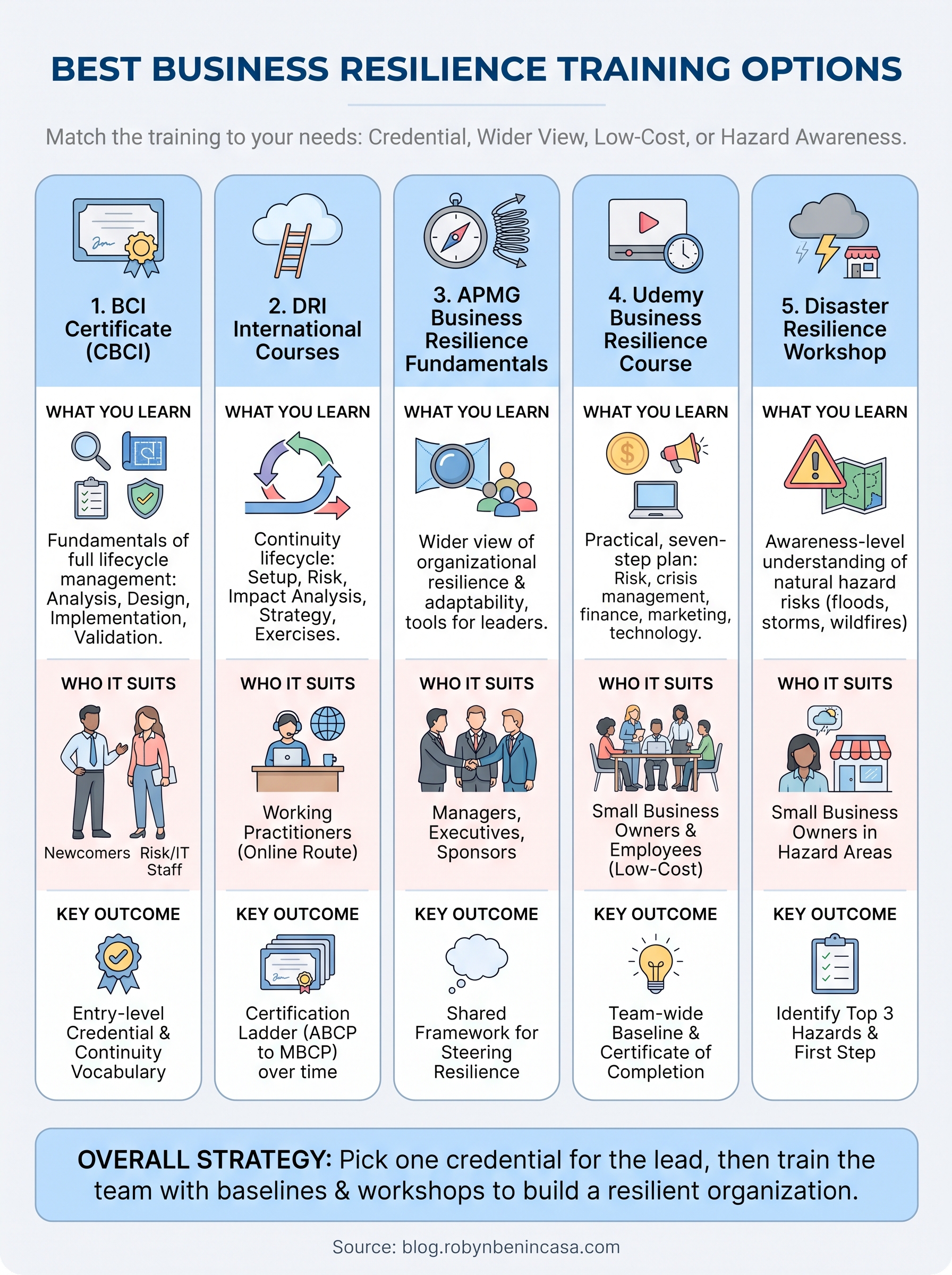
Match the course to the job. Choose CBCI or DRI to build a continuity practitioner, APMG for the executive who sponsors resilience, Udemy for a team-wide baseline, and the workshop for a small owner who needs to see the risks first.
A 50-person company could send the owner to the workshop, put one manager through CBCI or a DRI course, and assign the Udemy course to everyone else.
Process training tells you what to do when disruption hits. It does not tell you whether your people will pull together. Robyn Benincasa’s keynote, Adapt, Overcome, and Win as One (45 to 60 minutes), speaks to teams facing change such as AI transformation. For that people side, explore Robyn Benincasa’s keynotes and team resources.