
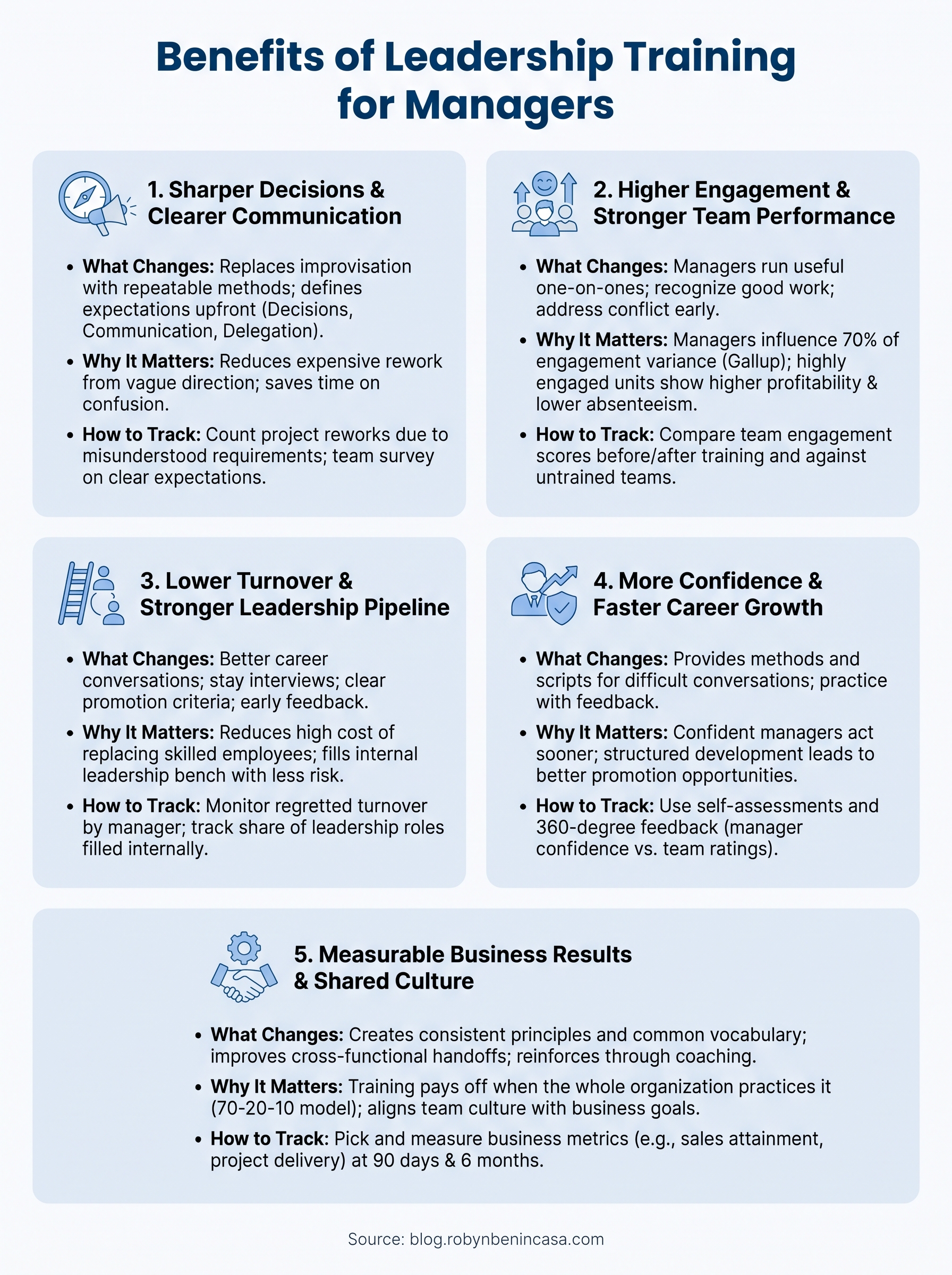
The benefits of leadership training for managers fall into five groups: sharper decisions and clearer communication, more engaged teams, lower turnover, faster career growth for the manager, and better business results. Each one shows up in daily work, and each one can be measured. New managers gain the most from the first and fourth. HR leaders will care most about the third. Executives who need to justify the budget should start with the fifth.
The importance of leadership training for managers comes down to one fact. Most managers are promoted for being good at their previous job, not for knowing how to lead people. Without training, they learn by trial and error, and their teams pay for the mistakes. That is hard to defend in a budget meeting when the training bill is a visible line item and the cost of poor management is not.
This article gives you five benefits you can point to, with what changes in practice, why it matters to the organization, and how to track it. The advice draws on Robyn Benincasa’s two decades of work with Fortune 1000 organizations as a keynote speaker on leadership and team culture. Her background as a former firefighter and world champion adventure racer shaped how she thinks about what teams need from the people who lead them.
1. Sharper decisions and clearer communication
Leadership training improves the two things managers do all day: decide and communicate. A trained manager makes decisions faster, explains them better, and wastes less of the team’s time on confusion.

What changes
Training replaces improvisation with a repeatable method. Managers learn to separate decisions they should make alone from those that need input. They also learn to say what they expect before the work starts instead of after it goes wrong.
- Decisions: weighing trade-offs openly, setting a deadline, and owning the outcome.
- Communication: specific feedback, given soon after the event, instead of vague comments at review time.
- Delegation: handing over an outcome, not a list of tasks.
Why it matters and how to track it
Unclear direction is expensive. When a manager is vague, five people each guess differently, and the rework lands on everyone. Fixing this one habit pays back almost immediately.
You can track it with a few simple signals. Count how often projects get reworked because of misunderstood requirements. Ask the team in a short survey whether they know what is expected of them this quarter. A rising score after training is a strong early result.
Clear expectations are the cheapest performance improvement a manager can make.
2. Higher engagement and stronger team performance
Trained managers build teams that are more engaged and perform better, because the manager is the biggest single influence on how a team feels about its work. Gallup’s research has found that managers account for about 70% of the variance in team engagement scores.

What changes
Managers learn to run useful one-on-ones, recognize good work, and handle conflict before it hardens. Consider a manager with eight direct reports who holds a 30-minute one-on-one with each every week. That is four hours a week. Untrained, those hours drift into status updates. Trained, they become coaching, and the same four hours produce far more.
- Regular recognition tied to specific behavior.
- Conflict addressed within days, not months.
- Team goals that people can explain in their own words.
Why it matters and how to track it
Engagement is not a soft metric. In Gallup’s meta-analysis, business units in the top quartile for engagement showed 23% higher profitability, 18% higher productivity, and 78% lower absenteeism than those in the bottom quartile. Those figures describe engagement, not training itself, but managers are the main lever that moves it.
Track team engagement scores before training and again at three and six months. Compare against teams whose managers have not yet been trained.
If you want a more engaged team, start with the person who manages it.
3. Lower turnover and a stronger leadership pipeline
Leadership training reduces turnover and builds a bench of future leaders. People rarely quit a company in the abstract. They quit a manager who ignores them, overloads them, or never develops them.
What changes
Trained managers have better career conversations. They notice who is ready for more and who is struggling. They also learn to give hard feedback early, which is kinder than a surprise termination later.
- Stay interviews that ask what keeps a person in the role.
- Stretch assignments matched to individual strengths.
- Clear criteria for promotion, so high performers see a path.
Why it matters and how to track it
Replacing a skilled employee costs recruiting time, onboarding time, and months of reduced output while the new hire ramps up. Training also fills your pipeline. When managers develop their people, you promote from within more often, and internal promotions come with less risk than external hires.
Watch regretted turnover, meaning the departures you wish had not happened, by manager. Track the share of leadership openings filled internally. Both numbers should improve within a year or two.
A manager who develops people keeps them, and a manager who ignores them loses them.
4. More confidence and faster career growth
Training gives managers confidence and a clearer route to advancement. New managers often feel they are guessing. Training turns that guesswork into skills they can practice and defend.
What changes
Confidence comes from having a method for the situations managers dread. These include delivering bad news, correcting a senior employee, and pushing back on an unrealistic deadline. Practicing them in a workshop, with feedback, makes the real conversation less frightening.
- Scripts and frameworks for difficult conversations.
- Feedback from peers and facilitators in a safe setting.
- A network of other managers facing the same problems.
Why it matters and how to track it
Confident managers act sooner. They address a problem in week one, not month three. For the manager, the career payoff is just as real. Leaders who can show results from a structured development program are better placed for promotion.
Use a short self-assessment before and after training, plus 360-degree feedback from direct reports and peers. If the manager’s confidence rises but the team’s ratings do not, the training taught theory and not practice. Adjust the program.
Confidence that comes from practiced skill changes behavior. Confidence from a pep talk does not.
5. Measurable business results and a shared culture
Leadership training produces business results when it gives all managers the same language and expectations. Isolated courses help individuals. A consistent program changes how the whole organization works.
What changes
When every manager learns the same principles, handoffs between teams improve and silos shrink. A common vocabulary for feedback, accountability, and teamwork reduces friction. One sales team Robyn Benincasa worked with moved from 17th to 1st nationally after building a stronger team culture. Culture alone did not win every deal, but it changed how the team worked together.
- A shared definition of what good leadership looks like here.
- Consistent standards across departments.
- Reinforcement through coaching, not a single event.
Why it matters and how to track it
Training sticks when it goes beyond the classroom. The 70-20-10 model, developed at the Center for Creative Leadership, suggests that about 70% of leadership learning comes from on-the-job experience, 20% from other people, and 10% from formal instruction. So pair workshops or keynotes with real assignments and peer coaching.
Pick two or three business metrics before you start, such as sales attainment, project delivery, or customer satisfaction. Measure them at 90 days and six months. Report results alongside cost, so the next budget conversation is easy.
Training pays off when the whole organization practices it, not when one manager attends it.
Making the case to invest
Leadership training helps managers decide better, engage their teams, keep their people, grow in confidence, and deliver results that the business can measure. The strongest case combines these benefits with a clear plan to track them, because a budget request backed by before-and-after numbers is hard to turn down.
If you are planning a leadership offsite or a team event and want to bring these ideas to your managers, you can explore more leadership and team culture resources from Robyn Benincasa. Start by choosing the two benefits that matter most to your organization, set a baseline for each, and build the program around them.