The best leadership training for managers near me is the one that matches your goal, your headcount, and your calendar, not the one with the biggest brand. If you want to energize a whole management team in one room, book an on-site keynote. If one or two people need specific skills, a public seminar from a national provider fits. If you want depth and a credential, look at a university program. If the training must target your company’s own problems, hire a local consulting firm or coach.
Searching for this usually returns a jumble of event listings, directories, and provider pages with no clear way to compare them. This article sorts them into four types. For each, you get how it works, who it suits, what it costs, and how to find one near you. Then it compares them side by side and shows how to make the training stick.
One disclosure: option one is the keynote work of Robyn Benincasa, whose blog this is. I will say plainly where it fits and where a classroom course is the better choice.
1. An on-site keynote for your management team
How it works and who it suits
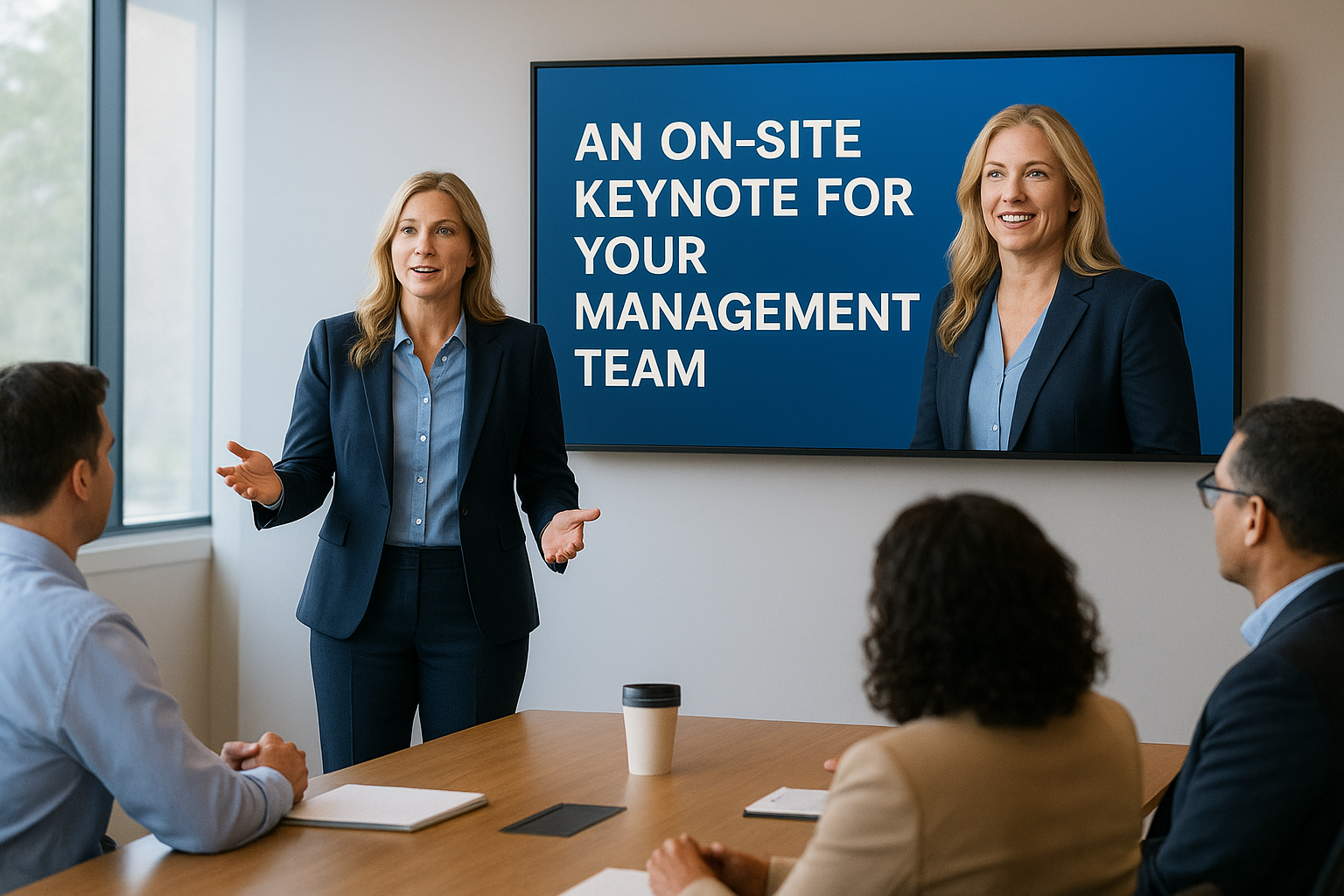
An on-site keynote brings a speaker to your location or to your team’s screens for one session. Robyn Benincasa is a world championship adventure racer and a longtime San Diego firefighter. She delivers four keynotes: Extreme T.E.A.M.W.O.R.K., Adapt, Overcome, and Win as One, Inspiring Greatness through G.R.I.T., and Why Winners Win. Extreme T.E.A.M.W.O.R.K. uses storytelling and video to show how ordinary people achieve extraordinary things together.
It suits management offsites, sales kickoffs, and teams facing change, such as an AI transformation, industry disruption, or a hard year. Be realistic, though. A keynote is a spark, not a curriculum. It will not teach your managers how to run a performance review or handle a difficult conversation. For that, pair it with one of the options below.
A keynote starts the conversation, and the training that follows is what changes how managers lead.
Cost, time, and finding one near you
You do not search for a keynote by zip code. The speaker comes to you, in person or virtually, so "near me" means wherever your team meets.
- Length: 45 to 60 minutes for most keynotes, 30 to 60 minutes for Why Winners Win.
- Format: in person or virtual.
- Cost: Ask about fees at bookrobyn@worldclassteams.com and say which keynote and audience size you have in mind.
2. Public seminars from national providers
How it works and who it suits
National training companies run open-enrollment courses in many metro areas. The American Management Association lists seminars by city, covering leadership, management, and communication. Dale Carnegie has regional location pages, and its flagship course centers on confidence, communication, and leadership. You enroll one manager or several, and they learn alongside people from other companies.
This route suits new managers and first-time supervisors who need foundations, and individuals with a clear skill gap. The mixed classroom is also a quiet advantage, because your manager hears how other companies handle the same problems. It suits you less when the real issue is your own team’s culture.
Public seminars build individual skills well, but they cannot fix a problem that belongs to your whole team.
Cost, time, and finding one near you
- Cost: priced per seat. Check the current rate on the provider’s listing before you budget.
- Time: usually a day or more, so plan for lost workdays and possible travel.
- Finding one: enter your city in the provider’s seminar calendar or location page. Event platforms such as Eventbrite list shorter local workshops.
3. University executive education programs
How it works and who it suits
Many business schools run non-degree executive education for working managers. These are open-enrollment programs with faculty instruction and a cohort of peers, often ending in a certificate. Audiences vary by program. Some target broad groups, from managers to HR professionals to veterans moving into civilian roles.
This option suits managers heading toward director roles and anyone who wants structured, deeper learning rather than a quick workshop. It works best when the person can step away from daily work for the full schedule. If you cannot spare someone for weeks, choose a shorter format.
Choose a university program when depth and a credential matter more than speed.
Cost, time, and finding one near you
- Cost: often higher per seat than a one-day seminar. Ask for the full tuition, including materials.
- Time: from a few days to several months, depending on the program.
- Finding one: look at the executive education or professional development pages of nearby business schools. Check whether a program is open enrollment or custom for one company.
4. Local consulting firms and executive coaches
How it works and who it suits

Local firms and coaches design a program around your team and usually deliver it at your office. Some focus on C-suite leadership but also train managers at every level. Topics typically include coaching skills, conflict, delegation, and communication. Because the content is built for you, examples come from your own business.
This route suits teams of roughly six or more managers with a specific problem, such as weak handoffs between departments. It also suits a company that wants one coach to follow up over months. A single manager with a general skill gap is usually better served by a public seminar.
A custom program is worth the higher price only when you can name the problem it must solve.
Cost, time, and finding one near you
- Cost: quoted per engagement. Ask what is included, such as assessments and follow-up coaching.
- Time: usually a series of sessions over weeks or months.
- Finding one: start with referrals and a search for your city. Directories such as Yelp can surface names, but verify each firm on its own site. Ask for a sample agenda and references from a company of similar size.
How to compare and choose the right option
Side-by-side comparison
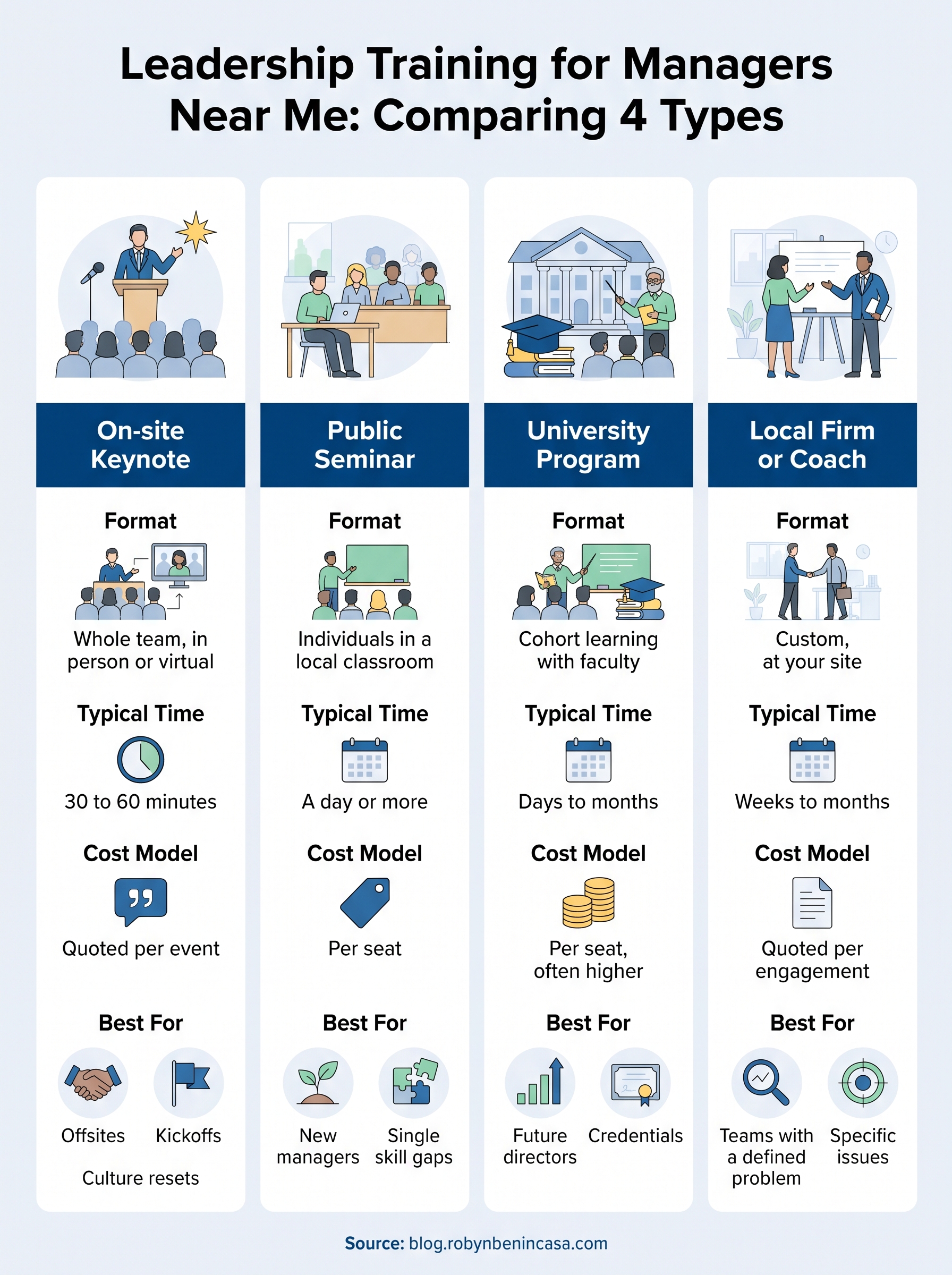
The right choice depends on how many managers you are training and what you want them to do differently afterward. Use this table to narrow the field.
| Option | Format | Typical time | Cost model | Best for |
|---|---|---|---|---|
| On-site keynote | Whole team, in person or virtual | 30 to 60 minutes | – | Offsites, kickoffs, culture resets |
| Public seminar | Individuals in a local classroom | A day or more | Per seat | New managers, single skill gaps |
| University program | Cohort learning with faculty | Days to months | Per seat, often higher | Future directors, credentials |
| Local firm or coach | Custom, at your site | Weeks to months | Quoted per engagement | Teams with a defined problem |
If you are training one person, buy a seat. If you are training a team, ask for a quote.
What it costs, plus free and online options
There is no single average price, because formats differ so much. Seat-based options scale with headcount. Say a seminar seat costs $2,000, an illustrative figure and not a quote. Eight managers then cost $16,000 before travel and lost workdays. At that size, ask a local firm for an on-site quote and compare.
For free or low-cost options, check whether your local chamber of commerce runs a community leadership program, since many do. If travel is the barrier, online and on-demand programs exist, and virtual keynotes cover the team-wide need. You give up in-person practice, though.
Making the training stick
A common rule of thumb is the 70-20-10 model. About 70 percent of leadership growth comes from on-the-job experience, 20 percent from feedback and coaching, and 10 percent from formal courses. Treat the class as the smallest part and plan the rest:
- Pick one behavior each manager will change within 30 days.
- Give each manager a real task that stretches that skill.
- Schedule a monthly check-in with a peer or senior leader.
Start with the problem, then pick the format
Match the format to the problem. A keynote energizes a team, a public seminar builds one manager’s skills, a university program adds depth, and a local firm customizes the work. Whatever you choose, plan the on-the-job practice that follows, because that is where most of the learning happens.
If your next step is a team-wide kickoff or offsite, browse more leadership resources on the Robyn Benincasa blog to see how her keynotes and team culture ideas could anchor it.