
You’ve been asked to launch a leadership program, and now you’re stuck on what to call it. "Leadership Training 2026" sounds like a compliance module nobody wants to attend, and your executive team wants something people will actually talk about. Finding the right names for leadership training programs matters more than most HR teams realize. A flat, forgettable title signals a forgettable program before a single session even starts.
This list gives you exactly what you’re searching for: real, usable catchy names for leadership training programs that fit different cultures, industries, and goals, from scrappy startups to defense contractors. Whether you need something bold, something rooted in your company values, or innovative names for leadership training programs that hint at transformation rather than another checkbox exercise, you’ll find options here you can adapt in minutes.
I’ve spent two decades building team cultures, first racing adventure teams to world championships, then leading firefighting crews, and now speaking to organizations about what actually makes people commit to a program. Below are 50 names, organized to help you pick one that matches your team’s identity and the results you’re after, plus quick tips on what makes a training name stick.
1. Teamwork and culture-focused names
When your real goal is breaking down silos and building a shared identity through team building activities for leadership teams, the program name should say "team" before it says "training." These names for leadership training programs work best when the leaders you’re developing already spend their days managing groups, not just individual output. A culture-focused name tells everyone from day one that this isn’t a solo development track, it’s about how people work together.

Example names
- Culture Builders Academy
- One Team Leadership Lab
- WIN AS ONE Leadership Series
- The Collective Advantage
- Unified Command Program
- Bridge Builders Initiative
- The Culture Code Workshop
- Team Forward Program
Why it works
These names work because they set expectations before anyone opens a syllabus. A participant who signs up for "Unified Command Program" already knows the sessions will cover coordination, trust, and shared accountability, not just personal executive presence. Culture-driven names also age well. Unlike trendy buzzwords, phrases like "team" and "collective" don’t feel dated in five years, which matters if you’re building something you’ll run annually.
A program name built around teamwork tells people the goal before the first slide does.
I saw this firsthand leading adventure racing teams through multi-day expeditions. The teams that won weren’t the ones with the strongest individual athletes, they were the ones who trained together under a shared banner. The name of the effort mattered because it reminded everyone, especially in the brutal 3 a.m. hours, what they’d actually signed up to build. That’s the same psychology at play when you name a corporate program: the title becomes shorthand for the culture you’re trying to create, referenced in emails, hallway conversations, and performance reviews long after the actual sessions end.
Best for
This category suits organizations coming out of a merger, reorg, or period of heavy turnover, where the biggest leadership gap is trust between departments rather than individual skill, which is exactly what team building training for managers is designed to close. It also fits companies running corporate training leadership development initiatives aimed at middle managers who supervise cross-functional teams, often paired with cross-functional collaboration training. If your leadership pipeline problem is really a collaboration problem, start here, and with the leadership and team building skills behind it, rather than with a more individually-focused name from later in this list. Sales organizations trying to unify regional teams under one playbook, in particular, tend to respond well to this style of naming because it mirrors the outcome they’re chasing.
2. Classic and professional program names
Some cultures don’t want cute or clever, they want credibility. Banks, law firms, healthcare systems, and government contractors often need names for leadership training programs that sound serious enough to put on a resume or a promotion packet. Nobody wants their director-level certification to sound like a summer camp activity.
Example names
- Executive Leadership Institute
- Leadership Excellence Program
- The Management Development Series
- Strategic Leaders Program
- Foundations of Leadership
- Leadership Certification Track
- The Advanced Leadership Curriculum
- Professional Leadership Academy
Why it works
Classic names borrow authority from familiar institutional language. Words like "institute," "academy," and "certification" signal rigor and structure, which matters when participants need to justify the time commitment to their own bosses. These names also travel well across departments and don’t require an explanation in an email subject line. A regulated industry, in particular, benefits from a title that sounds defensible in an audit or a board presentation rather than one that needs a tagline to make sense.
Sometimes the most credible name is the one that doesn’t try too hard to be memorable.
Think of this category as the tailored suit of program naming. It won’t generate buzz on its own, but it won’t raise eyebrows either, and in conservative industries, that’s often exactly the point.
Best for
This style fits organizations where leadership development ties directly to promotion or certification, such as insurance, pharmaceutical, defense, and financial services companies. If your program needs sign-off from compliance or legal before it launches, a classic, professional name will clear that bar faster than anything experimental.
3. Inspirational and aspirational names
Some leaders don’t need another certification, they need a reason to believe they’re capable of more. Inspirational names for leadership training programs work when the real barrier isn’t skill, it’s confidence or burnout. These titles borrow language from movement and possibility rather than curriculum, and they tend to show up in kickoff emails and company all-hands meetings because they’re easy to rally around.
Example names
- Rise Leadership Program
- The Greatness Initiative
- Beyond the Title
- Leaders Unleashed
- The Bold Leader Series
- Ignite Leadership Program
- Elevate: A Leadership Journey
- The Fearless Leader Track
Why it works
Aspirational names work because they speak to identity rather than task lists. Nobody gets excited to attend "Module 3: Delegation Skills," but plenty of people will lean into a program called "Leaders Unleashed" because it implies something is being unlocked in them personally. These names also carry well into speeches and internal marketing, since they double as rallying language leadership can reference at every town hall.
A program that promises to help people rise will always outsell one that promises to train them.
I built my own keynote series, INSPIRING GREATNESS THROUGH G.R.I.T., around this exact idea. People commit harder to programs that name the transformation, not just the schedule.
Best for
This category fits organizations leading teams through change, restructuring, or a slump in morale, where leaders need energy as much as technique. It also suits sales and frontline teams that respond to momentum-driven language over academic framing, and any culture rebuilding confidence after a rough year or two.
4. Growth and journey-themed names
Growth doesn’t happen in a single workshop, and journey-themed names admit that upfront. These names for leadership training programs work when you’re building a multi-year pipeline rather than a one-off event, and you want participants thinking in terms of progress, not completion. A journey name also gives you room to add phases later, like "Leadership Path: Level Two," without renaming the whole initiative.
Example names
- The Leadership Path
- Climb: A Leadership Development Program
- Momentum Leadership Series
- The Ascent Program
- Compass Leadership Track
- Next Level Leaders
- The Trailblazer Initiative
- Forward: A Growth-Focused Leadership Program
Why it works
Journey language reframes leadership as an ongoing practice instead of a certificate you earn once and shelve. Words like "path," "climb," and "compass" imply direction without pretending anyone has arrived, which keeps senior participants engaged instead of feeling like the material is beneath them. This framing also helps HR teams justify a recurring budget line, since a journey clearly continues past year one.
A leadership program that admits it never finishes is one people stay committed to longer.
I think about this the same way I think about long-distance adventure races. Nobody crosses the finish line and calls themselves finished with endurance; they start training for the next one. Growth-themed names carry that same expectation into the workplace.
Best for
This category suits organizations building a formal leadership pipeline across multiple cohort years with the best leadership training programs behind it, especially companies promoting from within rather than hiring leadership from outside. It also fits fast-growing companies where today’s individual contributor is tomorrow’s manager, and the name needs to still make sense two promotions later.
5. Action-oriented and dynamic names
Some cultures don’t want to talk about leadership, they want to practice it. Action-oriented names for leadership training programs trade reflection for momentum, using verbs instead of nouns to signal that participants will be doing something, not just sitting through slides. These names suit companies that already move fast and don’t want a program that feels like a pause button on their normal pace.
Example names
- Lead Now
- The Execution Edge
- Drive: Leadership in Motion
- Accelerate Leadership Lab
- The Launchpad Program
- Sprint to Leadership
- Full Throttle Leaders
- Move the Needle Leadership Series
Why it works
Dynamic names work because they mirror how the business already talks internally, especially in sales, startups, and operations-heavy teams that measure everything in output. A name like "Sprint to Leadership" tells a manager exactly what pace to expect before they read a single agenda item. Action verbs also make a program easier to sell to skeptical participants who assume leadership training means long lectures and worksheets nobody revisits.
A leadership program named after motion has to deliver motion, or the title will work against you.
That last point matters. I’ve watched teams lose trust fast in a program that promised acceleration and delivered a slow, theory-heavy curriculum instead. Name the pace you can actually run.
Best for
High-growth companies, sales organizations, and startups scaling their management bench quickly all fit this category well. Businesses under real time pressure, where leaders need essential leadership skills within weeks rather than a semester-long curriculum, get the most mileage out of a name built around speed and action.
6. Acronym-based names
Acronyms give a leadership program something most names can’t: instant recall. Acronym-based names for leadership training programs work because they turn abstract values into a memorable shorthand people actually repeat in meetings, not just read once in a launch email. I built my own signature keynote around this idea, T.E.A.M.W.O.R.K., which breaks down the eight essential elements of a world-class team culture into letters people can quote back to me years later.
Example names
- L.E.A.D. (Learn, Engage, Act, Deliver)
- G.R.I.T. Leadership Series
- S.P.A.R.K. Program
- C.O.R.E. Leadership Track
- R.I.S.E. Initiative
- F.I.R.E. Up Leadership
- B.U.I.L.D. Leadership Academy
- V.I.S.I.O.N. Leadership Program
Why it works
Each letter forces you to name a specific behavior, so the acronym doubles as a built-in curriculum outline instead of a vague label. Employees remember five letters far longer than a full sentence, and managers reference them naturally when coaching, which extends the program’s life well past the actual training days.
A good acronym turns a training name into a daily vocabulary word.
Cross-industry credibility matters here too. Acronyms travel from a fire station to a sales floor without losing meaning, which is exactly why I still use one after two decades of building team cultures under real pressure.
Best for
This style suits organizations that want a program tied directly to a values framework, particularly companies rolling out leadership training programs meant to outlast a single cohort. It also works well for teams that already communicate in shorthand, like sales floors, operations centers, and emergency services.
7. Names for specific leader levels and audiences
Not every leader needs the same program, and lumping a new supervisor into the same track as a VP wastes both their time, which is why management and leadership skills training usually gets split by tier. Names for leadership training programs that call out a specific level or audience signal immediately who belongs in the room, which cuts down on the awkward mismatch of a first-time manager sitting through content built for someone running a division.
Example names
- Emerging Leaders Program
- Frontline Leadership Academy
- Director’s Edge
- The New Manager Bootcamp
- Women in Leadership Series
- Senior Leaders Roundtable
- First-Time Supervisor Track
- Executive Leadership Circle
Why it works
A targeted name sets the right expectations before anyone reads the agenda. "Frontline Leadership Academy" tells a shift supervisor the material will address their actual day, not boardroom strategy, while "Executive Leadership Circle" signals peer-level discussion rather than a lecture. This kind of audience-specific naming also helps HR justify separate budgets and timelines for each group, since the name itself explains why a new manager and a senior director aren’t in the same cohort.
A leadership program named for the wrong audience loses credibility before the first session starts.
I’ve watched companies try to save money by running one generic program for every level, and it backfires. Senior leaders disengage because the content feels basic, and new supervisors feel lost. Naming by level fixes that mismatch before it happens.
Best for
This category fits larger organizations with a real leadership pipeline spanning multiple tiers, from frontline supervisors to executives. It also suits companies running diversity-focused tracks, like a women in leadership series, where the audience itself is part of the program’s identity.
8. Creative single-word and metaphor names
Sometimes the strongest names for leadership training programs are the shortest. A single word, or a sharp metaphor, forces a program to stand for one clear idea instead of trying to explain itself. This category works well when your culture already has a strong identity and the training just needs a name that fits the same voice as the rest of the brand.

Example names
- Catalyst
- The Forge
- Anchor Leadership
- Compass
- The Foundry
- Beacon
- Summit Leadership Program
- Keystone
Why it works
A single word carries more weight than a full phrase because people fill in the meaning themselves. "The Forge" implies heat, pressure, and something being shaped, without a single sentence of explanation needed. Metaphor-driven names also print well on a lanyard, a slide deck, or a coffee mug, which matters more than most planning teams admit when a program needs visibility long after launch day.
A one-word name works because it leaves room for people to define what it means to them.
These names also resist becoming dated the way trendier phrases can. "Catalyst" meant the same thing ten years ago as it does now, which isn’t true of most buzzwords tied to a specific business moment.
Best for
Companies with a strong existing brand voice, especially ones already using metaphor in their mission statement or values, get the most out of this style. It also suits smaller, tight-knit organizations where a single evocative word becomes shorthand fast, without needing a tagline to carry the meaning.
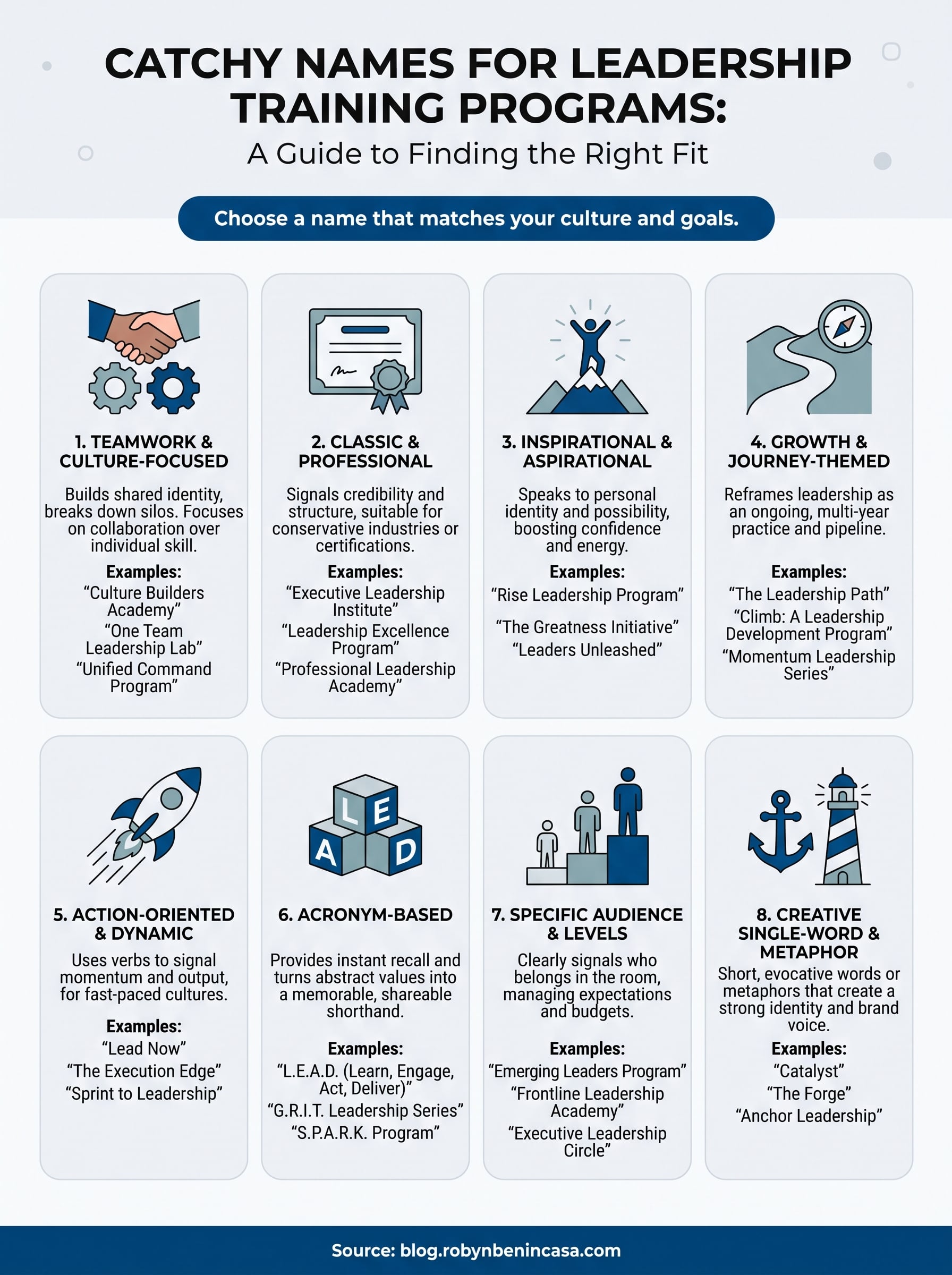
Finding the name that fits your culture
A name from any of these eight categories can work, but only if it matches what your team actually needs right now. Don’t pick something aspirational if your real problem is a trust gap between departments, and don’t reach for acronym-based names if your culture doesn’t already talk in shorthand. The best names for leadership training programs come from being honest about the gap you’re closing, then choosing language that fits how your people already talk to each other.
Once you’ve landed on a name, the harder work starts: building a program that actually earns it. I’ve spent two decades studying what makes teams commit under real pressure, from world championship expeditions to firehouse crews, and I bring those lessons into every keynote I deliver. If you’re building out a leadership initiative and want someone who can anchor the launch, see which leadership keynote speakers are worth booking and what fits your culture.