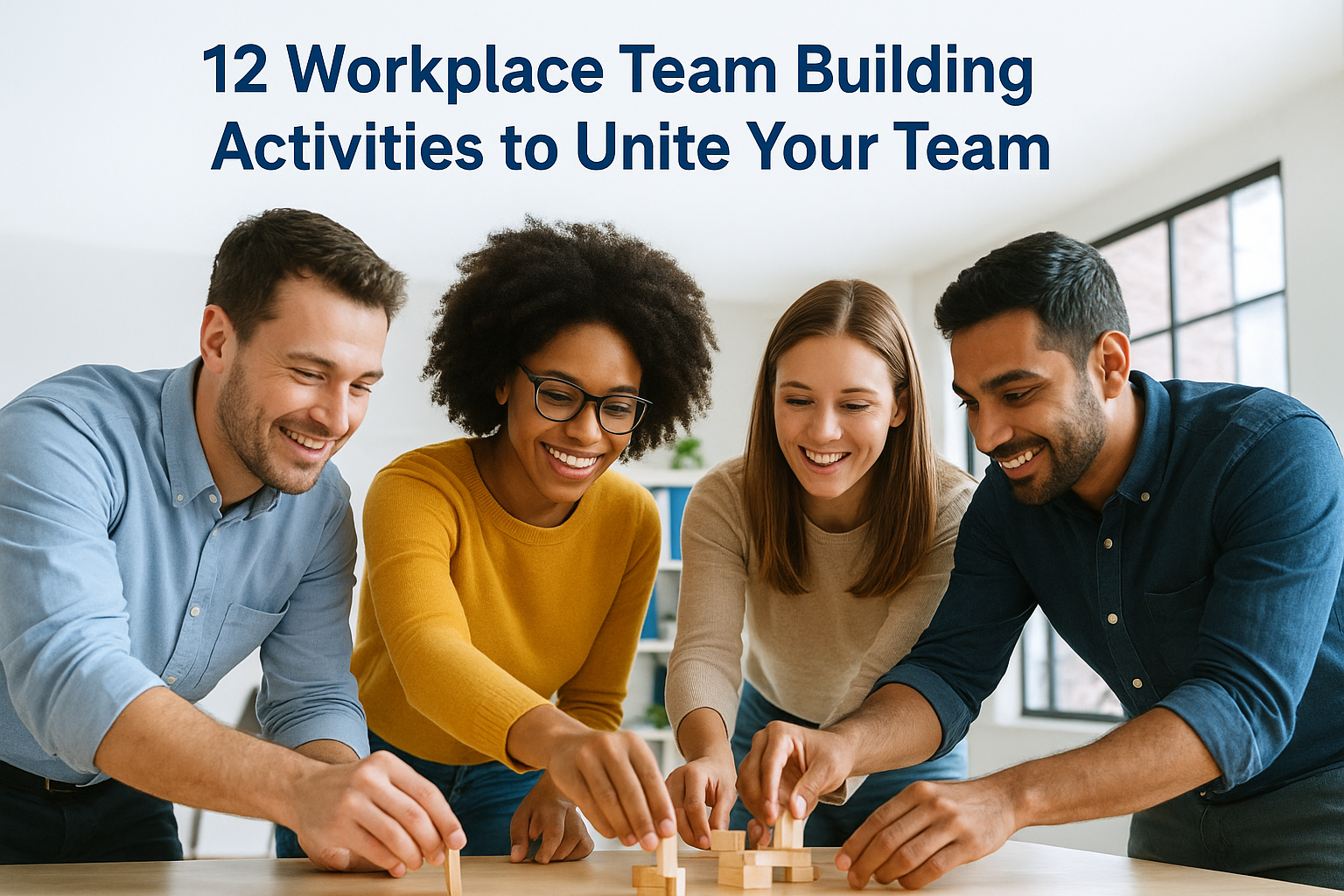
Trust falls and awkward icebreakers don’t build anything except eye-rolls. If your team still dreads the words "team building," you’re not alone, and it’s usually a sign the activity was picked for entertainment value instead of results. Team building and activities only work when they’re tied to real collaboration challenges your people face every day.
This list gives you workplace team building activities that actually move the needle, exercises rooted in the same principles that win world championship adventure races and unite firefighters who have to trust each other with their lives. You’ll find options for small teams and large groups, quick 20-minute exercises and half-day sessions, plus ideas that work whether your team sits in the same office or logs in from three time zones.
I’ve spent 20 years building teams under pressure, first as a San Diego firefighter, then as captain of a world champion adventure racing team, and now helping companies like Allstate and Northrop Grumman apply those same lessons. Below are 12 team building activities for teams that build real trust, break down silos, and get coworkers pulling in the same direction, not just for an afternoon, but long after the event ends.
1. Bring in a leadership keynote speaker
Starting a conference or offsite with a keynote speaker isn’t just a warm-up act. When you bring in someone who has actually led teams through pressure and failure, you give everyone in the room a shared language for the work that follows. It’s the difference between telling people to "communicate better" and showing them exactly what breaks down when a team doesn’t, using real stories from the field. This is one of the most effective team building activities for workers because it sets the tone for every activity that comes after it, from a scavenger hunt to a strategy session.
How it works
A good keynote isn’t a motivational pep talk. It’s a structured session where the speaker breaks down a framework, like my T.E.A.M.W.O.R.K. model built from 15 years of world championship adventure racing, and connects each element directly to what your organization is facing right now, whether that’s a merger, a sales slump, or departments that don’t talk to each other. I work with event planners beforehand to pull in specifics about their company so the examples land, not generic slides. The session can run in person or virtually, and it typically closes with a concrete takeaway list your teams can apply the same week.
A keynote works when people leave with a plan, not just a good feeling.
Team skills it builds
Done right, a keynote speaker builds the foundation every other team activity for team building depends on: shared vocabulary and buy-in. Specifically, it develops:
- Trust and psychological safety, by showing leaders what vulnerability under pressure actually looks like
- Cross-departmental alignment, since everyone hears the same message at the same time
- A framework for accountability, giving managers language to reference for months afterward
- Renewed motivation, especially useful when morale has taken a hit from layoffs or restructuring
Best for
Executives and HR leaders planning a conference, sales kickoff, or leadership offsite get the most out of this format, particularly when the organization is navigating change, silos, or a performance slump. It also suits companies that have tried generic workplace team building activities before and found they didn’t stick. Businesses in high-stakes industries, insurance, pharmaceutical, defense, and financial services among them, tend to respond well to stories drawn from firefighting and elite competition because the stakes feel familiar. If your goal is a single event that reframes how the whole room thinks about teamwork before you run smaller exercises, this is where you start.
Time and group size
Keynotes are built to flex around your agenda, whether you’re speaking to 50 people or 5,000.
| Format | Typical length | Group size |
|---|---|---|
| In-person keynote | 45-60 minutes | 50 to 5,000+ |
| Virtual keynote | 30-45 minutes | Unlimited |
| Keynote plus workshop | Half day | 20-200 |
Most planners pair the keynote with a Q&A or a short breakout workshop to reinforce the material, but even a standalone talk gives your team a common starting point they’ll reference in meetings for months.
2. Escape room challenges
Escape rooms have become a go-to option for workplace team building activities because they force people to solve problems together under a ticking clock, no lecture required. Whether you rent a commercial room downtown or bring a portable kit into your office, the format works the same way: a locked scenario, a stack of clues, and one shared deadline that nobody can beat alone. That last part matters. It’s one of the few activities for a team building session where the pressure is real enough that personalities show up fast, who takes charge, who checks out, who talks over everyone else.

How it works
Groups of four to eight get locked into a themed room or scenario and have 45 to 60 minutes to find clues, crack codes, and solve puzzles to "escape." Larger teams split into smaller squads and run parallel rooms, then compare times afterward. The best facilitators build in a debrief immediately after, asking what worked, what stalled the group, and who ended up leading. Skip that debrief and you’ve just run a fun outing, not a team building activity.
An escape room only teaches teamwork if someone asks what happened after the timer stops.
Team skills it builds
Escape rooms surface communication gaps and decision-making habits fast, under conditions your team can’t fake their way through.
- Problem-solving under time pressure
- Delegation, since no one person can solve every puzzle
- Active listening, when someone shouts a clue across the room
- Quick trust-building among people who don’t normally work together
Best for
This fits mixed-department groups who don’t collaborate day to day and need a low-stakes reason to work as one unit. It’s especially useful for newly merged teams or departments coming out of a reorg, since the shared challenge gives people something neutral to bond over. Skip it for teams already drowning in high-pressure deadlines; recreating stress isn’t the same as relieving it.
Time and group size
Budget 90 minutes total, including setup, the room itself, and a real debrief conversation. Commercial rooms typically cap at 6 to 8 people per room; for larger groups, book multiple rooms and compare notes afterward. Portable in-office kits scale further and cost less per person than renting a venue.
3. The human knot
The human knot is old-school, but it earns its spot on almost every list of team building activities for workers because it costs nothing and works in a conference room, a hallway, or a grassy patch outside the office. Everyone stands in a circle, reaches across, and grabs two different hands. Then the group has to untangle itself without letting go. No props, no budget, just bodies and patience.
How it works
Gather six to twelve people in a tight circle. Each person extends both hands into the center and grabs the hands of two different people who aren’t standing directly next to them. Once every hand is paired, the group works together to untangle the knot into a single circle or two separate circles, without anyone releasing their grip. It usually takes a few false starts before someone figures out that stepping over an arm or rotating under a bridge of hands opens things up. Set a loose time limit, ten minutes works well, so the group feels urgency without giving up too soon.
The knot doesn’t untangle until someone stops giving orders and starts asking what everyone else sees.
Team skills it builds
This is a physical exercise, but the lessons transfer straight to how a team solves problems at a desk.
- Nonverbal communication and patience, since talking over each other rarely helps
- Spatial problem-solving, spotting a path when the obvious move is blocked
- Shared leadership, as different people spot the solution at different stages
- Tolerance for discomfort, both physical and the awkwardness of close contact
Best for
The human knot suits teams that are still getting to know each other, new hires, freshly merged departments, or a group meeting in person for the first time after months of remote work. It’s also a solid warm-up before a more serious workshop, since it loosens people up fast. Skip it with groups that include anyone with mobility limitations or a strong aversion to physical contact; there are better activities in team building for those situations.
Time and group size
Budget 15 to 20 minutes total, including a short debrief on who ended up leading the untangling. Six to twelve people per knot is the sweet spot; larger groups should split into multiple knots running side by side.
4. Two truths and a lie
Two truths and a lie earns its place among classic workplace team building activities because it does something rare: it makes coworkers actually curious about each other. Each person shares three statements about themselves, two true and one invented, and the group votes on which one is the lie. It sounds simple, but you’d be surprised how much a team learns about a colleague they’ve sat next to for three years without ever really talking to.
How it works
Go around the room or the video call and have each person share three statements, phrased so the lie isn’t obvious. Give people a minute to think beforehand so the statements have some substance, a surprising hobby, an unusual job history, a weird fact, rather than throwaway lines. The group discusses and votes before the person reveals the lie. Keep it moving so quieter members don’t get skipped, and set a time cap of two minutes per person so it doesn’t drag.
People stop treating coworkers like job titles once they know something real about them.
Team skills it builds
This exercise works because curiosity is the first ingredient in trust, and trust is what most team building activities for teams are ultimately trying to build.
- Active listening, since guessing correctly requires paying attention to details
- Psychological safety, as people share something personal in a low-risk format
- Cross-team familiarity, especially valuable when departments rarely interact
- Humor and lightness, which lowers defenses before a harder conversation
Best for
This fits new hires, onboarding sessions, and teams that just merged after a reorg or acquisition. It’s also a reliable opener for meetings where half the attendees have never met in person. Skip it with groups who already know each other well; the novelty wears off fast, and repeating it signals a lack of imagination rather than genuine interest in connection.
Time and group size
Budget 15 to 30 minutes depending on group size, roughly two minutes per person plus guessing time. It works for groups as small as four and scales up to twenty before energy starts to drag; beyond that, split into smaller circles.
5. The marshmallow and spaghetti tower challenge
The marshmallow and spaghetti tower challenge is a favorite among team building activities for workers because it exposes how a group actually plans under a deadline, not how they say they plan. Give each team 20 sticks of dry spaghetti, a yard of tape, a yard of string, and one marshmallow, then task them with building the tallest free-standing structure that can hold the marshmallow on top. Stanford’s design school popularized this exercise, and it still works because the constraints are tight enough to force real decisions fast.

How it works
Split into teams of three to five and hand out identical kits: spaghetti, tape, string, and the marshmallow. Set an 18-minute timer and let teams build without interference. Most groups spend the first ten minutes arguing over a plan and the last two minutes panicking, which is exactly the point. Measure the tallest structure that’s still standing with the marshmallow balanced on top when time runs out, then run a debrief on what each team’s process looked like.
Teams that build early and fail fast beat teams that plan perfectly and never test anything.
Team skills it builds
This challenge is one of the more revealing activities for team building because it puts prototyping and planning styles on display in real time.
- Rapid prototyping over perfect planning, since teams that build early outperform teams that only theorize
- Resource management, deciding how much tape and string to commit before knowing what works
- Role clarity, as someone naturally starts directing structure while others test stability
- Handling failure gracefully, when a tower collapses with two minutes left on the clock
Best for
This suits teams stuck in analysis paralysis or heavy approval chains, since the exercise rewards fast iteration over consensus-building. Engineering, product, and sales teams tend to get the most out of it because the parallels to real project work are obvious within minutes.
Time and group size
Budget 30 minutes total: a five-minute briefing, the 18-minute build, and a debrief. Works well for groups of 12 to 60, split into teams of three to five competing side by side.
6. Office scavenger hunts
Office scavenger hunts turn a dull Friday afternoon into one of the more flexible workplace team building activities you can run without hiring an outside facilitator. Teams get a list of items to find or tasks to complete, a photo of the break room mascot, a signature from someone in accounting they’ve never met, and a time limit to finish. Unlike an escape room, you control the entire scenario, which means you can tailor it to your actual office, your actual departments, and the specific silos you’re trying to break down.
How it works
Build a list of 15 to 20 clues that require teams to interact with people or places outside their usual routine, a selfie with someone from IT, a fact about the company’s founding, a scanned QR code hidden in the warehouse. Split the office into mixed teams of four to six, making sure no team is made up entirely of one department. Set a 45 to 60 minute window and require photo or video proof for each completed item. Award points for creativity, not just speed, so teams that improvise get rewarded alongside teams that move fast.
A scavenger hunt only builds teamwork when the clues force people to talk to someone they’d normally never approach.
Team skills it builds
This format is one of the more adaptable activities in team building because you design the challenges around your actual org chart.
- Cross-departmental relationships, since clues can be written to require contact with specific teams
- Time management, balancing which clues to chase and which to skip
- Creative problem-solving, especially with open-ended or riddle-style clues
- Friendly competition, which boosts energy without raising real stakes
Best for
Scavenger hunts suit larger offices where departments rarely cross paths, and they work well as a lighter follow-up to a heavier session like a keynote or workshop. New employee cohorts also benefit, since the hunt doubles as an informal office tour. Skip it for fully remote teams unless you adapt the clues to a virtual format.
Time and group size
Budget 90 minutes total: 15 minutes to explain rules, 45 to 60 minutes to hunt, and 15 minutes to review answers and award points. Scales comfortably from 12 to 100 people, split into teams of four to six.
7. Volunteering together for a shared cause
Volunteering as a group turns team building and activities into something that actually matters beyond the office walls, and that shift changes how people show up. Building a playground, packing meal kits, or renovating a shelter gives coworkers a shared goal with real stakes, not a manufactured challenge. I’ve watched this firsthand through Project Athena, where survivors and volunteers work side by side toward something bigger than any one person’s job title, and the bonds that form there rival anything I saw on a championship racing team.
How it works
Pick a project that requires actual teamwork, not just showing up and writing a check. Building a Habitat for Humanity home, staffing a food bank shift, or organizing a donation drive all require people to coordinate tasks, hand off tools, and rely on each other to finish. Partner with a local nonprofit a few weeks out so the day has real structure and a defined outcome your team can point to afterward. Close the day with a short reflection, what surprised you, what would you do differently, so the experience sticks rather than fading into a nice memory.
Teams that struggle together for someone else remember it longer than teams that struggle together for themselves.
Team skills it builds
Shared purpose does something internal exercises rarely manage on their own.
- Empathy and perspective-taking, from working outside the company’s usual context
- Cross-level collaboration, since executives and entry-level staff do the same physical tasks
- Shared purpose, which strengthens loyalty to the team, not just the job
- Resilience, when the work is physically or emotionally demanding
Best for
This fits organizations wanting to strengthen culture around values, not just performance metrics, and it’s especially effective after a difficult year, layoffs, restructuring, or public setbacks that left morale bruised. Companies with strong CSR commitments get compounding value here, since the day supports both team culture and public mission.
Time and group size
Budget a half day to a full day depending on the project scope. Groups of 10 to 50 work well; larger organizations should split into multiple sites or shifts to keep everyone actively engaged rather than standing around waiting for a task.
8. Trust-building exercises
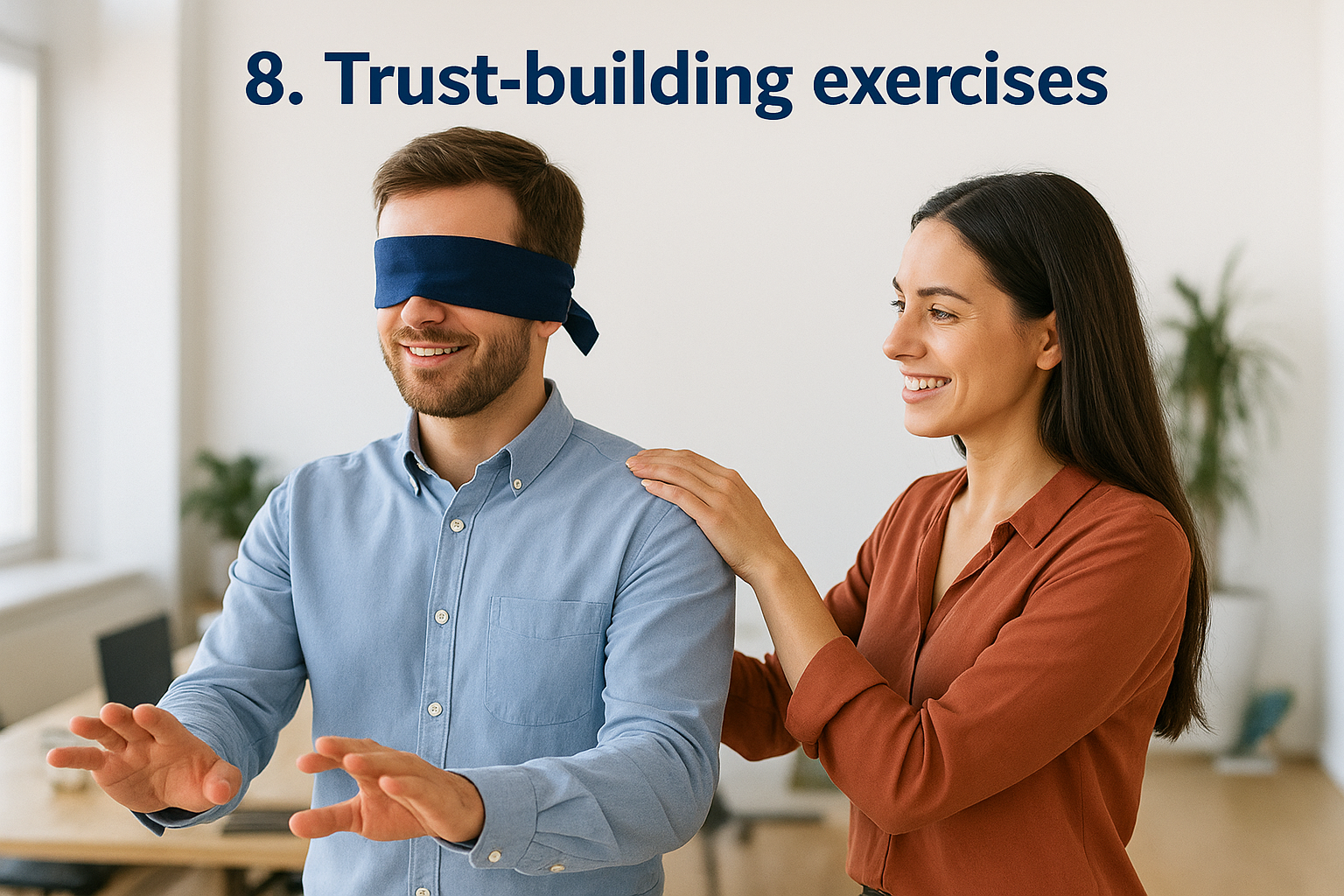
Trust-building exercises cover a specific category of workplace team building activities designed to test whether people will rely on each other when the stakes feel real, even if the risk is staged. The classic trust fall belongs here, but so do less clichéd versions: blindfolded obstacle courses, trust walks where one partner guides another through a maze verbally, and paired exercises where one person describes a task while the other executes it without seeing the instructions. The goal isn’t the fall itself, it’s what happens in the seconds before someone lets go.
How it works
Pair people up, ideally across departments or seniority levels, and run a short series of exercises where one person depends on the other’s guidance or physical support. A blindfolded obstacle walk works well: one partner navigates blind while the other calls out directions, then they switch roles. Keep each round under ten minutes and rotate partners so trust gets tested with more than one person. Debrief immediately, asking what made trusting the partner easier or harder, since that conversation is where the real learning happens.
Trust isn’t built by falling backward once, it’s built by choosing to rely on the same person again.
Team skills it builds
These exercises target the emotional layer underneath most workplace friction.
- Vulnerability and reliance, practiced in a low-stakes setting before it’s needed in a high-stakes one
- Clear, direct instructions, since vague guidance fails fast when someone can’t see
- Empathy, from experiencing what it feels like to depend on someone else’s judgment
- Faster repair after conflict, since teams who’ve practiced trust recover quicker from disagreements
Best for
Teams rebuilding after a conflict, a leadership change, or a period of low morale benefit most from this category of activities for team building. It also suits teams preparing for high-pressure projects where reliance on each other isn’t optional.
Time and group size
Budget 30 to 45 minutes for two or three rounds plus debrief. Works best in pairs, so groups of 10 to 30 people rotate smoothly through multiple partners.
9. Office trivia challenges
Office trivia challenges belong on this list because they turn competitive energy into workplace team building activities without anyone needing an outdoor space, a budget for kits, or an offsite location. Split into small teams, answer rounds of questions, mix in company-specific trivia alongside pop culture and history, and let the scoreboard do the rest. Nothing fancy is required, just a host, a set of questions, and a group willing to argue over answers in a group chat or a huddle.
How it works
Build five or six rounds of eight to ten questions each, blending general knowledge with questions specific to your company, the year it was founded, an inside joke from last year’s retreat, the name of the office plant everyone waters. Split into teams of four to six, mixing departments so no single team can lean on one person’s expertise. Run it live with a host calling out questions, or use a simple platform that projects questions to a screen for both in-person and remote participants. Score each round and reveal a leaderboard between rounds to keep energy up.
Trivia only builds a team when the questions make people compare notes, not just shout answers.
Team skills it builds
Good trivia rounds reward group memory over any one person’s knowledge, which is exactly what makes it useful as one of several team activities for team building.
- Quick consensus-building, since teams have limited seconds to agree on an answer
- Institutional knowledge sharing, especially with company-specific rounds
- Light competition, which energizes a room without raising real stakes
- Inclusion of quieter voices, since trivia rewards knowledge, not volume
Best for
This fits teams looking for a low-effort, high-energy activity to close out a meeting, a Friday afternoon, or a hybrid all-hands where some people join remotely. It also works well as a recurring monthly event rather than a one-time exercise.
Time and group size
Budget 30 to 45 minutes for five to six rounds plus a final scoring wrap-up. Scales from 8 to 100 people, split into teams of four to six competing side by side.
10. Skill-swap lunch and learns
Skill-swap lunch and learns take the idea of a mentorship program and compress it into an hour, making them one of the more practical team building work activities you can run without hiring anyone. One employee teaches a skill they know well, Excel shortcuts, a design tool, public speaking tricks, while everyone else eats lunch and asks questions. Nobody has to be a professional trainer. They just have to know something useful and be willing to share it.
How it works
Pick one volunteer per session to teach a 20 to 30 minute mini-lesson on something relevant to their work or a hobby they’re skilled at. Book a conference room, order lunch, and let the presenter walk through their topic with a live demo if possible, since watching someone actually do the thing beats a slide deck every time. Rotate presenters weekly or monthly across departments so the spotlight moves around the office instead of landing on the same few people. Keep a running sign-up sheet so volunteering feels easy rather than like an assignment.
A lunch and learn works because it treats every employee like they have something worth teaching, not just something to learn.
Team skills it builds
This format quietly reshapes how people see their coworkers’ value beyond their job title.
- Cross-training, giving teams backup knowledge when someone’s out
- Recognition, since presenting a skill is a low-pressure form of visibility
- Curiosity about other roles, especially across departments that rarely interact
- Confidence building, for employees who don’t usually get to lead a room
Best for
This suits offices looking for a recurring, low-cost habit rather than a one-time event, and it works especially well for teams with a wide range of tenure and specialties. Companies trying to surface hidden expertise, the person who’s quietly great at a tool nobody else uses, get outsized value here.
Time and group size
Budget 45 to 60 minutes including lunch and questions. Works for groups of 8 to 40; larger offices should run parallel sessions on different topics.
11. Outdoor field day challenges
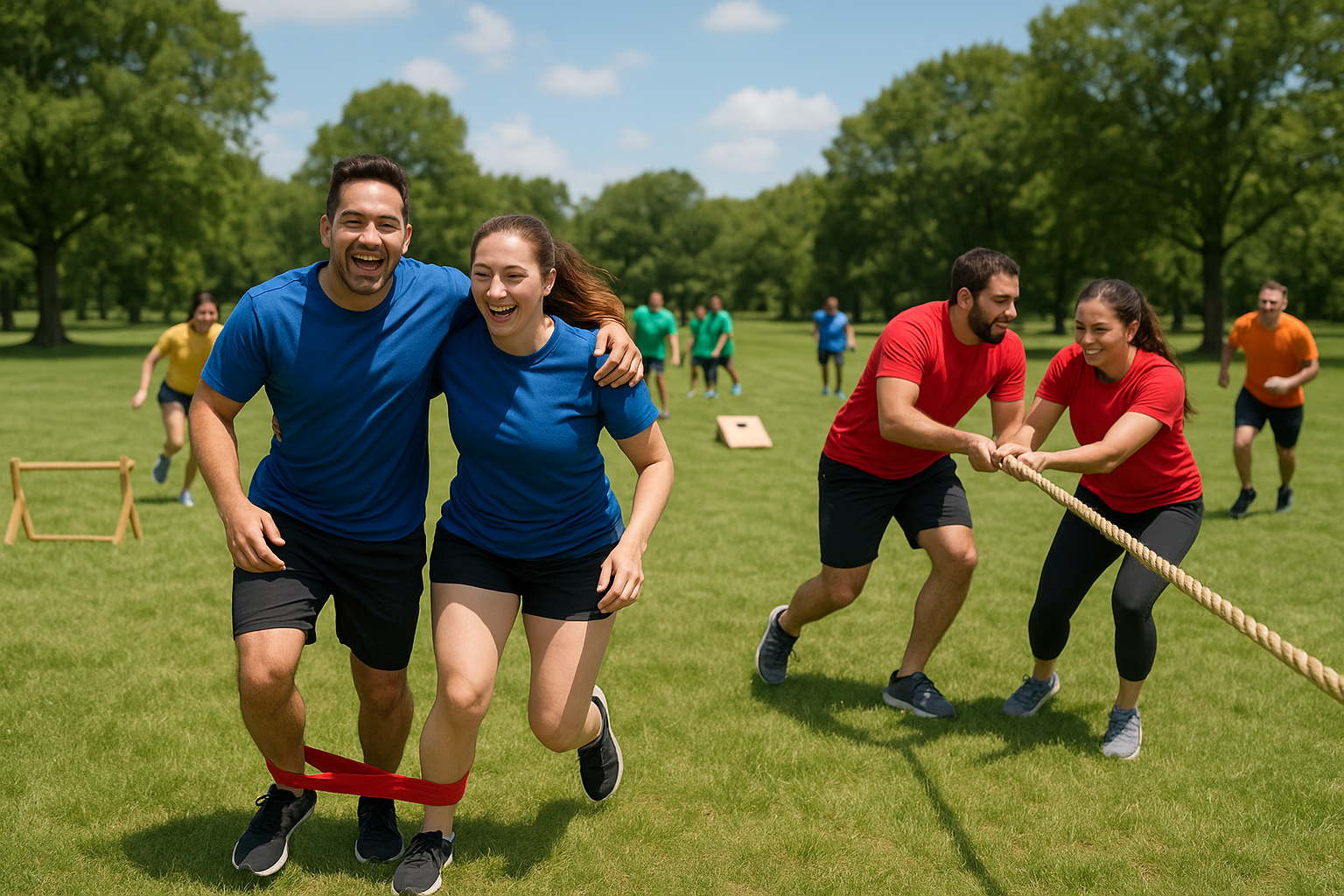
Outdoor field day challenges bring back the energy of a company picnic but structure it around team building work activities instead of just burgers and a volleyball net. Think relay races, tug of war, a three-legged obstacle course, and a tournament bracket that mixes departments onto the same squad. The format works because it gets people moving, competing, and cheering for coworkers they might only know from email threads, and physical energy tends to loosen people up faster than any icebreaker script.
How it works
Block off a park, sports field, or large parking lot and set up four to six stations: relay races, tug of war, a scavenger-style obstacle course, and a low-stakes tournament like cornhole or kickball. Divide the whole company into mixed teams ahead of time, cross-departmental only, so sales isn’t just competing against sales. Rotate stations every 20 to 30 minutes and keep a running scoreboard so momentum builds toward an afternoon awards moment. Bring water, shade, and a backup indoor plan for weather.
A field day only builds a team when the rosters mix departments; leave people with their usual desk neighbors and you’ve just run a picnic.
Team skills it builds
Physical, low-pressure competition surfaces cooperation habits that don’t show up in meetings.
- Cross-departmental bonding, since teams are deliberately mixed
- Encouragement and morale support, watching coworkers cheer for people outside their usual circle
- Friendly competitive spirit, which boosts energy without real workplace stakes
- Physical trust and coordination, especially in relay or partner-based stations
Best for
Larger companies with an annual budget for a bigger event get the most value here, particularly organizations wanting a workplace team building activity that feels like a reward rather than a workshop. It suits teams heading into a busy season who need a morale boost beforehand, and works well as an annual tradition rather than a one-off.
Time and group size
Budget a half day, four to five hours including setup, rotations, and an awards close. Scales well from 30 to several hundred people across multiple stations running in parallel.
12. Virtual team building activities for remote teams
Virtual team building activities exist because a distributed team can’t rely on hallway chats or shared lunch breaks to build rapport, so you have to engineer those moments on purpose. Options range from virtual escape rooms and online trivia to a shared Slack channel where people post their weirdest home office setup, but the common thread is intentional structure. It team building activities often fall into this category too, since remote developers and IT staff frequently work async across time zones and need scheduled, low-friction ways to connect that don’t feel like another meeting.
How it works
Pick one focused activity per session rather than stacking several into a single call, since video fatigue kills energy fast. A virtual trivia round, an online version of two truths and a lie, or a collaborative whiteboard challenge using a tool like Miro all work well within a 30 to 45 minute window. Assign a host to keep the pace moving and mute-manage the group, and always send materials or prompts ahead of time so people aren’t scrambling on camera.
A remote team doesn’t need more meetings, it needs a handful of moments that don’t feel like work at all.
Team skills it builds
Good virtual sessions replace the informal bonding that in-person offices get for free.
- Async collaboration habits, since remote work depends on clear handoffs
- Familiarity across time zones, especially for teams that rarely overlap live
- Comfort on camera, which improves every future video meeting
- Inclusion of remote-only hires, who often miss out on organic culture
Best for
This suits fully remote or hybrid teams spread across regions, particularly companies that hired heavily during remote-first years and never built culture rituals to match. It also works as a lighter complement to an annual in-person offsite.
Time and group size
Budget 30 to 45 minutes per session, ideally recurring monthly. Works for groups of 5 to 50; larger teams should split into breakout rooms to keep participation high.
Making team building part of your culture
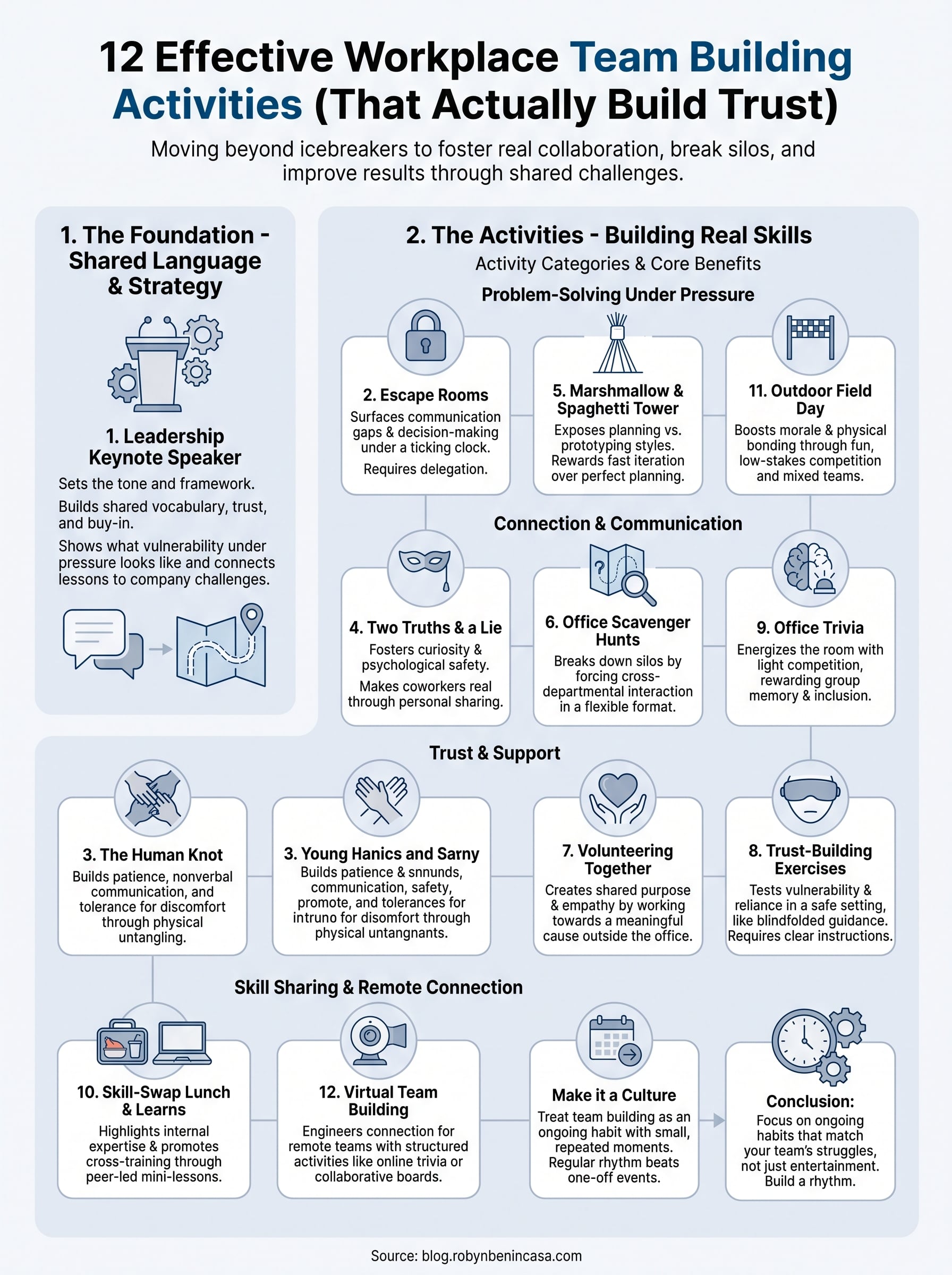
None of these 12 activities work as a one-time fix. Team building and activities stick when you treat them as an ongoing habit, not a checkbox you clear once a year at an offsite. Pick two or three from this list that match where your team actually struggles right now, whether that’s silos between departments or a remote crew that never bonded, and build a rhythm around them. A monthly trivia round, a quarterly volunteer day, a recurring lunch and learn: small, repeated moments beat one big event every time.
If you want a stronger starting point than a scavenger hunt can give you, bring in someone who’s led teams through real pressure and can hand your people a framework they’ll actually use. That’s the fastest way to turn a room full of coworkers into a team that pulls together long after the event ends. Book Robyn to speak at your next event and give your team something worth remembering.