
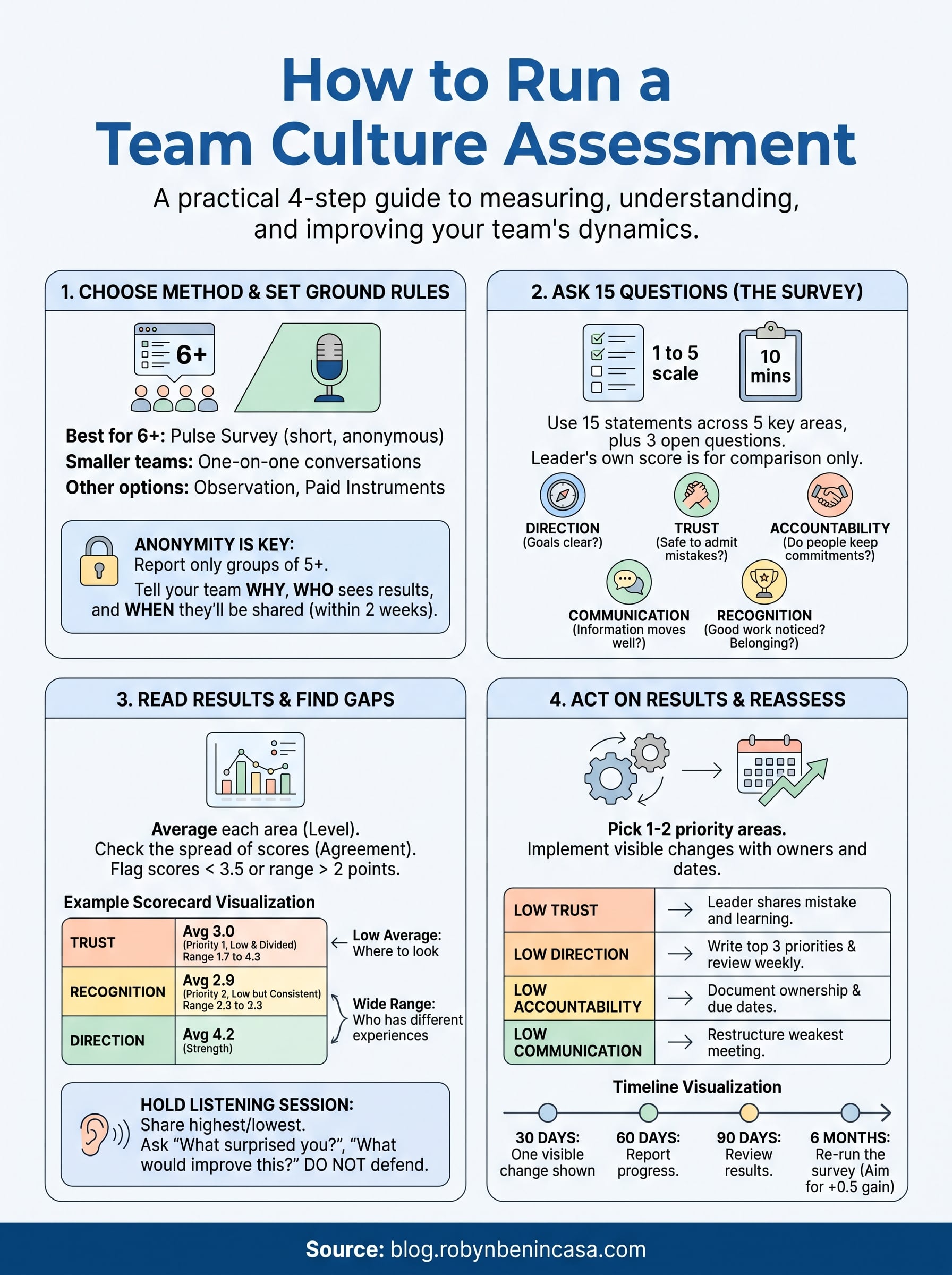
To run a team culture assessment, pick a method, ask your team 15 short rating questions across five areas, find the lowest and most divided scores, and commit to one or two visible changes. Then repeat the same questions six months later. The whole cycle takes about three weeks of light effort, and you can do it with a free survey tool.
Most leaders sense a problem long before they can name it. People go quiet in meetings, deadlines slip, and the same disagreement keeps coming back. Gut feel tells you something is off, but not what or where to start. Many assessments fail for one reason: they produce a report, and nothing changes afterward.
This guide walks through the full process, from a plain definition to a copy-ready question set, a worked example of reading the scores, and a plan for acting on them. Robyn Benincasa has spent more than 20 years as a San Diego firefighter and led adventure racing teams to world championship level. Those are settings where culture has real consequences, and they shape the practical approach here.
What a team culture assessment measures and when to run one
A team culture assessment is a structured check on how your team really works together, built from survey scores, conversations and observation. It compares the culture you describe with the culture people experience day to day.
The five areas worth scoring
Culture is too broad to measure as one number, so split it. This guide scores direction (do people know the goals), trust (can they speak up and admit mistakes), accountability (do people keep commitments), communication (do information and conflict move well), and recognition (does good work get noticed, and do people belong).
Some frameworks sort whole organizations into types instead. The Competing Values Framework uses four quadrants: collaborate, create, control and compete. That helps you name a company style. For a single team, scores you can track and change are more useful.
You cannot fix "culture" in general, but you can raise a score for trust or recognition.
Signs it is time to run one
Run an assessment when something changes or something repeats. Common triggers:
- A new leader, merger or reorganization has changed how the team works
- The same conflicts or missed deadlines keep returning
- Turnover or absenteeism is climbing
- Remote or hybrid work has changed how people communicate
- You have never measured it, and a yearly baseline would help
Step 1. Choose your method and set ground rules
For most teams of six or more, the best method is a short anonymous survey followed by a listening session to explain the numbers. Smaller teams should skip the survey and use one-on-one conversations.
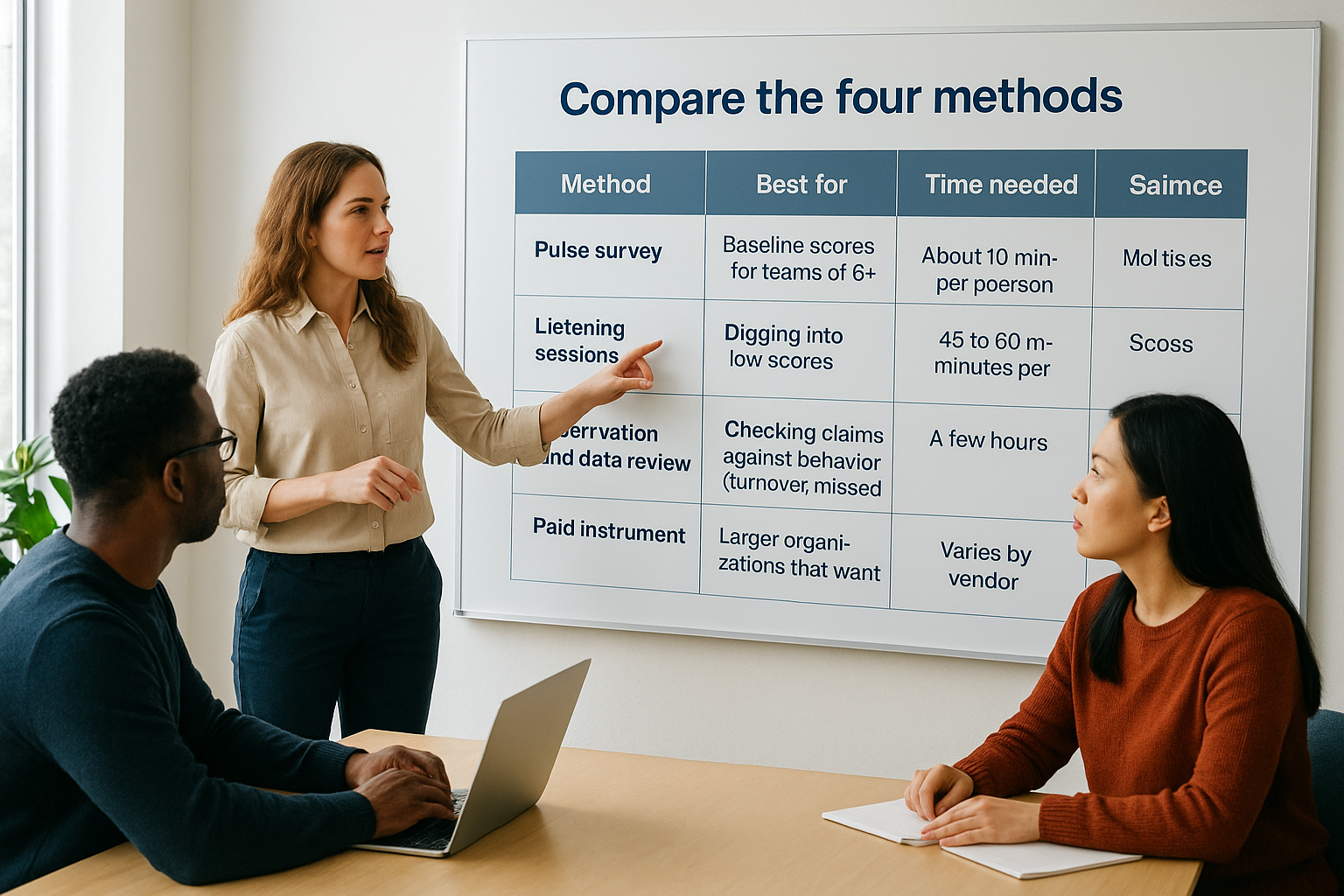
Compare the four methods
| Method | Best for | Time needed | Main limit |
|---|---|---|---|
| Pulse survey | Baseline scores for teams of 6+ | About 10 minutes per person | Shows what, not why |
| Listening sessions | Digging into low scores | 45 to 60 minutes per session | People hold back with the boss in the room |
| Observation and data review | Checking claims against behavior (turnover, missed deadlines, meeting habits) | A few hours | Indirect evidence |
| Paid instrument (for example, Denison or Five Behaviors) | Larger organizations that want benchmarks | Varies by vendor | Cost, and it works best with a facilitator |
Set ground rules before you send anything
Tell your team why you are asking, who will see the results, and when you will share them. Promise results within two weeks of the survey closing, then keep that promise. Silence after a survey teaches people that honesty is pointless.
Protect anonymity. Collect no names, and report only groups of five or more so no one can be identified from a score. If your team is smaller than five, use conversations instead.
People answer honestly only when they believe the answers will be used and cannot be traced.
Step 2. Ask these 15 questions
Use 15 statements rated from 1 (strongly disagree) to 5 (strongly agree), three per area, plus three open questions. This works as a team culture assessment template and takes about 10 minutes to complete.
Copy-ready sample questions
Paste this into Google Forms or Microsoft Forms and set the rating questions to a 1 to 5 scale.
Rate each statement: 1 = Strongly disagree, 5 = Strongly agree

DIRECTION
1. I can explain our team's top three priorities this quarter.
2. I know how my work contributes to those priorities.
3. Decisions on this team are consistent with our goals.

TRUST
4. I can admit a mistake without fear of blame.
5. I can disagree with the team lead and be heard.
6. Teammates support each other when work gets hard.

ACCOUNTABILITY
7. People on this team do what they say they will do.
8. Expectations for my role are clear.
9. Missed commitments are addressed directly and fairly.

COMMUNICATION
10. I get the information I need on time.
11. Conflict gets resolved, not avoided.
12. Our meetings are a good use of my time.

RECOGNITION
13. Good work gets noticed here.
14. I feel I belong on this team.
15. I can see a future for myself here.

OPEN QUESTIONS
A. What is one thing this team should keep doing?
B. What is one thing that gets in your way?
C. If you could change one thing about how we work together, what would it be?
Send it and collect responses
Keep the window to one week and send a single reminder on day three. Explain in the invitation that the survey is anonymous and takes about 10 minutes. Do not ask for names, and skip demographic questions on small teams, because they make people traceable.
Answer the survey yourself, but keep your scores out of the team average. Compare them later. A leader who rates trust at 5 while the team averages 3 has found the most important gap in the whole exercise.
A leader’s own scores matter most when they differ from the team’s.
Step 3. Read the results and find the gaps
Average each area, check how widely people disagreed, and flag any area that scores below 3.5 or has a range wider than 2 points. Averages show the level, and the range shows whether the team shares one experience.
Score each area
First average the three questions for each person. Then average those results across the team. Look at a single item to see the effect of spread: if eight people score question 4 as 5, 4, 4, 3, 3, 2, 2 and 1, the total is 24 and the average is 3.0. The range is 4 points, so some people feel safe admitting mistakes and others clearly do not.

A sample result for a team of eight looks like this:
| Area | Average | Lowest to highest | Reading |
|---|---|---|---|
| Direction | 4.2 | 3.7 to 4.7 | Strength, keep it |
| Trust | 3.0 | 1.7 to 4.3 | Priority one, low and divided |
| Accountability | 3.6 | 3.0 to 4.0 | Acceptable, watch it |
| Communication | 3.8 | 3.3 to 4.3 | Acceptable |
| Recognition | 2.9 | 2.3 to 3.3 | Priority two, low but consistent |
A low average tells you where to look, and a wide range tells you who is having a different experience.
Look for the story behind the numbers
Read the open answers next and group them into themes. Then hold a 45-minute listening session. Share the two highest and two lowest areas, and ask: "What surprised you?" and "What would make this score higher?" Take notes, and do not defend yourself. If trust scored low, your reaction in that room is the real test.
Step 4. Act on the results and reassess
Choose no more than two priority areas, give each a visible change with an owner and a date, and re-run the same 15 questions in six months. More than two priorities dilutes effort and tells the team that nothing is really a priority.
Turn low scores into specific changes
Match the fix to the symptom:
| Low area | First move |
|---|---|
| Direction | Write the top three priorities on one page and review them in every weekly meeting |
| Trust | Leaders share a recent mistake and what they learned, then open meetings with "what did not go well" |
| Accountability | Document who owns each commitment and its due date, and address misses privately and promptly |
| Communication | Cut or restructure the weakest recurring meeting and set a clear rule for urgent messages |
| Recognition | Add a weekly shout-out and name specific work, not general praise |
Track progress and keep momentum
Show one visible change within 30 days, report progress at 60 days, and review results at 90. Then re-run the survey after six months and aim for a gain of at least 0.5 points in each priority area. If a score has not moved, change the action, not the question.
Some teams also benefit from a shared reset moment before the work begins. Robyn’s Extreme T.E.A.M.W.O.R.K. keynote runs 45 to 60 minutes and teaches the 8 elements of a winning culture. It helps only when it is followed by concrete changes like those above.
Scores improve when a leader changes visible behavior, and rarely because of a presentation alone.
Start with one honest score
A team culture assessment is simple: choose a method, protect anonymity, ask 15 clear questions, read both averages and spread, and act on no more than two areas. The value is not the report. It is the conversation that follows and the changes your team can see within a month.
You do not need a large budget or a consultant to begin. A free survey form, an hour of listening and the willingness to hear a low score from your own team are enough. Run it, share what you find, and fix one thing visibly.
If you want more practical guidance on building strong team culture, explore more leadership and team culture resources from Robyn Benincasa.