Most team-building activities you find online are recycled icebreakers that get a laugh in the moment and change nothing by Monday morning. If you’ve run a trust fall or a scavenger hunt and watched your team go right back to the same silos and communication gaps, you already know the problem. The activity itself was never the point. What actually builds a team is shared struggle toward a real goal, the kind that forces people to depend on each other and figure out how to win together.
This list skips the filler and focuses on activities that mirror what actually works, drawn from lessons learned racing across jungles and deserts with teammates whose lives depended on trusting each other completely. Each one is built to strengthen communication, accountability, and morale in ways that carry back into the office.
You’ll find 13 activities here, ranging from quick exercises you can run in a 30-minute meeting to full offsite challenges for leadership teams. Some need zero budget, others fit a corporate retreat. All of them are designed to expose how your team currently solves problems and give them a better way to do it, together.
1. Book a facilitated team-building keynote experience
Most team-building activities on this list work best when someone with real experience frames why they matter and connects them to the stakes your team actually faces. That’s the gap a facilitated keynote experience fills. Instead of handing a manager a printed list of games and hoping for the best, you bring in a speaker who has lived the lessons, who can open a meeting or offsite with a story that makes the rest of the day’s exercises land differently. I’ve done this hundreds of times, walking teams through the same principles that kept my adventure racing crews alive and winning across some of the toughest terrain on earth, then translating those lessons directly into the pressures of sales floors, hospitals, and executive suites.
How it works
A facilitated keynote isn’t a motivational speech that ends when the applause stops. It’s built around a specific leadership framework, like the eight elements of a world-class team culture, and it’s customized to your organization’s actual challenges before you ever get on stage. The process typically looks like this:
- A pre-event call to understand your team’s current friction points, whether that’s silos, low morale, or a merger shaking up culture
- A keynote or workshop session, delivered live or virtually, that mixes real stories with practical tools
- Optional breakout exercises where teams apply the framework to their own goals
- Take-home materials, like a leadership guide, so the lessons don’t evaporate the next morning
Best for
This format suits leadership teams, sales organizations, and entire departments that need more than a one-off game to shift how they operate. It’s the right call when you’re kicking off a conference, closing out a sales meeting, or trying to unify a workforce after a reorg or acquisition. Companies like Allstate and Northrop Grumman have used this approach specifically because printed slogans and standalone icebreakers weren’t moving the needle on actual performance.
Time and group size
A keynote runs 45 to 90 minutes and scales from a leadership team of 20 to a conference hall of several thousand, in person or virtual. Extended workshop formats can run half a day when you want breakout exercises layered on top of the talk itself.
Why it works
Games alone rarely change behavior because they don’t answer the question everyone in the room is silently asking: why does this matter to my job? A facilitated keynote answers that question first, using proof from high-stakes, real-world team performance, then gives people a shared vocabulary they’ll reference for months afterward, in meetings, in hallway conversations, in how they handle conflict.
A game changes an afternoon. A shared framework, taught well, changes how a team makes decisions for years.
If you’re planning an offsite or conference and want the rest of the activities on this list to actually stick, this is where you start. You can see available topics and book Robyn for your next event to anchor the day around lessons that come from real championship team culture, not theory.
2. Two truths and a lie
This classic works because it’s low-stakes and instantly personal. Everyone states three facts about themselves, two true and one false, and the group has to guess which one is fiction. It’s often the first team-building activity people think of, and there’s a reason it’s stuck around this long: it forces people to actually listen to each other instead of just waiting for their turn to talk.
How it works
Each person gets sixty seconds to share three statements about themselves. The group discusses and votes on which statement they think is the lie, then the person reveals the answer. Keep the pace quick so it doesn’t drag into a full hour of guessing games. A few ground rules help:
- No statements about work titles or job history, keep it personal
- Encourage surprising or specific details, not vague claims
- Cap each round at two minutes including the reveal
Best for
Use this with new teams, onboarding groups, or remote hires who haven’t built rapport yet. It’s a strong opener for a meeting where half the room has never met in person, especially after a merger or a wave of new hires joining a growing department.
Time and group size
Budget 15 to 30 minutes for a group of 6 to 15 people. Beyond that, break into smaller circles or you’ll lose the room’s attention halfway through.
Why it works
People remember surprising facts about coworkers far longer than they remember a title or department. That small act of vulnerability and curiosity starts breaking down the assumptions people make about each other based on role or seniority alone.
The fastest way to build trust on a team is to make people curious about each other again.
It won’t fix deep silos on its own, but it’s a fast, free way to loosen up a room before heavier work begins.
3. Human knot
The human knot is a physical puzzle disguised as a team-building activity. Everyone stands in a circle, reaches across, and grabs two different hands that aren’t a neighbor’s. The group then has to untangle itself into a circle without letting go. It looks silly for the first minute and gets serious fast once people realize talking is the only way out.

How it works
Form a tight circle of 8 to 12 people. Each person extends both hands into the middle and grabs two different hands belonging to two different people, never the person standing directly next to them. Once every hand is linked, the group works together to untangle the knot into a single circle, without breaking any grip. Some quick guidelines:
- No letting go, ever, even when it seems impossible
- Someone has to call out directions since not everyone can see the whole knot
- Set a 10-minute cap so it stays a challenge, not a grind
Best for
This fits mid-size teams that already know each other but need practice communicating under mild pressure. It works well in a conference room during an offsite, or outdoors if you’ve got the space. Skip it with a group that’s brand new to each other, since it requires close physical contact that works better once some trust already exists.
Time and group size
Plan for 15 to 20 minutes with 8 to 12 people per knot. Larger groups should split into multiple circles running at the same time, then compare how each team solved it.
Why it works
No single person can see the whole tangle, which forces the group to rely on verbal direction and patience instead of one person taking charge and solving it alone. It surfaces who naturally steps into a coordinating role and who tends to go quiet under pressure.
A knot only comes undone when the group agrees to move slowly and listen to the one voice that can actually see the way out.
Debrief it by asking who ended up giving directions and why. That conversation usually says more about your team than the puzzle itself.
4. Escape room challenge
Escape rooms turn a team-building activity into a countdown. Your group gets locked into a themed room, or a virtual equivalent, and has to solve a chain of puzzles to "escape" before time runs out. Unlike a lot of icebreakers, there’s a real stake here: the clock doesn’t care about your org chart, and it exposes fast who defaults to problem-solving mode versus who waits to be told what to do.
How it works
Groups typically book a commercial escape room or bring in a portable kit for the office. The format usually breaks down like this:
- A briefing explains the theme and the one rule that matters: work together or run out of time
- The team splits attention across multiple puzzle stations simultaneously
- Clues only make sense when someone shares what they found with the rest of the room
- A facilitator or app tracks the countdown and can offer hints if the group stalls
Best for
This suits departments planning an offsite or smaller teams of coworkers who want a shared challenge outside the office. It’s a strong fit for groups that lean analytical, like engineering or finance teams, since the puzzles reward the kind of thinking they already do daily, just applied to each other instead of spreadsheets.
Time and group size
Most rooms run 60 minutes and hold 6 to 10 people comfortably. Larger departments should book multiple rooms and compare completion times afterward.
Why it works
A hard deadline forces rapid, honest communication because there’s no time for politics or ego. People either share what they know immediately or the whole group loses.
Nothing exposes how a team actually communicates faster than a clock that doesn’t stop for anyone.
Debrief by asking who took charge, who got ignored, and whether that pattern shows up back at the office too.
5. Marshmallow and spaghetti tower
The marshmallow and spaghetti tower is a fast, hands-on team-building activity that puts engineering under pressure. Give each small group the same kit of raw spaghetti, tape, string, and one marshmallow, then set a timer. The goal is simple: build the tallest freestanding structure that supports the marshmallow on top. What happens in those 18 minutes tells you a lot about how your team actually plans and adapts.

How it works
Split into teams of four or five and hand out identical materials. The classic kit looks like this:
- 20 sticks of dry spaghetti
- One yard of string
- One yard of tape
- One standard marshmallow
Set an 18-minute timer and let teams build without further instructions. The marshmallow must sit on top, unsupported by hands, when time runs out. Measure each tower and announce a winner.
Best for
This works well for cross-functional teams who need a quick reminder that planning beats guessing. It’s a strong fit for project teams, product groups, or any department that tends to jump straight into execution without testing assumptions first.
Time and group size
Budget 25 to 30 minutes total, including a short debrief, for groups of four to five people. It scales easily to a dozen tables running at once, which makes it a solid choice for larger offsites.
Why it works
Most teams waste the first ten minutes planning and building one tall structure, only to watch it collapse the second the marshmallow goes on. The teams that win usually test small prototypes early and adjust fast instead of committing to one idea. That’s the real lesson: early, cheap failure beats a late, expensive one.
The teams that win aren’t the ones with the best plan. They’re the ones willing to test their plan and fail fast, before the clock forces the failure on them.
Debrief by asking which teams tested early versus which ones planned the whole time. That gap usually mirrors how your projects actually run back at the office.
6. Blind square rope challenge
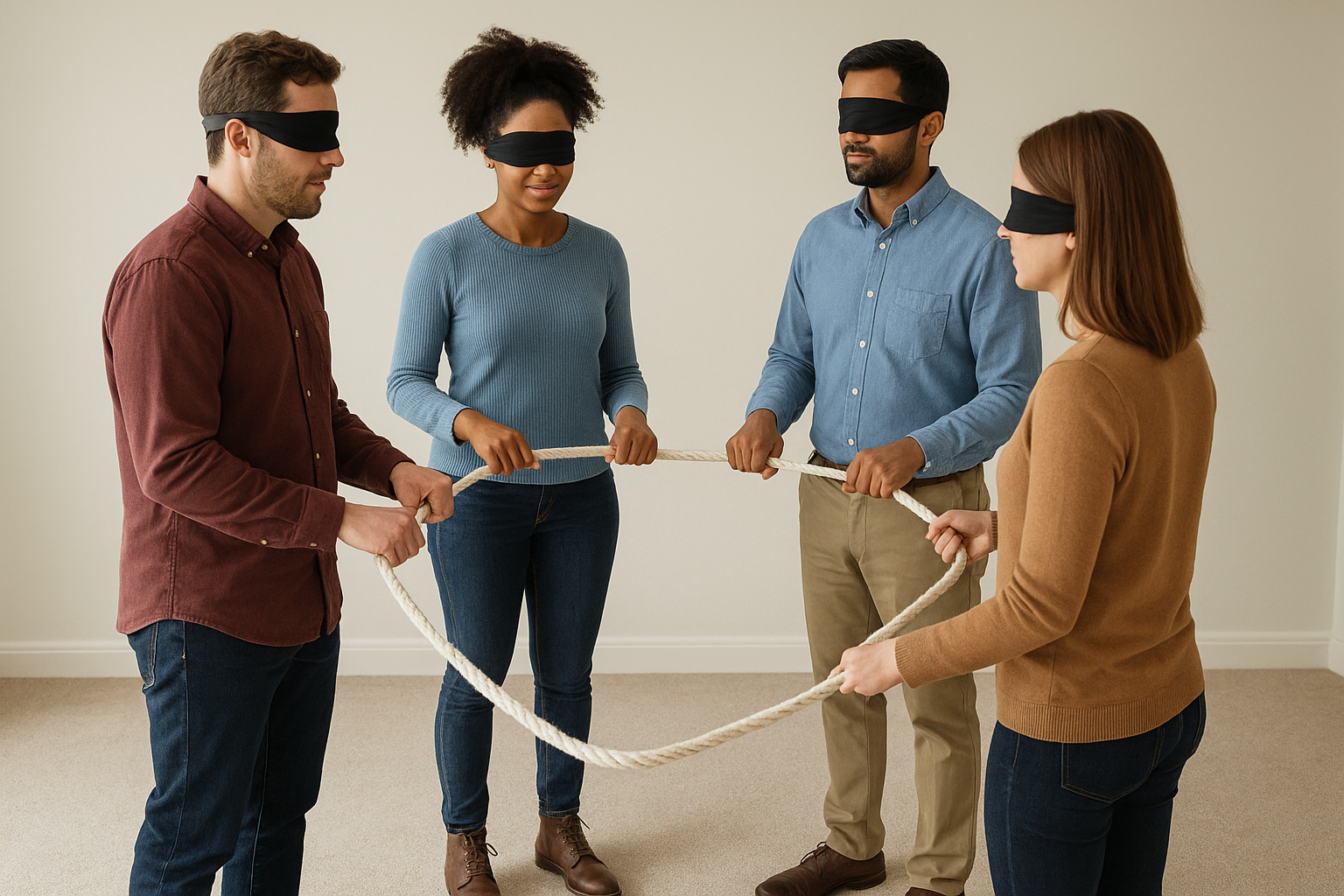
The blind square rope challenge strips away the one sense most teams lean on without thinking: sight. Everyone puts on a blindfold, holds a length of rope, and has to work together to form a perfect square using only verbal communication. There’s no leader appointed and no visual cues to fall back on, so this team-building activity forces a group to build a shared plan out of words alone.
How it works
Lay out a long loop of rope on the floor and have the group put on blindfolds before they pick it up. Once everyone’s holding the rope, give them one instruction: form a perfect square, then call out when they think they’ve done it. A few setup notes:
- Use rope long enough that a square gives each person a few feet of space
- Remove blindfolds only after the group calls time, not before
- Set a 15-minute cap so frustration doesn’t take over
Best for
This fits teams that talk over each other or default to one loud voice in meetings. It’s especially useful for groups coming off a rocky project where communication broke down, since the exercise makes that same dynamic visible in a low-stakes setting instead of a real deadline.
Time and group size
Plan for 20 to 25 minutes with groups of 8 to 15 people. Bigger departments can run several ropes side by side and compare how each group organized itself.
Why it works
Without sight, a team has to agree on a common language fast, corner, left, pull, or the whole exercise stalls. It exposes who naturally organizes chaos and who talks past everyone else without checking if the group actually understood them.
Take away sight and a team either learns to listen or it goes in circles, literally.
Debrief by asking how the group settled on directions. That’s usually the same pattern showing up in your project meetings, just without the blindfolds.
7. Office scavenger hunt
An office scavenger hunt turns a dull afternoon into a race against other teams, and it works because it forces people to move through spaces and departments they’d normally never touch. Small groups get a list of items to find or tasks to complete, some silly, some collaborative, and whoever finishes first or scores the most points wins. This team-building activity costs almost nothing and adapts to any office layout, which is why it shows up so often for new hire orientations and quarterly kickoffs.
How it works
Build a list of 15 to 20 items or tasks that require splitting up and covering ground fast. Mix physical finds with small challenges to keep it interesting:
- Take a selfie with someone from a department you’ve never worked with
- Find an object on someone’s desk older than five years
- Get a signature from three people in leadership
- Solve a riddle that points to the next clue
Teams of four to six race against a clock, checking items off as they go, then reconvene to compare results and swap stories.
Best for
This fits new hires, growing offices, and hybrid teams who rarely interact outside their own department. It’s a natural fit for onboarding weeks or when several teams merge into one floor plan and don’t yet know who sits where.
Time and group size
Budget 45 minutes to an hour, including a wrap-up, for groups of 20 to 60 people split into smaller teams. Larger offices can run it across multiple floors without much extra planning.
Why it works
The hunt forces cross-department contact that never happens naturally during a normal workweek, and it gives people a reason to talk to someone outside their usual circle.
People stop feeling like strangers the moment they’re racing toward the same finish line together.
Debrief by asking which clues forced teams to talk to someone new. That’s usually the real prize.
8. Trust-building exercises
Trust-building exercises cover a family of activities designed to do one thing: get people to rely on each other physically or emotionally in ways their normal workday never requires. This is broader than a single game, and that’s the point. Different teams need different entry points into trust, and this team-building activity category lets you pick the right one instead of forcing a single format on everyone.
How it works
Pick an exercise that matches your team’s comfort level, since trust work fails fast if people feel pushed too far too soon. A few reliable formats:
- Trust falls, done in pairs or small groups with clear spotting instructions
- Blindfolded obstacle walks, where one partner guides another through a simple course using only voice
- Vulnerability sharing circles, where each person answers a structured prompt about a real challenge they’ve faced
- Paired problem-solving, where partners must solve a task while one person has limited information
Walk through safety instructions before any physical exercise, and always give people the option to opt out without explanation.
Best for
These exercises suit teams recovering from a breakdown, whether that’s a leadership change, layoffs, or a project that fell apart publicly. They also work well for newly formed leadership teams who need to build trust quickly before tackling hard decisions together.
Time and group size
Budget 20 to 45 minutes depending on the format, for groups of 6 to 20 people. Physical exercises need more space and should stay in smaller clusters of 8 or fewer per facilitator.
Why it works
Trust isn’t built by talking about it, it’s built by taking a real risk together, even a small one, and watching the other person show up for you.
Trust isn’t a value you post on a wall. It’s what’s left after people have taken a risk together and nobody let go.
Debrief by asking what made the exercise uncomfortable. That discomfort is usually the exact gap your team needs to close.
9. Virtual trivia night
Virtual trivia night solves a real problem: how do you run a team-building activity when half your people work from home and will never all be in the same room? Teams log into a video call, split into small breakout groups, and compete through rounds of questions across categories like pop culture, company history, or industry trivia. It’s the rare remote activity that doesn’t feel like a forced substitute for something better done in person.
How it works
A host runs the game live over video conferencing, using a shared screen or trivia platform to display questions. The format usually looks like this:
- Split the group into breakout rooms of four to six people per team
- Run five to six rounds mixing easy and hard questions
- Give teams 30 to 60 seconds to confer and submit an answer
- Track scores on a shared leaderboard so teams can see standings update live
A mix of general knowledge and a few company-specific questions keeps things personal instead of generic.
Best for
This fits fully remote or hybrid teams spread across time zones who rarely get a casual reason to talk outside of work meetings. It also works for distributed sales teams or customer support groups who need a low-pressure way to build rapport without traveling anywhere.
Time and group size
Budget 45 minutes to an hour for groups of 10 to 50 people, split into breakout teams of four to six. Larger groups need a second host managing breakout rooms so nobody gets stuck waiting.
Why it works
Competition gives remote coworkers a reason to unmute and talk that a normal video call rarely provides. Small breakout teams force quick collaboration under time pressure, even if the stakes are just bragging rights.
Distance doesn’t kill teamwork. Lack of a shared reason to talk to each other does.
Debrief by asking which breakout teams clicked fastest and why. That chemistry is worth studying.
10. Team volunteering event
A team volunteering event takes your group out of the office and puts them to work on something bigger than a quarterly goal. Think building homes with Habitat for Humanity, packing meals at a food bank, or cleaning up a local park. This team-building activity works because the stakes are real. Nobody’s grading the outcome, but the work still matters to actual people, which changes how seriously your team shows up.
How it works
Partner with a local nonprofit or use a corporate volunteering platform to find a project that fits your group’s size and skill set. A typical event runs like this:
- Pick a cause that connects to your company’s values or community
- Assign roles ahead of time so people aren’t standing around waiting for direction
- Build in a short kickoff where the organization explains why the work matters
- Close with a group photo or quick share-out on what got done
Best for
This fits companies wanting to build culture around shared values, not just shared deadlines. It works especially well for teams that feel burned out on typical office games, or for leadership groups looking to model generosity instead of just talking about it in a mission statement.
Time and group size
Budget a half day to a full day for groups of 10 to 100 people. Larger teams should split across multiple project sites to keep everyone actively working instead of waiting around.
Why it works
Shared physical labor toward a cause outside your own business creates a different kind of bond than any office icebreaker can. People see coworkers handle discomfort, tedium, and teamwork without a performance review attached to it.
People remember how you treated a stranger far longer than they remember what you said in a meeting.
Debrief over lunch by asking what surprised people about the work. Those answers often reveal more about your culture than any survey.
11. Outdoor adventure challenge
Outdoor adventure challenges push a team into unfamiliar terrain, literally, where comfort zones disappear fast. Think orienteering courses, ropes courses, kayak relays, or a full-day adventure race with checkpoints scattered across trails. This team-building activity draws directly from what actually built my adventure racing crews: shared physical discomfort and a real goal that only gets solved together. Nobody fakes effort on a mountain, and that honesty is exactly what makes this format so effective.

How it works
Work with an outdoor guide company or a corporate adventure outfitter to design a course matched to your team’s fitness level. A typical structure includes:
- A morning briefing covering safety and the day’s checkpoints
- Small teams of four to six navigating together using a map, compass, or GPS device
- Physical obstacles like rope crossings, kayak legs, or steep hikes between checkpoints
- A shared debrief at the finish line comparing routes and decisions
Best for
This fits leadership teams and sales groups preparing for a genuinely hard stretch ahead, like a merger, a product launch, or an aggressive new target. It also suits teams that have grown complacent and need a real physical stake to reset how they work together.
Time and group size
Budget a half day to a full day for groups of 15 to 60 people, split into smaller navigation teams. Terrain and weather dictate pacing more than headcount, so build in buffer time.
Why it works
Physical fatigue strips away office politeness fast, and what’s left is how people actually problem-solve under pressure. Teams either communicate honestly about pace and navigation or they fall behind, and there’s no faking a finish line.
Put a team on a mountain instead of in a meeting room, and you find out who actually leads.
Debrief by asking which decisions cost the group the most time. Those same decision patterns are running your projects back at the office too.
12. Back-to-back drawing game
The back-to-back drawing game is a quick communication drill that exposes exactly how clearly your team gives instructions. Two people sit back to back. One holds a simple image, the other holds a blank sheet and a pencil. The describer has to explain the image using only words, no gestures, no peeking, while the artist tries to recreate it from scratch. This team-building activity costs nothing, needs no setup beyond paper and pencils, and takes less time than most meetings run over.
How it works
Pair people up and give the describer a simple line drawing, shapes work better than anything realistic. Set a five-minute timer and let the pair work through it with these rules:
- No looking at each other’s paper or turning around
- The artist can ask clarifying questions, but the describer can’t see what’s been drawn
- Compare the original and the recreation once time’s up
- Swap roles and run a second round with a new image
Best for
This fits teams that struggle with written instructions or handoffs, like project managers passing work between departments or remote teams that rely heavily on written communication. It’s a strong warm-up before a workshop on process improvement or documentation.
Time and group size
Budget 20 minutes for pairs working simultaneously, which scales to almost any group size since everyone’s paired off at once. A room of 40 people runs just as smoothly as a room of eight.
Why it works
Most communication breakdowns at work aren’t about effort, they’re about assuming the other person sees what you see. This game makes that gap visible in under five minutes, with a piece of paper as proof.
Nobody argues about whether instructions were clear when the drawing on the page tells the truth.
Debrief by comparing the two drawings side by side and asking what got lost in translation. That’s usually the same gap showing up in your project handoffs.
13. Team code of conduct workshop
A team code of conduct workshop closes out this list because it’s the one team-building activity that turns everything else into something permanent. Instead of another game, the group sits down and writes the actual rules they’ll hold each other to: how conflict gets handled, how decisions get made, what respect looks like on a bad day. Nothing here is abstract. It’s a working document your team can point to the next time someone breaks a commitment.
How it works
Facilitate a session where the team drafts and agrees on a shared set of behavioral norms. The structure usually runs like this:
- Ask each person to name one behavior that helps the team and one that hurts it
- Group the answers into themes like communication, accountability, and conflict
- Draft five to eight concrete norms as a group, worded as commitments, not slogans
- Get verbal agreement from everyone in the room before finalizing the document
- Post it somewhere visible and revisit it every quarter
Best for
This fits newly formed teams, merged departments, or groups coming off a rough stretch where trust took a hit. It’s especially useful for leadership teams who need a shared standard before they can hold each other accountable to anything else.
Time and group size
Budget 60 to 90 minutes for groups of 6 to 15 people. Larger departments should draft norms in smaller groups first, then merge the results into one document everyone signs off on.
Why it works
Most teams never actually agree on what good behavior looks like, they just assume everyone shares the same standard. Writing it down forces honest disagreement before it turns into resentment, and gives the team language to use when someone drifts from what they promised.
A team without written norms is just guessing at what everyone else expects.
Debrief by checking the document again in 90 days and asking honestly whether the team lived up to it.
Choosing the right activity for your team
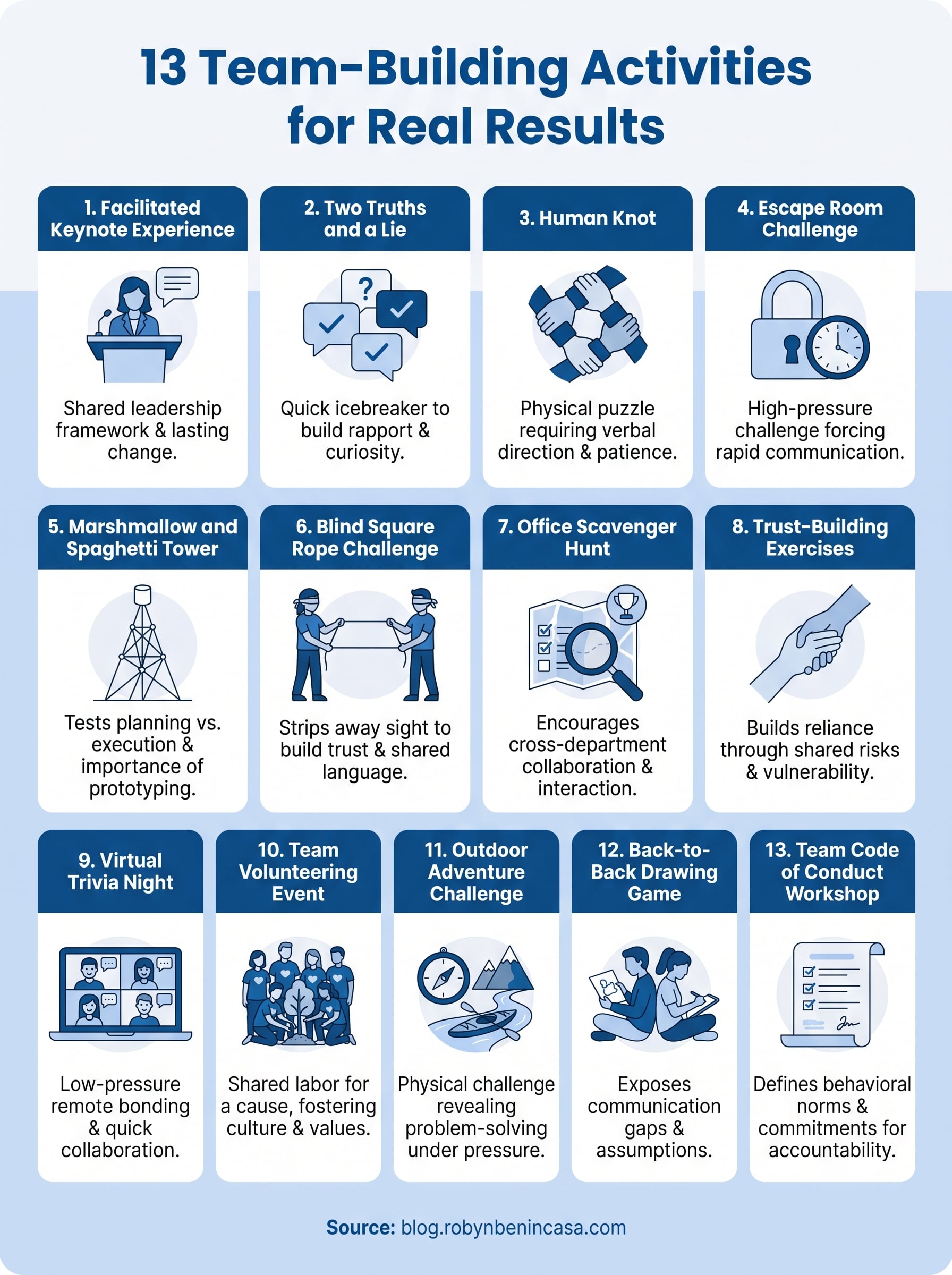
Skip the temptation to run through this whole list looking for a quick fix. Pick one or two activities that match the actual problem your team has right now, whether that’s a communication breakdown, a trust gap after a rough project, or a group that’s simply never had a reason to talk outside their own department. A scavenger hunt won’t heal a leadership team that stopped trusting each other after a layoff, and a rope course won’t help new hires learn names faster than a scavenger hunt would.
The activities that stick share one thing: they connect back to a real goal your team already cares about, not just an hour off the calendar. If you want that connection built into the day itself, from someone who’s led teams through actual life-or-death stakes and translated those lessons into boardrooms, book Robyn for your next event and give the rest of this list something worth building on.