
You’ve probably felt the difference between a team that clicks and one that just clocks in. That difference has a name: team culture. It’s not a poster in the break room or a line in your employee handbook. It’s the actual pattern of behavior, communication, and shared values that determines whether people show up to win together or just show up.
So what is team culture, exactly? It’s the unwritten set of norms, attitudes, and habits that shape how a group works, treats each other, and handles pressure. A great team culture shows up in small, repeatable moments: how a team reacts when a deadline slips, whether people speak up in meetings, whether wins get shared credit. Look at any high-performing team and you’ll find a culture of a team that was built on purpose, not left to chance.
I spent 15 years racing on world championship adventure racing teams and another 20 as a San Diego firefighter, and both jobs taught me the same lesson: talent loses to culture almost every time. In this article, I’ll walk you through the real definition of team culture, concrete examples of what it looks like at work, and the practical steps that turn a group of individuals into a team that actually performs like one.
Why team culture matters more than you think
Most leaders treat culture as a soft topic, something to address after the numbers get fixed. That’s backwards. Team culture at work drives the numbers. When I raced Primal Quest and Eco-Challenge with my adventure racing teammates, we weren’t the strongest athletes in the field most years. We won because our team culture meant nobody quit on each other at hour 80 of a 100-hour race. The same principle plays out in offices, hospitals, and fire stations every single day: culture sets the ceiling on performance, and no amount of individual talent breaks through it.
Culture isn’t the soft stuff. It’s the stuff that decides whether your strategy actually gets executed.
The business case is measurable
Companies love to call culture "intangible," but the outcomes are anything but. I’ve worked with sales organizations that moved from 17th to 1st in national rankings after we rebuilt how their teams communicated and supported each other under pressure. That’s not a motivational anecdote. That’s a culture of team behavior translating directly into revenue. Gallup’s research backs this up at scale: business units with highly engaged teams see 23% higher profitability and 18% higher productivity compared to those with low engagement, underscoring the well-documented link between organizational culture and performance (gallup.com). Engagement doesn’t happen in a vacuum. It’s a byproduct of culture.
Here’s what shifts when culture improves versus when it’s ignored:
| Metric | Weak Culture | Strong Culture |
|---|---|---|
| Turnover | High, frequent backfilling | Low, longer tenure |
| Decision speed | Slow, bottlenecked by silos | Fast, distributed trust |
| Response to setbacks | Blame, finger-pointing | Adjust, own the fix |
| Innovation | Rare, risk-averse | Frequent, psychologically safe |
| Customer experience | Inconsistent | Reliable, team-backed |
Retention and recruiting ride on it
People don’t leave jobs, they leave environments. If your definition of team culture in practice is "everyone for themselves," your best performers will eventually find a place where that’s not the case. I’ve sat across from HR leaders at companies like Allstate and Boston Scientific who weren’t dealing with a talent shortage, they were dealing with a culture leak. Talented people were walking out the door because the day-to-day experience of working there didn’t match what was promised in the interview. Fixing that leak is cheaper and faster than constantly refilling the pipeline.
Recruiting benefits just as directly. Candidates today ask about team dynamics before they ask about ping-pong tables. When your current team genuinely likes working together, that reputation travels through referrals, Glassdoor reviews, and LinkedIn posts, whether you’re managing it or not.
Culture determines how teams handle pressure
Any team looks fine when nothing’s going wrong. The real test is what happens during a merger, a missed quarter, or a crisis. As a firefighter for over 20 years, I watched crews perform under conditions where hesitation or ego could cost lives. The crews that performed best weren’t necessarily the most experienced, they were the ones who had built trust and clear communication habits long before the fire started. Corporate teams face a version of this every time market pressure hits or leadership changes. What is team culture if not the operating system a group falls back on when the pressure is highest? Teams with strong cultures adapt. Teams without one fracture.
It shapes how change actually lands
Organizations leading teams through change during mergers, reorgs, or new leadership shifts often assume resistance is about the change itself. Usually it’s about culture. A team that trusts its leaders and each other will absorb disruption and keep moving. A team without that foundation will treat every change as a threat, and productivity stalls while people protect themselves instead of the mission. If you’re planning a major shift and haven’t addressed organizational culture and change management first, you’re building on sand.
The bottom line: culture isn’t a nice-to-have sitting next to strategy, compensation, and process. It’s the mechanism that determines whether all three actually work. Ignore it, and you’ll keep solving the same performance problems on a loop without understanding why they keep coming back.
Types of team culture you’ll find at work
Walk into ten different companies and you’ll find ten different flavors of team culture, and most of them fall into a handful of recognizable patterns. Researchers who study organizational behavior, including the widely cited organizational culture framework developed by University of Michigan professors Kim Cameron and Robert Quinn, have mapped these patterns for decades. You don’t need an academic framework to spot them, though. Examples of organizational culture show up the moment you sit through one staff meeting or watch how a team handles a missed deadline.

Four common team culture types
Here’s how the major types break down, along with what tends to go right and wrong in each:
| Culture Type | Core Focus | Typical Strength | Typical Risk |
|---|---|---|---|
| Clan/Family | Loyalty, mentorship, collaboration | High trust, low turnover | Can avoid hard conversations |
| Adhocracy/Innovation | Risk-taking, new ideas, speed | Fast adaptation, creativity | Can lack follow-through |
| Market/Competitive | Results, targets, winning | Strong performance drive | Can burn people out |
| Hierarchy/Process | Structure, consistency, control | Reliable, low error rate | Can slow decisions to a crawl |
Most real teams are a blend. A sales floor might run heavy on Market/Competitive energy while the operations team behind it leans Hierarchy/Process to keep things consistent. Neither is wrong on its own. Problems start when the blend doesn’t match the work in front of the team, like a crisis-response unit stuck in slow, process-heavy habits when speed is what actually saves the day.
Which type actually wins
Over 15 years of adventure racing against teams from every kind of background, the teams that consistently outperformed us weren’t pure clan or pure market types. They combined the loyalty and trust of a clan culture with the results-driven push of a competitive one. That combination is close to what I mean by an organizational culture definition built for teams: a shared identity strong enough that people protect each other, paired with a shared scoreboard everyone actually cares about hitting.
The best team cultures don’t pick one lane. They borrow trust from family, urgency from competition, and discipline from process, then apply whichever one the moment demands.
That’s the real insight most typologies miss. Categorizing your team’s culture is useful diagnostically, but the goal isn’t to pin a label on it and stop there. The goal is building a culture flexible enough to shift gears depending on what’s in front of you: warm and patient during onboarding, sharp and fast during a launch, disciplined and careful during a safety-critical process. Rigid teams that only know one mode eventually break under conditions that call for a different one. Teams that understand the full range, and can move between them deliberately, are the ones that hold up under real pressure.
What great team culture looks like in practice
Talk is cheap when it comes to culture. Great team culture isn’t a value statement on the wall, it’s a set of behaviors you can actually watch happen. Picture a team where someone admits a mistake in a meeting and the response is "okay, how do we fix it" instead of silence or blame. That single reaction tells you more about culture than any mission statement ever could. If you’re trying to spot an example of team culture in action, stop reading brochures and start watching how people react in the moments that actually matter.

You don’t build culture in the mission statement. You build it in how people react when something goes wrong.
The behaviors that separate great from average
Over two decades of racing and firefighting, I noticed the same handful of behaviors showing up again and again on teams that outperformed everyone else. They’re specific enough to check for on your own team this week:
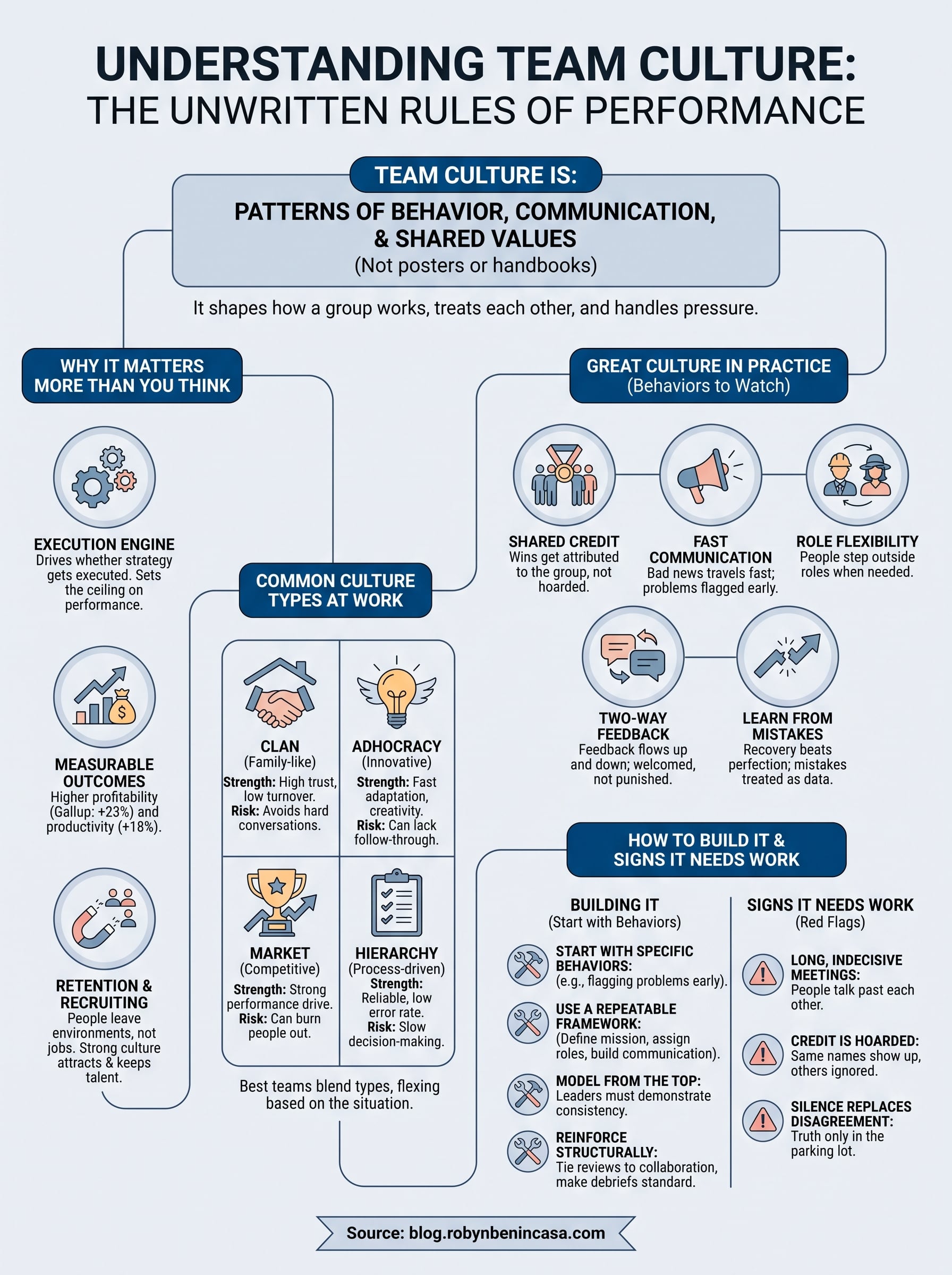
- Credit flows outward. Wins get attributed to the group, not hoarded by whoever presented last.
- Bad news travels fast. Problems get flagged early instead of hidden until they’re unfixable.
- Roles flex under pressure. People step outside their job description when the team needs it, without being asked twice.
- Feedback goes both directions. Junior team members feel safe correcting senior ones, one of the clearest examples of collaboration in the workplace, and it’s welcomed, not punished.
- Recovery beats perfection. Mistakes get treated as data, not evidence for a performance review.
Notice none of these show up on a values poster. They show up in Slack threads, status updates, and hallway conversations.
A real example from the field
During one 100-hour adventure race, our navigator made a call that cost us six hours. The old version of that team would have spent the next day rehashing whose fault it was. Instead, we recalculated the route, redistributed gear weight to our fastest paddler, and kept moving. Nobody brought it up again until the post-race debrief, and even then it was framed as "what do we adjust next time," not "who screwed up." That’s what a functioning culture of a team actually looks like when the stakes are real. Corporate teams face smaller versions of this constantly, a blown deadline, a lost account, a bad quarter, and the ones with strong cultures handle it the exact same way: assess, adjust, move.
What it sounds like in daily conversation
Listen closely to how a team talks and you’ll hear culture before you see it in any metric. Strong teams use "we" language even when describing individual contributions. Weak ones default to "they" when something goes wrong and "I" when something goes right. Meetings in a healthy team culture at work end with clear next steps and shared ownership, not vague nods and unanswered questions. If you want a fast diagnostic, sit in on one status meeting and count how often people interrupt to help versus interrupt to protect themselves. That ratio tells you almost everything you need to know.
How to build a strong team culture
Building team culture on purpose starts with the assumption that it’s already forming whether you plan it or not. Every team has a culture right now, the question is whether it’s the one you’d choose if you were designing it from scratch. Culture doesn’t come from a kickoff meeting or a new set of core values printed on mugs. It comes from what leaders repeat, reward, and tolerate every single day. If you want to shift how your team works, start by auditing those three things before you change anything else.
You don’t announce a new culture. You demonstrate one, repeatedly, until it becomes the default.
Start with behaviors, not slogans
Forget the values workshop for a minute. Pick three to five specific behaviors you want to see, things like flagging problems early, sharing credit, or backing up a teammate under deadline pressure. Then build systems that make those behaviors visible and rewarded. On my adventure racing teams, we didn’t talk about how to build trust in a team at work in the abstract, we practiced specific habits, like calling out fatigue before it became dangerous, until they were automatic. That’s the version of a culture of team behavior that actually sticks.
Use a repeatable framework
Don’t rely on inspiration alone. Teams that know how to create a high-performance culture that sustains itself over years, not just during a good quarter, tend to follow a structure. In my keynotes and in How Winning Works, I break this down into eight elements that world-class teams share, covering everything from communication under pressure to how a team defines and celebrates wins together. Here’s a simplified version you can start applying this week:
- Define the mission clearly so everyone knows what winning actually looks like.
- Assign roles based on strength, not just title or tenure.
- Build communication habits before a crisis forces you to.
- Reward team outcomes, not just individual heroics.
- Debrief honestly after both wins and losses.
Model it from the top
Leaders set the ceiling for what’s acceptable. If a manager takes credit publicly but assigns blame privately, no amount of team-building activities will fix the resulting team culture at work. Consistency matters more than charisma here. Show up the same way during an easy week and a brutal one, and your team will start mirroring that stability. Watching a leader stay calm and solution-focused during a real setback teaches more about culture than any offsite ever will.
Reinforce it structurally
Finally, build culture into your systems, not just your speeches. Tie performance reviews partly to collaboration behaviors. Make debriefs a standing part of every project, not an afterthought. Small structural choices like these turn a good intention into a habit that survives turnover, growth, and pressure, which is the real test of whether a culture was ever built at all.
Signs your team culture needs work
Some teams limp along for years without anyone naming the problem out loud. Nobody says "our culture is broken," they just say "we’re understaffed" or "people are stressed right now," and those excuses cover for the real issue longer than they should. If you’re asking what does team culture mean for your own group, the honest answer often shows up in the patterns leaders avoid looking at directly: who stays quiet in meetings, who’s already checked out, and who’s covering for gaps that never get fixed.

Signs you can spot from your desk
Certain warning signs don’t require a survey or a consultant, you can see them within a week of paying attention:
- Meetings run long and decide little. People talk past each other instead of to each other.
- Credit gets hoarded. The same one or two names show up in every update, regardless of who did the work.
- Problems surface late. Issues get flagged only after they’ve become expensive to fix.
- Turnover clusters. Your strongest performers leave first, not your weakest.
- Silence replaces disagreement. Nobody pushes back in the room, then everyone complains about the decision afterward.
If people only tell the truth in the parking lot after the meeting, your culture already has a problem.
Quieter signs that take longer to notice
Other signals build slowly enough that leaders miss them until the damage is done. Watch for teams that hit their numbers but burn people out doing it, that’s a team culture at work problem disguised as a performance win. Notice whether new hires adopt the existing habits within their first 90 days or start bringing bad habits of their own because nobody modeled anything different. Track whether feedback flows upward as easily as it flows down. A team where junior employees never correct senior ones isn’t respectful, it’s afraid, and fear is one of the fastest ways to kill the kind of trust a strong culture of a team depends on.
Watching how a team handles a shared loss tells you more than watching how it handles a win. Ask yourself honestly whether your last missed deadline or lost account got debriefed constructively or quietly buried. If it got buried, that silence is data. It means the team has learned that honesty about failure gets punished, so they’ve stopped offering it, and you’ve lost your best early-warning system in the process.
What to do once you spot them
Diagnosing the problem is only useful if you act on what you find. Start by naming the specific behavior you want to change rather than the vague feeling behind it, then treat it the same way you’d treat any other performance issue: with a clear expectation, a way to measure progress, and consistent follow-through from leadership. Rebuilding a damaged culture takes longer than building one from scratch, but the same principles apply either way. The teams I’ve worked with who turned things around didn’t wait for a perfect moment, they started with one honest conversation and one changed behavior, then built from there.
Bringing your team culture to life
Every team already has a culture, whether anyone designed it or not. The question is whether yours is the one you’d actually choose. Team culture isn’t built in a single offsite or fixed with a new values poster. It’s built in the small, repeated choices leaders make about what gets rewarded, what gets tolerated, and what gets modeled when things go wrong. A great team culture doesn’t happen by accident, and it doesn’t survive on good intentions alone. It survives on habits, structure, and leaders who show up the same way on the hard days as the easy ones.
If you’re ready to move past reading about culture and start rebuilding it inside your own organization, working with an organizational culture consultant is exactly the work I do with teams facing this challenge every day. Explore more insights on building winning team cultures and see what it takes to turn your group into one that actually performs like a team.