The best leadership foundational training for first-time managers is the course that fits how you learn and who pays for it. If you want research-backed, self-paced training for about $250, pick CCL Boost. If you want live practice with an instructor over two days, pick SkillPath’s first-time supervisor workshop. If you want the most hours for the least money, pick the Udemy foundational course, and check how dated its material feels.
Most people become managers because they were good at the job, not because anyone taught them to manage. Overnight you are handling delegation, feedback, former peers, and performance conversations with no manual. Choosing a course from dozens of near-identical titles is a second problem on top of the first.
This article compares six programs with the same three questions: what each covers, how long and how much it costs, and who it suits. First you get a short checklist of the skills any foundational course should teach, so you can judge the options yourself. After the six picks, you get a comparison table, a cost-per-hour example, and decision rules. New managers sit at the center of team culture, the topic Robyn Benincasa speaks on, so this guide is written for the person making that first jump.
What foundational training for first-time managers should cover
A foundational course should teach six skills: the shift from doer to leader, delegation, feedback and coaching, communication, performance and conflict conversations, and prioritizing. These are the skills new managers get wrong first, so use them as a filter for every program below.
The six skills that carry the first year
Courses that spend most of their hours on vision and strategy skip the daily work of managing people. A new manager needs practical routines before big-picture theory. Check each program against this list.
- The identity shift. Moving from doing the work to getting work done through others, including managing former peers.
- Delegation. Choosing what to hand off, setting clear outcomes, and following up without hovering.
- Feedback and coaching. Giving specific, timely input and running regular one-on-ones.
- Communication and meetings. Setting agendas, listening actively, and confirming that people understood.
- Performance conversations and conflict. Setting goals, documenting progress, and handling disagreements early.
- Prioritizing and decisions. Separating urgent from important and deciding with a repeatable process.
Foundational training earns its price when it covers the daily work of managing people, not just the theory of leadership.
What a course cannot do for you
No course turns you into a manager in a day. It gives you vocabulary, models, and a first set of habits. The habits only form when you use them with real people the following week.
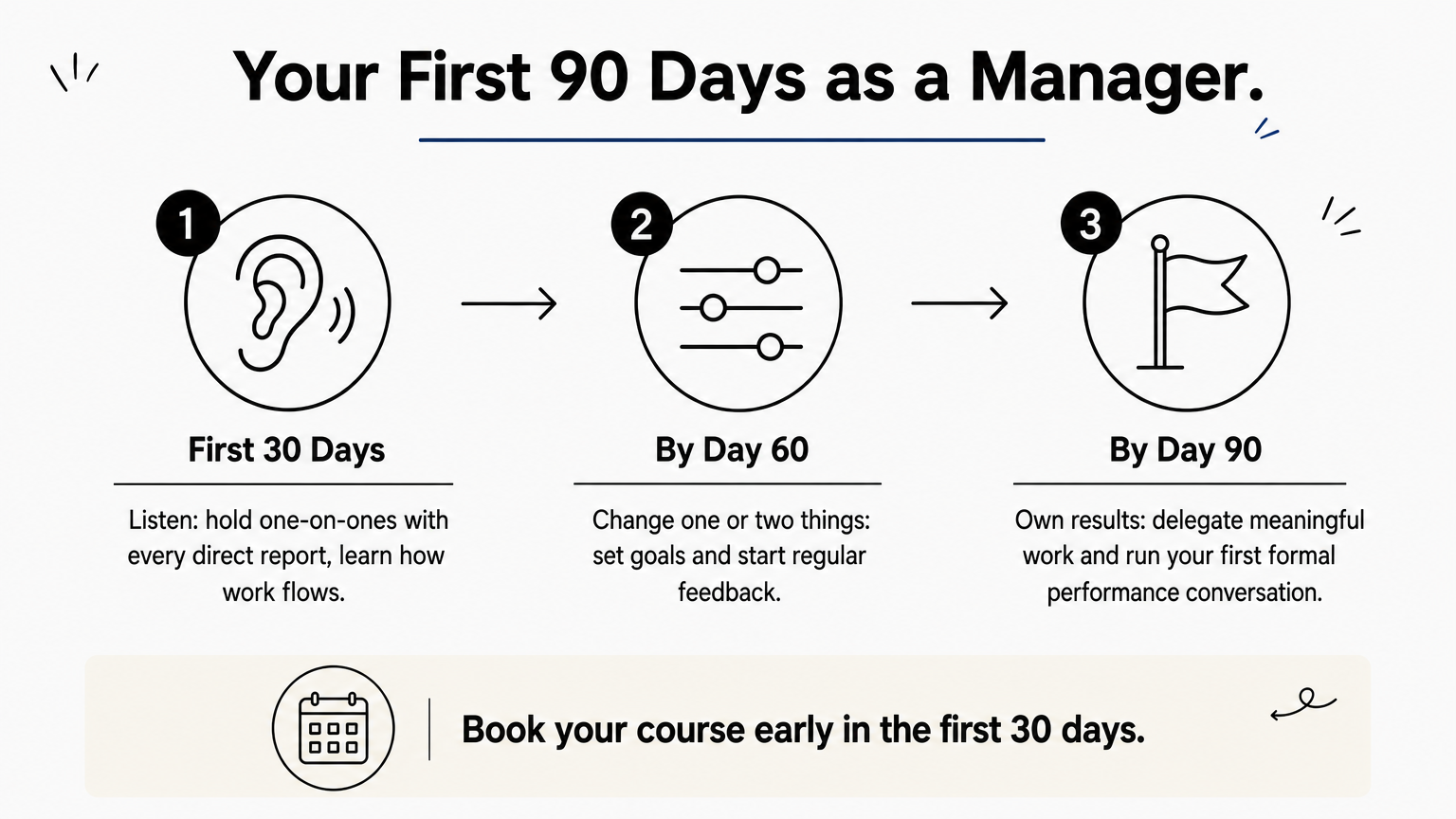
A simple structure helps you apply what you learn. The 30-60-90 rule splits your first three months into three jobs. In the first 30 days, listen: hold one-on-ones with every direct report and learn how work flows. By day 60, change one or two things: set goals and start regular feedback. By day 90, own results by delegating meaningful work and running your first formal performance conversation. Book your course early in the first 30 days so it feeds the plan.
1. CCL Boost for first-time managers
CCL Boost is the strongest pick for a self-paced, research-based reset on how a new manager thinks. It comes from the Center for Creative Leadership, which built the course around the transition from individual contributor to manager.

What it covers
The course teaches six shifts: mindset, skillset, relationships, a do-it-all attitude, perspective, and focus. Each shift follows a three-step rhythm of watching video case studies, reading practice assignments, and completing guided reflection. CCL also includes a generative AI tool that runs short guided conversations to help you reflect and practice.
CCL says its research found these challenges hit new managers hardest:
- Adjusting to managing others and leveraging authority
- Developing managerial and personal effectiveness
- Leading team achievement
- Managing internal stakeholders and politics
- Driving performance and accountability
- Resolving conflict and improving communication
Pick CCL Boost when you want a short, research-based reset on how a manager thinks, not a long catalog of tactics.
Format, length, and price
- Format: asynchronous online with rolling enrollment
- Length: 6 hours, self-paced
- Price: $250 USD, paid by credit card at registration (organizations can contact CCL to arrange invoicing)
- Credential: 1.8 CEUs awarded in partnership with National University
Who it suits
CCL Boost suits the self-directed new manager who wants a focused six hours instead of a multi-day commitment. It also works for an HR lead who needs a consistent baseline for people moving into their first supervisory role. The program lists job aids and reference tools you can use on the job right away.
Skip it if you learn best from live discussion. The reflection is mostly solo, so you will not get instructor feedback on your own situation, and a six-hour course will not go deep on any single skill.
2. SkillPath first-time supervisor workshops
SkillPath is the best pick if you want live instruction and a calendar date that forces you to show up. Its flagship is a two-day workshop called Management & Leadership Skills for First-Time Supervisors & Managers.

What it covers
The two-day workshop is built to give you the fundamental leadership skills for a new supervisory role. SkillPath also splits the new-manager problem into smaller sessions named after the moment you are in. These include How to Successfully Make the Transition to Supervisor, Managing Former Peers, and Survival Skills for First-Time Supervisors.
That modular approach is unusual. If your biggest worry is supervising people who used to be your teammates, you can book a one-hour session on exactly that. Read the agenda on the course page for the exact modules in the two-day program, and compare them against the six-skill checklist above.
SkillPath is the only option here that lets you buy a fix for one specific new-manager problem instead of a whole course.
Format, length, and price
- Two-day workshop: live virtual, also offered in person and on demand; listed at $425
- Transition workshop: live virtual, 3 hours; listed at $199
- One-hour webinars: listed at $199 each, with several included in SkillPath’s Unlimited + Live plan
- Dates: multiple sessions are scheduled each month, so you rarely wait long
Who it suits
This one suits managers who need to start soon and want an instructor who answers questions in real time. The live format also fits people who focus better with a fixed block of time away from their inbox. The on-demand version of the two-day course helps if your schedule cannot hold two live days.
Weigh the price carefully, though. A one-hour webinar at $199 costs nearly as much as CCL’s full six-hour course at $250. For a narrow problem it can be worth it. As a general foundation, the two-day workshop is the better buy.
3. Udemy’s foundational training for first-time managers
The LearnSmart course on Udemy is the pick for depth on a budget. It is by far the longest option in this list, and it comes with an important caveat about its age.
What it covers
The course runs 13 sections and 286 lectures and goes well beyond a typical intro. It covers the manager’s core functions, the seven-step decision-making process, the Eisenhower important/urgent matrix, ten leadership styles, and common leadership pitfalls. It then moves into delegation with SMART objectives, facilitating meetings and groups, and coaching, plus appraising performance, disciplinary responses, and employee development plans.
That list matches nearly every skill in the checklist at the top of this article. It also includes crisis handling and SWOT and STEP analysis, which most short courses skip.
If you want foundational breadth for the lowest cost per hour, this course delivers it, as long as you can live with older material.
Format, length, and price
- Format: on-demand video with quizzes, closed captions, and a certificate of completion
- Length: 13 hours 26 minutes
- Price: available through Udemy’s Personal Plan, which starts at $13 per month; Udemy lists a 30-day money-back guarantee
- Credential: qualifies for 27 PDU hours toward an existing PMP from PMI
- Reputation: rated 4.6 out of 5 across 783 ratings, with 6,256 learners
- Last updated: May 2017
Who it suits
It suits the budget-conscious manager who wants a full curriculum to work through over several weeks. It also suits anyone who already holds a PMP and wants PDU credit.
The 2017 update date matters. Remote and hybrid management, which has changed a lot since then, gets limited attention in the course outline. Treat it as a solid base for fundamentals and fill the gap with a current source on managing distributed teams. Also note that the course is video-only, so nobody will react to how you handle your actual team.
4. AMA’s management skills for new managers
The American Management Association course is the pick when your employer is paying and you want a structured, skills-first program from a long-established management training organization. It is built around the day-to-day tools of the job.
What it covers
AMA’s course description names delegation, coaching, feedback, communication, and performance management as its core skills. That is a close match for the checklist at the start of this article, and it is a more skills-oriented list than a mindset-focused program such as CCL Boost.
This is the right style of course if you already feel the identity shift and now need concrete techniques. Confirm the full agenda and any practice exercises on the AMA course page before you register.
AMA fits the manager who already knows what the job is and now needs the techniques to do it.
Format, length, and price
AMA sets its dates, delivery format, and price on the course page, and they vary by session. Before you commit, check these four things:
- Format: live online or in-person, and whether sessions run on consecutive days
- Total hours: compare against CCL’s 6 hours and the two-day SkillPath workshop
- Price: compare against the table in the next section
- Credential: whether the course carries CEUs or another credential your employer values
Who it suits
AMA suits managers whose company reimburses training and who want a recognized provider name on their record. It also suits those who prefer a facilitated group over a self-paced video stream.
If you are paying out of pocket, price it against the cheaper options before you enroll. A short, structured skills course is worth buying, but not at several times the cost of an equivalent program.
5. Pryor’s new manager seminar
Pryor’s two-day New Manager Seminar is the pick for people who want to be away from their desk for a fixed block, with leadership and management basics taught to new supervisors. It competes directly with SkillPath’s two-day workshop.
What it covers
Pryor positions the seminar as first-time manager training that combines leadership skills with management training for new supervisors. Its stated promise is confidence in the step from team member to leader.
Because the two-day workshops from Pryor and SkillPath target the same buyer, the agenda is the tiebreaker. Put both outlines side by side and check which one spends more time on the skills you feel weakest in, such as feedback, delegation, or handling conflict.
When two two-day seminars look the same on the surface, choose the one whose agenda spends the most time on your weakest skill.
Format, length, and price
- Length: 2 days
- Format and dates: listed on Pryor’s course page; check whether your preferred date is live online or in person
- Price: shown on the course page; set it next to SkillPath’s $425 listing
- Questions to ask: whether materials, a certificate, or follow-up support are included
Who it suits
This seminar suits the new supervisor who wants two protected days to focus, and learns best by working through exercises with other first-timers in the room. Hearing how other new managers handle the same problems is a real benefit of a live format.
It is a weaker fit if you need training at once, in small pieces, or at the lowest possible price. In those cases a self-paced option will serve you better.
6. Coursera’s management skills for new managers
Coursera’s course, offered by STARWEAVER, is the pick for flexible, low-commitment learning. It targets new managers directly and promises practical tools and leadership strategies.
What it covers
The course description says it equips new managers with practical tools and leadership strategies for their roles. The curriculum is built from weekly modules, which suits a manager who wants to learn in short blocks after work.
Review the module list on the course page and match it against the six skills checklist. A good sign is any module on feedback, delegation, or one-on-one meetings. A warning sign is a syllabus made mostly of general leadership theory.
A platform course is a smart way to test the waters before you spend $250 or more on a program.
Format, length, and price
- Format: self-paced online on Coursera, usually with video lessons and quizzes
- Length: shown on the course page
- Price: check the page for current terms, including whether you can preview or audit the material before paying
- Credential: a shareable certificate may be available when you complete it
Who it suits
It suits the first-timer with a small budget who is not sure how much training they need. It also suits anyone who wants to try a topic before committing real money, since you can quickly judge whether the teaching style works for you.
You will not get live coaching or feedback on your real situation. Pair it with a monthly one-on-one with your own manager so someone reacts to how you apply the lessons.
How to choose the right course for you
Choose by format first, then by price, then by credential. If you need live practice, pick a two-day workshop. If you need flexibility, pick a self-paced course. If you are on a budget, pick on-demand video.
Compare the options at a glance
The table puts the listed figures side by side. Prices change, so confirm each one on the provider’s page before you enroll.
| Course | Format | Length | Listed price |
|---|---|---|---|
| CCL Boost | Self-paced online | 6 hours | $250 USD |
| SkillPath two-day workshop | Live virtual, in-person, or on demand | 2 days | $425 |
| SkillPath transition workshop | Live virtual | 3 hours | $199 |
| Udemy LearnSmart course | On-demand video | 13 hours 26 minutes | Personal Plan from $13 per month |
| AMA new managers course | See AMA page | See AMA page | See AMA page |
| Pryor New Manager Seminar | Seminar | 2 days | See Pryor page |
| Coursera (STARWEAVER) | Self-paced online | See Coursera page | See Coursera page |
Two other routes are worth a look. Skillsoft’s first-time manager channel, which your employer may already license, covers building team relationships and aligning work with organizational goals. The NAB Leadership Foundation runs a First Time Manager Series for new and aspiring leaders.
Run the numbers for your situation
Cost per hour makes very different formats comparable. CCL Boost costs $250 for 6 hours, which is about $41.67 per hour. The Udemy course holds 13.43 hours of video, so a single month of the $13 Personal Plan works out to under $1 per hour if you finish in that month.
Now scale it up for a team. Eight new managers on CCL Boost at the listed individual price cost $2,000. The same eight in SkillPath’s two-day workshop cost $3,400. Ask each provider about group rates, because the figures above are individual prices.
Cheap does not mean equal, though. The Udemy course gives you volume, while a live workshop gives you feedback and accountability. Buy the format that fixes your real gap.
Match the course to your situation
Use these rules to decide quickly:
- Starting the role within weeks: a live SkillPath session or CCL Boost, because both can start soon.
- Managing your former teammates: SkillPath’s Managing Former Peers webinar, then a broader course.
- Need live practice with other first-timers: a two-day seminar from SkillPath or Pryor.
- Tight budget: Udemy’s Personal Plan or a Coursera trial, plus monthly one-on-ones with your own boss.
- Need continuing education credit: CCL’s 1.8 CEUs, or Udemy’s 27 PDUs if you hold a PMP.
- Building a program for a cohort: a self-paced base course, then a live session for discussion.
Add team-level support to the course
A course teaches one person. It does not change what your team expects of you. If you run HR or lead a department, pair individual training with a shared moment where new and experienced managers hear the same message about team culture. Robyn Benincasa’s keynote Extreme T.E.A.M.W.O.R.K. runs 45 to 60 minutes and can be booked for all-hands meetings, kickoffs, or leadership offsites, in person or virtual. A talk like this does not replace training, but it gives the newly promoted a common reference point for the habits the course teaches.
Ready to pick your course?
Foundational leadership training works when it matches how you learn. Choose CCL Boost for a short, research-based reset, SkillPath or Pryor for two live days, Udemy for depth at a low price, AMA when your employer pays, and Coursera to test before you spend. Whatever you pick, schedule it in your first 30 days and apply one idea a week.
Courses start the learning. Teams and habits finish it. For more guides on leading teams, building culture, and growing as a leader, browse the Robyn Benincasa blog.