A keynote speaker is defined by the slot: the main address that sets the theme of an event, usually opening or closing it. A motivational speaker is defined by the goal: to lift energy and push people to act. That is the difference between a keynote speaker and a motivational speaker. One is a role in your program, the other is an outcome you want. A talk can be both, but the keynote speaker vs motivational speaker question comes down to which of those two jobs you are hiring for.
Planners and speakers often use the two labels interchangeably, which is why the choice feels fuzzier than it should. This article shows why the distinction matters when you book, how the two types differ side by side, how to choose for your event, and how to get a talk that does both.
Robyn Benincasa speaks on leadership, teamwork and organizational culture, so this is a practical question for her audience of event planners, HR leaders and executives. The advice below applies to any speaker you are considering, not only her.
Why the difference matters when you book a speaker
The two labels describe different things, so treating them as synonyms leads to a vague brief and a talk that misses what your audience needed. A clear answer to "keynote or motivational?" shapes who you shortlist, what you ask them, and how you judge the result.
Two labels, two different jobs
"Keynote" tells you where the talk sits in the program and what it must do for the event. It is the main general session, built around your theme, and it gives every attendee a shared message that the breakout sessions can echo. "Motivational" tells you what the talk is meant to do to people. It aims at energy, belief and commitment, whatever the slot.
That is why a motivational talk can appear as a keynote, a kickoff closer, an awards-dinner address or a team meeting opener. It is also why a keynote does not have to be motivational at all. Some keynotes are mostly educational.
A keynote is a position in your program, and motivation is an effect you want on the room.
What a mismatch costs you
Book a purely motivational speaker for your opening session and the room may leave energized but disconnected from your theme. The afternoon sessions then start from zero. Book an expert who knows the subject but has no stage presence, and you get a dry hour that people politely endure.

Both mistakes are expensive for the same reason. A speaker takes up your best slot, in front of your whole audience at once, and you rarely get that slot back.
Why the labels blur
Most working speakers wear both hats, and their marketing uses both words. The practical test is the emphasis. Ask whether the talk is built around your event’s theme and teaches something, or built around lifting people regardless of theme. Once you know which emphasis you need, the label matters much less than the content of the talk.
How a keynote speaker and a motivational speaker differ
A keynote speaker frames and informs, while a motivational speaker energizes and urges action. The comparison below sets the practical differences next to each other.
Side-by-side comparison
| Keynote speaker | Motivational speaker | |
|---|---|---|
| Defined by | The slot: the main session | The goal: energy and action |
| Typical placement | Opening or closing general session | Kickoffs, banquets, team meetings, or as a keynote |
| Link to event theme | Built around it | Optional |
| Main aim | Set direction, tone and shared language | Raise belief, morale and commitment |
| Content | Expertise, a framework, a message for the whole event | Personal story, mindset, resilience |
| Success looks like | Attendees repeat the message in breakouts | Attendees leave fired up and ready to act |
| Weak version | Accurate but flat | Energetic but forgettable |
If the talk must tie to your theme, you need a keynote. If the talk must change the mood, you need motivation. Strong speakers deliver both.
Where inspirational and guest speakers fit
An inspirational speaker usually shares a story of overcoming adversity to lift spirits and widen perspective. A motivational speaker pushes people toward a specific goal or change in behavior. In business settings, you will also see labels like performance speaker or mindset speaker for the same work. A guest speaker is simply anyone invited to speak, and a keynote speaker is the headline speaker among them.
So a guest speaker is not necessarily a keynote speaker. The difference between a speaker and a keynote speaker is billing and purpose. The keynote is the featured address that carries the event’s message, while other speakers support it.
What qualifies someone as a keynote speaker
No certification makes someone a keynote speaker. It is a title the event organizer gives to the person delivering the main address. In practice, the people who earn it share three things: credible expertise on the theme, a story or framework that holds a large room, and the delivery skill to keep people engaged for 30 to 60 minutes.
Experience on large stages matters because a keynote has to work for an entire audience at once, with mixed roles, tenures and levels of interest. That is a different challenge from a small workshop or a team talk.
How to choose the right speaker for your event
Choose by outcome first and label second. Decide what should be different after the session, then match the speaker to that result.
Start with what should change after the session
Work through these questions before you contact anyone:
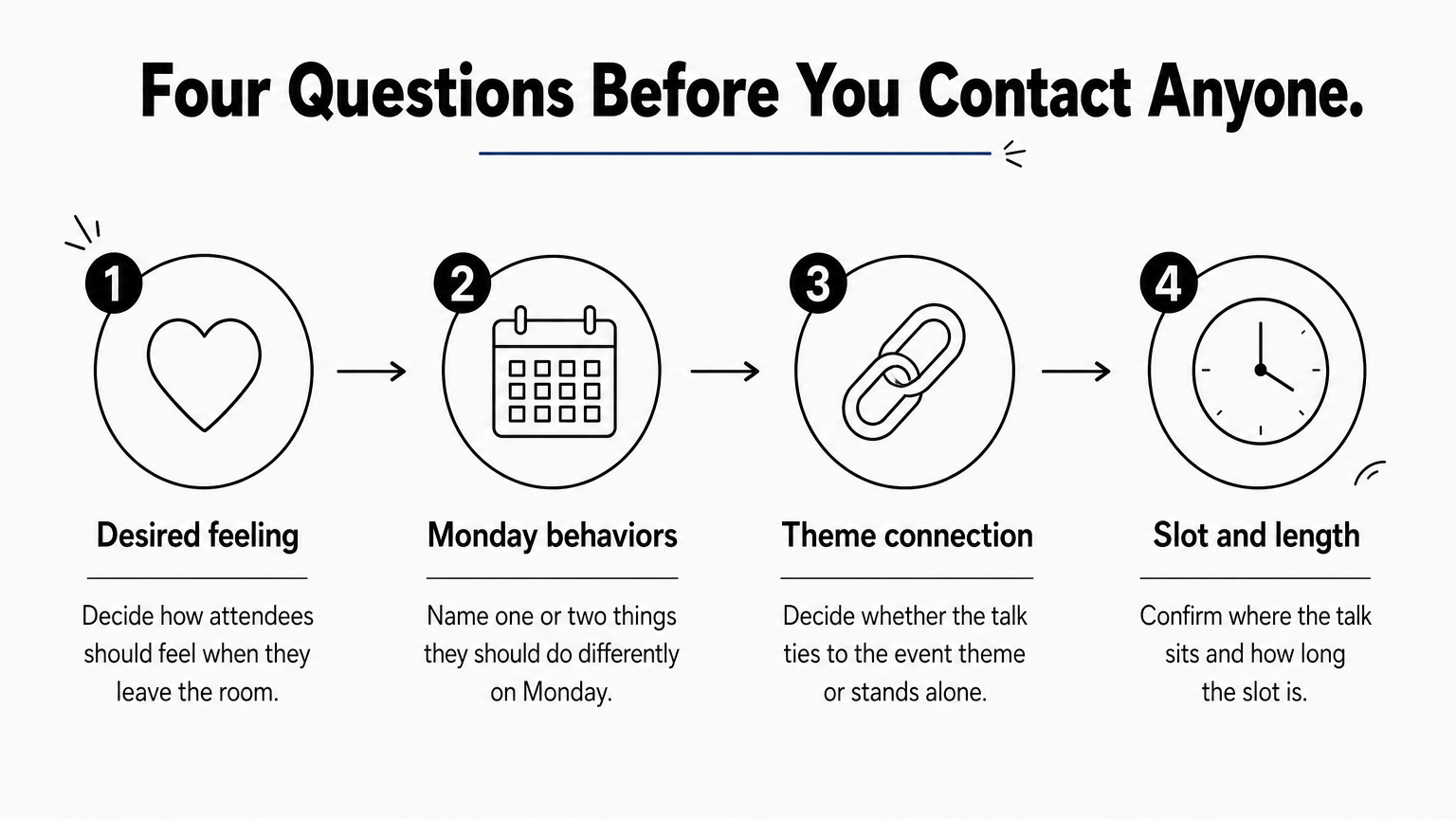
- What should attendees feel when they leave? Fired up, calmer, more connected?
- What should they do differently on Monday? Name one or two behaviors.
- Does the talk need to tie to the event theme, or is it a standalone lift?
- Where will the talk sit, and how long is the slot?
If your answers are mostly about feeling, lean motivational. If they are about a shared message and behaviors, lean keynote. If you answer both, you want a keynote speaker who motivates, which is the most common need.
Match the speaker to the event situation
| Your situation | Better fit |
|---|---|
| Conference with a set theme | Keynote speaker |
| Sales kickoff after a tough quarter | Keynote with strong motivational delivery |
| Awards dinner or celebration | Motivational or inspirational speaker |
| Leadership offsite with skill goals | Keynote with practical frameworks |
| Company in change, merger or disruption | Keynote that gives teams shared language |
A worked example: you run a sales kickoff for 400 people after a missed quarter. You want energy, but you also want the team to work together differently. You book one 45-minute opening keynote from a speaker with a motivational delivery, and you ask her to leave the room with two or three behaviors the team can use. Your breakout leaders then build on the same message. One slot, both goals met.
Choose the outcome first, then book the speaker whose core strength matches it.
How to get a keynote that also motivates
You get both by briefing the speaker on the outcome you want and screening for substance as well as stage energy. A keynote that motivates pairs an emotional hook with something people can use the next day.
What the best of both looks like
The strongest talks open with a story that lands emotionally, then move to a framework people can remember, and end with actions. Without the story, the framework is dry. Without the framework, the energy fades by lunch.

This is the approach Robyn Benincasa takes. She is a world champion adventure racer and spent more than 20 years as a San Diego firefighter, and she builds each keynote from lived team experience. Her topics map to common situations. Why Winners Win (30 to 60 minutes) suits sales meetings and revenue kickoffs. Inspiring Greatness through G.R.I.T. (45 to 60 minutes) suits teams facing a tough year or stretch goals. Adapt, Overcome, and Win as One (45 to 60 minutes) suits organizations in disruption, such as AI transformation.
Questions to ask before you book
Ask each candidate these questions:
- What will my audience do differently a week after your talk?
- How will you tie your message to our theme and our people?
- Will you talk with me beforehand about the audience and the moment we are in?
- What does your talk give people besides energy?
Then send a short brief so the speaker can aim at your outcome. You can copy and adapt this one:
Event and audience: [type, size, roles, tenure mix]
Slot and length: [opening, closing, minutes]
Event theme: [one sentence]
Where the audience is right now: [tough year, new launch, change]
What should feel different when they leave: [energy, trust, focus]
What should they do differently next week: [one or two behaviors]
A good brief turns a generic talk into one built for your room.
Pick the outcome first, then the label
A keynote speaker is a role in your program, and a motivational speaker is an effect on your audience. They overlap, and the best talks combine both: a message tied to your theme, delivered with enough energy that people act on it. Decide what should change after the session, write that into a short brief, and judge every candidate against it.
If your event is about leadership, teamwork or culture, you can explore Robyn Benincasa’s keynote topics and see which one fits the outcome you want.