Most leadership development budgets get spent on generic workshops that never change how people actually lead. If you’re researching leadership skills and training, you already know the gap between sitting through a seminar and building real behavior change on your team. That gap is where most programs fail.
This article gives you a straight answer: the six skills that separate teams that perform under pressure from teams that fall apart, and the training formats that actually build stronger teams behind each one. You’ll get practical ways to develop communication, decision-making, and accountability, not just theory about what good leaders look like.
I’ve spent 20 years as a San Diego firefighter and 15 years leading world champion adventure racing teams through some of the toughest conditions on earth. Those environments don’t tolerate weak leadership, so I’ve watched exactly which skills and training approaches produce results and which ones waste time. This guide breaks down what works, so you can build a leadership pipeline that holds up when things get hard.
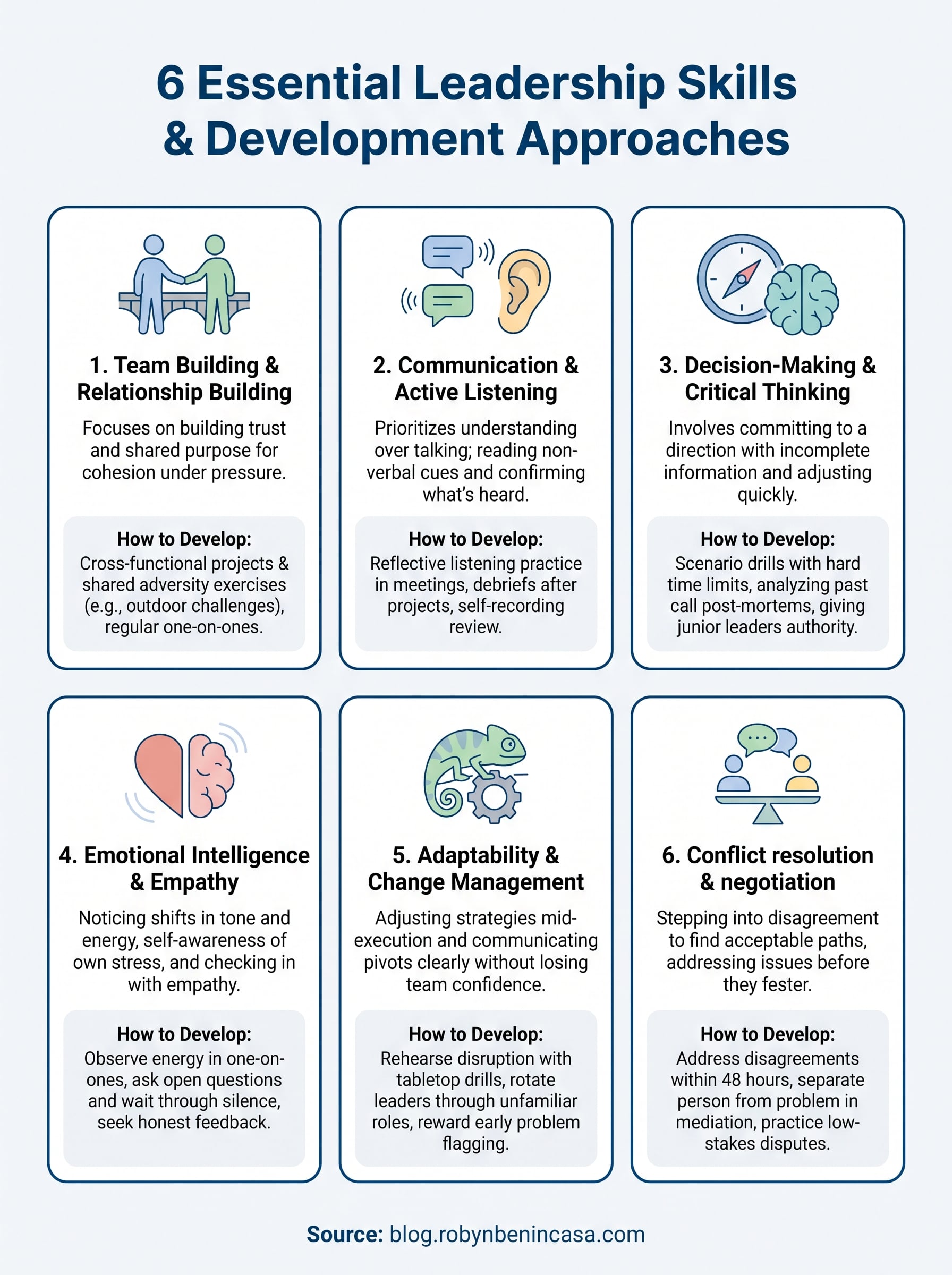
1. Team building and relationship building
Every expedition race I’ve won came down to one thing: a team that trusted each other before the gun ever went off. Team building and relationship building sits at the top of this list because no other skill matters if people don’t trust the person leading them. You can have the smartest strategist in the room, but if the team doesn’t believe in each other, they’ll fall apart the moment conditions get hard.

What it involves
This skill means creating shared purpose across people with different backgrounds, skill levels, and tenure. It’s not team lunches or trust falls. It’s building the kind of connection where a teammate covers for you at 2 a.m. on hour 30 of a race because they know you’d do the same. In a corporate setting, that looks like cross-department collaboration, mentorship, and leaders who actively invest in knowing their people beyond their job titles.
Why it matters for leaders
Organizations navigating mergers, layoffs, or market pressure lose cohesion fast without this skill actively managed. Weak relationships create silos, and silos kill performance. I’ve watched sales teams jump from 17th to 1st nationally once leadership stopped managing tasks and started building a strong team culture.
A team that trusts each other outperforms a team of individual stars every single time.
How to develop this skill
Building this skill takes structured practice, not just good intentions. Some proven approaches:
- Cross-functional projects that force collaboration across functions outside normal reporting lines
- Shared adversity exercises, like outdoor challenges for work teams or simulations, that mirror real pressure
- Regular one-on-ones focused on the person, not just the metrics
- Keynote and workshop training that gives teams a shared language around culture
This is exactly what I cover in my T.E.A.M.W.O.R.K. keynote, where I walk audiences through the eight elements that built world champion teams under real pressure, elements any organization can apply starting the next morning.
2. Communication and active listening
On a race course, a garbled radio call at mile 80 can cost you the win. In the office, a garbled directive costs you deadlines and trust. Communication and active listening rank second on this list because every other skill, from team building to conflict resolution, depends on people actually understanding each other.
What it involves
This skill covers more than talking clearly. It means active listening, where you repeat back what you heard before responding, and reading what’s not being said, like a teammate going quiet when they’re exhausted or a direct report hedging on a deadline they know they’ll miss.
Why it matters for leaders
Leaders who talk more than they listen miss early warning signs. I’ve seen expedition teams lose hours because a navigator assumed everyone understood the plan instead of checking. Corporate teams lose the same time to unclear handoffs and assumptions nobody questioned out loud.
The best leaders spend more time confirming they’ve understood than proving they’re right.
How to develop this skill
Good training in leadership skills here focuses on repetition under pressure, not lecture format, so lean on communication exercises for teams that force real practice:
- Practice reflective listening in real meetings, not just role-play
- Run debriefs after every project, asking what got miscommunicated
- Record yourself in a high-stakes conversation and review the ratio of talking to listening
3. Decision-making and critical thinking
Every adventure race throws a moment where the map is wrong, the weather turns, and someone has to call it in thirty seconds. Decision-making and critical thinking rank third because leadership eventually comes down to choosing a direction with incomplete information and owning what happens next.
What it involves
This skill means gathering just enough data, weighing risk against time pressure, and committing. It’s not endless analysis. It’s critical thinking under a deadline, spotting the one variable that actually matters and ignoring the noise that doesn’t change the outcome.
Why it matters for leaders
Teams stall when leaders freeze or flip-flop. I’ve watched racers lose hours because a captain couldn’t commit to a route change, and I’ve watched corporate teams miss quarters the same way, waiting for perfect certainty that never arrives.
A good decision made fast beats a perfect decision made too late.
How to develop this skill
Sharpen this through training and development for leadership that puts people in real pressure, not case studies alone:
- Run scenario drills and problem solving activities for teams with a hard time limit and no do-overs
- Debrief every major call, good or bad, to find the reasoning gap
- Give junior leaders real decision authority on smaller stakes first
- Study post-mortems from your own past calls, not just textbook examples
Decision-making improves with reps, not lectures. The goal is a leader who commits, then adjusts fast when new information arrives.
4. Emotional intelligence and empathy
Exhaustion strips people down to who they really are, and I’ve seen racers snap at teammates over nothing at hour 40 simply because their body was breaking down. Emotional intelligence and empathy rank fourth because leaders who can’t read what their people are carrying will misjudge every decision that involves those people.
What it involves
This skill means noticing shifts in tone, energy, and body language before someone tells you something’s wrong. It’s self-awareness about your own stress leaking into your leadership, plus enough empathy to ask a struggling teammate what’s actually going on instead of just pushing harder for output.
Why it matters for leaders
High performers rarely announce burnout. They go quiet, get short in meetings, or start missing details they normally catch. Leaders with strong emotional intelligence catch that early and adjust the workload or the conversation before it turns into a resignation letter or a blown deadline.
The leaders who last are the ones who notice the quiet ones struggling before they have to say so.
How to develop this skill
Build this through deliberate observation, not personality tests alone:
- Check in on energy and workload, not just task status, in every one-on-one
- Ask open questions and wait through the silence instead of filling it
- Get honest feedback from your team on how your stress shows up to them
- Debrief tough weeks by naming the emotional toll, not just the missed numbers
5. Adaptability and change management
Weather doesn’t care about your race plan, and neither does the market care about your five-year strategy. Adaptability and change management rank fifth because the leaders who win aren’t the ones with the best original plan, they’re the ones who adjust fastest when that plan falls apart.
What it involves
This skill means scrapping a strategy mid-execution without losing the team’s confidence in you. It requires reading conditions in real time, whether that’s a course reroute at midnight or a sudden reorg, and communicating the pivot clearly enough that people follow without panic.
Why it matters for leaders
Organizations facing mergers, leadership turnover, or shifting markets lose momentum fast when leaders cling to outdated plans instead of learning change management for leaders. I’ve watched racing teams lose a podium finish because a captain refused to abandon a route everyone else knew was broken. Corporate teams do the same thing with dead strategies.
The leader who adapts first usually wins, even with a worse starting position.
How to develop this skill
Good training and leadership skills work here means rehearsing disruption, not just discussing it:
- Run tabletop drills where the scenario changes halfway through
- Rotate leaders through unfamiliar roles to build comfort with uncertainty
- Review past pivots and ask what signal you missed before committing to a new direction
- Reward people who flag problems early, not just those who execute the original plan well
6. Conflict resolution and negotiation
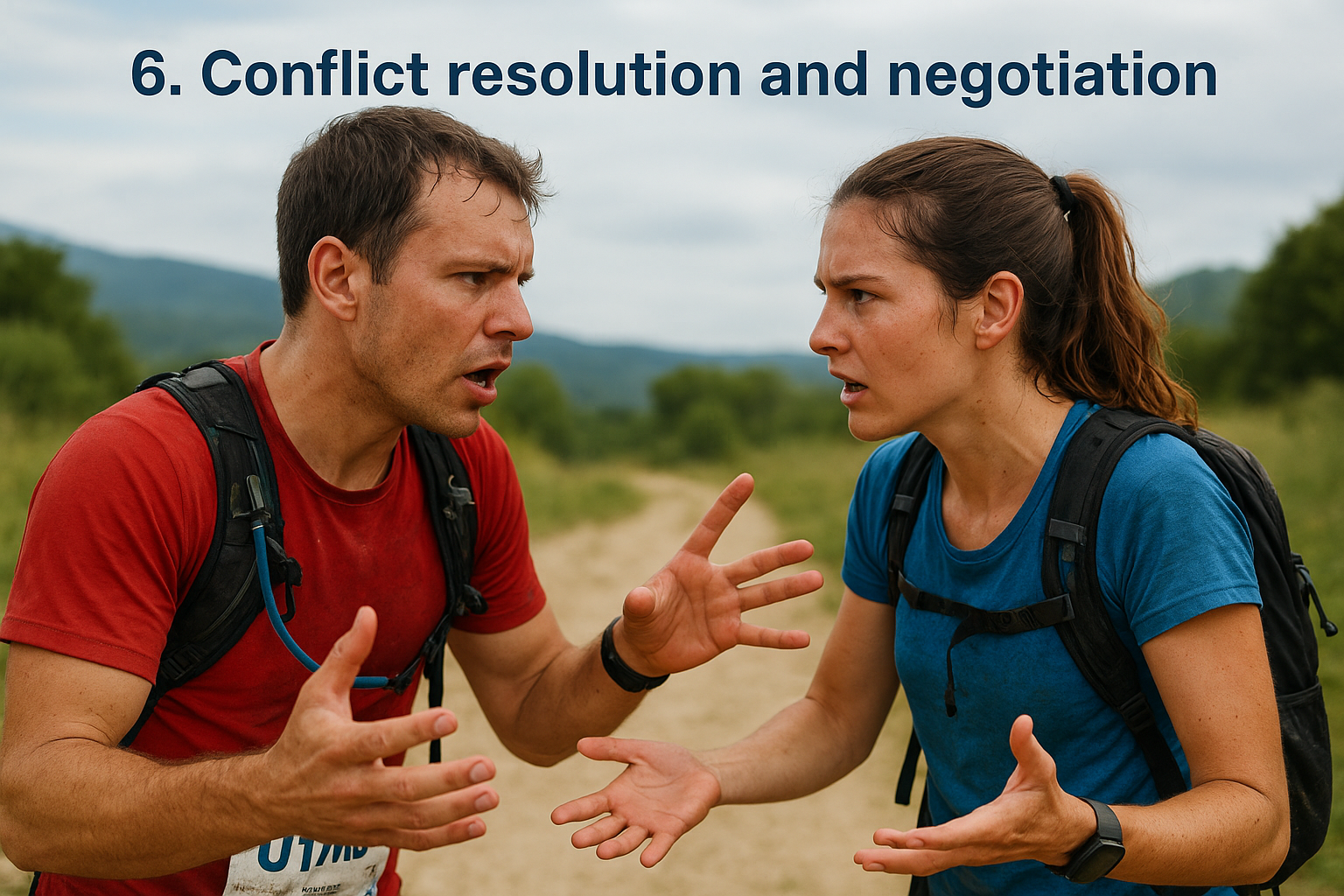
Two exhausted teammates arguing over a route choice at hour 50 can end a race faster than any storm. Conflict resolution and negotiation close this list because tension is guaranteed on any team pushing hard, and the leader’s job isn’t preventing conflict, it’s channeling it before it turns into resentment or silence.
What it involves
This skill means stepping into disagreement instead of avoiding it, naming the real issue underneath the argument, and finding a path both sides can accept without either one losing face. It’s negotiation built on understanding what each person actually needs, not just splitting the difference to end the discomfort quickly.
Why it matters for leaders
Unresolved conflict festers and spreads. I’ve seen a two-person disagreement on a race team poison morale for the rest of the crew within hours. Corporate teams see the same pattern, where one unresolved dispute between managers trickles down into disengaged staff and missed handoffs.
Conflict you avoid today becomes the culture problem you can’t fix next year.
How to develop this skill
Effective training leadership skill development here means practicing hard conversations, not reading about them:
- Address disagreements within 48 hours, before positions harden
- Separate the person from the problem in every mediation
- Practice naming the unspoken issue out loud in low-stakes disputes first
- Debrief resolved conflicts to confirm both sides actually feel heard, not just quieted
Turning these skills into everyday leadership
None of these six skills work in isolation. Trust built at work through team building gives you the room to communicate honestly. Honest communication feeds sharper decisions. Sharper decisions, made with empathy, hold up when conditions change and conflict flares. Skip one, and the whole chain weakens under pressure.
Reading about leadership skills and training won’t build any of this. Reps will. Pick one skill from this list, the one costing your team the most right now, and run a drill on it this month. Debrief it. Adjust. Then move to the next.
Organizations serious about this shift usually need a shared starting point, a moment where the whole team hears the same language around culture and accountability at once. That’s exactly what I built my keynotes to deliver. If you want your team to hear this framework directly and start applying it the next morning, here’s how to hire a keynote speaker for your next event, and how to book Robyn.