
You’ve probably noticed the gap: someone gets promoted for being great at their job, then struggles to actually lead the people who report to them. That’s the exact problem management and leadership skills training is built to fix. It’s not one workshop or one skill. It’s the deliberate development of both the operational side of managing (deadlines, processes, performance reviews) and the human side of leading (trust, motivation, communication under pressure).
If you’re searching for this, you likely want a straight answer to what separates leadership and management training from generic professional development, and whether it actually changes outcomes on your teams. It does, but only when it’s built around real team dynamics instead of theory. I’ve spent 15 years leading championship adventure racing teams and two decades as a firefighter, and the same principles that keep a team alive on a mountain apply directly to a sales floor or an IT department.
In this article, I’ll break down what this training actually covers, who needs it most, and how manager and leadership training translates into measurable results like higher retention, stronger culture, and teams that perform under pressure instead of falling apart.
Why management and leadership skills training matters
Most companies promote based on tenure or individual performance, not leadership ability, which is exactly why team building training for managers matters so much after the promotion. That’s how you end up with a top salesperson running a demoralized team or a brilliant engineer who can’t hold a difficult conversation. Untrained managers default to micromanaging, avoiding conflict, or copying whatever leadership style they experienced, good or bad. None of that builds a team that can handle pressure, change, or a bad quarter without falling apart.
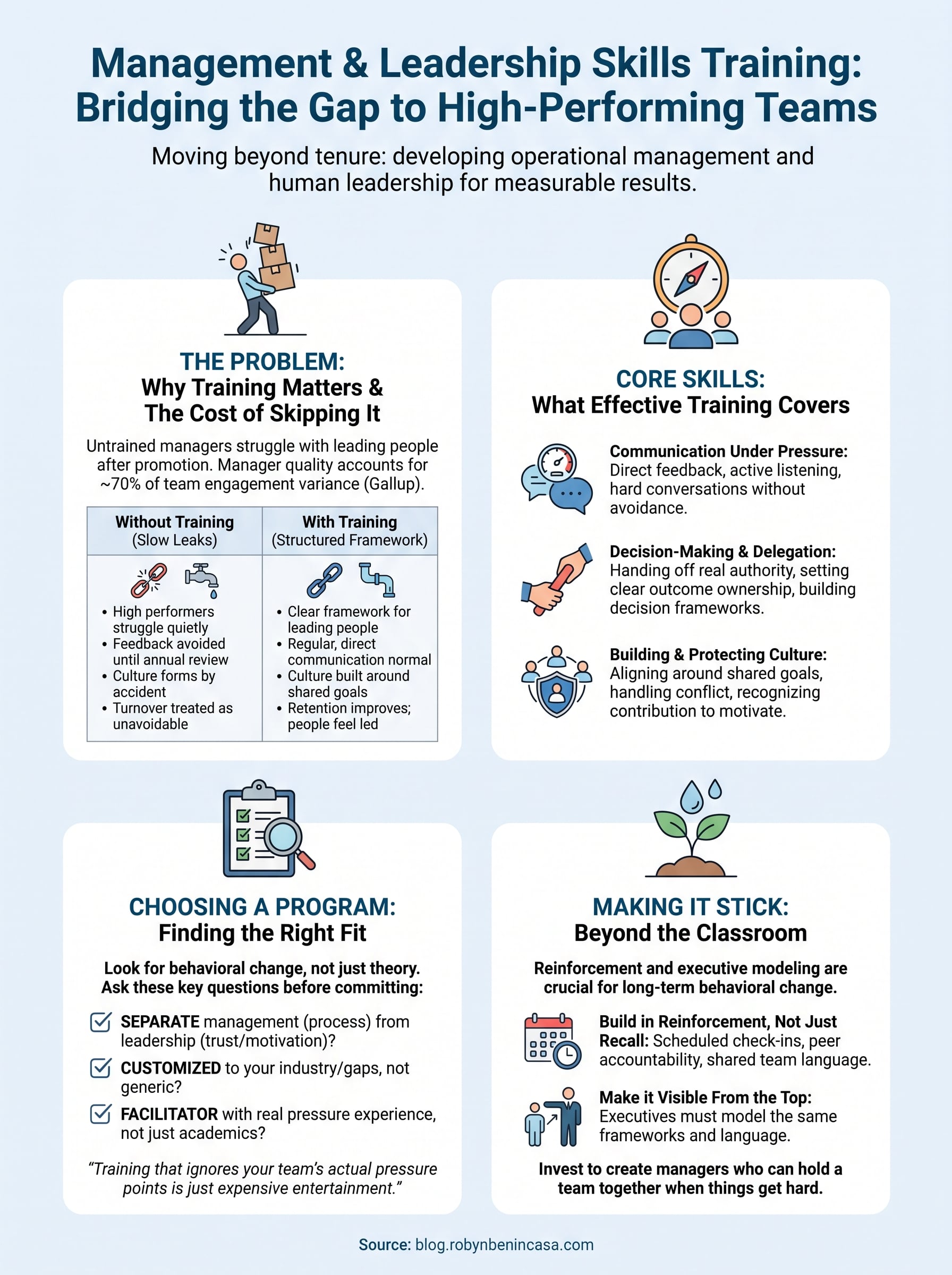
Gallup has found that manager quality accounts for roughly 70% of the variance in team engagement across business units, which means the person running the meeting matters more than the mission statement on the wall. I saw the inverse play out on expedition teams: the strongest athletes lost races because nobody managed the pace, the communication, or the morale when things got hard. Business teams fail the same way, just slower and quieter.
A team’s performance ceiling is set by its manager’s skill, not its talent.
What untrained leadership actually costs
The damage from skipping training on management and leadership doesn’t show up as a single dramatic failure. It shows up as slow leaks: your best people leaving, projects stalling in silos, and decisions bottlenecking at the top because nobody below the executive level feels empowered to make a call. Consider what changes when a manager actually gets trained versus when they’re left to figure it out alone:

| Without training | With structured training |
|---|---|
| High performers promoted, then quietly struggle | Clear framework for leading people, not just tasks |
| Feedback avoided until annual review | Regular, direct communication becomes normal |
| Team culture forms by accident | Culture is built deliberately around shared goals |
| Turnover treated as unavoidable | Retention improves because people feel led, not managed |
Why this matters more during change
Training pays off hardest when conditions get difficult, not when things are calm. Organizations navigating a merger, a leadership transition, or a rough sales quarter need managers capable of leading teams through change and holding people together under stress, and that skill doesn’t appear on its own. Whether it’s called training management leadership or management leadership training, the goal is the same: give managers the tools to lead through friction instead of just administering around it.
You’ve likely watched a team hit a wall and either come together or fall apart. The difference almost always traces back to the manager in the room, and that’s not luck. It’s a skill set. If you’re weighing what that skill set actually looks like in practice, a leadership keynote speaker session on building world-class team culture breaks down the exact behaviors that separate teams that unify under pressure from teams that splinter.
Core skills covered in leadership and management training
Good leadership training for it managers, sales directors, or operations leads all comes back to the same handful of core competencies, just applied to different environments. The best programs don’t teach abstract theory. They build specific, repeatable behaviors: how to give feedback that lands, how to delegate without micromanaging, and how to read a team’s morale before it tanks. This is the practical core of any managerial leadership training, regardless of industry.
Communication under pressure
Every expedition team I’ve led has fallen apart at the same moment: when communication broke down under stress. Business teams fail identically. Training should cover direct feedback, active listening, and how to have hard conversations without avoiding them or blowing them up. This is the single most transferable skill in any curriculum.

The teams that survive pressure are the ones that kept talking through it.
Decision-making and delegation
Managers who can’t delegate become bottlenecks. Strong training in leadership and management teaches people to hand off real authority, not just tasks, so decisions get made closer to the problem. This includes:
- Setting clear ownership for outcomes, not just to-do lists
- Building decision-making frameworks the team can use without you
- Recognizing when to step in and when to let people fail small so they learn fast
Building and protecting culture
Team culture doesn’t happen by accident, it’s built through consistent behavior from the top. Programs covering leadership management training should address how to align a team around shared goals, handle conflict without letting it fester, and recognize contribution in ways that actually motivate people. Skip this piece and you get a technically competent manager who still can’t hold a team together when things get hard.
How to choose the right leadership and management training program
Plenty of programs promise leadership and management training and deliver a slideshow, a personality quiz, and nothing that changes behavior back on the job. Before you sign a contract, ask what happens in week three after the workshop ends. If the answer is nothing, keep looking. The strongest leadership training programs build around real scenarios your managers will actually face, not generic case studies pulled from a textbook.
Match the content to your real gaps
Start by naming the specific problem you’re solving. A team drowning in turnover needs different training for leadership and management than one struggling with cross-department silos. Ask any program these questions before committing:
- Does it separate management skills (process, deadlines, performance tracking) from leadership skills (trust, motivation, communication)?
- Is the content customized to your industry, or is it the same deck used for every client?
- Does the speaker or facilitator have first-hand experience leading teams under real pressure, not just academic credentials?
Training that ignores your team’s actual pressure points is just expensive entertainment.
Look for built-in accountability
Format matters less than what happens after the room empties. Programs worth paying for build in follow-up: manager check-ins, measurable behavior changes, or a framework teams keep using months later. Online leadership training programs and in-person formats both work, but only if the content connects directly to your team’s daily friction points rather than staying theoretical. When you’re evaluating options, ask for outcomes from past clients, not just satisfaction scores. You can see how that structure works firsthand through a keynote built around measurable team outcomes, rather than a one-off lecture that fades by Monday.
How to make leadership training stick beyond the classroom
A great workshop that ends without follow-through is a wasted budget line. Leadership for managers training only changes behavior if the organization builds structure around it after the event, not just during it. The biggest mistake companies make is treating training as a single date on the calendar instead of the start of a habit-building process.
Build in reinforcement, not just recall
Managers forget most of what they hear in a room within weeks unless someone holds them to it. Reinforcement means scheduled check-ins where a manager reports what they actually tried, what worked, and what didn’t. It means giving managers a short list of behaviors to practice weekly rather than a binder to shelve. Consider requiring:
- A 30-day follow-up session to troubleshoot real situations
- Peer accountability pairs so managers coach each other
- A shared language across the team so feedback and delegation habits stick
Training that isn’t reinforced fades faster than the memory of the workshop itself.
Make it visible from the top
Executives who skip the same leadership training management expects of their managers send a clear signal that it’s optional. When senior leaders visibly use the same feedback frameworks and language taught in training, managers take it seriously because they see it modeled, not just mandated. Culture change starts at the top or it doesn’t start at all.
Ownership matters just as much as reinforcement. Assign someone, whether that’s HR or a designated internal champion, to track whether the specific behaviors from training actually show up in team meetings, one-on-ones, and performance reviews three months later. Without that accountability loop, even the best training becomes a pleasant memory instead of a lasting change in how people lead, which is why knowing how to create a culture of accountability matters as much as the workshop itself.
Turning training into stronger teams
Strip away the jargon and management and leadership skills training comes down to one question: can your managers hold a team together when things get hard? Everything else, the frameworks, the workshops, the follow-up check-ins, exists to answer that one question. Skip the training and you’re betting your culture on whoever happened to get promoted last. Invest in it properly and you get managers who communicate under pressure, delegate real authority, and build culture on purpose instead of by accident.
Going forward, treat leadership development the same way you’d treat any skill that determines whether your team wins or loses under pressure: deliberately, consistently, and with real accountability attached. If you’re ready to see what that looks like for your organization, start with team culture building and turn training into results that outlast the workshop.