Most leadership training programs get judged on how they make people feel during the workshop, not on what changes back at the office three months later. That gap is why so many HR leaders end up skeptical of the whole category, even when they know their organization needs it. If your teams are dealing with turnover, silos between departments, or a leadership bench that looks thin heading into next year, you’re not wrong to want something more rigorous than a one-day seminar with a feel-good speaker.
This article breaks down what leadership training actually means, the core skills and qualities it should build, and how the strongest programs are structured to produce results you can measure, not just applause in the room. You’ll see the difference between programs that inform and programs that change behavior.
I’ve spent 20 years leading firefighting crews and world-championship adventure racing teams, where a bad leadership decision doesn’t just hurt a quarterly number, it puts people in danger. That’s the lens I bring to this: practical, tested frameworks drawn from high-stakes team environments, translated for the corporate teams that book me to speak. By the end, you’ll know exactly what to look for when you’re evaluating options for your own organization.
Why leadership training programs matter now
The cost of skipping leadership development
Untrained managers cost you more than a bad quarter. Most leaders get promoted because they hit their sales number or wrote clean code, not because anyone ran them through team building training for managers or taught them how to run a team. Poor management is one of the biggest drivers of voluntary turnover, and every open seat you have to backfill costs real money. The Society for Human Resource Management puts the price of replacing a single employee at six to nine months of that person’s salary once you count recruiting, onboarding, and lost productivity. A leadership development program that actually changes how managers operate pays for itself the first time it prevents one resignation on a team you can’t afford to lose.
A manager who never learned to lead will quietly drain your best people long before the numbers show it.
What’s different about today’s workforce
Hybrid and remote arrangements have erased the hallway conversations that used to let new managers absorb leadership skills by watching someone else do it well. Four generations now often work side by side on the same team, each with different expectations for feedback, recognition, and career growth, so a one-size approach to managing people doesn’t land the way it used to. Flatter org charts push decision-making further down the chain too, which means more people are making judgment calls under pressure with less preparation than the managers who came before them. This is exactly the environment where corporate leadership training built around real scenarios, not a lecture, builds the judgment people need when things go sideways.
Where most organizations fall short
Most companies still treat leadership development as an event instead of a system. They send a cohort to a two-day offsite, hand out a workbook, and call it finished, with no coaching, no follow-up, and no way to tell whether behavior actually changed once everyone got back to their inbox. I’ve watched this play out with corporate teams I speak to directly: the room is fully engaged on day one, and then nothing structural shifts because the training was never connected to how people are managed, measured, or held accountable afterward. Common gaps look like this:

- Promoting people based on tenure or technical skill rather than readiness to lead
- Treating training as a single event instead of an ongoing practice
- Skipping manager coaching or peer accountability once the session ends
- Never tying the program to a metric beyond a same-day satisfaction survey
Numbers make the case better than opinions do:
| Statistic | What it tells you |
|---|---|
| Roughly 6 in 10 new managers receive no formal training before stepping into the role | Leadership skills are being learned on the job through trial and error, often at your customers’ expense |
| Replacing an employee costs 6 to 9 months of their salary | Weak management shows up directly on the P&L through turnover, not just in exit interviews |
| Gallup has found manager quality accounts for a large share of the variance in team engagement | The person leading the team matters more to output than almost any other single factor |
Organizations that ignore this data keep hiring for skills and hoping leadership shows up on its own. It rarely does. The teams I’ve led in wildland fires and in expedition racing taught me the same lesson corporate data now confirms: what team culture is and why it matters comes down to building it deliberately or not at all, and the cost of leaving it to chance shows up everywhere from turnover to safety incidents to missed targets.
How to choose the right leadership training program
Start with the problem, not the topic list
Before you look at a single vendor, name the specific problem you’re trying to solve. Are new managers struggling with conflict, is turnover concentrated in one department, or is the leadership bench too thin to survive a promotion wave? A vague goal like "improve leadership" gets you a generic program that nobody remembers by Friday. Corporate leadership training works best when it’s built around a problem you can point to and a behavior change you can name in advance, not a topic on a menu.
Match the format to how people actually work
Once you know the problem, match the delivery format to your team’s reality. A distributed sales team spread across time zones needs something different than a single-site manufacturing plant where everyone’s on the floor together. Consider these questions before you commit:
- Can the program run virtually, like the stronger online leadership training programs, or in person or as a hybrid, and does that match how your teams actually work?
- Does it include follow-up coaching, or does it end when the workshop does?
- Is content customized to your industry, or is it the same deck every client gets?
- Does the vendor offer a manager’s guide or toolkit so learning gets reinforced back on the job?
A program that stops the moment the workshop ends was never built to change behavior in the first place.
Vet the trainer’s actual experience
Credentials on a slide don’t tell you whether someone has actually led people through pressure. Ask who’s delivering the content and what they’ve actually led, not just studied. A facilitator with a consulting certificate can walk a room through a framework, but someone who has run a team through a real crisis, whether that’s a hospital floor, a fire scene, or an expedition race, brings judgment that no case study can replicate. This is exactly why organizations often look for the best keynote speaker for a corporate event with hands-on team leadership experience to open a training initiative or reset momentum mid-year. If you’re evaluating options for a kickoff event or a leadership offsite, look at how a speaker like Robyn Benincasa frames team culture around real, high-stakes decisions rather than theory, since that’s often the piece that makes a program stick with a room full of managers.
Ask how success gets measured before you sign
Every vendor will tell you their program works. Push past that and ask exactly how they define success and what data they’ll hand you at the end. A serious leadership development program should be able to tell you what metric moves, whether that’s manager retention, engagement scores, or time-to-productivity for new hires, and over what timeframe you should expect to see it. If a provider can’t answer that question specifically, or the answer is limited to a same-day satisfaction survey, that’s a signal the program was built to fill a room, not change how people lead. Comparing a shortlist of vendors side by side on format, measurement, and real-world credibility will surface the differences faster than any sales pitch will.
Common types of leadership training programs
Leadership training isn’t one product, it’s a category with several distinct formats, each suited to a different problem. Knowing the differences helps you stop comparing apples to oranges when you’re evaluating proposals, and it keeps you from buying a format that doesn’t match the behavior change you actually need.
Cohort-based workshops
Workshops bring a group of managers together, usually over one to three days, to work through a shared framework and practice it in real scenarios. Strong versions build in role-play, peer feedback, and small-group problem-solving instead of slide after slide of theory. Weak versions are lecture with a workbook attached, and everyone can tell the difference by lunch on day one. Cohort programs, including many of the best leadership training programs for building stronger teams, work best when you have a group being promoted at the same time, since shared language and shared experience make it easier for new managers to support each other after the room empties out.
Executive coaching and one-on-one development
Coaching pairs a single leader with a trained coach over weeks or months, usually to work through a specific gap: delegation, difficult conversations, or executive presence. It’s slower and more expensive per person than a workshop, but the personalization drives change that group training can’t match for senior leaders whose blind spots are individual, not shared. Companies often layer coaching on top of a cohort program, using workshops to build shared skills and coaching to reinforce them where it matters most.
Coaching changes one leader at a time; workshops change how a whole team talks about leadership. You usually need both, not one or the other.
Keynote-driven kickoffs and offsites
A keynote isn’t a substitute for ongoing training, but it’s an effective way to open an initiative, reset momentum after a rough quarter, or unify a room before breaking into workshop tracks. The right speaker sets a shared vocabulary and an emotional hook that the rest of the program can build on. This is where corporate leadership training initiatives often start, and it’s why organizations bringing teams together for a sales kickoff or leadership offsite learn how to hire a keynote speaker with real high-stakes team experience to open the day, rather than a motivational speaker with no operational background.

Blended academies and ongoing programs
The most durable leadership development programs run over months, not days, combining live sessions, coaching check-ins, peer accountability groups, and manager toolkits that reinforce the material back on the job. These cost more up front and take longer to show results, but they’re the format most likely to change how people actually manage.
| Format | Best for | Typical length | Follow-up built in? |
|---|---|---|---|
| Cohort workshop | New managers, shared skill gaps | 1 to 3 days | Rarely, unless purchased separately |
| Executive coaching | Senior leaders, individual blind spots | Weeks to months | Yes, by design |
| Keynote kickoff | Momentum, alignment, culture reset | Half day to full day | No, needs a follow-on program |
| Blended academy | Organization-wide culture change | 3 to 12 months | Yes, built into the structure |
Most organizations end up combining two or three of these, not picking just one. A keynote can open the conversation, a workshop can teach the framework, and coaching can make it stick for the leaders carrying the most weight.
Core skills and topics the best programs teach
Strip away the branding and every strong program teaches the same handful of leadership and team building skills that show up again and again, no matter the industry. Leadership training programs that skip these in favor of personality quizzes or generic communication tips end up forgettable, because they never touch the moments where leadership actually gets tested: the layoff conversation, the missed deadline, the team that’s stopped trusting its manager. Here’s what the best ones cover, and why each one earns its place on the agenda.
Communication under pressure
Giving feedback when things are going well is easy. The skill that separates trained leaders from untrained ones is delivering hard news clearly, without softening it into confusion or letting it turn into a blowup. Programs worth their price teach specific frameworks for structuring a difficult conversation, then have managers practice it out loud with a peer, not just read about it in a workbook. On a fire scene, an unclear order costs seconds you don’t have. In an office, an unclear conversation costs weeks of confusion and a team that stops trusting what its manager tells them.

Decision-making with incomplete information
Most real decisions get made without all the facts, on a deadline, with people watching to see how the leader handles it. Good programs run managers through scenario-based exercises and problem solving activities for teams where they have to choose, act, and then debrief what worked, building the kind of judgment that no slide deck can install on its own.
Leadership isn’t tested when the plan is working. It’s tested in the ten seconds after the plan falls apart.
Building trust and accountability
Teams don’t perform because someone told them to; they perform because they trust the person leading them, which is why knowing how to build trust in a team at work matters as much as any framework. Strong programs use culture of accountability training to teach managers how to set clear expectations, follow through consistently, and create the kind of psychological safety where a team member will flag a mistake before it becomes a crisis instead of hiding it until it’s unfixable. This is the backbone of what I call T.E.A.M.W.O.R.K., the eight elements I’ve watched separate world champion teams from everyone else chasing the same finish line, and it translates directly into how corporate teams function under deadline pressure.
Coaching and developing others
A manager’s job isn’t to be the best individual performer on the team, it’s to make everyone around them better. The best leadership development programs dedicate real time to coaching skills: asking better questions, giving feedback that builds capability instead of defensiveness, and knowing when to step back and let someone else own a decision.
Here’s how these core areas typically map to the problems they solve:
| Core skill | Problem it solves | How it’s usually taught |
|---|---|---|
| Communication under pressure | Miscommunication, avoided conflict | Role-play, scripted difficult conversations |
| Decision-making | Hesitation, poor judgment calls | Scenario simulations, after-action debriefs |
| Trust and accountability | Silos, hidden problems | Team culture frameworks, peer feedback |
| Coaching others | Bottlenecked teams, weak succession | One-on-one practice, manager toolkits |
Organizations that build training around these four areas, rather than a rotating list of soft-skill topics, see the difference in how their managers handle the next real crisis, not just how they rate the workshop on a feedback form.
How to measure the impact of leadership training
Establish a baseline before training starts
Most organizations skip this step entirely, then wonder why they can’t prove the program worked. Before you run a single session, pull the numbers that matter: manager retention, engagement scores by team, time-to-productivity for new hires, and exit interview themes tied to management. Without a baseline, you’re left comparing a post-training survey to nothing, which tells you how the room felt, not whether anything changed. Treat this the same way you’d treat any capital investment: you wouldn’t approve a new piece of equipment without knowing the output it’s replacing.
Separate satisfaction scores from behavior change
Satisfaction surveys measure whether people enjoyed the day, not whether they lead differently three months later. A leadership development program worth the budget tracks behavior indicators instead: are managers holding regular one-on-ones, are difficult conversations happening before problems escalate, is feedback showing up in peer reviews or 360 assessments run 90 days out. These signals take longer to surface than a same-day survey, but they’re the ones that predict whether turnover actually drops.
If the only data point you have is a same-day survey score, you don’t have a measurement plan, you have applause.
Connect training to business metrics
Eventually the program has to show up in numbers the rest of the organization already tracks, the same way change management metrics and KPIs do. Connect the dots explicitly rather than hoping someone else does it for you:
| Metric | What to track | Reasonable timeframe |
|---|---|---|
| Voluntary turnover | Manager-level attrition before and after training | 6 to 12 months |
| Engagement scores | Pulse survey results by team, not company-wide averages | Quarterly |
| Time-to-productivity | Ramp time for new hires under trained vs. untrained managers | 3 to 6 months |
| Internal promotion rate | Percentage of leadership roles filled internally | Annually |
Quantifying this way keeps the conversation with finance grounded in numbers instead of impressions, and it protects the program’s budget the next time cuts get discussed.
Build a review cadence that outlasts the workshop
Reviewing results once, right after the workshop, tells you almost nothing. Schedule check-ins at 30, 90, and 180 days to see whether behavior change is holding or fading, and loop in the managers who went through training to hear what’s sticking and what isn’t. This is also where corporate leadership training initiatives either earn a renewed budget or quietly disappear, depending on whether anyone can point to a number that moved. Organizations that build this cadence into the calendar from day one, rather than scrambling to justify the spend after the fact, are the ones that keep leadership development funded year over year. If you’re building this kind of measurement plan around a keynote or workshop kickoff, my guide to creating a strong team culture can help you frame what to track before the first session even happens.
Turning training into lasting leadership
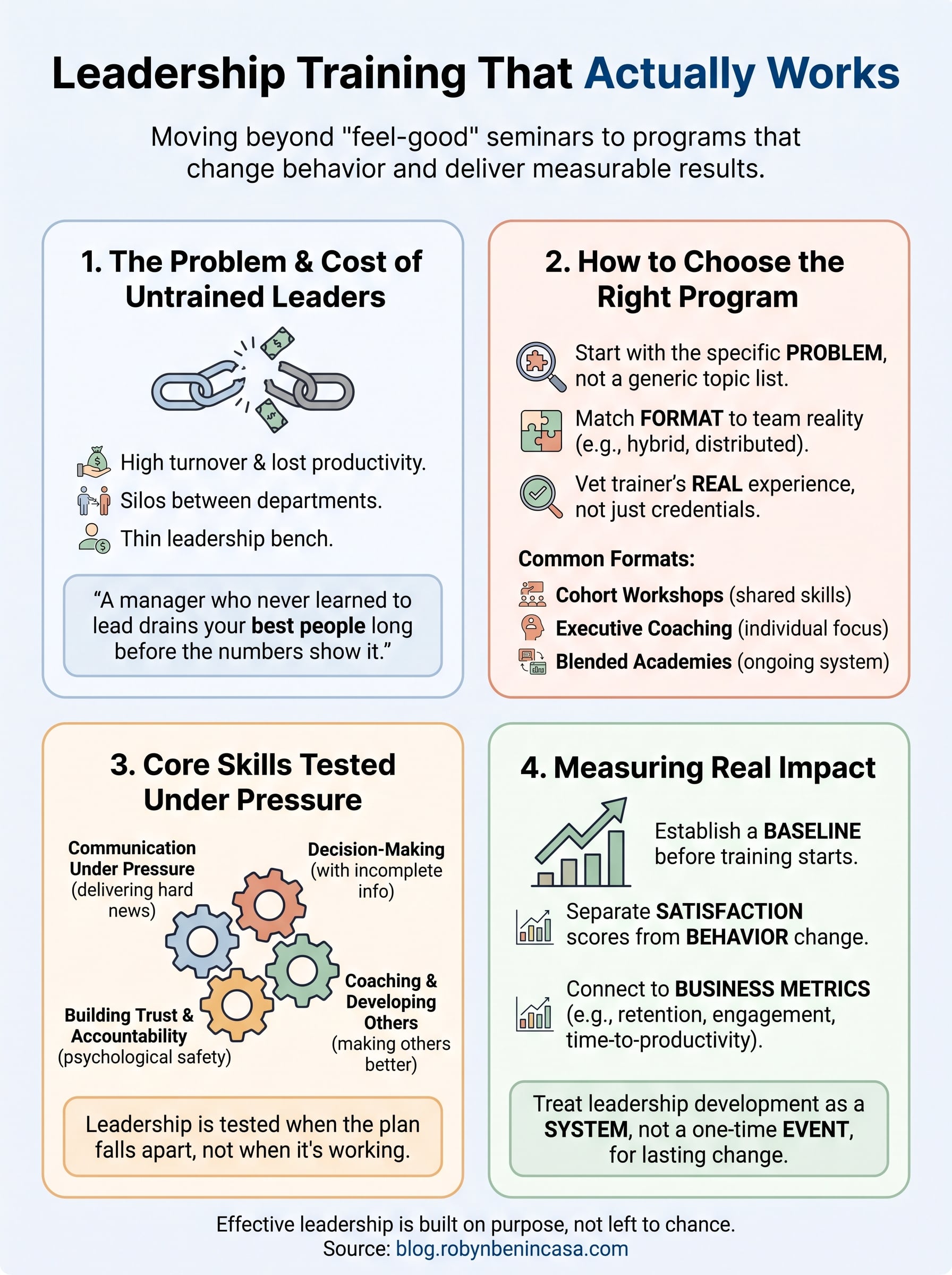
Good leadership training programs don’t end when the workshop does. They start with a real problem, use a format that matches how your people actually work, teach the handful of skills that get tested under pressure, and get measured against numbers finance already cares about. Skip any one of those steps and you’re back to a feel-good day that fades by the following Monday.
Organizations that treat leadership development as a system, not an event, are the ones that see turnover drop and bench strength grow year over year. The teams I led through wildfires and world championship races won because culture was built on purpose, not left to chance. Your teams can win the same way.
If you’re planning a kickoff, offsite, or training initiative and want a speaker who brings that kind of tested, high-stakes team experience into the room, see which leadership keynote speakers are worth booking and what fits your team.