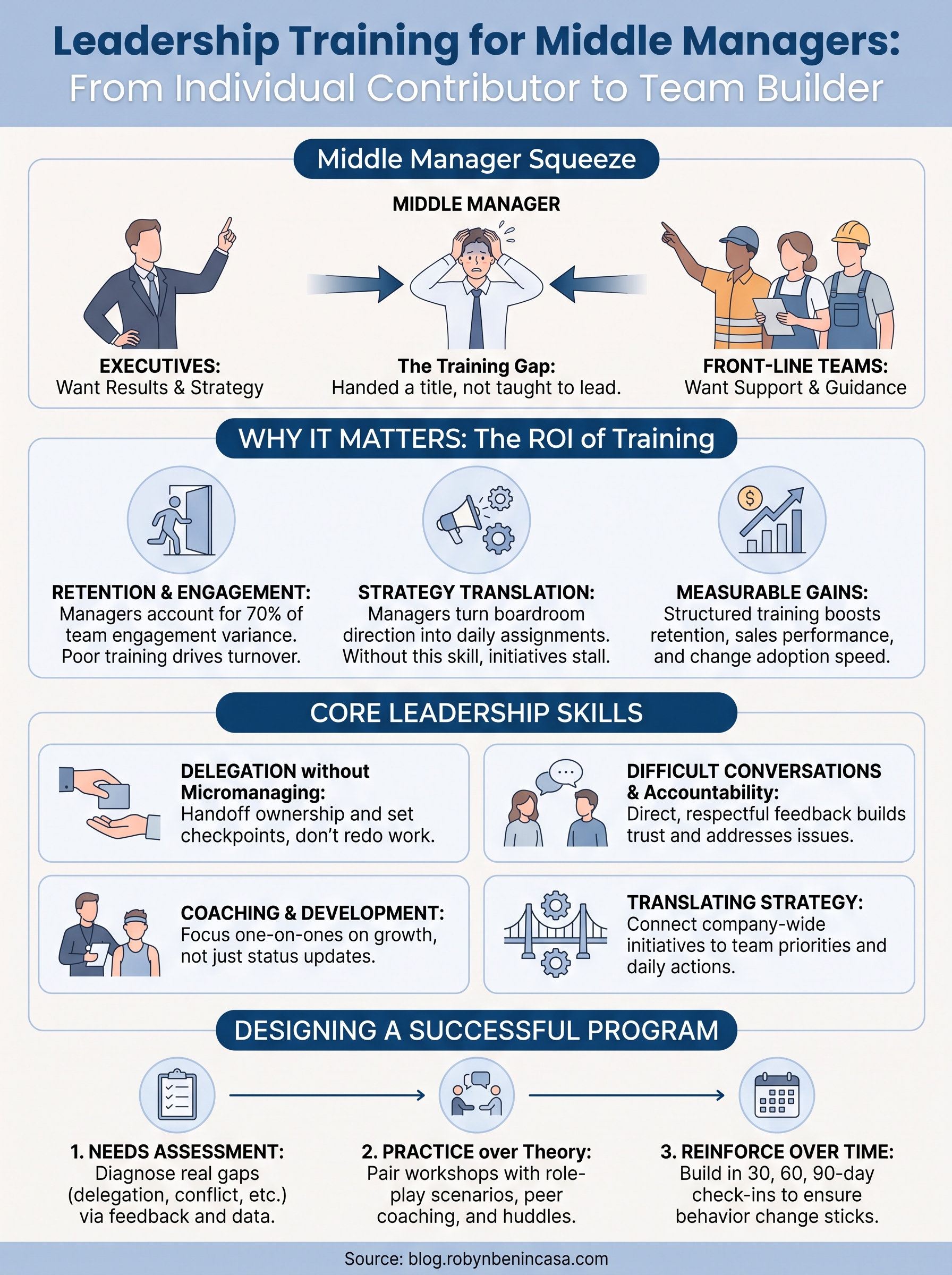
Middle managers get squeezed from both directions. Executives want results, front-line teams want support, and most companies hand new managers a title without ever teaching them how to lead. That gap is exactly why leadership training for middle managers has become one of the fastest-growing investments in corporate learning budgets.
Done right, this training isn’t a generic workshop on communication styles. It’s a targeted program that builds the specific skills a manager needs to run interference for their team, translate strategy into daily action, and hold people accountable without crushing morale. Whether your organization calls it leadership training for mid-level managers or something else, the goal stays the same: turn capable individual contributors into leaders who can actually build a team culture.
I’ve spent 15 years leading world championship adventure racing teams and two decades as a San Diego firefighter, and the pattern is identical in both worlds: teams win or lose based on the people in the middle. In this article, you’ll get a clear definition of what this training actually covers, the core competencies it builds, and why organizations that invest in their mid level managers see measurable gains in retention, sales, and performance.
Why leadership training matters for middle managers
Most middle managers get promoted because they were excellent individual contributors, not because anyone tested whether they could lead people. That’s the core problem. Technical skill and leadership skill are different disciplines, and companies routinely conflate them. A top salesperson becomes a sales manager. A skilled nurse becomes a charge nurse. Neither one gets management and leadership skills training on how to run a difficult conversation, delegate without micromanaging, or rebuild trust after a team misses a target. Without structured leadership development, they default to whatever style their own worst boss modeled, which is exactly the gap formal leadership training programs exist to close.
The turnover and engagement problem
Gallup has found that managers account for at least 70% of the variance in team engagement scores, which means a poorly trained manager can single-handedly tank morale across an entire department, regardless of how strong the company culture looks on paper. When employees quit, they’re rarely quitting the company. They’re quitting the person they report to every day. That single fact should be enough to justify investing in middle management training as a retention strategy, not just a leadership development nice-to-have.
A poorly trained middle manager doesn’t just underperform, they actively push good people out the door.
The strategy translation gap
Executives set direction from 30,000 feet. Middle managers are the ones who have to translate that direction into daily assignments, deadlines, and difficult tradeoffs on the ground. If they don’t understand how to communicate strategy in a way that makes sense to a front-line team, initiatives stall no matter how good the plan looked in the boardroom. I saw this constantly leading adventure racing teams: the strategy meeting matters far less than whether the team captain can actually get four exhausted people rowing in the same direction at 3 a.m. Middle managers are that team captain, and they need training that treats that translation role as a skill, not an assumption.
The measurable business case
Organizations that treat this seriously see it show up in the numbers, not just in employee satisfaction surveys.

| Investment area | Typical outcome without training | Typical outcome with structured training |
|---|---|---|
| Employee retention | Higher turnover on managed teams | Measurably lower attrition |
| Sales performance | Inconsistent quotas across regions | Teams moving from bottom-tier to top-tier rankings |
| Change adoption | Resistance and confusion during transitions | Faster buy-in and execution |
| Manager confidence | Reactive, avoidance-based leadership | Proactive coaching and accountability |
Ultimately, the case for leadership training for mid-level managers isn’t theoretical. It’s a direct line from how well you prepare the people in the middle to how well your entire organization performs, retains talent, and executes on strategy.
How to design a leadership training program that works
A generic slide deck on "leadership principles" won’t change behavior. Effective leadership training for middle managers starts with a diagnosis, not a curriculum. Before you choose a leadership training program, a format, or a speaker, figure out where your managers are actually struggling: is it delegation, difficult conversations, cross-department friction, or all three? Skipping this step is why so many training budgets get spent on programs nobody remembers six months later.
Start with a real needs assessment
Talk to the managers themselves, not just their bosses. Pull turnover data by department, review recent 360 feedback if you have it, and ask front-line employees what their manager does well and where they get stuck. This gives you a shortlist of the two or three skills that will move the needle fastest, rather than a broad, unfocused agenda.
Build in practice, not just theory
Adults retain leadership skills the same way athletes retain technique: through repetition under real conditions. A single keynote or workshop can reset mindset and create urgency, but it needs to be paired with role-play scenarios, peer coaching cohorts, or manager huddles where people practice the actual conversation they’re avoiding.
Training that never leaves the classroom never makes it into the next tough conversation.
Reinforce over time
One-and-done sessions fade fast. Build in 30, 60, and 90-day check-ins where managers report what they tried, what worked, and what didn’t. This is where structured leadership development for mid level managers actually compounds instead of evaporating.
Many organizations kick off this process with a keynote that resets the room and gives everyone shared language before smaller cohort work begins. If you’re evaluating leadership keynote speakers and formats built specifically around team leadership and culture, that’s a strong first move before you build out the rest of the program.
Core skills every middle manager training should build
Not every leadership topic deserves equal airtime. Skill-specific training works because it targets the handful of competencies that separate a manager people want to work for from one they tolerate. After running teams through high-stakes conditions for years, I’ve noticed the same five essential leadership skills show up as gaps in almost every organization, regardless of industry.
Delegation without micromanaging
Before anything else, a manager has to learn the difference between delegating a task and delegating an outcome. Managers who never got training default to checking every detail, which slows the team down and signals distrust. Effective delegation training teaches managers to hand off ownership, set clear checkpoints, and resist the urge to redo the work themselves.
Difficult conversations and accountability
Giving hard feedback is the single most avoided skill in middle management. Handled poorly, it either turns into conflict avoidance or a blowup that damages trust. Handled well, it’s a short, direct conversation that addresses the issue, keeps the relationship intact, and builds toward a culture of accountability.
The managers who avoid hard conversations aren’t being kind, they’re just delaying a bigger problem.
Coaching and development
Good managers grow their people on purpose, not by accident. That means regular one-on-ones focused on growth, not just status updates, and knowing how to ask questions instead of handing down answers.
Translating strategy into daily work
Strategy means nothing until someone breaks it into this week’s priorities. Leadership communication training gives a manager the strategic communication skills to connect a company-wide initiative to what their team does on Monday morning.
Core skills worth building in any program:
- Delegation and ownership transfer
- Direct, respectful feedback delivery
- Coaching conversations that build capability
- Translating strategy into team-level action
- Conflict resolution across departments
Each of these skills compounds the others, which is exactly why leadership training for mid level managers works best when it’s sequenced, not scattered.
Choosing the right training format for your team
Format matters as much as content. Leadership training for mid level managers can fail simply because it’s delivered in a way that doesn’t match how your team actually works, learns, or is distributed across locations. A 200-person sales org spread across five states needs a different delivery method than a single-site manufacturing plant where every manager eats lunch in the same room.
Live keynotes vs. ongoing coaching
Generally, a live keynote is the right tool for creating urgency and shared language across a large group fast. It’s not meant to replace deeper coaching, it’s meant to kick it off. Ongoing coaching, whether through cohorts, peer huddles, or manager-to-manager mentoring, is where the behavior change actually sticks over months.
A keynote opens the door, coaching is what walks people through it.
Virtual or in-person, and how to decide
Here’s how the two formats typically compare for middle management audiences:

| Factor | Virtual training | In-person training |
|---|---|---|
| Geographic reach | Easy across multiple sites | Best for single-location teams |
| Cost per participant | Lower | Higher, includes travel |
| Energy and buy-in | Harder to sustain | Stronger emotional impact |
| Practice opportunities | Breakout rooms, limited | Live role-play, immediate feedback |
Instead of picking one format and forcing every team into it, many organizations blend both: online leadership training or a virtual keynote to reach everyone at once, followed by smaller in-person cohort sessions for the managers who need the deepest practice.
Ultimately, the right choice depends on your team’s size, budget, and how spread out your managers are. If you’re weighing virtual and in-person keynote options for your next leadership initiative, start by mapping your team’s geography and urgency before committing to a single format.
Investing in the managers in the middle
Middle managers carry more weight than any other layer in your organization. They translate strategy into action, hold the line on culture, and decide whether good employees stay or quietly start job hunting. Leadership training for middle managers works when it’s targeted, practiced repeatedly, and reinforced over months, not delivered as a one-time slide deck nobody remembers by the next quarter.
Skip this investment, and you’re gambling your retention, sales numbers, and execution speed on whatever leadership style your managers picked up by accident. Make it deliberate instead. Diagnose the real gaps, build in practice and reinforcement, and choose a format that actually fits how your team works.
If you’re ready to give your managers a shared starting point and the language to build a real team culture, here’s how to hire a keynote speaker like Robyn for your next leadership event and get the process moving.