
If you work in pharma or life sciences, speaker bureau programs can sound like a simple idea that turns complicated fast. A company pays healthcare professionals to educate their peers about a product, and suddenly legal, compliance, and commercial teams all have a stake. One weak process can mean regulatory scrutiny and reputational damage.
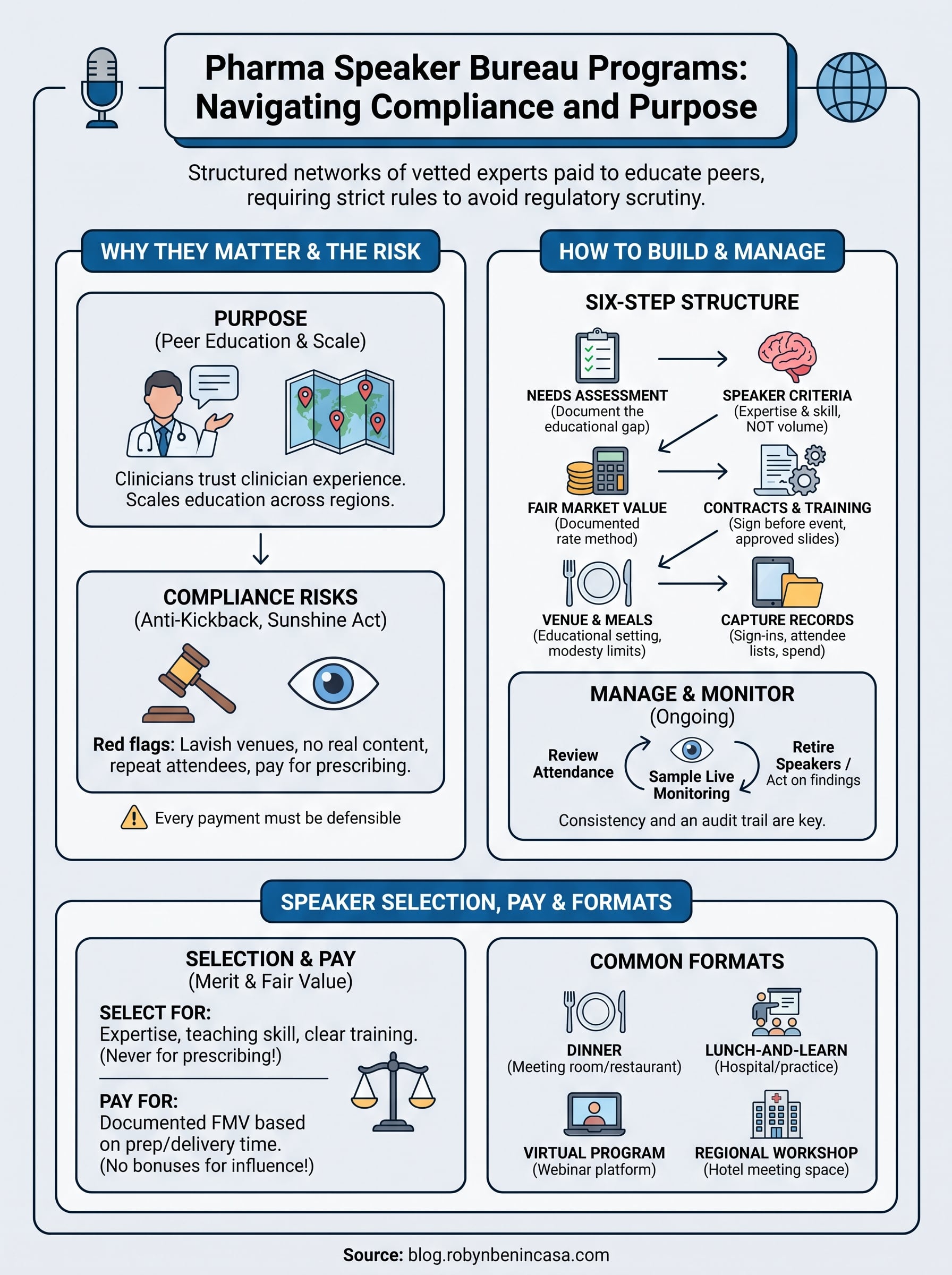
Here is the short answer. A speaker bureau program is a structured network of vetted experts who present on a company’s behalf, and in pharma it must follow strict rules. That means documented needs assessments, fair market value pay, approved content, attendance tracking, and clean records. Most companies either run this in-house or hire a specialized management provider to handle the logistics and audit trail.
This article covers how these programs work, the compliance risks that cause the most trouble, and what to look for when choosing a provider. I’m Robyn Benincasa, and as a keynote speaker who works with corporate teams, I see the other side too: the best programs treat speakers as partners in a team, not just names on a roster.
Why pharma speaker bureau programs matter
Peer education that reaches prescribers
Speaker bureau programs exist because clinicians trust other clinicians. A sales rep can explain a label, but a cardiologist describing how she manages a patient on a new anticoagulant carries different weight. That is the legitimate value of peer-to-peer education: real clinical experience, shared by someone who treats patients every day.
Companies also use these programs to scale medical education across regions. One well-trained speaker can present at dozens of dinners, hospital sessions, or virtual events in a year, which beats flying a medical expert to every market. A well-run speaker bureau program also gives you a bench of trained voices ready the moment a new indication launches.
Why regulators watch them closely
Yet the same structure that makes these programs effective makes them a magnet for enforcement. Money flows from a manufacturer to a prescriber, and that is exactly the pattern the Anti-Kickback Statute targets. In November 2020, the HHS Office of Inspector General issued a Special Fraud Alert on speaker programs warning that speaker payments can work as disguised inducements to prescribe.
The alert lists red flags that investigators look for first:
- Little or no substantive medical information presented
- Alcohol or lavish meals at venues that do not suit education, such as high-end restaurants
- The same attendees returning for the same topic again and again
- Attendees who are friends, family, or colleagues of the speaker with no real need for the content
- Speakers chosen because of their prescribing volume rather than their expertise
A speaker program counts as education only when education is the point and every record proves it.
What is at stake
The consequences are concrete. In 2020, Novartis agreed to pay about $678 million to resolve federal allegations that included paying kickbacks to doctors through sham speaker programs. Cases like that is why compliance teams now treat every dinner, every honorarium, and every sign-in sheet as potential evidence.
Visibility adds pressure. Under the Sunshine Act, manufacturers must report payments to physicians, and the public can search them in the CMS Open Payments database. Your speaker fees are not private. Patients, journalists, and enforcement agencies can all see them, so every payment has to be defensible on its own.
That is why structure matters more than size. A small program with clean selection criteria, documented needs, and complete attendance records is safer and easier to defend than a large one run on habit. The next section shows how to build that structure.
How to build and manage a speaker bureau program
Building a speaker bureau program works best as a sequence, not a launch event. Each step creates a record that supports the next one, and together they form the audit trail you will need when someone asks why a program existed.
Start with the need, not the roster
Every program should begin with a written needs assessment. Document the educational gap, the audience that has it, and why a live speaker is the right format. If you cannot explain the gap in two sentences, you do not need another dinner. The number of speakers should follow the documented need, not a sales target.
Build it in six steps
Once the need is clear, work through these steps in order. Skipping one usually means rework later or a gap in your records that you cannot fill after the fact.

- Write a needs assessment for each topic and audience.
- Set speaker criteria based on expertise, training, and communication skill, never prescribing volume.
- Pay a fair market value rate, calculated with a documented method.
- Sign contracts before any event, then train speakers on approved slides only.
- Approve venues and set meal limits that suit an educational setting.
- Capture sign-in sheets, attendee lists, and spend for every event.
Manage it after launch
Launch is the easy part. Management is where programs drift. Review attendance and spend every quarter, compare each speaker’s event count against the need you documented, and retire speakers whose programs no longer serve a clear educational purpose.
You cannot defend a program you do not review.
Treat your speakers like a team, too. Run a short refresher whenever a label changes or a new indication launches, and ask what questions audiences really raise. Programs that listen to speakers catch content problems early and prevent off-label drift before it shows up in a talk.
How to keep speaker programs compliant
Compliance in speaker bureau programs is not a document you file once. It is a set of habits that show up at every event. Start with the rules that apply to you, then build controls that catch problems before an investigator does.
Know which rules apply
Federal law is only the start. The Anti-Kickback Statute and Sunshine Act reporting sit on top of the PhRMA Code for member companies and a patchwork of state laws. Some states cap meals, require disclosure, or limit what you can offer prescribers. Ask legal to map the rules for every state where you hold events, then write the result into your standard operating procedures.
Speakers also need clear limits on content. They present approved uses only, on approved slides, and they know what to do when an audience member asks an off-label question.
Monitor events, not just paperwork
Records show what was meant to happen. Monitoring shows what did happen. Send a trained monitor to a sample of live events and compare their notes against sign-in sheets and spend reports. This table gives you a workable rhythm:
| Control | What to check | How often |
|---|---|---|
| Speaker audit | Event count against documented need | Quarterly |
| Live monitoring | Approved slides, meal limits, no off-label talk | Sample each quarter |
| Attendance review | Repeat attendees, family, non-clinical guests | Every event |
| Payment review | Honorarium matches contract and fair market value | Before payment |
| Training | Speaker attests to current slides and policy | Annually and at label changes |
Paperwork shows what you planned, and monitoring shows what actually happened.
Act on what you find
Finding a problem is not the failure. Ignoring it is. Document each issue, assign a corrective action such as retraining or suspension, and track it to closure. A speaker bureau program that acts on its findings can show regulators it takes the rules seriously.
Keep the evidence, too. Retain contracts, slides, attendee lists, and payment records for the period your policy and counsel require, and remove repeat offenders from the roster without exceptions for top performers.
How to choose a speaker bureau management provider
Outsourcing makes sense when your team lacks the headcount to run speaker bureau programs across dozens of markets. A provider can take over logistics and record keeping. It cannot take over accountability. Your company still owns every decision, so pick a partner that makes your compliance team’s job easier, not one that hides the work.
What a provider should handle
Start by listing the tasks you want off your desk. Most providers offer the same core services, but depth varies a lot, so compare what each one actually delivers.
| Capability | What good looks like |
|---|---|
| Speaker onboarding | Credential checks, contracts, and training attestations tracked in one system |
| Fair market value | A documented rate method applied the same way every time |
| Event logistics | Venue approval and meal caps enforced before booking |
| Attendance capture | Sign-ins reconciled against invitations and spend |
| Reporting | Spend data ready for Sunshine Act reporting and audit-ready exports |
| Monitoring support | Live event monitors and corrective actions tracked to closure |
Questions to ask before you sign
Ask for evidence, not promises. A vendor that runs a clean speaker bureau program will answer these without hesitation:
- Can you show an anonymized, audit-ready report from a current client?
- How do you stop a venue or meal that breaks policy before the event is booked?
- Who owns the data, and what happens to it if we leave?
- What happens when a speaker exceeds the event cap you agreed on?
- Have you supported pharma clients through an internal audit or government inquiry?
A provider should make your records stronger, not just your calendar fuller.
Red flags and a smart way to start
Walk away from vendors that pitch volume instead of controls. Be wary of anyone who ranks speakers by sales impact, or who cannot explain how they set fair market value. Those habits recreate the exact red flags the OIG warned about, only with a vendor’s name on the invoice.
Finally, run a pilot in one region or one product before you commit nationally. Review the pilot’s records the way an investigator would, and check whether you could rebuild every event from the paperwork alone. If you can, scale up. If you cannot, you have learned that cheaply.
Speaker bureau program formats and examples
Four common formats
Most speaker bureau programs use a small set of formats, and each one carries its own risk. Choose the format that fits the educational need you documented, then build controls around its weak spot.

| Format | Typical setting | Main compliance watch point |
|---|---|---|
| In-person dinner | Restaurant or meeting room | Venue and meal cost, repeat attendees |
| Lunch-and-learn | Hospital or practice | Modest food, only relevant staff attending |
| Virtual program | Webinar platform | Verified attendance, no unapproved recording |
| Regional workshop | Hotel meeting space | Agenda time spent on content, not recreation |
The format matters less than your ability to prove that education happened.
A clean program in practice
Consider a hypothetical oncology launch. The company documents that community oncologists lack experience with a new dosing schedule. It recruits eight speakers chosen for clinical training and teaching skill, caps each at a few events per year, and runs virtual sessions and hospital lunch-and-learns instead of steakhouse dinners.
Every event then follows the same pattern. Speakers use approved slides, a monitor attends a sample, and sign-in sheets are reconciled against invitations. When one speaker’s event count climbs past plan, the team pauses that speaker for review rather than waiting for the quarter to end. Nothing here is fancy. It is just consistent, and consistency is what an investigator hopes to find.
Not the same as a keynote bureau
Outside pharma, the phrase means something different. A keynote speaker bureau is a booking agency that matches speakers with conferences, sales meetings, and corporate events. Planners use one to find a leadership or team culture speaker without vetting dozens of candidates alone.
That difference matters if you landed here from the planner side. The vetting, fee, and selection questions in the next section apply to both kinds of speaker bureau program, though the compliance stakes are far higher in pharma.
Speaker selection, pay, and getting on a bureau
Choosing speakers on merit
Selection is where speaker bureau programs most often go wrong. The rule is simple: pick people for what they know and how well they teach, never for how much they prescribe. Write down the reason for each choice before you make an offer. Strong candidates usually show:
- Board certification or recognized expertise in the disease area
- Hands-on experience with the patient population the product serves
- A track record of teaching or presenting to peers
- Completed training on approved content
- No conflicts that would undermine their credibility
Paying speakers fairly
Fair market value means paying what a comparable expert would earn for comparable work, not whatever keeps a top performer happy. Build the rate from a documented method, such as tiers by expertise with hourly rates applied to preparation and delivery time. Then apply it to everyone in the tier, every time.
Pay only for work actually done. Set the rate in the contract before the event, release payment after attendance records are verified, and never add bonuses for popular talks. Prescribing data should stay out of every rate conversation.
Pay for the expertise and the time, never for the influence.
Getting on a bureau
Clinicians who want to join a pharma program should build a teaching record first: grand rounds, conference talks, society committees. Ask the company’s medical affairs team how it identifies speakers, and expect training and a signed contract before you ever present. If someone invites you because of your prescribing volume, treat that as a warning, not a compliment.
On the keynote side, a bureau wants a clear topic, a demo reel, and references from past clients. Bureaus typically earn a commission, often 20 to 30 percent, built into the keynote speaker fee. Planners should ask what the speaker will do beyond the stage, such as customizing content to the audience. A good speaker bureau program on either side rewards preparation and proof over polish.
Putting a program together
Strong speaker bureau programs come down to one idea: education has to be the point, and your records have to prove it. Start with a documented need, choose speakers on merit, pay fair market value, and monitor live events. Whether you run the program in-house or hire a provider, you own the outcome.
Consistency beats size every time. A small program with clean records and regular reviews is easier to defend than a big one built on habit, and it treats speakers as the partners they are.
If your work goes beyond pharma, or you want your teams to work as one, the same discipline applies to team culture. For practical lessons on leadership and teamwork from the adventure racing course and the firehouse, explore the Robyn Benincasa blog.