
Most team culture training fails within a month. The team spends a day in a ballroom, leaves energized, and by the next Monday the old habits are back. If you have paid for that kind of day before, you know the frustration.
Here is the short answer. Training sticks when it is built around behaviors, not slogans, and when you reinforce it weekly after the session ends. That means agreeing on a few specific commitments, practicing them on real work, and holding each other accountable in short, regular check-ins.
This guide walks you through how to do it. You will learn how to assess where your culture stands today, choose the right format, run the session, and build follow-up routines that last. The approach draws on what Robyn Benincasa learned leading adventure racing teams for 15 years and working with organizations like Allstate and Boston Scientific. Teams win because they practice working together, not because they attend one great event.
Why most team culture training fades fast
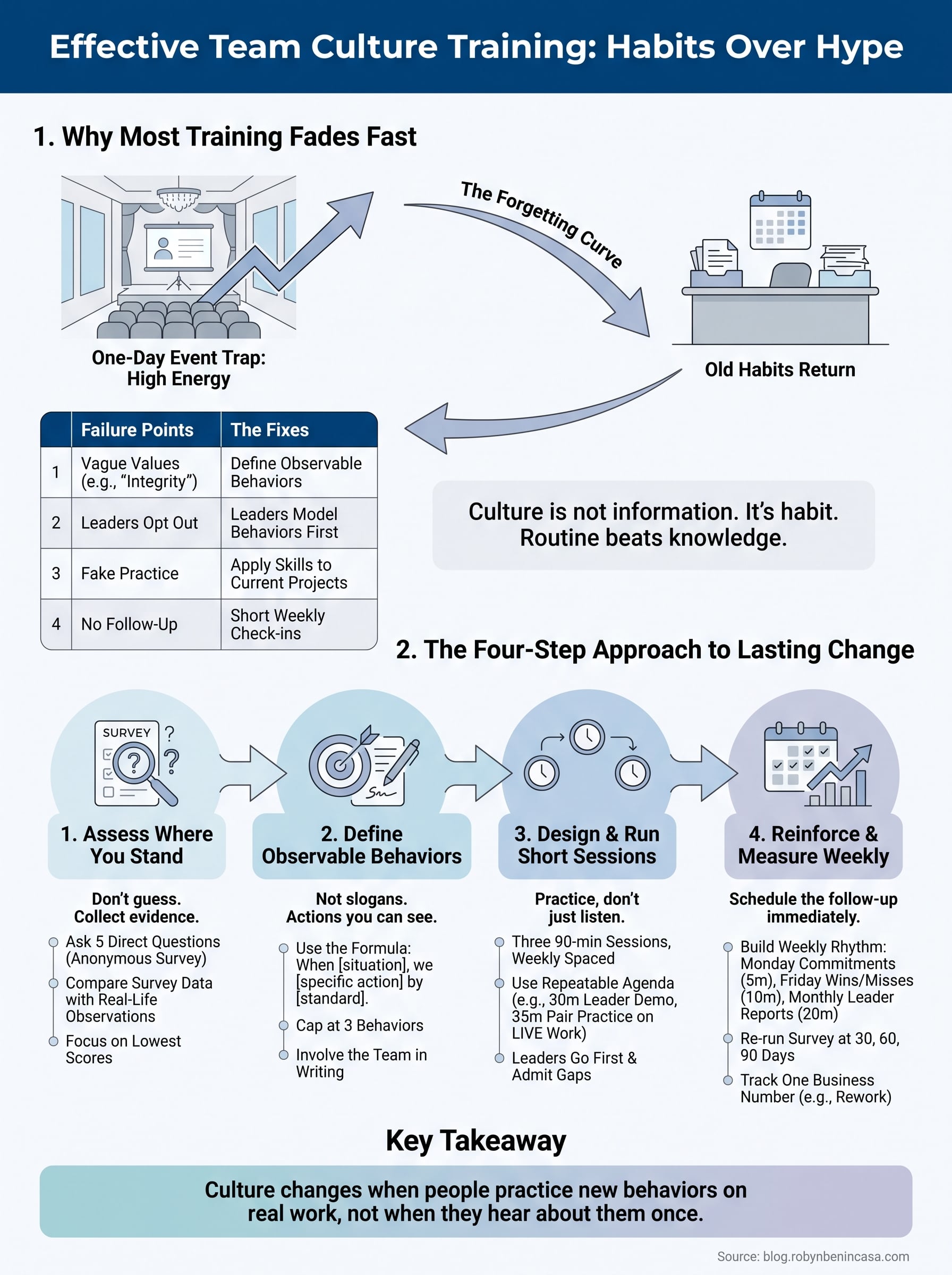
Culture training fades for a predictable reason: it treats culture as information instead of habit. People leave a workshop knowing what good teamwork looks like. Then they return to the same calendar, the same deadlines, and the same meeting dynamics. Routine beats knowledge almost every time.
The one-day event trap
Most programs are built as events. A facilitator, a few exercises, a slide deck, a catered lunch. The energy in the room is real, but nothing in the following week asks anyone to behave differently. Managers go back to their inboxes, and the session becomes a pleasant memory.
Research on the forgetting curve shows that people lose much of what they learn within days unless they use it. Culture works the same way. A behavior you do not repeat is a behavior you will not keep, no matter how inspiring the day was.
Culture changes when people practice new behaviors on real work, not when they hear about them once.
Four failure points to watch for
When you look at programs that did not last, the same problems keep showing up. Check your own past efforts against this table.

| Failure point | What it looks like | What fixes it |
|---|---|---|
| Vague values | Posters say "integrity" and "collaboration," but nobody can describe the behavior | Define observable behaviors |
| Leaders opt out | Executives open the day, then leave for meetings | Leaders go first and model the behaviors |
| Fake practice | Exercises use made-up scenarios | Apply skills to current projects |
| No follow-up | Nothing is scheduled after the event | Short weekly check-ins |
Notice that none of these are about the quality of the facilitator. A great speaker cannot fix a missing follow-up system. Elite adventure racing teams treat teamwork as a skill to rehearse, not a value to announce, and your team needs the same mindset.
The rest of this guide is built to close each gap in that table. You will start by assessing where your culture really stands, because you cannot train the right behaviors until you know which ones are missing.
Step 1. Assess where your team culture stands
Before you plan any team culture training, find out what your culture actually is. Leaders usually guess, and their guess is rosier than what the team lives. Spend one week collecting evidence.
Ask five direct questions
Use an anonymous survey in Google Forms or Microsoft Forms. Ask everyone to rate these statements from 1 to 5, with five statements only so people actually finish it:
- I can disagree with a teammate without worrying about consequences.
- I know how my work connects to the team’s goal.
- When someone is stuck, a teammate helps without being asked.
- Our meetings end with clear owners and deadlines.
- Leaders do what they say they will do.
Any average below 3.5 is a priority gap. Low scores on statements 1 and 5 point to a trust problem, so give that area the most training time.
Compare the numbers with what you see
Numbers tell half the story. Sit in on two or three regular meetings and notice who speaks, who stays silent, and what happens when someone raises a problem. Then hold 15-minute one-on-ones with four or five people and ask, "What is one thing we do here that slows us down?"
Look for gaps between the survey and the room. A team that scores itself 4.5 on openness but goes quiet when the boss disagrees has told you exactly what to train.
You cannot train the right behaviors until you have seen the real ones.
Finish by choosing the two or three lowest-scoring areas. Those become your focus in Step 2.
Step 2. Define the behaviors you want to train
Slogans do not change results in team culture training. Behaviors do. Take the two or three gaps from Step 1 and turn each one into an action someone could watch happen. If you could not film it, it is still a slogan.
Write behaviors as observable actions
Use one simple formula. It forces you to name the situation and the standard, so nobody can claim they were already doing it.
When [situation], we [specific action] by [time or standard].

Example: When we disagree in a meeting, we say it in the room,
not in chat afterward.
If an outsider could not see the behavior happen, it is not a behavior yet.
Match each gap to a behavior
Start from your survey results. Here is how each low score can translate into something trainable.
| Survey gap | Behavior to train |
|---|---|
| Disagreeing feels risky | We state concerns in the meeting, not afterward |
| Goal feels unclear | Every kickoff opens with one sentence on how it serves the team goal |
| Teammates work alone | If stuck for 30 minutes, we ask in the team channel |
| Meetings drift | The last five minutes name an owner and a deadline for each item |
| Leaders slip | Leaders report on their own commitments first |
Now cap the list at three behaviors. A team cannot practice ten things at once, and a long list guarantees none of them stick. Then ask the team to rewrite each behavior in its own words, because people defend what they helped write.
Step 3. Design and run the training sessions
Plan three short sessions instead of one long day. Give each session 90 minutes and one behavior from Step 2, and space them a week apart. The gap is the point, because it forces the team to try the behavior on real work between sessions.
Use the same agenda every time
A repeatable format lowers anxiety and cuts your prep time. Run every team culture training session on this structure.

| Minutes | Activity | Purpose |
|---|---|---|
| 0-10 | Share a recent moment when the behavior was missing | Make it concrete |
| 10-30 | Leader demonstrates the behavior | Set the standard |
| 30-65 | Pairs practice on a live project | Build the habit |
| 65-80 | Debrief what felt awkward | Surface obstacles |
| 80-90 | Each person commits to one use this week | Create follow-through |
Let leaders go first
Leaders should speak first in the debrief and admit where they fall short. When a manager says, "I cut off two people on Tuesday, and here is what I will do differently," everyone else gets permission to be honest. Skip this and the team will watch the boss for cues and stay guarded.
Leaders who go first make it safe for everyone else to follow.
Keep the practice tied to current work. Use this week’s actual client issue or deadline, not a made-up case study. Adventure racing teams rehearse gear changes and handoffs before race day, so rehearse the hard conversation the same way, with real stakes and a real teammate.
Step 4. Reinforce, measure, and keep it going
The sessions are only the start. Team culture training lasts when you schedule the follow-up before the final session ends. Put three small routines on the calendar this week.
Build a weekly rhythm
Keep each routine short enough to survive a busy week, and attach it to a meeting you already hold so no new invite is needed.
- Monday, 5 minutes: Each person names the behavior they will use this week.
- Friday, 10 minutes: Everyone shares one win and one miss.
- Monthly, 20 minutes: Leaders report on their own commitments first.
What you review every week is what your team treats as important.
Measure what changes
Re-run the five-question survey from Step 1 at 30, 60, and 90 days. Use the identical wording so the scores compare cleanly. Your target is to move every priority gap above 3.5.
Pair the scores with one business number the behaviors should affect, such as project handoff time, rework, or voluntary turnover. A rising survey score with a flat business number means the team is saying the right things but not yet changing how the work gets done.
If a score stalls, go back to Step 2. In most cases the behavior was too vague to practice, so rewrite it as a sharper action and run one more 90-minute session on it.
Making culture training last
Lasting team culture training comes down to one idea: culture is a set of habits, and habits need practice. Assess honestly, define three observable behaviors, run short sessions on real work, and review the results every week. Skip any of those steps and the old routines come back.
Start small. Send the five-question survey this week, write your first behavior by Friday, and book all three sessions before your calendar fills up. Leaders who go first set the pace for everyone else.
If you want a partner in building that kind of culture, or a corporate culture keynote speaker who gets your team energized to begin, explore Robyn Benincasa’s team building and leadership resources. Her lessons from 15 years of adventure racing and 20-plus years as a San Diego firefighter give your team a practical place to start.