
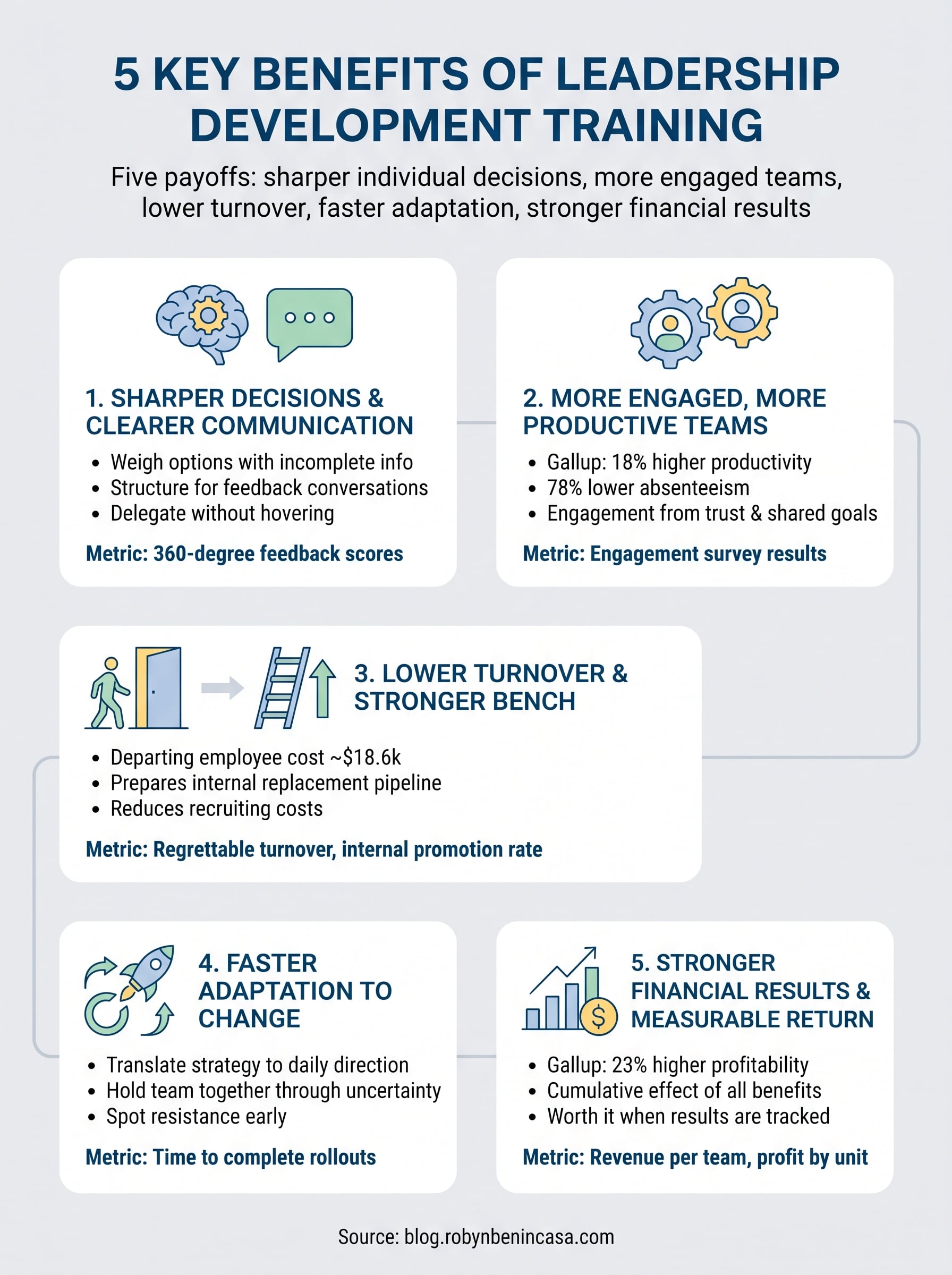
The benefits of leadership development training come down to five payoffs: sharper individual decisions, more engaged teams, lower turnover, faster adaptation to change, and stronger financial results. The best programs tie learning to real work and measure outcomes afterward. New managers gain the most from feedback and delegation skills. Senior executives gain the most from alignment and change leadership. HR buyers see the clearest return in retention.
Most organizations already agree that leaders matter. The harder question is whether the spend is worth it, especially when budgets tighten. Vague promises about "growth" rarely survive a finance review, so you need specific results you can name and track.
This article walks through five benefits of leadership training and development. Each comes with the evidence behind it and a practical way to capture it. Robyn Benincasa is a world champion adventure racer and a firefighter with 20+ years of service in San Diego. She has spent years teaching organizations how winning teams operate, so the examples reflect what leaders actually do under pressure.
1. Sharper decisions and clearer communication
Leadership development training first improves two things inside each leader: how they make decisions and how they explain them. Every other benefit on this list builds on these two skills.
What you get
Untrained leaders default to whatever worked when they were individual contributors. Training replaces that habit with tools. You get a way to weigh options when information is incomplete, a structure for feedback conversations, and a method for delegating without hovering.
Clear communication matters most under pressure. A firefighter on scene has no time to be vague, and a manager in a missed quarter has none either. Teams move faster when the leader states the goal, the constraints, and who owns what. In Center for Creative Leadership data covering more than 5,400 leaders, 86% reported significant improvement in their overall leadership effectiveness after completing a program.
Training turns a leader’s instincts into habits that other people can rely on.
How to capture it
Practice beats lectures. Choose leadership development training activities that make leaders rehearse real situations, then check whether behavior changed. Three methods work well:
- Role-play a hard feedback conversation with a peer, then swap roles.
- Review a recent decision as a group: what you knew, what you assumed, what you would change.
- Have each participant commit to one behavior, and ask their manager to check in 30 days later.
2. More engaged, more productive teams
Trained leaders build teams that care more and get more done, because the manager shapes the daily experience of work more than any policy does. Engagement is where leadership development shows its effect earliest.

What you get
Gallup compared the top and bottom quartiles of business units by engagement. The most engaged units had 18% higher productivity and 78% lower absenteeism. Gallup also attributes roughly 70% of the variance in team engagement to the manager, which makes the leader the lever.
Engagement does not come from perks. It comes from trust, shared goals, and people knowing how their work fits. Robyn’s adventure racing teams dominated the sport for 15 years, and she credits a deliberate team culture of collaboration over individual talent. Her clients have seen results like a sales team moving from 17th to 1st nationally. The benefits of leadership training and development often start with that shift from individual effort to shared commitment.
Engagement is an output of leadership, not a separate HR program.
How to capture it
Start with managers, because they sit closest to the work. Teach them to build the conditions for employee engagement rather than chase it with surveys. Three habits make the difference:
- State the team’s goal in one sentence that everyone can repeat.
- Hold short weekly check-ins focused on obstacles, not status.
- Recognize results the team earned together, not only top individuals.
3. Lower turnover and a stronger leadership bench
Leadership development training keeps good people longer and prepares the next group of leaders. Both cut the cost of replacing talent.
What you get
Gartner reports that each departing employee costs an organization $18,591 on average. A Conference Board survey found that 58% of workers say they are likely to leave if they do not receive leadership development opportunities. People want to see where they are going, and a development program is visible proof that the company plans to invest in them.
The second payoff is the bench. When you train people before they need the promotion, a vacancy no longer means months of scrambling. Internal candidates already know your customers and your culture. Promoting them also often costs less than an external search. Leadership training for new managers matters most here, since a bad first year in management pushes strong performers out.
Every promotion-ready employee is a replacement you will not have to recruit.
How to capture it
Treat the bench as a pipeline you can inspect, not a hope. Three steps keep it honest:
- Identify first-time managers and high-potential employees early.
- Train new managers within their first 90 days, not their first year.
- Track regrettable turnover by manager, so weak spots show up in the data.
4. Faster adaptation to change
Organizations with developed leaders respond to change faster, because leaders translate a strategy shift into daily direction for their teams. This benefit matters most during mergers, reorganizations, and market pressure.

What you get
The Center for Creative Leadership found that 86% of companies with strategic leadership development programs say they can respond rapidly to an unpredictable business environment. Among companies with less mature programs, the figure was 52%. The gap is large, though the figures reflect association and not proof that training alone caused it.
The mechanism is simple. Change fails in the middle layers, where managers must explain a decision they did not make to people who did not want it. A trained leader can answer "why" honestly, hold the team together through uncertainty, and spot resistance early. Without that skill, silos harden and each team protects its own turf.
A strategy only moves as fast as the least prepared leader who has to explain it.
How to capture it
Connect training to a live initiative, not a generic curriculum. Leaders retain more when they apply lessons to a real problem that week. Include these elements:
- Teach change leadership to managers at every level, not just executives.
- Use a current project as the case for each session.
- Bring cross-functional leaders into the same room, so silos break down during the training itself.
5. Stronger financial results and measurable return
Leadership development training pays off financially through the other four benefits, and you can measure the return if you decide on metrics before the program starts.
What you get
Gallup found that top-quartile engagement business units had 23% higher profitability than bottom-quartile units. Add the avoided cost of turnover, higher productivity, and quicker execution, and the business case builds from several directions. Be honest about the limits: these are comparisons across business units, not guarantees that any single program will repay its cost.
The answer to "are leadership development programs worth it?" is yes, when the program targets specific behaviors and someone tracks results. Programs fail when they are one-off events with no follow-up. The importance of leadership training and development shows up only when the training changes what leaders do on Monday.
A leadership program is worth what you measure afterward, not what you spend beforehand.
How to capture it
Pick a baseline metric for each benefit before the first session, then review it at 90 days and again at one year. This table pairs each benefit with a metric most organizations already collect:
| Benefit | Metric to track |
|---|---|
| Decisions and communication | 360-degree feedback scores, decision cycle time |
| Engagement and productivity | Engagement survey results, absenteeism, output per team |
| Retention and bench | Regrettable turnover, internal promotion rate |
| Adaptation to change | Time to complete rollouts, adoption rates |
| Financial results | Revenue per team, cost of turnover, profit by unit |
Making the investment count
Leadership development training pays off when it improves how leaders decide, communicate, and build teams. Those changes lead to more engaged people, less turnover, faster change, and results you can track. The programs that deliver are tied to real work, led by people with credibility, and measured long after the last session.
If you want your leaders to hear how world-class teams build trust and win together, see how Robyn Benincasa brings these lessons to leadership keynotes and team events. Start by choosing the one benefit on this list that your organization needs most.