The best officer resilience training program teaches skills officers can use on shift, puts leadership in the room, and comes with a plan for the months after the class. For a one-day entry point, the IACP program is the simplest fit. For federally backed training in person or online, start with VALOR. For the strongest published evidence, HeartMath’s Coherence Advantage has a controlled study behind it. For peer-led models, look at Georgia and New Jersey.
The problem is that police work ranks among the most stressful jobs, yet most officers get far more training in tactics than in recovering from what they see. Programs differ widely in length, delivery, and proof. That makes it hard to know which one deserves your budget and your officers’ time.
This guide compares eight programs on what they cover, how they are delivered, what evidence exists, and who they suit. It comes from the fire service side of public safety. Robyn Benincasa spent more than 20 years as a San Diego firefighter before she began teaching organizations how strong teams handle pressure. Use the list to shortlist, then ask each provider the questions near the end.
What a strong officer resilience training program includes
A strong program gives officers skills they can use before, during, and after a call, supports them after the class ends, and can show proof that it works. Judge every program below against those three tests.
Skills officers can use on shift
Good resilience training teaches techniques, not just ideas about stress. The need is concrete. In a 2012 study of Santa Clara County officers, simulated police calls such as a car pursuit and a domestic violence scenario produced a large physiological response. Recovery took a considerable amount of time.
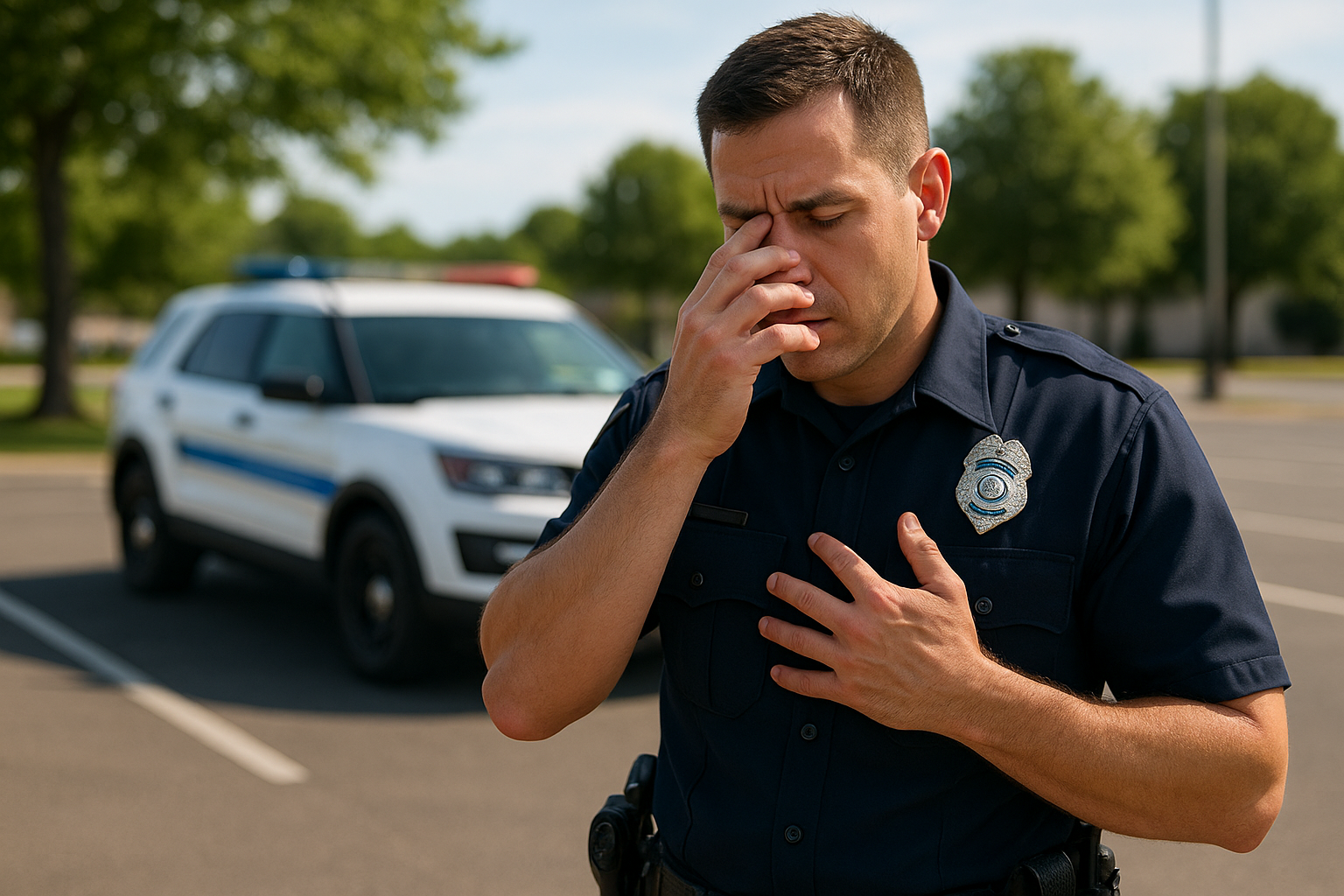
Look for training that covers three things:
- A fast way to settle the body after an acute incident, such as controlled breathing
- Tools for chronic problems, including poor sleep, anger, and anxiety
- Plain language for talking about stress with peers and family
Resilience training works when an officer can use it in the parking lot after a bad call, not only in the classroom.
Support that outlasts the class
Training alone rarely holds. The same research notes that organizational factors such as shift schedules, management style, and paperwork can be an even greater source of stress than the street. It also describes a culture that discourages officers from admitting stress reactions. A single class cannot fix that.
Leadership attendance matters here. When a chief or sergeant sits through the session and uses the vocabulary afterward, officers see permission to speak about stress. Peer support, refresher sessions, and clear access to counseling turn a one-time event into a habit.
Evidence you can ask for
Ask every provider four questions:
- Has anyone outside the provider evaluated the program?
- Was there a comparison group?
- What was measured, and what did officers simply report?
- How many officers and agencies took part?
Treat the Santa Clara study as the benchmark and hold other police resilience training to the same questions. A program without published trials is not automatically weak, but you will need agency-level feedback to judge it.
1. IACP Officer Resilience Training Program
What it is and what it covers
The International Association of Chiefs of Police designed this officer resilience training program to equip officers with empirically validated skills of resilience. The IACP is the best-known professional body for police chiefs, so the program carries weight with command staff. That helps when you need approval to pull officers off patrol.
The description points to practical skills, not clinical treatment. Expect an introduction to coping and recovery techniques aimed at line officers. Request the current syllabus before you book, so you can match its topics to your agency’s biggest stressors.
How it is delivered
The program is offered as a one-day, in-person training. That format is both the main selling point and the main limit. One day is easy to schedule and easy to explain to a city council. It is also a small dose of content, so officers need reinforcement afterward.
Plan coverage early. Splitting a squad across two sessions keeps patrol staffed. A joint session with neighboring agencies spreads cost and builds cross-agency peer ties. Ask the IACP through its program page whether it can host at your site or in a regional setting.
Evidence and best fit
The IACP describes the skills it teaches as empirically validated. That means the techniques rest on research. It is not the same as a published trial of this specific one-day class. Ask for feedback or outcome data from agencies that have already hosted it.
A one-day class is a strong start and a weak finish, so budget for follow-up.
This program suits small and mid-size agencies that want a credible first step. It also suits chiefs who need a simple pilot to show a board or council. Pair it with a peer support team and a refresher schedule so the skills do not fade within weeks.
2. FBINAA officer resiliency training
What it is and what it covers
The FBI National Academy Associates lists Officer Resiliency within its officer safety and wellness education. The training aims to reshape how an officer thinks. It asks officers to look at the world, themselves, and the events they experience differently. That is a mindset approach, closer to cognitive reframing than to breathing drills.
The focus fits the part of police work that follows an officer home. Replaying a call at 2 a.m. or carrying anger from one shift into the next are the problems it targets. Ask FBINAA for the current syllabus and for examples of how instructors handle post-incident thinking.
How it is delivered
Beyond the core training, FBINAA offers a train-the-trainer option. It lets an agency certify its own instructors rather than booking outside trainers every time. Over several years that usually costs less per officer. It also puts the message in the voice of someone the squad already knows.
The tradeoff is upkeep. Instructors need protected time, refreshers, and backing from command. Without those, an in-house program fades within a year. Confirm length, cost, and instructor requirements directly with FBINAA before you commit.
Evidence and best fit
Reframing unhelpful thoughts draws on well-established psychological methods, and it speaks to a culture that discourages officers from naming stress. As with any program, ask for outcome data from agencies that have used it. A policing audience will trust numbers from peer departments more than a brochure.
Train-the-trainer turns a one-time purchase into a standing capability.
It suits larger departments with a wellness coordinator, command staff who already know FBINAA through the National Academy, and regional groups of agencies that want to share instructors and costs.
3. VALOR Officer Safety and Wellness Program
What it is and what it covers
The Bureau of Justice Assistance runs the VALOR Officer Safety and Wellness Initiative. It is a training and technical assistance program that delivers a variety of resilience trainings and resources to law enforcement. Its stated mission is preventing injuries to and deaths of officers and the people they serve.
That mission is broader than stress management alone. Resilience is one piece of an officer safety and wellness effort, so VALOR works as a menu, not a single class. Browse its current offerings on the BJA overview page and choose the courses that match your agency’s problems.
How it is delivered
VALOR delivers both in-person and virtual trainings. Virtual options matter most for rural and small agencies, where sending officers away for a day can leave a shift short. In-person sessions suit departments that want a full group in one room.
Because the program sits within the Bureau of Justice Assistance, check whether your agency qualifies for no-cost or subsidized delivery. Ask about scheduling lead times as well. Federal training calendars can fill up, so contact VALOR well before the date you have in mind.
Evidence and best fit
VALOR is an umbrella, so quality and evidence vary by course. Do not judge it as one product. Ask the team for evaluation results on the exact course you are considering, and for references from agencies of your size.
With VALOR, evaluate the course you are booking, not the brand.
It fits agencies of any size that want an established national program, especially those with tight budgets or long travel distances. It also suits leaders who want ongoing technical assistance, since the initiative provides resources beyond a single class.
4. Coherence Advantage by the Institute of HeartMath
What it is and what it covers
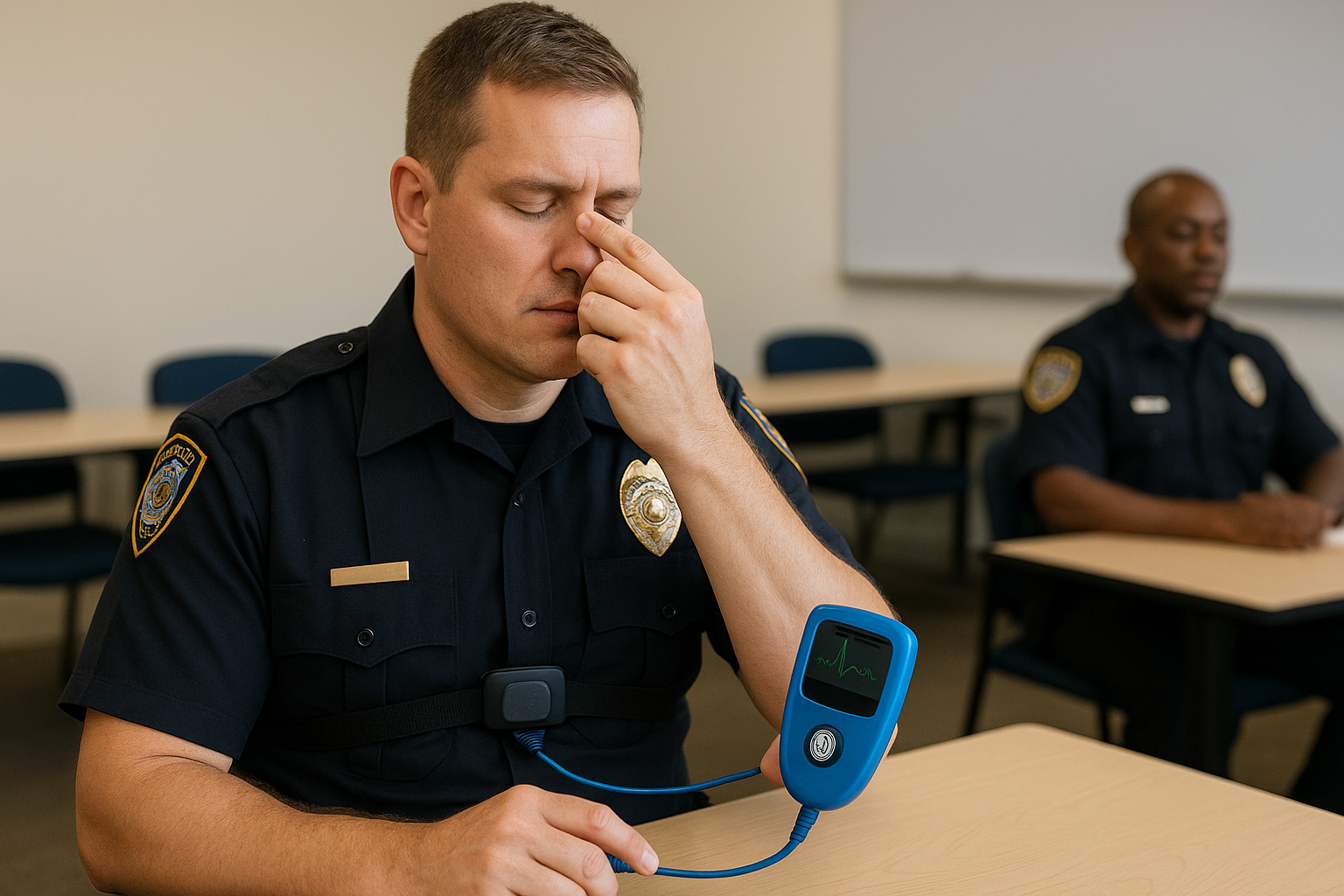
Coherence Advantage is the best-studied police resilience training on this list. It teaches self-regulation techniques named Heart Focused Breathing, Freeze Frame, Inner Ease, Prep, Shift, and Reset, and Getting In Sync. The goal is a physiological state the developers call coherence, where heart rhythm becomes more ordered and sine wave-like at about a 10-second cycle.
The stated objectives are practical. They include thinking clearly under pressure, keeping situational awareness, reducing sleep disturbance and fatigue, improving reaction times, and raising stress tolerance. Officers also use emWave devices, which show heart rhythm in real time through a pulse sensor.
How it is delivered
In the published study, officers attended three classroom sessions of four hours each, spaced about equally over one month. After the first session they had access to the emWave desktop devices for practice. That is 12 hours of instruction plus self-directed practice, a far larger dose than a single day.
The biofeedback is a real differentiator. Officers can see whether a breathing technique is working, which helps skeptical people who dislike abstract advice. The cost is logistics. You need devices, scheduled practice, and a champion who keeps officers using them. Ask HeartMath for current pricing and formats.
Evidence and best fit
A 2012 study in Global Advances in Health and Medicine tested the program on 65 participants from seven Santa Clara County agencies. Of those, 29 were trained and 36 formed a waiting-list control. Trained officers reported less stress, fewer negative emotions, less depression, and more peacefulness and vitality than controls. They also reported better family relationships and team communication.
It is the only program here with a published controlled study of police officers behind it.
Read it with care. The sample was small, the authors work at HeartMath, and many outcomes were self-reported. The study also found that 11% of officers showed a higher risk of sudden cardiac death on 24-hour heart rate variability testing, more than twice the typical general-population rate. The program suits wellness leads who want measurable physiology and have the time to support practice.
5. Georgia Public Safety Resiliency Program
What it is and what it covers
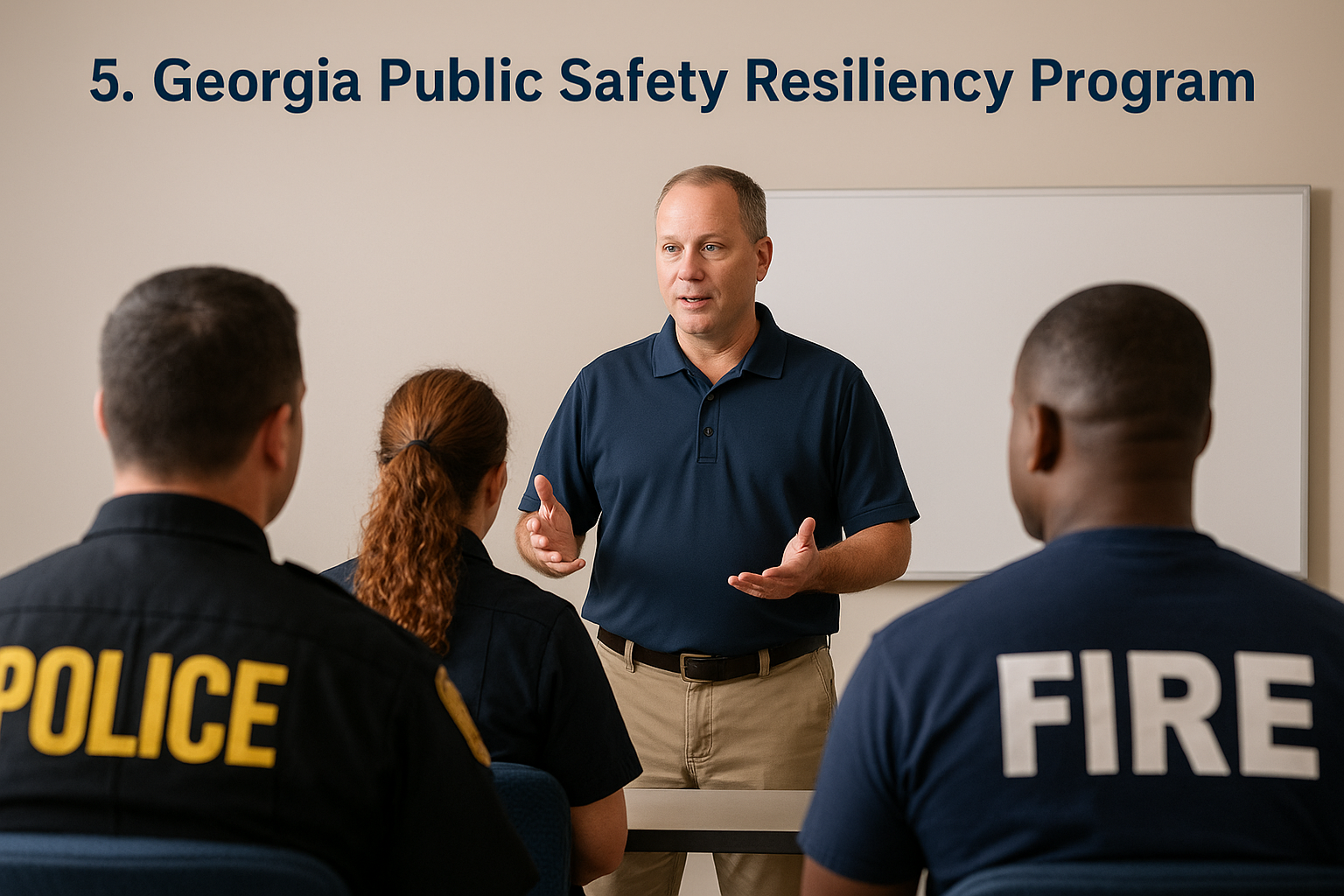
The Georgia Public Safety Training Center runs this program through its Critical Skills Training Section. It is an instructor-led, peer-to-peer initiative designed to strengthen the well-being of people across public safety. That wider scope matters. Police, fire, and dispatch staff often share the same incidents and the same strain.
The program’s strength is the peer element. Officers hear from colleagues who know the job, not from outsiders who have never worked a night shift. Ask GPSTC for the current curriculum and which roles the sessions are built for.
How it is delivered
Delivery is instructor-led, with peers in the teaching role. In the fire service, the conversation that matters most usually happens between crew members, not on a slide. Peer delivery brings that dynamic into a classroom, and it makes the message credible to officers who distrust outside experts.
For a Georgia agency, the practical step is contacting the training center about scheduling and eligibility. Agencies elsewhere should look at how the program is structured. A state training center that houses a resilience unit is a model that other states and large departments can adapt for their own police resilience training.
Evidence and best fit
The research on police stress describes a culture that discourages officers from admitting stress, and peer delivery goes straight at that barrier. That is a sound design logic, but it is not the same as outcome data. Ask GPSTC for participation numbers and post-session feedback before you promote it as proven.
Peer delivery attacks stigma, the barrier that keeps officers from using help that already exists.
The program fits Georgia agencies first. It also suits any department that wants to copy a peer-led model, particularly one that serves police and fire together under a joint public safety structure.
6. New Jersey Officer Resiliency Program
What it is and what it covers
The New Jersey Office of the Attorney General runs an Officer Resiliency program built around Directive 2019-1. Under it, a Chief Resiliency Officer provides training for Resiliency Program Officers (RPOs) and ensures that all officers have access to the latest resources and trainings. It is a statewide structure as much as a curriculum.
That structure is the lesson. Instead of one class, New Jersey created named people whose job is officer wellness. See the state’s Officer Resiliency page for the directive and current resources.
How it is delivered
Delivery is tiered. The state-level officer trains the agency-level RPOs, and the RPOs connect their own officers to resources and training. Officers get access through someone inside their own department, not through a distant hotline.
A tiered model scales well, and it keeps accountability local. The weak point is the quality of each RPO. If the person is overloaded or untrained, the structure exists only on paper. Any department copying this design should give the role protected hours and a direct line to the chief.
Evidence and best fit
New Jersey’s approach is a framework, so there is no single trial to cite. The logic is organizational. The 2012 research notes that agency climate can weigh heavily on officers, and a designated resiliency lead addresses that directly. Ask the state for participation figures if you plan to borrow the model.
A named person accountable for officer wellness in every agency beats a binder of resources nobody opens.
New Jersey agencies should treat the directive as their baseline. Departments in other states, and state training commissions, can adopt the structure. Even a 50-officer agency can designate a wellness coordinator and send that person to training.
7. POWER Officer Wellness Program
What it is and what it covers
POWER comes from the nonprofit Beyond Us & Them. It is an officer wellness program that builds resilience, peer support, and emotional wellbeing for law enforcement professionals. The emphasis on emotional wellbeing and peer connection sets it apart from skill-drill programs focused on physiology.
Because it centers on peers, it suits the stage before a crisis. Officers who already talk to each other about hard calls are more likely to seek help early. Request the full session outline from the provider so you can see what each session teaches.
How it is delivered
Peer-support programs generally run as group sessions where officers talk with each other, guided by facilitators. Check the format on the program page and ask who leads the sessions. Facilitator credibility decides whether officers speak freely or sit silent.
Ask about group size, session length, and whether your officers attend together or mixed with other agencies. Mixed groups can feel safer for candor, while same-agency groups build lasting bonds. There is no universal answer, so match the format to the culture of your department.
Evidence and best fit
Treat POWER as a promising option, not a proven one, until the provider shows you outcome data. Request any evaluation reports and references from agencies similar to yours. A program built on peer support should be able to give you officer feedback from past cohorts.
If a program leans on peer trust, test it with a pilot group before you roll it out to everyone.
It suits agencies that want to start a culture shift around talking about stress. It also fits departments that already have solid clinical resources but lack a peer layer to connect officers to them.
8. Hello Driven Resilience First Aid
What it is and what it covers
Hello Driven is an Australian provider that offers resilience training for police officers. Its core course is Resilience First Aid, a two-day mental health certification. It teaches people to proactively build mental wellness in others, support them across six resilience domains, and respond when someone is struggling.
This is different from the other programs. It trains officers to support each other, not just to manage their own stress. Hello Driven has also partnered with FirstWatch on an AI virtual coach app aimed at first responders. Ask for a demo to judge whether officers would actually use it.
How it is delivered
The certification totals 14 hours. You can take it fully online and self-paced, or as a blend of four hours in person or by webinar and ten hours online. Private workshops are available for organizations. Certification includes 12 months of ongoing training access.
Pricing is listed in Australian dollars. The certification is AU$575 per person, and the instructor course is AU$3,950, which lets an organization certify its own people. Convert to US dollars at current rates and ask about group pricing before you budget.
Evidence and best fit
Hello Driven’s page cites return-on-investment figures from general workplace research, not studies of police officers. That research is not worthless, but it does not show that this program reduces stress in a patrol unit. Ask for law enforcement outcomes specifically.
Online, self-paced certification solves scheduling, but only a pilot shows whether officers finish and use it.
It suits wellness teams that want to certify peer supporters across shifts without pulling everyone into a classroom. It also helps rural agencies and departments with rotating schedules, where a single in-person date is hard to find.
How to choose and launch the right program for your agency
Pick the program that fits your agency’s size, schedule, and biggest stressors. Then run it as a pilot, measure the results, and add follow-up before you expand.
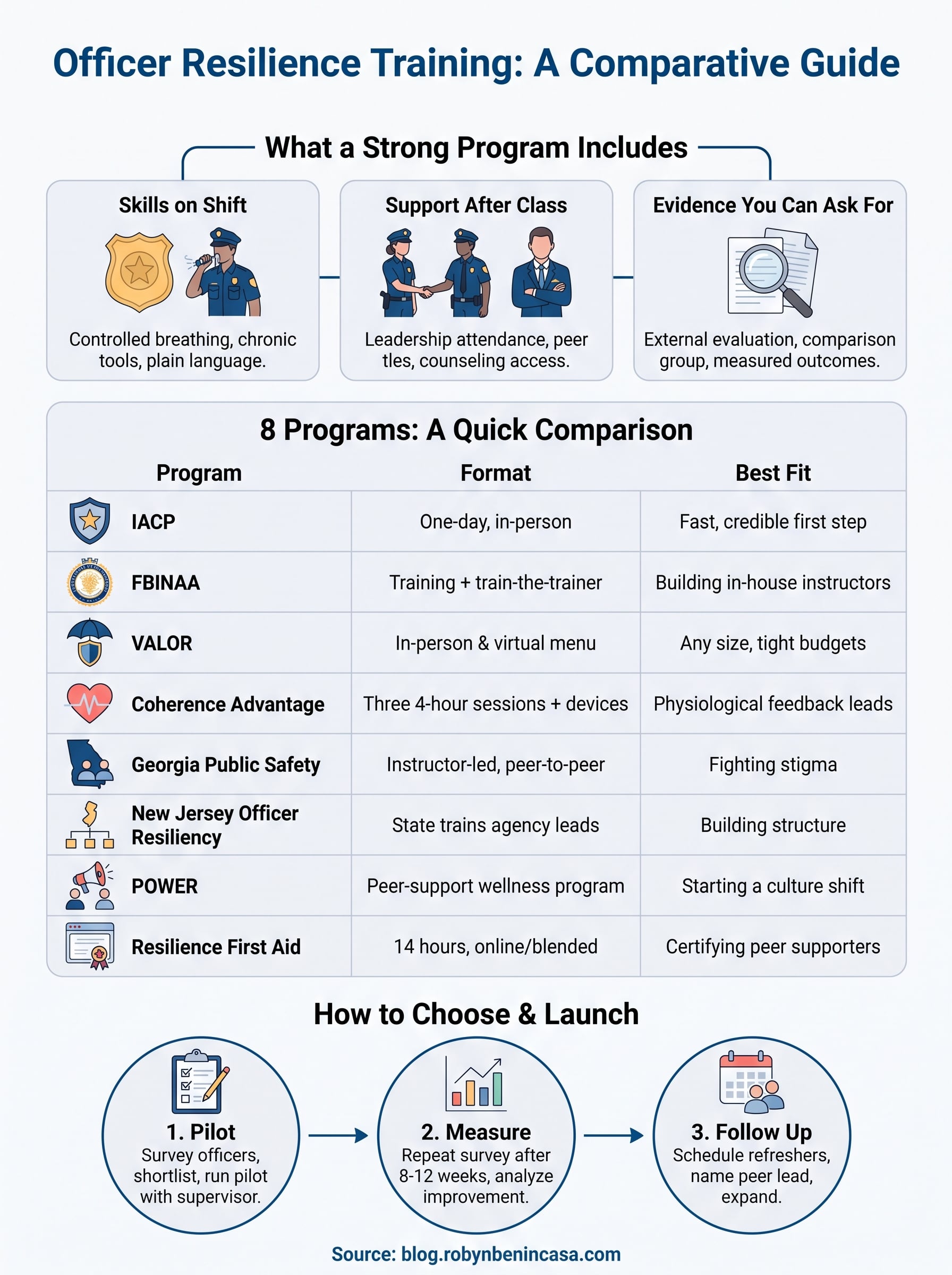
Compare the eight at a glance
The table puts the formats side by side, using only what each program states about itself.
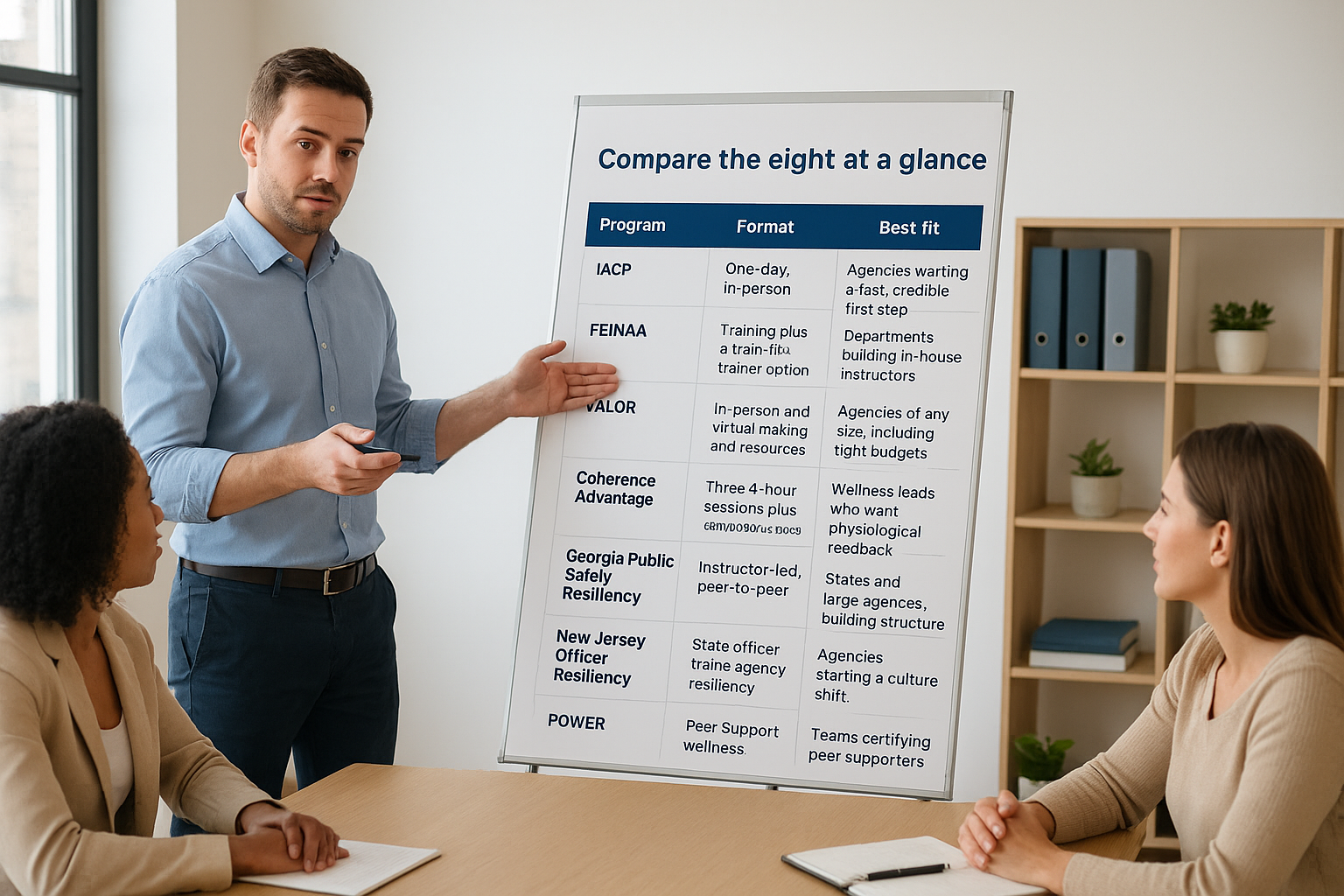
| Program | Format | Best fit |
|---|---|---|
| IACP | One-day, in-person | Agencies wanting a fast, credible first step |
| FBINAA | Training plus a train-the-trainer option | Departments building in-house instructors |
| VALOR | In-person and virtual training and resources | Agencies of any size, including tight budgets |
| Coherence Advantage | Three 4-hour sessions plus emWave devices, as studied | Wellness leads who want physiological feedback |
| Georgia Public Safety Resiliency | Instructor-led, peer-to-peer | Agencies fighting stigma |
| New Jersey Officer Resiliency | State officer trains agency resiliency officers | States and large agencies building structure |
| POWER | Peer-support wellness program | Agencies starting a culture shift |
| Resilience First Aid | 14 hours, online or blended, AU$575 | Teams certifying peer supporters |
Match the program to your problem
Start with your agency’s actual stressors, not the program’s brochure. If officers report poor recovery after critical incidents, lean toward skills-based training such as Coherence Advantage or IACP. If they will not talk to anyone, lean toward peer-led programs such as Georgia’s or POWER.
If you lack structure, borrow New Jersey’s model. Appoint a wellness lead before you buy any class. For a small agency, VALOR is often the lowest-friction place to begin. An anonymous survey of officers on sleep, workload, and support will sharpen all of these choices.
Pilot it, measure it, and follow up
Launch in six steps:
- Survey officers anonymously about their biggest stressors.
- Shortlist two programs and ask each provider the four evidence questions from earlier.
- Run a pilot with one squad or shift, with a supervisor attending.
- Repeat the same survey after 8 to 12 weeks.
- Schedule refreshers and name a peer support lead.
- Expand only if the pilot shows improvement.
One pilot squad and a before-and-after survey will tell you more than any brochure.
Start with one program and a plan to follow up
Officer resilience training works best when it teaches usable skills, has leadership behind it, and is followed by peer support and refreshers. The IACP and VALOR offer accessible starting points. FBINAA and New Jersey show how to build capacity inside an agency. Georgia and POWER focus on peer trust. Coherence Advantage has the strongest published evidence. Resilience First Aid training offers flexible online certification.
Whichever you choose, pilot it, measure it, and keep going after the first session. If you are planning a wellness day or a leadership event around this work, a speaker with a fire service background can open the conversation about teamwork under pressure. Explore Robyn Benincasa’s keynote and team resources to see how she approaches it.