
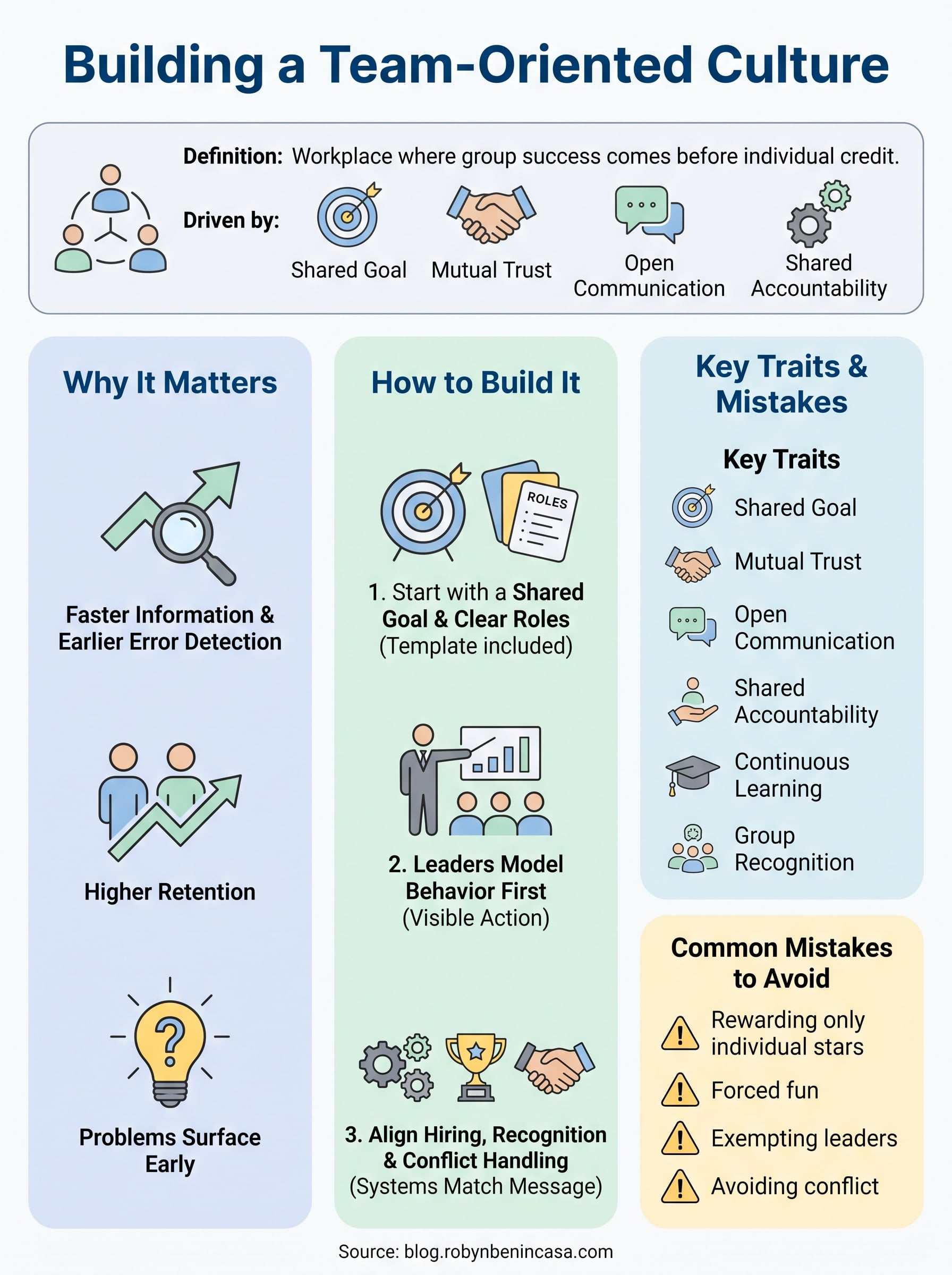
A team-oriented culture is a workplace where people put the group’s success ahead of individual credit, and where that belief shapes how goals are set, how work is shared, and how wins and mistakes are handled. In plain terms, people ask "what does the team need?" before they ask "what do I get?" The working definition has four parts: a shared goal, mutual trust, open communication, and shared accountability. If one of the four is missing, you have people who collaborate on good days, not a culture.
Robyn Benincasa has seen this from two angles. As a world champion adventure racer, she led teams that dominated the sport for 15 years. She also served as a San Diego firefighter for more than 20 years. In both worlds, the team’s culture decided the outcome more than any one person’s talent did.
This article covers why a team-oriented culture matters, how to build one step by step, the traits that define it, real workplace examples, and the mistakes that quietly undo it.
Why a team-oriented culture matters
A team-oriented culture matters because it decides whether people help each other before a problem becomes a crisis. When the culture is strong, information moves faster, errors get caught earlier, and good people stay. When it is weak, even talented teams stall.
What changes in day-to-day performance
The gains show up in small moments. A teammate flags a risk in week two instead of week ten. Someone takes a task they are good at because nobody is guarding turf. Problems surface early because raising them feels safe, and work moves faster because people hand off cleanly instead of protecting their own scorecard.

Leaders usually notice these changes first:
- Fewer surprises at deadlines, because bad news travels early.
- Faster onboarding, because experienced people teach new hires without being told to.
- Better ideas, because people offer them without fear of being shot down.
- Lower turnover, because people feel connected to the people beside them.
Retention deserves special attention. People leave a team where they feel needed less often than one where they feel invisible. Every departure costs you recruiting time, training time, and the knowledge that walks out the door.
Culture implications for team building
Culture sets the ceiling on every team building effort. If the daily rules reward individual stars, a ropes course or an escape room will not change behavior, because people return to the same incentives on Monday. Team building activities can practice a culture, but they cannot create one.
Team building events practice a culture. They cannot replace one.
Three implications follow. Leader behavior is the real curriculum, since people copy what the boss does, not what the poster says. Systems must match the message, so goals, bonuses, and recognition need to reward group results. And team building must be continuous, built into meetings and projects instead of saved for an annual offsite.
How to build a team-oriented culture
You build a team-oriented culture by making the group goal clear, having leaders model the behavior first, and then aligning hiring, recognition, and conflict handling to match. Expect it to take months, not weeks, because culture changes at the speed of repeated behavior.
Start with a shared goal and clear roles
Begin with one goal the whole group can repeat from memory. A shared goal gives people a reason to help beyond their own task list, and clear roles keep that help from turning into confusion. Write the goal in one sentence, then have each person add how their work contributes.
You can copy this template into your next team kickoff:
Our team exists to [outcome] for [who] so that [result].
This quarter, success means [measurable result].
My part is [role]. I need help from [names] on [task].
Review it at the start of every project and every quarter, so the goal stays alive instead of living in a slide deck.
Make leaders model it first
Leaders go first. If you want people to ask for help, ask for help in front of them. If you want peers to resolve conflicts, stop being the default referee. Visible modeling is the fastest lever you have, and admitting your own mistakes out loud gives everyone else permission to do the same.
Leaders do not announce a team-oriented culture. They demonstrate it until everyone else copies them.
Culture gets taught by watching. In a firehouse, a new crew member learns the real rules from how the officers treat the newest person on shift, not from the handbook. Your office works the same way.
Align hiring, recognition, and conflict handling
Once the goal and the modeling are in place, fix the systems that pull people back toward self-interest. Each of these four changes is small, and together they make the culture stick:
- Hiring: ask candidates to describe a time they helped a teammate succeed at some cost to themselves.
- Recognition: celebrate group results, and name the people who made others better.
- Conflict: expect peers to try to resolve it directly before anyone escalates.
- Training: cross-train so people understand each other’s work and appreciate it.
Key traits of a team-oriented culture
The core traits of a team-oriented culture are a shared goal, trust, open communication, shared accountability, continuous learning, and group recognition. You can spot each one by watching behavior, not by reading a values statement.
Six traits and how to spot them
The table below pairs each trait with what it looks like in practice and the warning sign that it is missing.
| Trait | What it looks like | Warning sign |
|---|---|---|
| Shared goal | Anyone can state the team goal in one sentence | Everyone names a different priority |
| Mutual trust | People admit mistakes and ask for help | Information gets hoarded |
| Open communication | Bad news travels up and sideways fast | Problems appear only at the deadline |
| Shared accountability | The team owns a miss together and fixes it | Blame lands on one person |
| Continuous learning | People cross-train and teach each other | Knowledge sits with one expert |
| Group recognition | Wins are credited to the team and its enablers | Only the top individual gets named |
Use the table as a quick audit. Pick three recent projects and ask which column each one fits. A single warning sign is normal, but a pattern across projects points to a culture problem, not a people problem.
You can see a team-oriented culture in behavior long before you can read it in a values statement.
What a team-oriented person looks like
A team-oriented person puts the group’s result first, shares information freely, and helps without waiting to be asked. They also receive help well, which is harder than it sounds, and they give credit specifically instead of vaguely. Team-oriented does not mean faceless. Strong teams use each person’s distinct strengths on purpose.
If you had to describe this culture in five words, choose trusting, open, accountable, supportive, and shared. Each one names a behavior you can observe, which makes them more useful than softer labels like "friendly" or "fun."
Team-oriented culture examples from real workplaces
Team-oriented culture examples appear wherever one person’s failure becomes everyone’s problem, including hospitals, fire crews, expedition races, and well-run sales teams. The common thread is that the system treats the group’s outcome as the score that counts.

Examples from high-stakes workplaces
Different industries express the same idea in different habits. This table shows what team orientation looks like in five settings, and what it protects against.
| Workplace | Team-oriented behavior | What it protects against |
|---|---|---|
| Hospital unit | Outgoing and incoming nurses review each patient together at shift handoff | Information lost between shifts |
| Fire crew | Members check each other’s gear and call out hazards regardless of rank | One person’s error in dangerous conditions |
| Adventure racing team | Stronger members tow and carry gear for a struggling teammate | The whole team slowing down |
| Sales team | Reps share leads, tactics, and call lessons toward one target | Hoarding and internal rivalry |
| Construction crew | Trades coordinate sequencing and a lead reviews work against standards | Rework and missed defects |
Adventure racing makes the logic plain. A team of four races nonstop for days and has to finish together, so the team moves at the pace of its slowest member. The best teams do not leave that person behind. They redistribute weight and tow, and the whole group gets faster. That is the same trade you make when a strong performer on your team stops to coach a struggling colleague.
Team orientation in organizational culture examples: what it sounds like
Culture is audible. You can hear it in how people talk when a deadline is close or a project goes sideways. Compare these everyday phrases:
- "That’s not my department" becomes "Who else should be in this conversation?"
- "I finished my part" becomes "What is blocking the rest of us?"
- "Who dropped the ball?" becomes "What did we miss, and how do we fix it?"
- "I need credit for this" becomes "Here is who made this possible."
Listen for these in your meetings for a week. The language people use tells you more than a survey, and the phrases that go unchallenged show you what your culture really allows.
Culture is what people say when they think it is normal.
Mistakes that undermine a team-oriented culture
The most common way to damage a team-oriented culture is to praise teamwork while rewarding individual heroics. People follow the incentives they see, not the values you state.
Four mistakes to avoid
These four errors cause most of the damage, and each one is fixable:
- Rewarding only individual stars. Bonuses and promotions that ignore group results teach people to compete.
- Forced fun. Mandatory social events without real collaboration at work feel like homework.
- Exempting leaders or top performers. One high performer who belittles colleagues undoes a year of good messaging.
- Avoiding conflict. Unspoken tension turns into silos, and silos turn into blame.
If the rules reward individual heroics, no amount of teamwork language will override them.
How to tell it is working
Track a few signals every quarter. People volunteer help without being asked, handoffs between teams get cleaner, new hires reach full speed sooner, and voluntary turnover drops. Add one or two statements drawn from organizational culture survey questions, such as "I can ask my teammates for help without feeling judged," and watch the scores over time.
Where to start
A team-oriented culture is a shared goal, trust, open communication, and shared accountability, made visible in daily behavior. It matters because it speeds up work, catches mistakes early, and keeps good people. You build it through clear goals, leaders who go first, and systems that reward the group.
Start small. Pick one behavior from this article, such as writing a one-sentence team goal or replacing blame questions with "what did we miss?" Practice it for 30 days, then add another.
If you want to go deeper on what makes winning teams work, read Robyn Benincasa’s guide on how to build culture in a team for more lessons drawn from adventure racing, firefighting, and leadership.