Community resilience model training is a skills course built around the Community Resiliency Model (CRM)®, a set of six body-based stress skills developed by Elaine Miller-Karas at the Trauma Resource Institute (TRI). It teaches you to notice sensations in your body, understand how your nervous system reacts to stress, and use simple tools to return to a steady state. Sessions run from a one-hour introduction to a full teacher certification, and you do not need a clinical background to learn the skills or share them.
This guide covers why the training matters, what the six skills are, how to find and register for a session, how certification works, what the research does and does not show, and how organizations put CRM to work. You will also see how "community resilience training" in the broad sense differs from this specific model, since people search both ways.
We publish this on Robyn Benincasa’s blog because her work centers on teams that perform under pressure. Robyn spent more than 20 years as a San Diego firefighter and led championship adventure racing teams, so the link between a calm body and good decisions is one she has seen up close. CRM gives ordinary people a structured way to build that calm.
Why community resilience model training matters
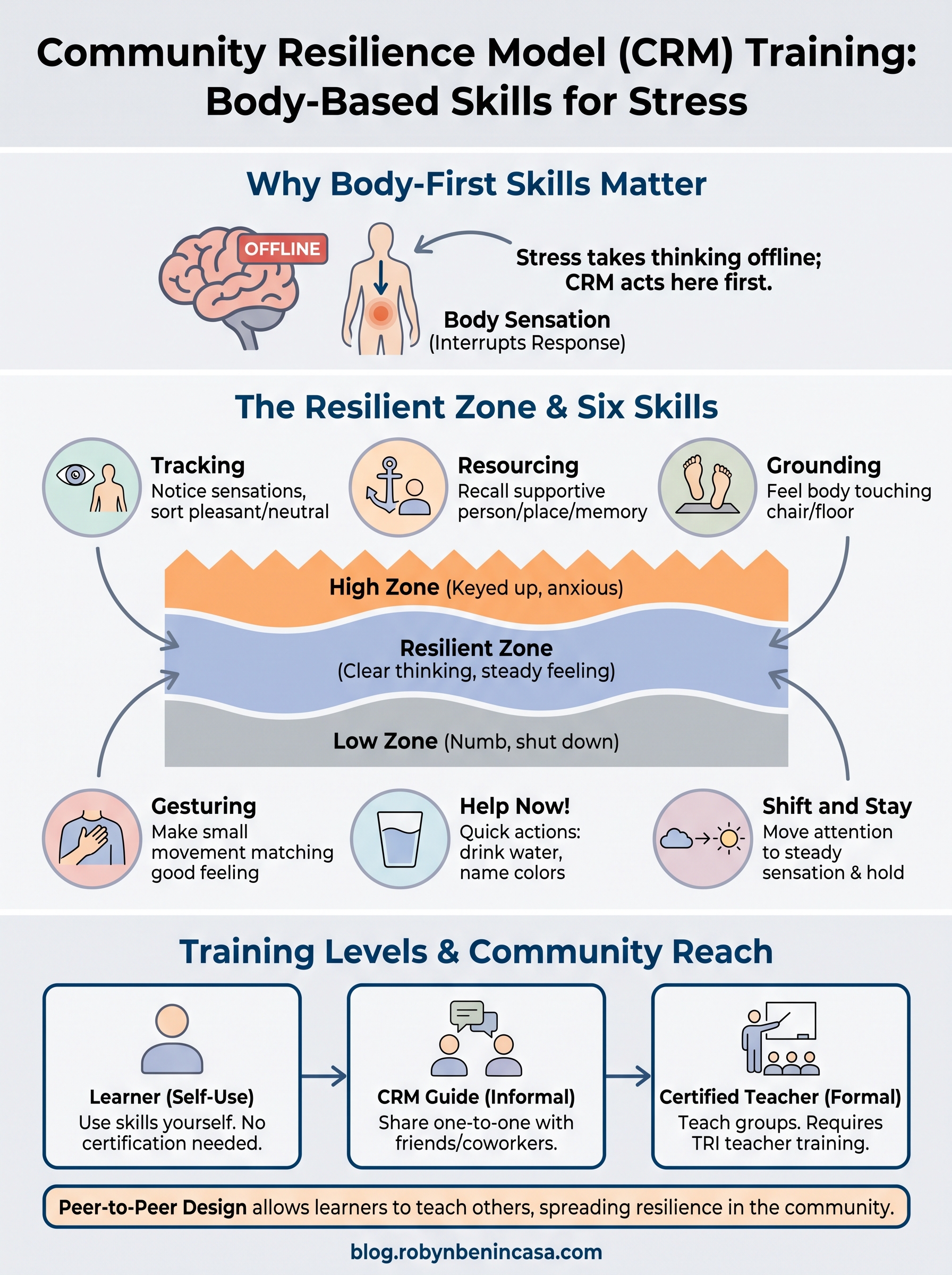
Community resilience model training matters because stress takes your thinking offline first, and CRM teaches a way to steady your body before you try to reason your way out. It also spreads easily, since people who learn the skills can pass them on to others.
Why body-first skills work when stress is high
Under acute stress, the brain shifts energy away from planning and toward fast reactions. That is why advice like "stay calm and think it through" so often fails in the moment. A 2023 paper on CRM, published in Global Mental Health and archived by the National Library of Medicine, explains that higher-level executive functions are sacrificed in acute stress so the body can react quickly. Cognitive strategies that depend on those functions may not work well at exactly the moment you need them.
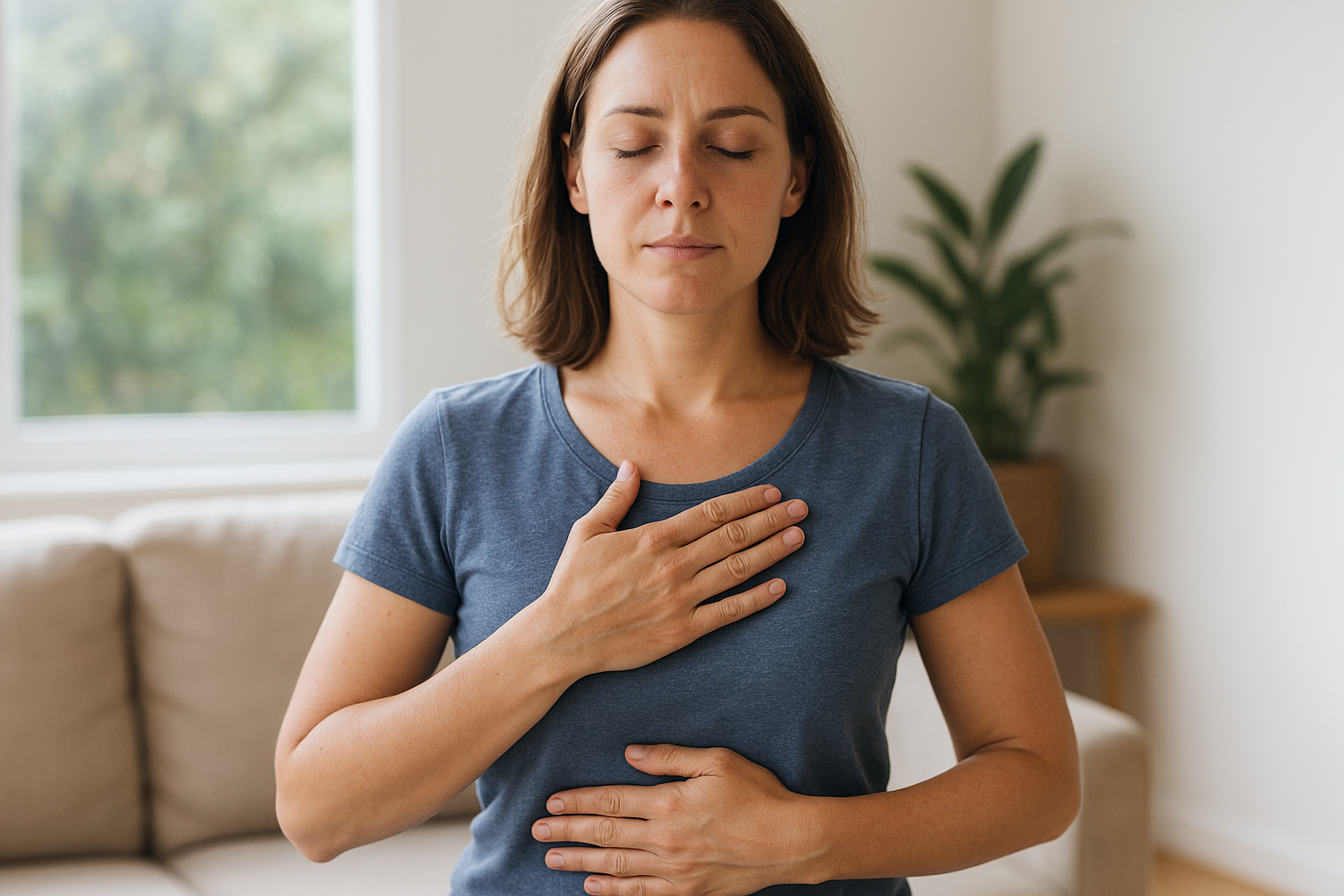
CRM works from the bottom up. You pay attention to a physical sensation, such as your feet on the floor, and that small act of attention interrupts the stress response. The authors suggest that intentional body awareness gives access to self-regulation even when thinking-based tools are unavailable.
When stress shuts down your thinking, the fastest way back is through your body.
The biological framing also lowers the barrier to joining. CRM presents strong reactions as normal nervous system responses, not weakness or a character flaw. People who would never walk into a therapy office will still sit in a workshop, and that reduced stigma is a big reason schools, employers, and health systems adopt the model.
Who benefits most from the training
Anyone under sustained pressure gains something, but a few groups stand out because their work or circumstances keep them near stress all the time:
- Health care workers: nurses, physicians, and aides who face patient deaths, long shifts, and secondary stress.
- First responders: firefighters, paramedics, police, and dispatchers who meet other people’s worst days repeatedly.
- Educators and school staff: teachers and counselors who absorb student crises while managing a classroom.
- Community members and volunteers: people living through disasters, violence, or economic strain who want practical tools they can share.
- Leaders and HR teams: managers responsible for teams in high-change or high-pressure environments.
Community resilience training versus the Community Resiliency Model
"Community resilience training" is a broad phrase. It can mean disaster preparedness drills, neighborhood networks, or public health programs that strengthen a community’s ability to adapt after a shock. Community resilience theory, in general terms, holds that communities recover better when members are connected, informed, and able to support one another.
CRM is one specific program inside that larger idea, and its official name uses "Resiliency." It focuses on the individual nervous system, then scales through the community because learners teach the skills to others. If you searched for either phrase, you are looking at the same thing: a trademarked, skills-based curriculum from the Trauma Resource Institute that anyone can learn and many people can share.
What CRM training teaches you, skill by skill
CRM training teaches you to recognize where your nervous system sits on a stress spectrum and gives you six skills to move back toward balance. The concept behind it is the Resilient Zone.
The Resilient Zone
The Resilient Zone is your personal bandwidth for stress. Inside it, you think clearly, feel steady, and act on purpose even when things are hard. Push past it and you land in one of two places. In the high zone, you feel keyed up, anxious, angry, or panicky. In the low zone, you feel numb, flat, foggy, or shut down. Research papers call these hyper-arousal and hypo-arousal.
Training has two goals. First, widen the zone over time so more stress fits inside it. Second, give you tools to get back in when something knocks you out. Neither goal asks you to avoid stress. Many people find the zone idea useful on its own, because it names what is happening without blaming anyone for it.
The six skills
Every community resilience model training session teaches some or all of the six skills below. Each one is a small, repeatable action that takes seconds.
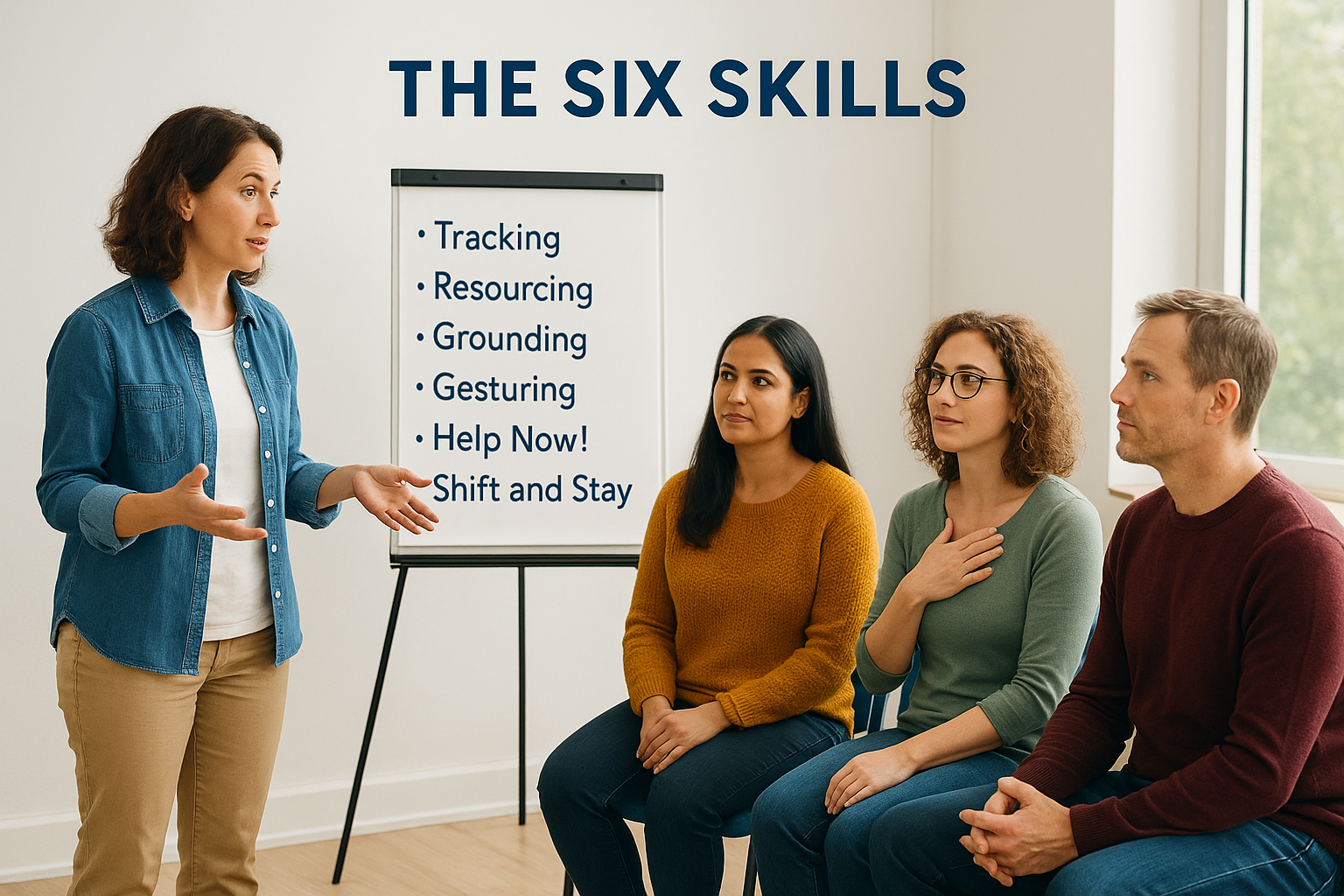
| Skill | What you do | When it helps most |
|---|---|---|
| Tracking | Notice sensations in your body and sort them as pleasant, neutral, or unpleasant | Every situation. It is the base for the other five |
| Resourcing | Bring to mind something that supports you, such as a person, place, pet, or memory, and notice what your body does | When stress spikes and you need an anchor |
| Grounding | Pay attention to where your body touches a chair, floor, or wall | When thoughts are racing |
| Gesturing | Make a small movement that matches a good feeling, such as a hand on your chest | When you want to reinforce calm or strength |
| Help Now! | Use quick moves like drinking water, naming colors in the room, or touching an object and noticing its texture | In an acute moment of distress |
| Shift and Stay | Move attention to a neutral or pleasant sensation and stay with it for a few breaths | When distress lingers after the first wave |
Tracking is the foundation skill, and the published description of CRM calls it fundamental to all the others. Once you can notice a sensation without judging it, you can deliberately move your attention to a steadier one. That shift of attention is what changes the stress response, according to the researchers who describe the model.
You do not need to fix the feeling. You only need to find one sensation that is steadier than the rest.
What a session feels like
Sessions are practice-heavy. You hear a short explanation, try the skill on the spot, and compare notes with the room. The skills are taught without asking you to describe what happened to you, so nobody has to tell their story. That matters in mixed groups where some people carry heavy experiences and others simply feel worn down.
Most trainers also encourage you to share what you learn. TRI calls someone who passes the skills along informally a CRM Guide, and a free smartphone app called iChill reinforces the material and helps people feel confident explaining it. The peer-to-peer design is the "community" in the name.
How to find and register for a CRM training
To find a CRM training, start with the Trauma Resource Institute’s own schedule, then check universities, health systems, and regional CRM hubs in your state. Registration is usually a simple online form with a fee or a free sign-up, depending on the host.
Where trainings are offered
TRI maintains a calendar of upcoming CRM trainings, including teacher trainings with full-day schedules. Beyond TRI, several institutions run their own sessions. Johns Hopkins’ Armstrong Institute lists CRM training among its services, and Colorado State University’s health services offer CRM to its campus community.
Regional hubs fill in the gaps. In Georgia, for example, CRMGeorgia promotes training across schools, health care, and law enforcement, and the Georgia Rural Health Innovation Center has offered free sessions to rural communities, delivered in person or virtually. Emory’s nursing program also hosts a free self-paced online course on CRM. Searching "CRM training" plus your state name, or asking your health system’s wellness team, often turns up a local certified teacher you would not find otherwise.
Formats, length, and cost
Costs vary more than formats do, because many community and workplace sessions are subsidized while certification courses are priced as professional training.
| Format | Typical length | Typical cost | Best for |
|---|---|---|---|
| Self-paced online course | Self-directed | Free through some hosts | Learning the basics alone |
| Introductory workshop | One to three hours | Free to low cost, set by the host | Teams, classrooms, community groups |
| Teacher training | Full-day sessions, listed at 9:00am to 5:00pm | Registration listed at $2,050, with a $1,950 figure shown beside it for some registrants | People who want to teach CRM formally |
Prices change, so confirm the current rate and which one applies to you on the registration page. The research on CRM studied sessions of one and three hours, so a short workshop is a legitimate starting point, not a watered-down version.
Steps to register
- Decide your goal. Personal use, team use, or formal teaching each point to a different format.
- Check TRI’s calendar for open sessions, formats, and dates.
- Search your region for a hub, university, or health system that hosts workshops.
- Read the listing carefully for fees, prerequisites, and whether the session is virtual or in person.
- Register and note the details you will need, such as materials, a video link, or arrival time.
- Plan to practice for a few weeks afterward, since the skills stick through repetition.
Start with a short workshop, and decide about certification after you have felt the skills work.
How CRM certification works
CRM certification is for people who want to teach the model formally, and you earn it by completing TRI’s teacher training. If you only want the skills for yourself or to share informally, you do not need it. Community resilience model training comes in three levels of commitment.
The three routes
| Route | What it means | Formal certification needed? |
|---|---|---|
| Learner | You take a workshop or course and use the skills yourself | No |
| CRM Guide | You share the skills one-to-one with friends, coworkers, or clients | No |
| Certified CRM Teacher | You complete teacher training and can teach CRM to groups | Yes, through TRI |
The published description of the model stresses that lay people and community members can become certified teachers, not only licensed clinicians. That task-sharing design is how CRM reaches large numbers of people without depending on a scarce supply of therapists. Certified teachers can also adapt delivery to the culture and needs of their own communities.
TRI sets and updates the teacher training requirements. Before you pay, confirm the current prerequisites, the schedule, and exactly what your certificate allows you to teach.
Which route fits you
Choose the Learner route if you want to manage your own stress or sample the method. Choose the Guide route if your role already puts you near people who are struggling, such as a manager, nurse, or coach, because the model explicitly allows informal sharing. Choose certification if you plan to run sessions for a team, school, congregation, or neighborhood.
One boundary deserves a clear statement. Certification qualifies you to teach CRM skills. It does not make you a mental health clinician, and a good teacher knows when to point someone toward professional care. TRI also offers a separate model, the Trauma Resiliency Model, designed as a trauma processing tool for mental health professionals. Do not confuse the two when you compare courses.
What the research says about CRM
Research on CRM is growing and mostly positive, with some studies showing real gains in well-being and stress symptoms. It is still best described as evidence-informed, not proven beyond question.
What the studies show
The 2023 overview in Global Mental Health reports that two randomized controlled trials of single one-hour or three-hour trainings, delivered virtually or in person, found significantly improved well-being and reduced stress symptoms among people in high-stress jobs. Other measures that improved over time in that body of work included somatic symptoms, depression, anxiety, and PTSD symptoms.
The studies span very different groups:
| Group | Setting | Focus of the research |
|---|---|---|
| Nurses | United States hospitals | Well-being support for nurses |
| Health care workers | COVID-19 period | Randomized trial of practical resiliency training |
| Marginalized communities | United States | Usability in high-need, low-resource settings |
| Communities after Ebola | Sierra Leone | Building resilience and well-being |
| Genocide survivors | Rwanda | Use of CRM with trauma-exposed adults |
The breadth is a strength. CRM has been tested across occupations, cultures, and countries, and the findings point in a consistent direction.
CRM has been studied in many settings, and the signal is consistent: short skills training can improve well-being.
Where the evidence is thin
Be honest about the limits before you commit budget or time. TRI describes CRM as evidence-based, while Johns Hopkins uses the more careful term evidence-informed. The careful wording is more accurate today. Much of the published work comes from a small circle of researchers who also teach and promote the model, and the studies lean on self-reported measures. The authors themselves call for more research using biomarkers such as cortisol levels and heart rate variability, and for outcomes at the community and public health level.
None of this is a reason to skip the training. It is a reason to treat CRM as a promising, low-risk, low-cost tool for well-being and prevention, and not as a replacement for therapy, medication, or crisis care. If someone you train is in serious distress, connect them with a licensed professional.
Examples of CRM in real communities
CRM has been used after mass-casualty events and disasters, inside schools and police training, and in health systems trying to reach people who are waiting for care. These examples show what community resilience model training looks like once it leaves the classroom.
Disasters and emergencies
CRM grew out of disaster response work in the 2000s, when responders trained in body-based methods taught survivors to regulate their own stress with no time for psychotherapy. The model has since been used after events such as the Pulse nightclub shooting in Florida, the Route 91 Harvest festival shooting in Las Vegas, and the Paradise, California wildfire. In these settings, the value is speed. A person can learn a skill in minutes and use it that same night.
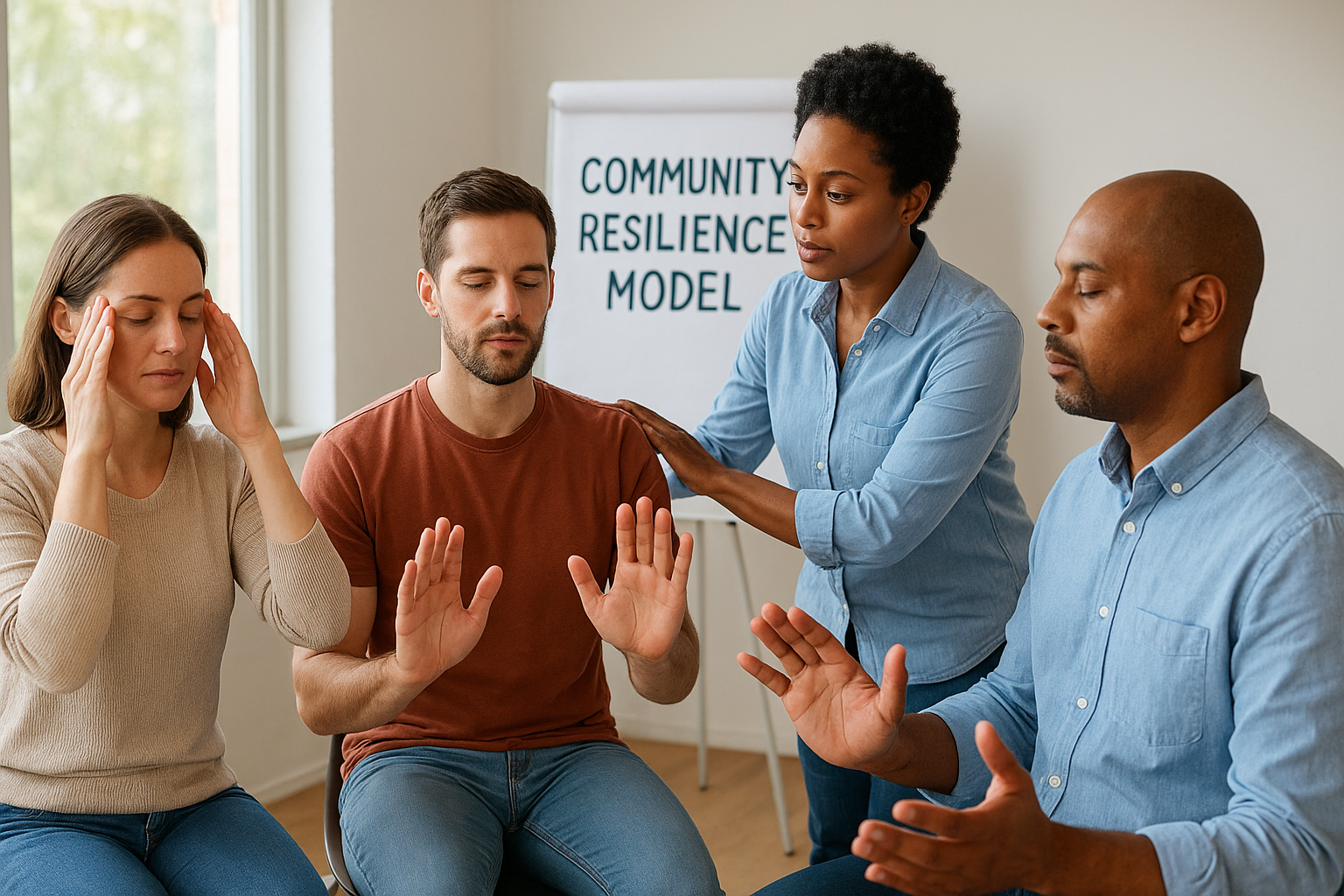
TRI also made CRM training available online to Ukrainians as a humanitarian effort, which shows how a skills-based model travels when in-person help cannot.
Schools, institutions, and health systems
CRM is taught to all students in Wake County, North Carolina, and it is part of sexual assault interview training for police in Washington State. Emory University has built CRM into the Social, Emotional and Ethical (SEE) Learning curriculum, which has reached schools in dozens of countries.
Health systems use it too. In Georgia, CRM has been started as a "bridge to therapy" for children with behavioral problems who wait months for assessment. Rural programs have delivered free community sessions in person and online. The shared idea is that a one-time training can give people something useful while longer-term help is built or waited for.
The best examples share one design choice: teach many people a small skill, then let them pass it on.
How to bring CRM to your team or organization
To bring CRM to a team, choose a goal, hire or train a certified teacher, run a short pilot, and reinforce the skills in everyday routines. Treat community resilience training as one part of a larger culture effort, not the whole effort.
Match the training to the goal
A team recovering from a crisis needs a different session than a team facing steady, grinding pressure. For an acute event, such as a layoff, accident, or loss, a short introductory workshop focused on Help Now! and Grounding can be delivered quickly. For chronic strain, such as heavy call volume or constant change, plan a repeatable program with refreshers and a few internal CRM Guides.
Decide early who will teach. You can hire a certified CRM teacher, send one or two employees to teacher training, or do both. Building internal capacity costs more up front but keeps the skills alive after the first workshop ends.
A simple rollout plan
- Name the pressure your team faces and what better would look like, such as fewer sick days or steadier performance in peak season.
- Choose a teacher through TRI’s network or a regional CRM hub.
- Pilot with one group of 10 to 30 people and collect honest feedback.
- Add reinforcement, such as a two-minute grounding practice at the start of meetings and access to the free iChill app.
- Recruit Guides from the people who respond best, and give them time to share the skills.
- Run a short well-being check-in before and after, then repeat it a few months later.

What CRM does not replace
CRM does not replace therapy, employee assistance programs, or fair workloads. A calm body cannot fix a broken schedule. It also does not build trust, clear roles, or shared goals, which are the foundations of a strong team culture.
That is the pairing we see work best. Skills training gives each person a way to stay steady, and a deliberate team culture gives that steadiness a place to land. Robyn’s keynotes on teamwork and leadership address the second part, drawing on her years leading championship adventure racing teams and serving as a firefighter.
Where to start with CRM
Community resilience model training teaches six simple body-based skills that help you stay inside your Resilient Zone and return to it when stress pushes you out. You can learn them in a one-hour workshop, practice them on your own, and share them with others without any certification. The research is encouraging and still growing, so treat CRM as a strong support for well-being and a complement to professional care.
Start small. Find one session through TRI or a regional hub, try the skills for a few weeks, and decide then whether to bring CRM to your team or train as a teacher. If you are building a team that stays steady under pressure, explore Robyn Benincasa’s work on leadership skills and team culture for the next step beyond individual skills.