Emotional resilience training works best when you pair a small daily skill with a structure that keeps you practicing. If you want a free start, begin with paced breathing and a thinking-trap check. If you like structure, pick an 8 to 10 week course. If your stress has lasted more than two weeks, work with a clinician. If you lead a team under pressure, a keynote can set the tone before the practice begins.
Most advice on this topic stops at a list of traits like optimism and flexibility. That leaves you guessing what to do when a project collapses or a hard year drags on, and how to judge whether a course deserves your time. Resilience is a set of learnable skills, and skills need repetition.
Below you get seven options, each with how it works, who it suits, and what it costs in time or money. The first is for teams and comes from Robyn Benincasa, a world champion adventure racer and longtime San Diego firefighter who teaches resilience to organizations. The rest are personal practices and programs, followed by a four-week plan that combines them.
What emotional resilience training involves
What it is and what it is not
Emotional resilience training is a set of learned skills that help you recover from stress and adapt to adversity. You practice them before, during and after hard events. It does not mean you stop feeling stress. Returning to baseline means getting back to the emotional state you had before the event, not never being shaken by it.
Anyone can learn these skills. They are common among first responders, caregivers, military members and people with chronic conditions, but they help anyone with a demanding job or a rough season. The research supports the approach: a systematic review and meta-analysis of resilience training programs found a moderate positive effect, and the programs that combined cognitive behavioral therapy and mindfulness did best.
Resilience is not a trait you either have or lack, it is a skill you build with practice.
What a program usually contains
Programs differ in structure, but most draw on the same core ingredients. Expect some mix of these:
- Stress management and relaxation practice
- Cognitive-behavioral skills, such as spotting and reframing unhelpful thoughts
- Mindfulness and emotional regulation
- Distress tolerance, which is staying steady while you are uncomfortable
- Building social support and identifying what matters to you
- Gratitude and self-compassion practice
Formats range from a few minutes of daily self-practice to weekly sessions of 60 to 90 minutes over several weeks. The seven options below cover that whole range.
Frameworks you will see: 7 C’s and 5 pillars
You will run into models like the 7 C’s, which pediatrician Kenneth Ginsburg built around competence, confidence, connection, character, contribution, coping and control. Other authors publish a 5 C’s list or five pillars of emotional resilience. No single list is official, and they overlap heavily.
Strip off the labels and the skills are the same. You learn to regulate your body, manage your thinking, stay connected to other people, keep taking action, and hold on to meaning. Every option in this article trains at least one of those five.
1. G.R.I.T. keynote for teams under pressure
How it works
Inspiring Greatness through G.R.I.T. is a 45 to 60 minute keynote from Robyn Benincasa for teams facing adversity, a tough year or a stretch goal. It aims to restore energy and build the passion and perseverance to pursue the impossible together. Its central idea is that real grit comes from connection, not from gritting your teeth alone.
Robyn built that view in two places where nobody wins alone: world championship adventure racing and firefighting. A keynote works as a spark. It frames resilience as a team sport, and then your people need the daily practices below to make it stick.
Resilience at work is rarely a solo project, so train the team and not only the individual.
Who it suits and what it costs
This option suits executives, HR leaders and event planners whose people are carrying a heavy year, a merger or an aggressive target. If your pressure is AI transformation or industry disruption, the Adapt, Overcome, and Win as One keynote is built for that situation and also runs 45 to 60 minutes.
Ask for a quote at bookrobyn@worldclassteams.com. Be realistic about what you are buying. One talk does not replace practice, so pair it with the exercises that follow and give your team a simple routine to start on the same week.
2. Paced breathing for fast stress relief
How it works
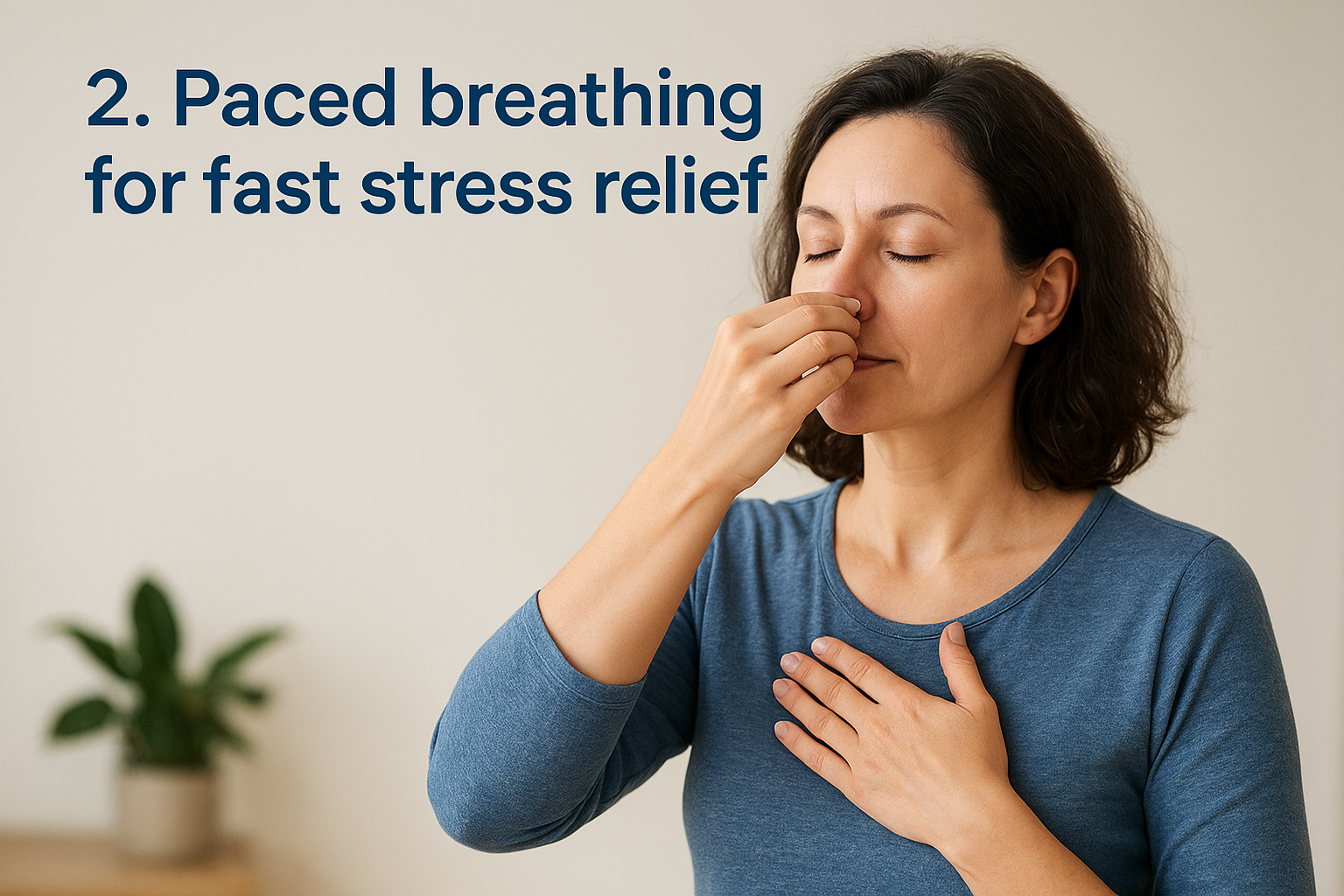
Paced breathing is slow, deliberate breathing that tells your body the threat has passed. A long exhale helps your body calm down and sends your brain the message that you can handle what is coming. It takes one to five minutes and works anywhere.
- Sit comfortably and drop your shoulders.
- Breathe in slowly through your nose for about 4 counts, until your lungs feel full.
- Breathe out through your mouth for about 6 counts, until they feel empty.
- Repeat for one to five minutes.
One slow minute of breathing is the cheapest stress tool you will ever own.
Who it suits and what it costs
It suits anyone whose stress spikes before meetings, during conflict, or at 2 a.m. when sleep will not come. It costs nothing and needs no equipment. The catch is timing: practice daily while you are calm, so the skill is ready when you are not.
Start with the counts that feel comfortable, since 4 and 6 are only a common pattern. If you feel dizzy, shorten the counts. If you have a breathing condition, check with your doctor before you push the exhale.
3. A thinking-trap check for anxious thoughts
How it works
A thinking-trap check is a cognitive-behavioral skill. You catch an anxious thought, name the distortion, and test it against reality. Three traps cause most of the spirals.
| Trap | What it sounds like | A more realistic reply |
|---|---|---|
| Black-and-white thinking | "That presentation was a total disaster." | "Two slides fell flat and the rest landed." |
| Catastrophic thinking | "If I miss this target, I’m finished." | "That would hurt. I would cope, and here is my next step." |
| Predicting the future | "This reorg will never settle down." | "I don’t know that yet. Here is what I control this month." |
The routine has three steps. Catch it when you feel sad, panicky or hopeless. Test it by asking what is real, what is not, and what the in-between possibilities are. Then answer it with a short mantra, such as "I’m doing the best I can, and I’m going to be OK."
You cannot stop every anxious thought, but you can stop believing the worst version of it.
Who it suits and what it costs
This skill suits overthinkers, perfectionists and anyone who lies awake rehearsing worst cases. It is the backbone of cognitive behavioral therapy, so learning it on your own makes any later course easier to absorb.
It is free and takes about five minutes with a notebook or a phone note. Do it when you notice distress rising, and write the trap and your reply down. Writing slows the thought enough for you to see it.
4. A gratitude journal you will keep up
How it works
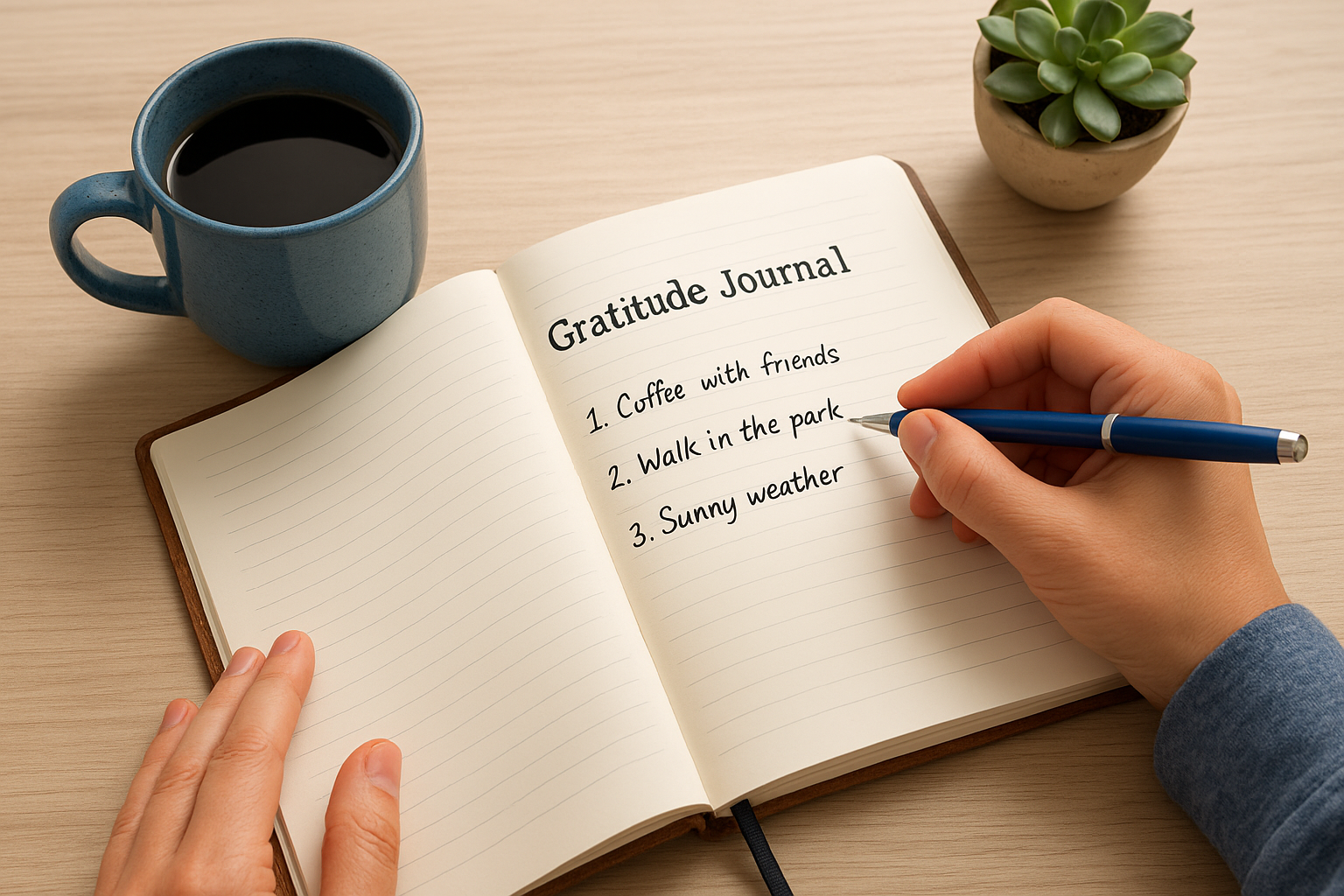
A gratitude journal asks you to write three things you enjoyed or were grateful for each day. They can be small: a coffee, time with a pet, something you saw outside. The aim is to find a silver lining for the day, a shift in attention that affects how you feel and what you do next.
A few habits make it stick:
- Be specific. "Dana covered my Thursday shift" beats "my coworkers."
- Vary your entries, because repeating the same three turns it into a chore.
- Write it before bed, away from the news and your inbox.
Specific, small and daily beats grand and occasional.
Who it suits and what it costs
It suits people who replay the day’s bad moments at night, and it works for kids too. Families can do it at dinner. It takes about three minutes and costs the price of a notebook.
Be honest about its limits. During a truly bad stretch, entries can feel hollow, so keep them tiny. Treat the journal as a supplement to the other practices, not a replacement for support when distress will not lift.
5. Behavioral activation to break the avoidance loop
How it works

Behavioral activation means scheduling actions that give you a sense of control and momentum, even when you do not feel like acting. Stress and low mood push you to withdraw, and anxiety pushes you to avoid. You do the opposite, in small steps that keep you safe. Pick from four types:
- Physical: a walk, a workout, dancing, muscle relaxation
- Creative or outward-focused: drawing, a puzzle, a volunteer shift
- Mastery: learning a skill, such as guitar or a new language
- Sensory: a self-soothe kit with something to see, smell, touch, hear and taste
Put the activity in your calendar like a meeting. The action comes first and the motivation follows, which is the reverse of what your mood tells you.
Mood follows action more often than action follows mood.
Who it suits and what it costs
It suits people who are pulling away from friends, skipping things they used to enjoy, or avoiding tasks that feel threatening. A realistic dose is 20 to 30 minutes, three times a week. Most options cost nothing, and the sensory kit costs a few dollars.
If avoidance starts to interfere with work or relationships, treat that as a signal to add professional support, not as a willpower problem. Behavioral activation is a standard tool in therapy for exactly this reason.
6. A structured course, free or paid, online or live
How it works
A structured course spreads the same skills over 8 to 10 weeks with assignments and an instructor. Harvard Medical School’s Stress Management and Resiliency Training (SMART) is an 8-week interactive course in mind-body techniques and self-care practices. Other programs run about 10 weeks and target the psychological processes behind anxiety and low mood.
Free emotional resilience training online exists, and the exercises above are a start. Paid courses add structure, feedback and accountability. Compare formats before you pick:
| Format | Typical length | Best for |
|---|---|---|
| Self-paced online video course | Several hours, at your own speed | Managers who want an overview |
| Instructor-led group course | 8 to 10 weeks | Adults who need accountability |
| Continuing-education course | A few credit hours | Clinicians and HR professionals |
| Employer or community program | Set by the provider | People whose workplace sponsors it |
Before you enroll, check for the following:
- Weekly practice assignments, not only lectures
- Content on cognitive-behavioral skills, mindfulness and emotional regulation
- A qualified instructor with a described background
- A clear time commitment per week
Who it suits and what it costs
Courses suit adults who know the basics but never practice without a deadline. The meta-analysis mentioned earlier points to a useful filter: look for programs that combine CBT and mindfulness rather than only one.
Costs vary widely, from free to a meaningful fee, so read the listed price and the refund terms. Ask your employer whether it sponsors a program. Employers, community groups and physician referrals are the usual routes into one.
A course earns its fee through weekly practice, so pick the one you will actually finish.
7. Clinician-led resilience training
How it works
Most clinician-led resilience training is face to face with a mental health professional, though some sessions run online. Expect 60 to 90 minute sessions once a week over several weeks to months, with a follow-up months later to track progress.
Common themes include distress tolerance, finding social support, identifying meaning, coping skills and flexible thinking. The methods often include cognitive-behavioral therapy, mindfulness, emotional regulation training and relaxation practice. A good clinician tailors the work to your resources instead of using a blanket script.
Who it suits and when to get help
This route suits anyone with a chronic condition, a high-stress career, or a hard event they cannot shake. It is also the right move when symptoms last more than two weeks or get worse. Watch for these signs:
- Poor sleep, low energy or changes in appetite
- Intense sadness, anxiety or irritability
- Pulling away from people
- Neglecting basic self-care
- Using alcohol or other substances to cope
Cost depends on your insurance and provider, so check your employer’s assistance program first. If you have thoughts of suicide, call or text the 988 Suicide & Crisis Lifeline at 988, which is available 24/7. In immediate danger, call 911.
Asking for help is not a sign of weak resilience, it is one of the skills.
A four-week plan to put it together
The plan
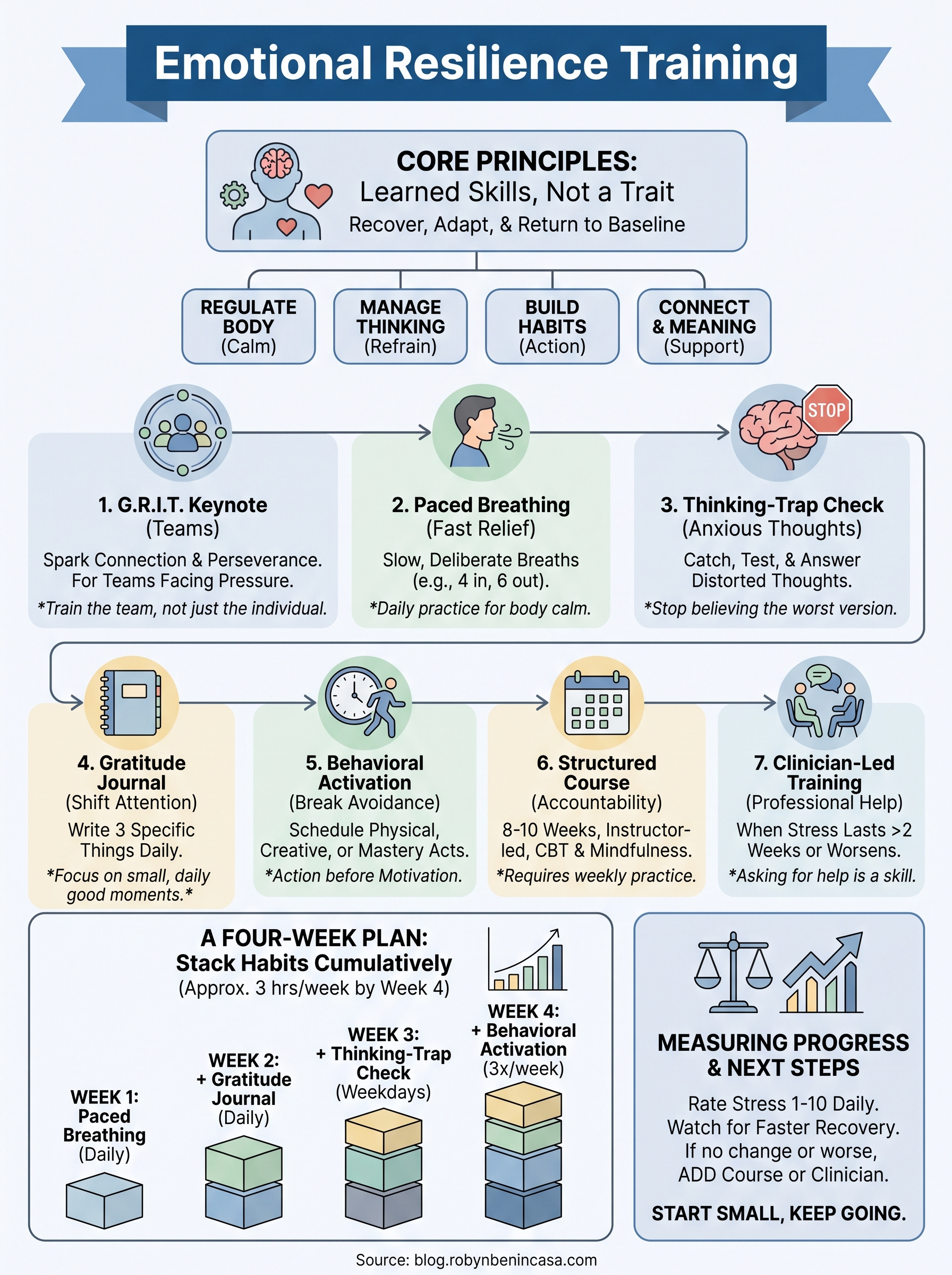
You do not need all seven options at once. Stack one practice per week so each becomes a habit before the next arrives. The table shows the cumulative weekly time.
| Week | Add this | Time | Weekly total |
|---|---|---|---|
| 1 | Paced breathing, daily | 5 min x 7 days | 35 min |
| 2 | Gratitude journal, daily | 3 min x 7 days, plus week 1 | 56 min |
| 3 | Thinking-trap check, weekdays | 5 min x 5 days, plus weeks 1 and 2 | 81 min |
| 4 | Behavioral activation | 30 min x 3 sessions, plus weeks 1 to 3 | 171 min |
By week four you spend about three hours a week on your emotional resilience training. Keep your phone out of reach during the breathing and journaling slots, and trim news checks, since constant news intake feeds anxiety. If you lead a team, schedule the keynote first so everyone starts the same plan together.
Four small habits stacked over four weeks beat one heroic weekend.
How to know it is working
Rate your stress from 1 to 10 each evening. You are not looking for zero. Watch for faster recovery: a bad meeting stings for an hour instead of a day, or you fall asleep sooner after a hard call. Also note one thing you did despite wanting to avoid it.
At the end of week four, review your ratings. If you see no change, or your stress keeps getting worse, add a course or a clinician rather than trying harder alone. Treat that step as part of the plan.
Start small and keep going
Emotional resilience training is not one program. It is a handful of skills for your body, your thinking, your habits and your relationships, practiced until they hold under pressure. Free exercises like breathing, thinking-trap checks, gratitude and activation cover the daily work. Courses add structure, and clinicians help when stress outlasts your own tools.
Pick one practice this week and begin tonight. If you lead people through a hard stretch, remember that grit grows from connection, so bring your team into the effort. To build a resilient, high-performing team, bring in the Inspiring Greatness through G.R.I.T. keynote from Robyn Benincasa.