The best corporate team building outdoor activities give every person a real job, cost little to run, and still work for the least athletic person on your team. For a tight budget, start with field day games or a human knot. For a team that wants a challenge, try a scavenger hunt or a build-and-test contest. If you have a retreat budget, a guided hike, a ropes course or a kayaking day will deliver the most memorable shared experience.
Most outdoor events fail for predictable reasons. The competition runs too hot, a few loud people dominate, quieter colleagues drift to the sidelines, or the activity has nothing to do with how the team works on Monday morning. Planners then scroll through lists of 40 or 50 ideas that all sound alike and still can’t tell which one fits their group.
This article gives you nine outdoor corporate team building activities, each broken down the same way: how it works, who it suits, and what it costs in time and logistics. The picks reflect how Robyn Benincasa thinks about teams, shaped by years of world championship adventure racing and more than 20 years as a San Diego firefighter. In both jobs, a team wins or fails on how its people treat each other under pressure.
1. Field day games
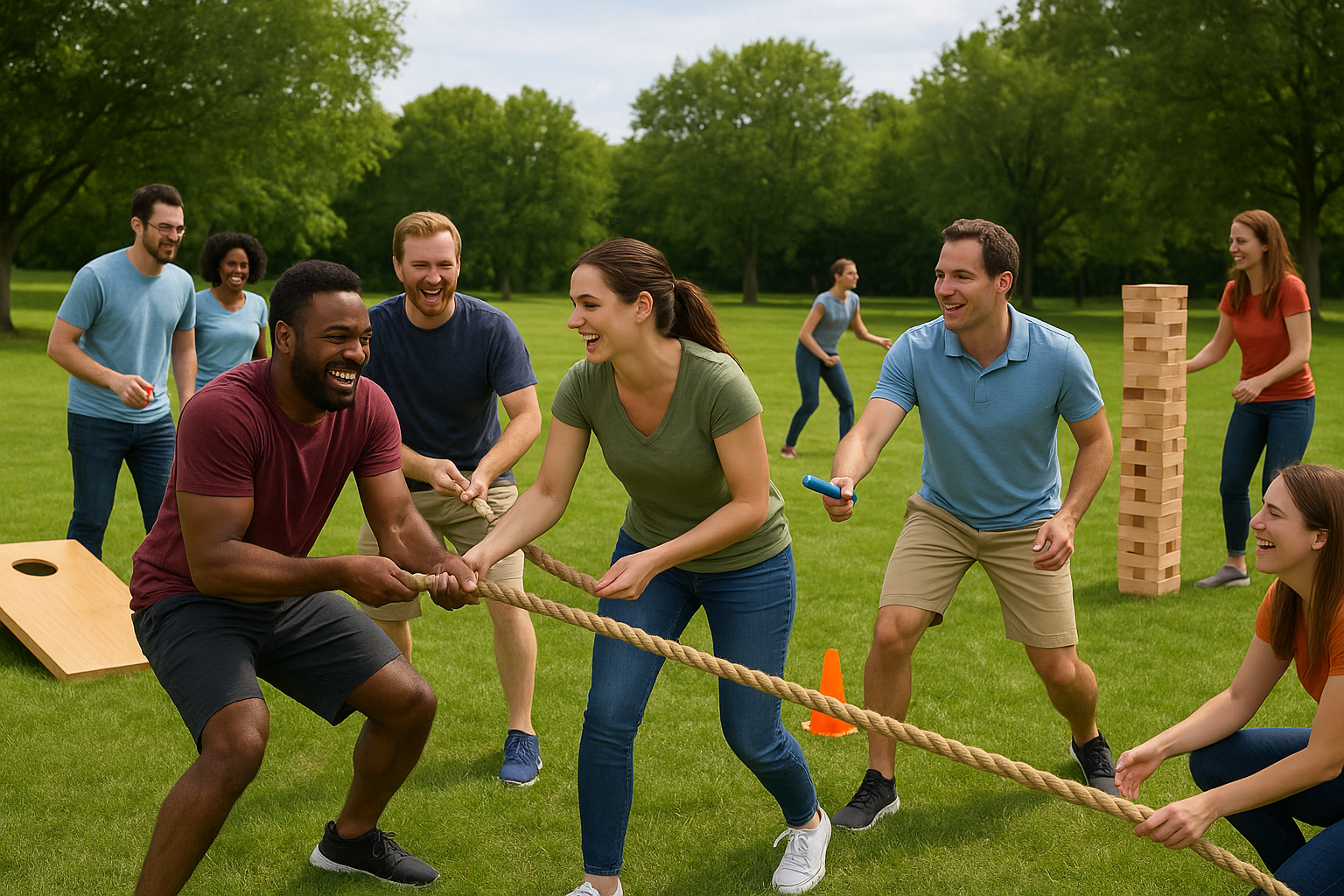
Field day games are the easiest outdoor corporate team building activity to run. They are short rounds of tug of war, relays, cornhole and giant Jenga that everyone already knows how to play. Familiar rules mean the briefing takes minutes, and nobody feels tested on arrival.
How it works
Set up four stations and put people into mixed teams of about ten from different departments. Teams rotate every 15 minutes and score points at each station. For 40 people, a 90-minute plan looks like this: 10 minutes of briefing, 60 minutes of play across four 15-minute stations, 15 minutes of walking between stations, and 5 minutes to announce the winners.
Good station ideas:
- Tug of war with a thick rope
- Relay with a baton or an egg and spoon
- Cornhole or ladder toss
- Giant Jenga or a giant puzzle race
Who it suits
Field games suit large groups and teams with mixed fitness, because each station rewards a different skill. Keep at least one low-exertion station, such as Jenga, so everyone can contribute without running.
Keep the rivalry light. Award bonus points for cheering and sportsmanship, so the most competitive person does not set the tone for the day.
Cost and logistics
Costs stay low because most equipment is a rope, cones and a few lawn games. Rent or borrow the bigger items.
- Group size: 12 to 100 or more
- Time: 60 to 120 minutes
- Space: open lawn, with shade and water nearby
- Cost level: low
Make the games familiar and the teams mixed, and the bonding takes care of itself.
2. Human knot and no-equipment games
Human knot and similar no-equipment games are the cheapest corporate outdoor team building activities, because they need people and a patch of grass. They also teach communication under mild stress faster than most paid programs.
How it works
For the human knot, have 8 to 12 people stand in a circle, reach across, and grab two different hands. The group then untangles itself without letting go. Run a second round with a rule that only one person may speak, and watch how the strategy changes.
Other free options:
- Blind minefield: one person closes their eyes and a partner guides them through scattered cones or bottles using only words.
- Group tic-tac-toe: teams race to place markers on a grid of hoops, and may talk only before the first runner leaves.
Who it suits
These games suit small teams and any group that needs a warm-up before a longer session. They also work well in a parking lot, a courtyard or a hotel lawn.
Let people close their eyes instead of wearing blindfolds, and offer an observer role for anyone who prefers not to participate. Finish with one debrief question, such as "Who was heard, and who wasn’t?"
Cost and logistics
These games cost close to nothing, which makes them easy to add to a longer agenda.
- Group size: circles of 8 to 12 per facilitator
- Time: 10 to 30 minutes per game
- Space: a flat, clear area
- Cost level: free
The cheapest activity often teaches the most, as long as you debrief it.
3. Amazing race-style scavenger hunt
An amazing race-style scavenger hunt sends teams around a park, campus or town center to solve clues, take photos and complete small challenges. It is the best pick when you want movement, problem solving and light competition in one event.
How it works
Teams of four to six get a list of clues, a map and a time limit, and use their phones to capture proof. Mix puzzles, physical tasks and photo missions so different strengths matter. Adventure racers live by a simple rule: the team moves at the pace of its slowest member. Borrow it by requiring every teammate to appear in each photo, so nobody gets left behind.
Who it suits
Hunts suit mid-sized to large groups with mixed fitness, because the brainwork carries as much weight as the running. They work well for newly merged teams and for cross-department groups that rarely talk.
Plan the route with accessibility in mind, with paved or short legs where needed. Award points for collaboration, not only speed, so one fast runner can’t win it alone.
Cost and logistics
You can write a hunt yourself for almost nothing, or hire a provider or an app-based service if you want a polished event.
- Group size: 12 to 100 or more, in teams of four to six
- Time: 90 minutes to 3 hours
- Space: a park, campus or walkable district
- Cost level: free if DIY, moderate with a provider
Reward the team that finishes together, not the individual who finishes first.
4. Build-and-test challenges
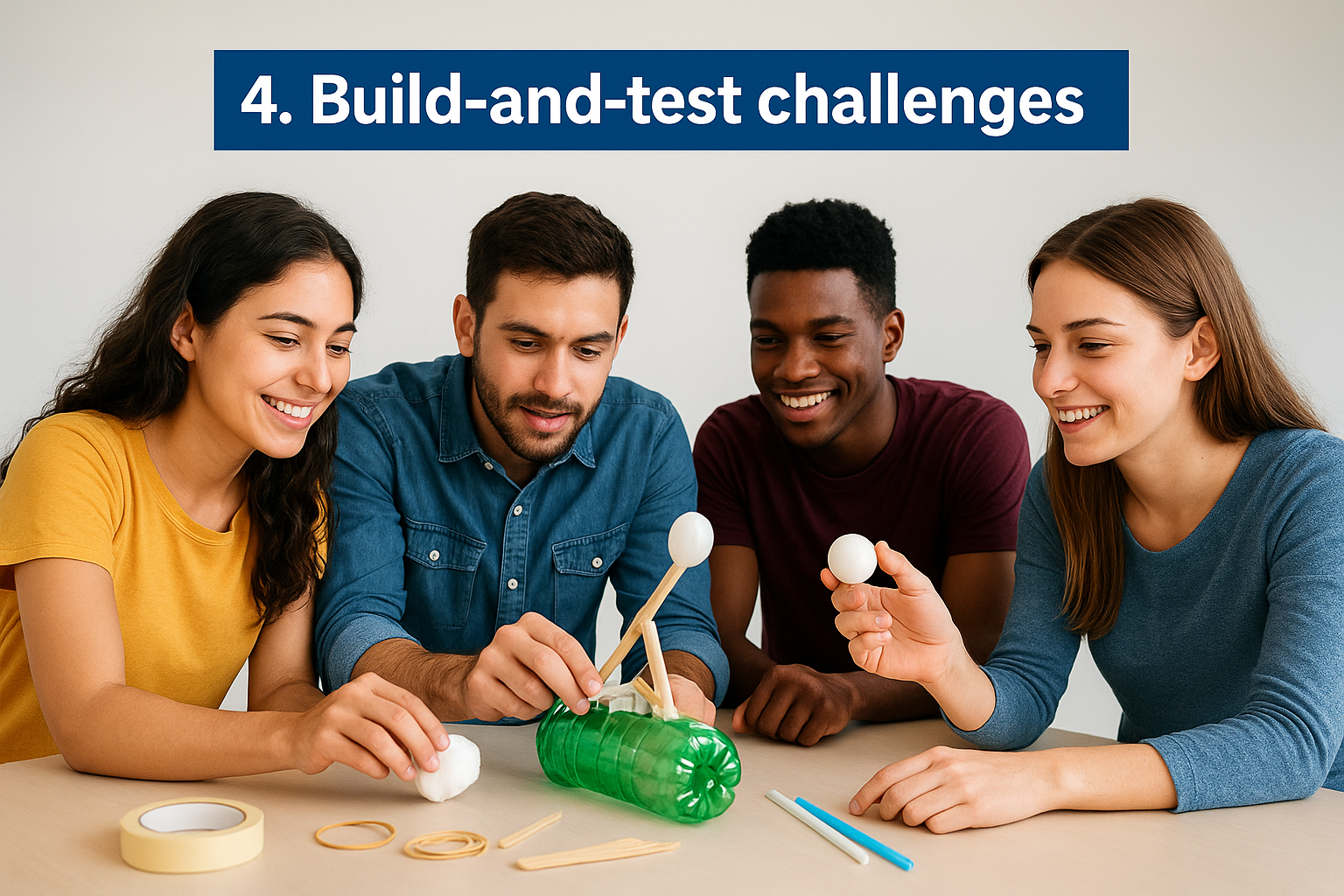
Build-and-test challenges give teams identical materials, a short deadline and a public test, such as an egg drop, a cardboard boat or a catapult. They work because everyone has to contribute an idea and live with the result.
How it works
Give each team the same supplies and 20 to 30 minutes to build. For the egg drop, use tape, straws and cotton balls, then drop every egg from the same height. Raise the height until only one egg survives. For catapults, use bottles, rubber bands and sticks, and measure whose launcher throws a ball the farthest.
Cardboard boats need cardboard, tape and a pond or pool for the race.
Who it suits
These challenges suit project teams, engineers, designers and any group that likes making things. They are also good for teams that struggle to make decisions together.
In the debrief, ask how the team chose its design and who changed the plan. Those answers apply directly to real projects.
Cost and logistics
Materials are cheap, but boat races need supervision. Provide life jackets for anyone who enters the water and keep a lifeguard or trained spotter nearby.
- Group size: teams of four to six
- Time: 45 minutes for egg drop or catapults, 1 to 2 hours for boats
- Space: open ground, plus water for boats
- Cost level: low
Identical materials and a hard deadline show you how a team actually decides.
5. Capture the flag
Capture the flag is a team strategy game played across a large outdoor space. It rewards planning, roles and trust, and it burns off more energy than any activity so far on this list.
How it works
Split into two teams, each with a flag and a home territory. Players try to grab the other flag and bring it back without being tagged. Use flag-pull or two-hand-touch tagging instead of tackling, and set a jail rule so tagged players can be freed by a teammate.
Give teams five minutes to plan before the first round. Strong teams assign defenders, runners and a coordinator.
Who it suits
It suits energetic groups of 12 to 60, including sales teams and younger staff who like competition. It also suits teams that need to practice delegating.
Create non-running roles such as strategist, spotter or flag guardian, so people with limited mobility still have a real part in the game. Agree on boundaries before play starts, especially in a wooded park.
Cost and logistics
You need two flags, boundary markers and bandanas or pinnies to tell the teams apart.
- Group size: 12 to 60
- Time: 60 to 90 minutes, with two or three rounds
- Space: a large field or lightly wooded park
- Cost level: low
Give each player a role beyond running, and the game becomes a lesson in delegation.
6. Outdoor cooking challenge
An outdoor cooking challenge turns lunch into the activity. Teams cook a meal together over a grill or campfire, and the shared meal at the end does a lot of the bonding for you.
How it works
Give each team of four to six the same basket of ingredients and 45 minutes to make a dish. Chili, tacos, outdoor pizza and Dutch oven recipes all work. Judge on taste, presentation and teamwork, then have everyone eat together.
Different skills surface quickly. Someone leads, someone organizes, and someone keeps morale up when the fire won’t light.
Who it suits
It suits hybrid and remote teams that rarely share a meal, and culture-focused events where conversation matters more than competition. It is also gentle enough for groups with limited mobility.
Collect dietary restrictions before the day and make sure each team has a food-safe prep surface and a way to wash hands. Check the park’s rules on open fires and grills before you book.
Cost and logistics
Food, grills and fuel are the main costs, and some venues or local chefs will run the challenge for you.
- Group size: 12 to 60, in teams of four to six
- Time: 2 to 3 hours including eating
- Space: a park pavilion, ranch or backyard with fire permission
- Cost level: moderate
A shared meal gives a team something no scoreboard can: unhurried conversation.
7. Team hike
A team hike is the lowest-pressure way to get people talking. Walking side by side takes away the eye contact and turn-taking of a meeting room, so conversations happen more naturally.
How it works
Pick a scenic trail of two to four miles with an easy option and a longer option, and have a leader for each pace. Pair people from different departments for the first stretch, then swap partners every 20 to 30 minutes. Finish at a viewpoint or picnic spot for a short group discussion.
Who it suits
Hikes suit leadership offsites and small to medium groups, especially teams that want honest conversation without a formal agenda. They work for mixed fitness levels if you offer two routes.
Avoid steep trails in summer heat. The goal is connection, and a punishing hike leaves the least fit people feeling excluded.
Cost and logistics
Hiking is cheap, and a guide is optional but useful if the group is large or the terrain unfamiliar.
- Group size: 6 to 30 per guide
- Time: half a day
- Gear: water, sun protection, sturdy shoes, and a first-aid kit carried by the leader
- Cost level: low to moderate
Walk together first and talk second, and the conversation takes care of itself.
8. Outdoor volunteer project
An outdoor volunteer project replaces competition with contribution. Park cleanups, tree planting, trail work and community gardens give teams a visible result to point to afterward.
How it works
Partner with a local park, garden or nonprofit that supplies tools, a plan and a supervisor. Split into small crews, give each a clear task and rotate jobs halfway through. At the end, walk the site together and note what changed.
Ask the host about gloves, waivers and what to wear before the day.
Who it suits
Volunteer days suit mission-driven companies, groups that dislike competitive games, and teams that want to represent the company in its community. They also work well for any size of group, because tasks scale easily.
Let people choose their own task within the project, for example planting, hauling or sorting, so physical limits are not a barrier.
Cost and logistics
Costs are often low, because the host usually provides equipment. Confirm what is available well in advance.
- Group size: 10 to 100, depending on the site
- Time: 2 to 4 hours
- Space: a park, trail, garden or waterway
- Cost level: low
Teams that build something real together remember it longer than teams that win a game.
9. Ropes course or kayaking
A ropes course or kayaking trip is the strongest guided adventure option. Both put people in a controlled challenge where communication and trust are required to move forward, such as paddling in sync or encouraging a teammate on a high element.
How it works
A trained facilitator runs the session. On a ropes course, participants work through low and high elements while teammates coach and support from the ground. In kayaks or canoes, pairs and small crews must steer and paddle together to cover a course or reach a landing.
Hire a licensed, insured operator and ask about safety certifications, staff-to-guest ratios and equipment checks.
Who it suits
These activities suit leadership teams and groups with a retreat budget that are ready for something memorable. They fit teams that are comfortable with heights or water, or that want to stretch together.
Use a "challenge by choice" policy so nobody is pushed, and provide a meaningful alternative role for anyone who opts out. Psychological safety matters as much as physical safety.
Cost and logistics
This is the highest-cost option here, and prices vary by location, season and group size, so request written quotes.
- Group size: typically 8 to 40, depending on the operator
- Time: half a day to a full day
- Space: a dedicated course, lake, river or coastline
- Cost level: high
Choose the operator for its safety record first and its price second.
Pick one and run it well
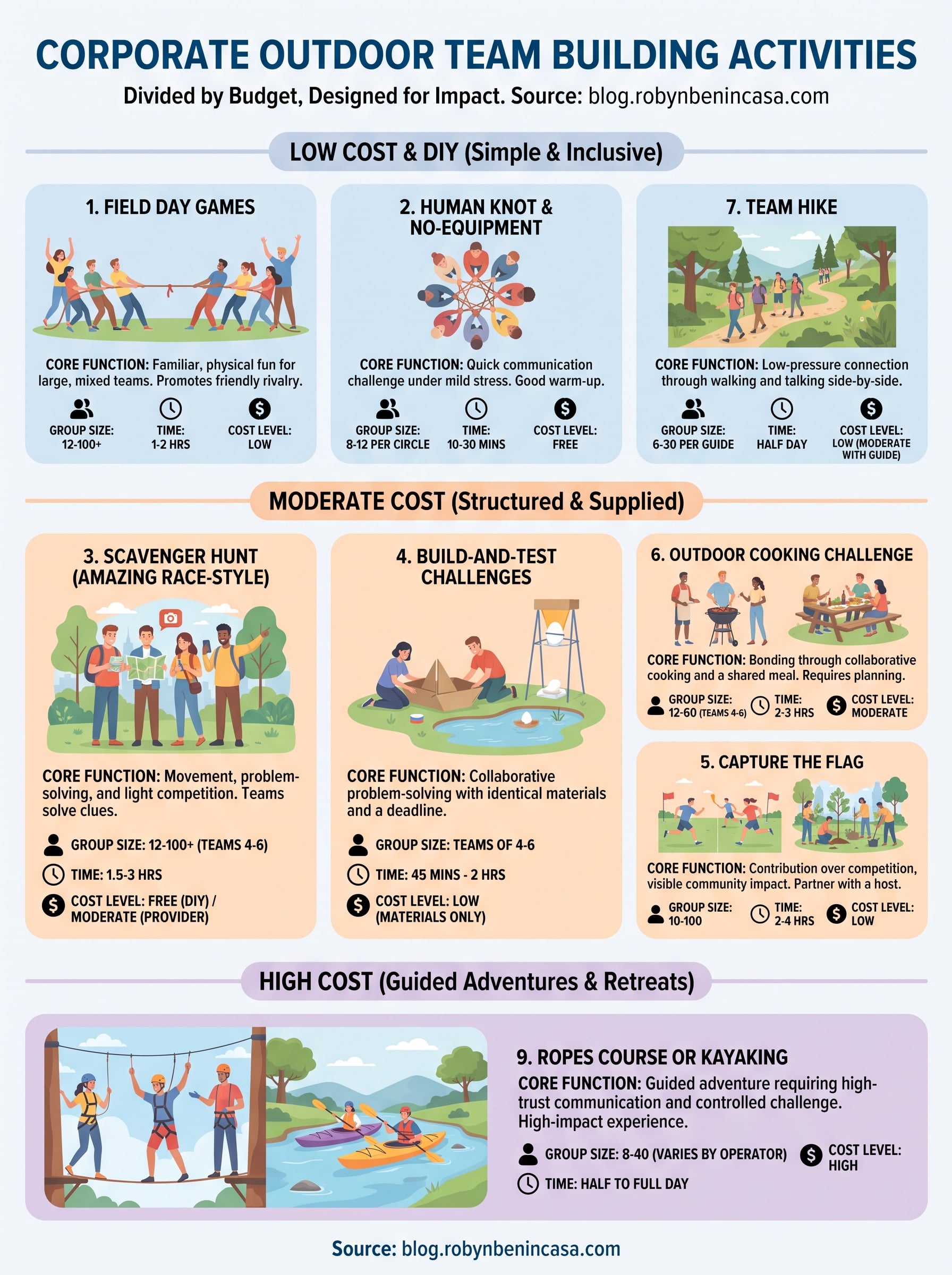
The right outdoor activity depends on your budget, group size and goal. Field games and no-equipment exercises work for almost any team, scavenger hunts and build challenges add problem solving, and guided adventures reward a bigger investment. In every case, mix up the teams, keep the rivalry friendly, give people a way to opt in at their own comfort level, and close with one honest debrief question.
Done well, a half day outside gives your people stories to share when they are back at their desks. If you want to keep building on that momentum, explore more team-building ideas from Robyn Benincasa.