You need an activity that actually gets people talking, not another trust fall nobody wants to do. Scavenger hunts solve that problem because they force collaboration without feeling forced, which is why they sit alongside the team-building activities that actually strengthen teams rather than the ones people dread. That’s why team building scavenger hunt activities keep showing up on every planner’s shortlist for offsites, sales kickoffs, and department meetings that need an energy reset.
Below you’ll find eight team building activities scavenger hunt formats that work whether your group is sitting in the same conference room or scattered across three time zones on a video call. Each one is built around a real objective: breaking down silos, mixing up seniority levels, or just getting people to laugh together before a hard quarter. None require a big budget or a facilitator with a whistle.
I’ve spent 15 years building championship adventure racing teams and another two decades as a firefighter, and the lesson is always the same: shared small missions build trust faster than lectures ever will. This list covers indoor and outdoor options, virtual-friendly versions, and tips for scaling each hunt from a team of six to a division of six hundred.
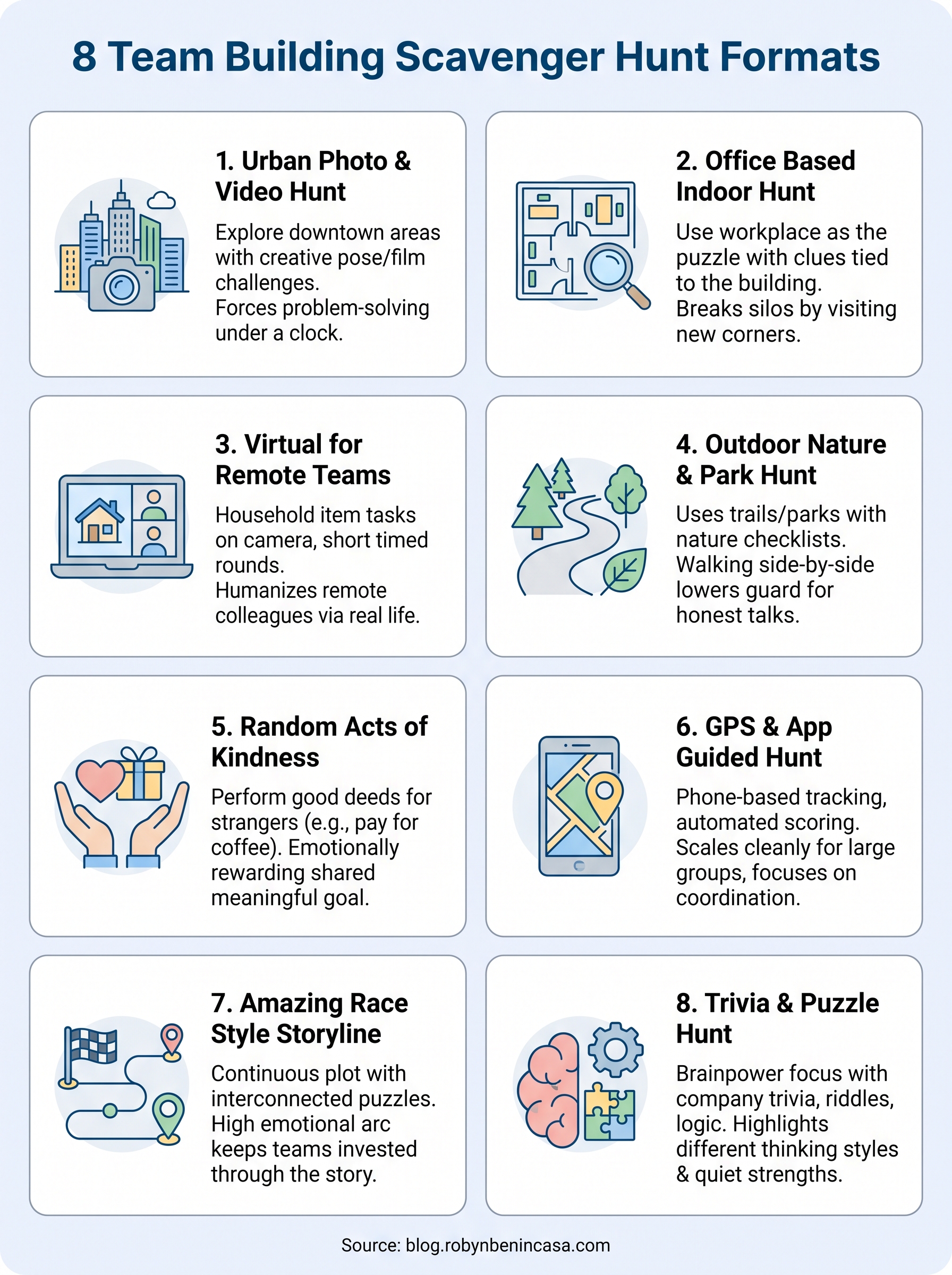
1. Urban photo and video scavenger hunt
An urban photo and video scavenger hunt sends small groups out into a downtown area, business park, or convention district with a list of shots to capture and a deadline to beat. It’s one of the most requested team building scavenger hunt activities for companies hosting offsites in a new city, because it turns unfamiliar streets into a shared adventure instead of a logistics headache.

How it works
Split your group into teams of four to six people and hand each team a checklist of 15 to 25 challenges: pose with a street performer, film a 10-second commercial for the host hotel, find the oldest building on the block, or get a stranger to teach them a local phrase. Teams submit proof through a shared photo app, a group text thread, or a simple hashtag on a private social channel. Set a hard return time, usually 90 minutes to two hours, and award points for creativity as much as speed.
Sample checklist categories:
- 1 group photo with a local landmark
- 1 video interview with a stranger
- 1 item collected that starts with each team member's initial
- 1 recreation of a famous movie scene
- 1 act of kindness caught on camera
Why it builds stronger teams
Unlike a scripted icebreaker, this format forces real problem-solving under a clock. Someone has to navigate, someone has to negotiate with strangers, and someone has to keep morale up when the group gets lost. That mix of roles is exactly what I saw in adventure racing: teams win when everyone’s strengths get used, not when one person carries the load.
A city block full of strangers teaches a team faster trust than any conference room ever will.
Groups also come back with inside jokes and a shared story, which does more for long-term culture than a single afternoon should reasonably accomplish.
Best for
This hunt suits groups of 20 to 200 attending an in-person conference, sales kickoff, or leadership offsite in a walkable city, and it pairs well with other corporate event team building activities on the agenda. It works less well for teams with mobility limitations or events in sprawling suburban office parks, where the office-based version below is a smarter fit.
2. Office based indoor scavenger hunt
An office based indoor scavenger hunt turns your own workplace into the puzzle, which makes it the easiest of all team building scavenger hunt activities to run on short notice, and one of the most reliable indoor team building activities for work. No permits, no travel budget, no weather risk. You just need a list, some clues, and a willingness to send people rummaging through the supply closet and the break room.
How it works
Build a clue list tied to your actual building: find the oldest piece of equipment in the IT closet, locate the framed photo from the company’s first office, or track down three coworkers from departments the team never talks to. Teams of three to five rotate through clues in 45 to 60 minutes, checking in with a supervisor or app after each stop.
- Mix physical clues (find an object) with people clues (interview a coworker)
- Include at least one station outside the team’s usual floor
- Cap the hunt at one hour to keep energy high
Why it builds stronger teams
This format works because it pushes people into corners of the building they’d never visit on a normal Tuesday. Quiet departments suddenly get noticed, and new hires learn the building’s layout faster than any orientation packet manages.
The fastest way to break down silos is to send people looking for each other.
Best for
Office hunts suit teams of any size stuck in one building, especially companies short on time or budget. New hire onboarding groups and cross-department mixers get the most value here, especially if you’re already running activities designed to break down silos.
3. Virtual scavenger hunt for remote teams
A virtual scavenger hunt solves the hardest problem in remote work, and the reason it tops most lists of team building activities for remote teams: getting people to actually see each other’s lives instead of just their video tiles. Companies with distributed staff lean on this format because it’s one of the few team building scavenger hunt activities that works identically whether someone joins from a home office in Denver or a kitchen table in Manila.
How it works
Build a list of household items and quick tasks that anyone can complete without leaving their desk: grab something red, find a photo from before age ten, locate the weirdest item in your junk drawer, or show your pet on camera. Run it live on a video call with a 60-second timer per round, or let teams submit through a shared chat channel over a full workday.
- Keep rounds short, 60 to 90 seconds each
- Score on speed and on the funniest or most personal item
- Rotate who calls out the next item
Why it builds stronger teams
Remote colleagues often know job titles but nothing personal about each other. This hunt fixes that fast, because everyone’s camera suddenly points at their real life instead of a blurred background.
Nothing humanizes a coworker faster than watching them sprint to find a childhood photo on camera.
Bonds formed this way tend to carry into regular meetings, where people reference each other’s reveals for weeks.
Best for
Distributed teams, hybrid companies running quarterly all-hands calls, and any group where half the roster has never met in person.
4. Outdoor nature and park scavenger hunt
An outdoor nature and park scavenger hunt takes the group away from screens and into open air, using trails, botanical gardens, or a nearby park as the game board, much like the best outdoor team building activities for work. This version ranks among the calmer team building scavenger hunt activities on this list, but calm doesn’t mean low energy. It’s built for companies that want a reset day without the noise of a downtown crowd.
How it works
Give teams of five or six a nature checklist: identify three tree species, find something that makes a sound, collect a leaf shaped like a heart, or photograph wildlife tracks. Set a loop trail with a clear start and finish so nobody actually gets lost.
- Print maps ahead of time; cell signal often drops in parks
- Add a few reflection prompts, like naming a lesson learned during the walk
- Budget 90 minutes including a group debrief at the end
Why it builds stronger teams
Walking side by side, rather than facing each other across a table, lowers people’s guard. Conversations get more honest when nobody has to hold eye contact, and the shared physical effort is one of the surest ways to build trust in a team at work, the same quiet trust I saw on long adventure race stages.
The best conversations happen when nobody has to make eye contact, just keep walking.
Best for
This hunt suits teams wanting a low-stress outdoor option, wellness-focused offsites, and groups recovering from a stretch of high-pressure deadlines.
5. Random acts of kindness scavenger hunt
A random acts of kindness scavenger hunt swaps competitive point-scoring for a shared goal: leave the day better for strangers. This is the most emotionally rewarding of the team building scavenger hunt activities on this list, and it works whether your group operates in an office park or a city block. Instead of racing each other, teams race the clock to do good.
How it works
Hand teams a checklist of kind acts to complete within a set window, usually two hours. Require photo or video proof for each one, and let teams choose their own order.
- Pay for a stranger’s coffee or parking meter
- Leave an encouraging note somewhere public
- Donate supplies to a shelter or food bank on the route
- Compliment three people they’ve never met
- Help someone carry something heavy
Score on completion and on the story behind each act, not on speed.
Why it builds stronger teams
This format shifts the group’s mindset from "win the game" to "do something meaningful together," and that shift sticks. Teams that give as a unit report feeling closer than teams that only compete against each other.
A team that does good together remembers it longer than a team that just wins together.
Colleagues also see each other’s genuine character here, since kindness under a deadline reveals more than any icebreaker question could.
Best for
Companies wanting a values-driven offsite, corporate social responsibility days, or teams navigating a rough stretch that needs a morale boost bigger than points on a leaderboard.
6. GPS and app guided scavenger hunt
A GPS and app guided scavenger hunt replaces paper checklists with a phone-based platform that tracks location, verifies clues, and updates a live leaderboard in real time. Of all the team building scavenger hunt activities on this list, this one scales the cleanest, since one organizer can run a hunt for six people or six hundred without printing a single page.
How it works
Load a route into a scavenger hunt app, drop GPS-locked clues around campus, downtown, or a conference center, and let teams follow the map on their own phones. Clues unlock as teams arrive at each pin, and photo or trivia challenges verify they actually completed the task instead of just walking past it.
- Set a route with 10 to 15 GPS stops
- Require a photo, video, or code scan at each point
- Watch team progress on a shared live dashboard
Why it builds stronger teams
The automated scoring removes the awkward job of an organizer chasing teams down to check answers, which keeps the focus on the group’s actual coordination. Someone reads the map, someone runs the clue, and someone tracks time, mirroring the division of labor that wins real races.
The best app just gets out of the way and lets the team’s own teamwork carry the score.
Best for
This format suits large conferences and sales kickoffs spread across a campus, plus any planner managing multiple simultaneous teams who needs accurate, hands-off scoring.
7. Amazing race style storyline hunt
An Amazing Race style storyline hunt strings challenges together into one continuous story, borrowing the format of the TV show so teams travel from checkpoint to checkpoint chasing a plot instead of a plain list. Of all the team building scavenger hunt activities here, this one delivers the biggest emotional arc, since the story escalates right up to a finish line reveal.

How it works
Write a loose narrative, maybe a corporate heist, a rescue mission, or a treasure hunt tied to your company’s history, then break it into five or six checkpoints. Each checkpoint hands teams a physical or mental challenge (a puzzle, a physical task, a trivia question) plus the next clue only after they finish.
- Assign a theme that ties into your industry or company milestone
- Build in one twist, like a fake clue or a rival team encounter
- Plan for 90 minutes to two hours total runtime
Why it builds stronger teams
Because the plot keeps moving, teams stay invested past the point where a plain checklist would lose steam. Someone has to track the story, someone solves the puzzle, and someone keeps pace, so leadership roles shift naturally as the story demands different skills.
A good story turns a checklist into a mission people actually want to finish.
Best for
Companies planning a milestone celebration, a big sales kickoff, or a group of 30 to 150 people who thrive on drama and friendly competition.
8. Trivia and puzzle scavenger hunt
A trivia and puzzle scavenger hunt swaps physical checkpoints for brainpower, mixing company trivia, riddles, and logic puzzles into one continuous challenge. Of all the team building scavenger hunt activities on this list, this one rewards the quiet analyst who never volunteers for the outdoor version, giving a different set of people a chance to lead.
How it works
Build a mixed round of questions covering company history, industry facts, and general knowledge, then layer in a few logic puzzles or riddles that unlock the next clue. Teams of four to six work through the set together, either at desks or stationed around a room, racing to solve everything correctly before time runs out.
Sample round mix:
- 5 company history questions
- 5 industry or product trivia questions
- 3 riddles that unlock a bonus clue
- 2 logic puzzles requiring group math
Keep the total runtime under an hour so momentum never dips.
Why it builds stronger teams
Like most problem solving activities for teams, puzzles force people to argue their reasoning out loud, which surfaces how each teammate thinks under pressure. The quiet engineer who spots the pattern nobody else sees earns respect fast, and that respect carries back into regular project meetings.
A good riddle exposes more about how someone thinks than a year of small talk ever could.
This format also works well for mixed-seniority groups, since trivia knowledge rarely tracks with job title.
Best for
Office teams, training days, and any group that includes people who’d rather solve a problem than run a lap. It’s also the easiest hunt to adapt for a hybrid audience split between a conference room and a video call, which makes it a staple among activities for hybrid teams.
Choosing the right hunt for your team
Pick the format based on what your team actually needs, not what looks impressive on an invite. A distributed workforce needs the virtual scavenger hunt. A group drowning in silos needs the office based version or the GPS guided hunt across a bigger campus. A team that just survived a brutal quarter needs the random acts of kindness format more than another leaderboard. Match the hunt to the goal, and the activity does the work for you.
I’ve watched shared missions turn strangers into teammates on adventure race courses and firehouse shifts, and the pattern holds in a conference room too: people bond over doing something together, not over being told to bond. Any of these eight team building scavenger hunt activities will get you there if you pick the one that fits your group’s size, energy, and format.
If you want to go deeper on what actually makes a team culture stick long after the hunt ends, start with this guide to creating a strong team culture, drawn from two decades of building winning teams under real pressure.