The fastest way to learn how to change team culture is to stop talking about culture and start changing what people do. Define the new culture as a short list of observable behaviors. Get the team to help shape it. Change the meetings, rewards, and decisions that drive those behaviors, then reinforce them for months. Culture is the result of those changes, not the starting point.
Most leaders do the opposite. They call an offsite, unveil new values, and hang posters. For a week, people nod. Then a deadline hits, the old habits return, and the team decides the new culture was another speech. That cynicism makes the next attempt harder, so a failed push can leave a team worse off than before it started.
This guide gives you four steps that work for a team of ten or an organization of a thousand. They come from the way Robyn Benincasa learned to build teams: in adventure racing, where a team lives or dies by how its members treat each other after days of exhaustion, and in more than 20 years as a San Diego firefighter. Whether you lead a department or are asking how to change the culture of a team you just inherited, you can start this week.
Why team culture changes through behavior
Team culture changes when people do different things, not when they hear different words. Culture is how your team behaves when pressure is high and nobody is watching. You cannot order it into existence, but you can change the conditions that produce it.

What you are actually changing
Culture sounds abstract until you look at what it produces every day. You can see it in four places:
- How decisions get made, and who gets a say
- How bad news travels, and how fast
- How people treat a mistake, with curiosity or with blame
- How a new hire is welcomed in their first two weeks
Those are the things you will change. Everything else is a label.
Why speeches and value posters fail
Speeches fail because they describe a culture without changing the incentives that created the current one. If your team hoards information because the person who closes the deal gets the bonus, a talk about collaboration loses to the bonus plan every time. People follow what gets rewarded, not what gets announced.
Adventure racing makes this obvious. Teams race together for days, and nobody cares about the team’s stated values at hour sixty. What matters is whether the strongest member takes weight from the weakest one without being asked. That behavior was built in training and reinforced in small moments long before race day.
Culture is a byproduct of how people work together, so change the work and the culture follows.
What to settle before step one
Check four things before you start:
- A business reason you can state in one sentence, such as "handoffs between sales and operations cost us customers."
- A sponsor with authority over budgets and rewards. If that is you, good.
- Patience for 90 days. Visible shifts take a quarter, and lasting ones take longer.
- Your own willingness to change. If you are part of the problem, the team will notice.
Step 1. Define the culture in observable behaviors
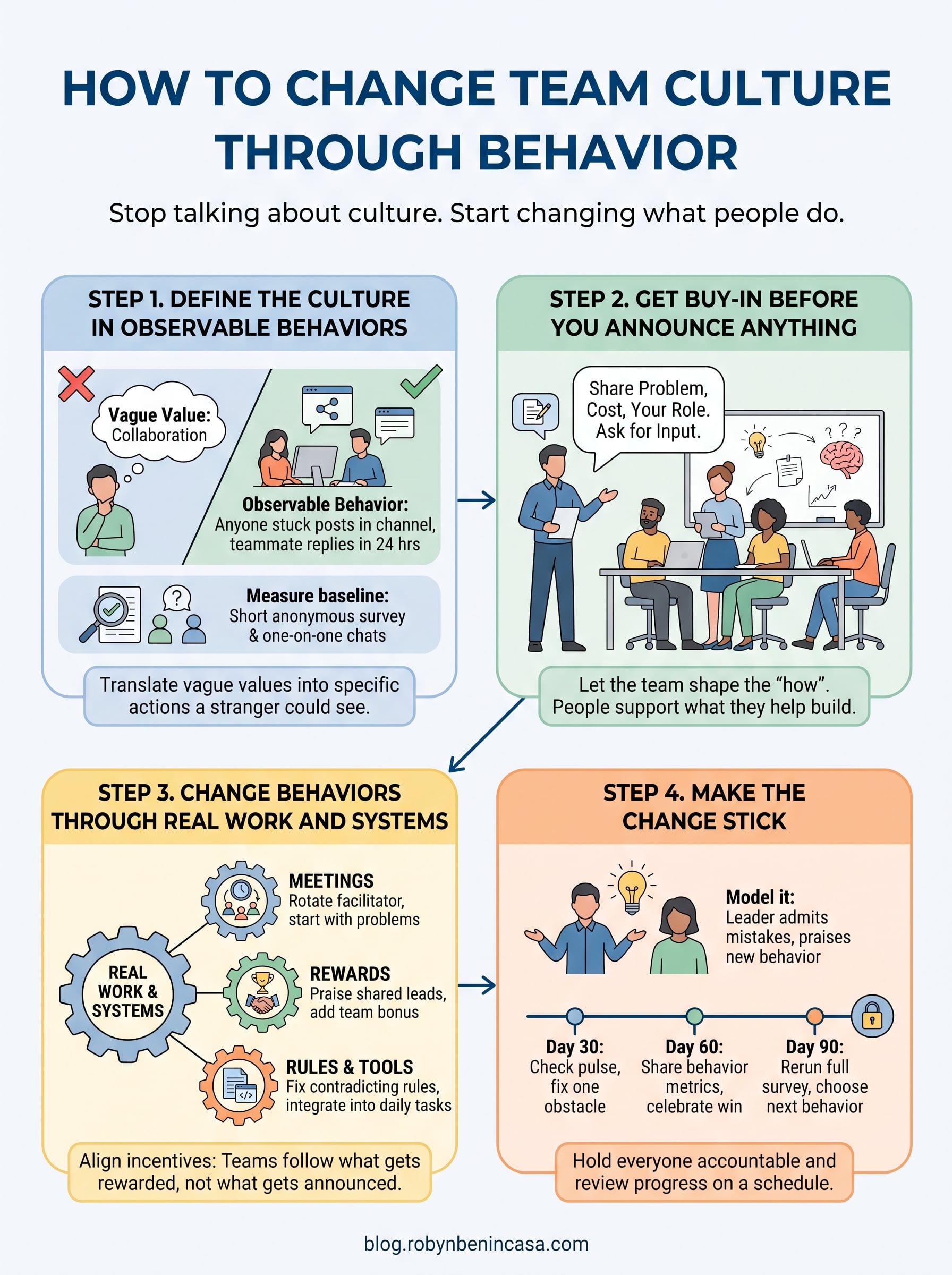
To define the culture you want, replace each value with a behavior someone could see on a video. "Collaboration" cannot be seen or measured. "Anyone stuck for a day posts the problem in the team channel" can be both.
Measure where you are now
Start with a baseline. Run a short anonymous survey of five or six statements, each rated 1 to 5, such as "I can admit a mistake without fear" or "People here share leads and information freely." Then talk to people one-on-one and ask, "What is it like to work here on a bad week?" Compare the answers. The gap between the survey and the stories tells you where trust is thin.
Consider a team of 12 account managers who guard their best leads. The survey shows low scores on sharing and high scores on individual pride. That is your baseline, and it points straight at the behavior to change.
Write the target as behaviors
Pick three or four behaviors, no more. For each one, ask what a stranger would see in a meeting, a message, or a handoff if it were happening. Use this table to translate:
| Vague value | Observable behavior |
|---|---|
| Collaboration | Anyone stuck for a day posts it in the team channel, and a teammate replies within one business day |
| Accountability | Owners report a missed deadline themselves, before the manager finds out |
| Respect | Disagreement is voiced as a question about the work, never about the person |
| Transparency | Leaders explain the reason behind a decision, including bad news, within 48 hours |
For the account managers, the target might be: "Every lead that doesn’t fit your territory goes on the shared board within 24 hours."
If a stranger could not see the behavior on video, you have not defined it yet.
Step 2. Get buy-in before you announce anything
You get buy-in by telling the team the truth about why change is needed, then letting them shape how it happens. People support what they help build. They resist what is handed down, however good it is.
Tell the truth about why
Open with the real problem, including your part in it. Spin creates a vacuum, and gossip fills it. Share the baseline numbers, name the cost, and say what you got wrong. Use this script for your kickoff, and fill in the brackets with specifics:
Here is what I see: [specific problem, with one fact or number].
Here is why it matters: [consequence for customers, results, or the team].
Here is what I got wrong: [your contribution to the problem].
Here is what I want to change: [the 3 or 4 target behaviors].
I don't have every answer on how. I want your input at [meeting date].
Anything you raise, I will respond to by [date].
Then stop talking and listen. The first few minutes of silence are normal. Do not fill them.
Let the team shape the how
Hold small working sessions of six to eight people, and ask two questions: "What gets in the way of this behavior today?" and "What would make it easy?" Your team knows where the friction lives. You will get ideas you would never have found alone, and each idea you adopt creates an advocate.
Seek out the respected skeptics, not only the enthusiasts. A skeptic who helps design the fix will defend it in the hallway. Also assign visible proponents, peers who live the behaviors early and talk about them honestly.
Announce the why and invite the how, and people will carry the change for you.
Step 3. Change behaviors through real work and systems
You change behavior by changing the work itself and the systems around it, not by asking people to try harder. Pick one high-impact behavior, build it into the real work, and align the systems that reward it.

Start with one high-impact behavior
Trying to change four behaviors at once changes none. Choose the one that unlocks the others. For the account managers, that is posting unneeded leads to the shared board within 24 hours. Build it into the week: a ten-minute lead review every Monday, run by a rotating team member. The behavior now happens as part of normal work, not as a special initiative.
Give it a clear owner, a clear start date, and a clear signal of success, such as the number of leads passed and closed by a teammate.
Align meetings, rewards, and rules
A new behavior dies if the old systems punish it. Walk through each lever and ask what it currently teaches:
| Lever | Question to ask | Example fix |
|---|---|---|
| Meetings | Who talks, and who is ignored? | Rotate the facilitator; start with problems, not status |
| Recognition | What did we celebrate last month? | Praise leads passed to a teammate by name |
| Pay and promotion | Does it reward solo wins only? | Add a team-result component to bonuses |
| Feedback | Is it used to judge or to teach? | Use short, specific, forward-looking notes |
| Hiring and onboarding | Do we select for the behaviors? | Ask candidates how they helped a struggling teammate |
If a rule or incentive contradicts your target behavior, fix it or the team will conclude you are not serious.
Teams believe what the incentives say, so make the incentives say the same thing you do.
Step 4. Make the change stick
Culture change sticks when you model the behavior, hold everyone to it, and review progress on a schedule. Expect the old habits to return under pressure, and plan for it.
Model it where everyone can see
Your team watches you more closely than you realize. If you say "bring me bad news," then react sharply the first time someone does, the culture resets to silence. Respond to the first piece of bad news with a thank-you and a question. Admit your own mistakes in front of the group. When you slip, say so and correct it.
Hold high performers to the same standard. A top seller who ignores the new behaviors without consequence tells the team that the values are optional. Hold a private conversation first. If nothing changes, the consequences must follow.
Track and adjust on a schedule
Use a simple 30-60-90 rhythm:
- Day 30: Repeat two or three survey statements and ask the team what is working. Fix one obstacle they name.
- Day 60: Check the behavior metric, such as leads passed and closed. Share the numbers openly and celebrate one specific win.
- Day 90: Rerun the full baseline survey. Compare it to Step 1, then choose the next behavior to add.
Resistance to change is normal. Treat it as information, since it often points to a broken incentive or an unclear expectation. Keep communicating the reason for the change, and keep the pace steady.
Culture holds when leaders repeat the same behaviors long after the excitement fades.
Start with one behavior
Changing team culture is not a speech or an offsite. It is a sequence: define the behaviors, win buy-in, change the work and systems that shape habits, and reinforce them through your own example. Pick one behavior this week, write it so a stranger could spot it, and bring your team into the conversation.
If you want help getting a larger group moving together, explore Robyn Benincasa’s team culture resources. Her keynotes build on the eight elements of a winning team culture and the lessons of teams that won by committing to each other.