The best corporate team building activities indoor share three traits: a clear goal, a task that needs every person, and a short debrief afterward. For a large all-hands, start with a culture keynote or company trivia. For a small team that needs trust, try back-to-back drawing or the blindfold minefield. If you have ten minutes and no budget, a quick icebreaker still beats skipping team time altogether.
Most lists hand you 50 games and no way to choose between them. That wastes your time. A game that works for eight people in a conference room can fall flat with sixty people in a ballroom. A competitive game can backfire on a team that is already tense. Below you get 12 formats, each with steps, group size, time, budget, and the situation it fits. A comparison table and a debrief you can reuse follow the list.
This blog comes from Robyn Benincasa, a keynote speaker, world champion adventure racer, and longtime San Diego firefighter. Both worlds taught her that a team wins or loses together. Every activity here makes people rely on each other and then asks what they learned.
1. Team culture keynote with a table debrief
A culture keynote is the fastest way to give a large group a shared language for teamwork, and it works best when people talk it through right afterward. It is the one item on this list where you listen first and act second, so plan the discussion before you book the speaker.
A keynote starts the conversation, and the table debrief is where your team finishes it.
How it works
Robyn Benincasa’s Extreme T.E.A.M.W.O.R.K. keynote teaches the 8 elements of a winning team culture through storytelling and video of ordinary people doing extraordinary things together. It draws on her bestseller Make Winning Inevitable. The talk becomes team building only when you add a structured follow-up:
- Schedule the keynote at the start of a meeting or offsite day, not at the end.
- Ask each attendee to jot down one thing their team does well and one thing it struggles with.
- Seat people in mixed-department tables of six to eight.
- After the talk, give each table 15 minutes to pick one element and one action, then report back in a single sentence.
Group size, time and cost
Plan around these numbers:
- Format: it can run in person or virtually.
- Time: 45 to 60 minutes for the talk, plus 15 minutes for the table debrief.
- Booking: email bookrobyn@worldclassteams.com with your date, headcount, and format.
Who it suits and what to watch
Choose a keynote when the whole organization needs to hear the same message at once, such as after a merger, a reorg, or at a new-year kickoff. Match the talk to your situation:
- Why Winners Win (30 to 60 minutes): sales meetings, revenue kickoffs, and competitive teams.
- Adapt, Overcome, and Win as One (45 to 60 minutes): disruption, change, and AI transformation.
- Inspiring Greatness through G.R.I.T. (45 to 60 minutes): teams coming off a tough year or facing a stretch goal.
Watch one trap. A great talk followed by a rushed "any questions?" changes nothing. Protect the debrief time on the agenda, and ask a senior leader to share the action their own table chose.
2. Escape room
An escape room is the easiest paid activity to book, because the venue supplies the puzzles, the host, and the clock. It reveals how your team shares information under time pressure.
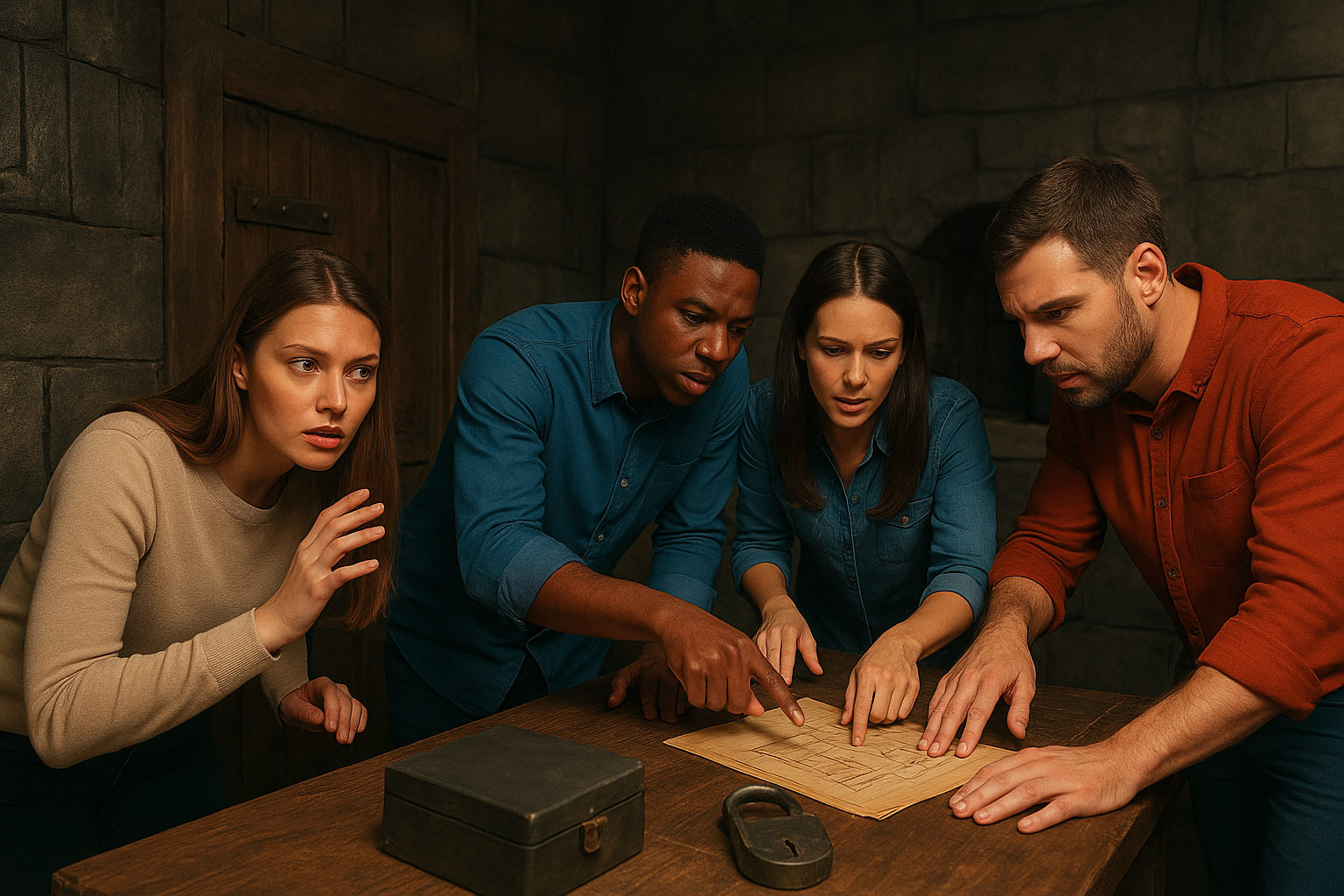
In an escape room, the puzzle matters less than who speaks up, who listens, and who hoards the clues.
How it works
Your team is locked in a themed room and has about 60 minutes to find clues and solve a chain of puzzles. A game master watches and offers hints when you stall. To make it count, follow this routine:
- Book a private session so your group is not mixed with strangers.
- If you have more people than one room holds, split into teams and compare results.
- Do not assign roles. Let leaders and listeners emerge on their own.
- Debrief in the same room or over coffee: who led, who went quiet, and how clues moved around.
Group size, time and cost
Here is what to budget:
- Group size: 4 to 20 people. Larger groups run in waves or across several rooms.
- Time: about 60 minutes in the room, 90 to 120 minutes with briefing, travel, and debrief.
- Cost: venues price per player, so ask for a group quote. A cheaper route is a DIY kit with padlocks and a box of clues.
Who it suits and what to watch
Pick this for mid-sized teams that want a change of scene and a shared story to retell on Monday. The activity rewards people who think out loud, so the quiet analyst can get squeezed out. Say up front that everyone’s find counts.
Check accessibility before you book. Some rooms are tight, dark, or require crawling. Ask the venue about mobility options and whether anyone can step out without ending the game for the team.
3. Spaghetti tower challenge
The spaghetti tower challenge gives small teams 18 to 20 minutes to build the tallest freestanding structure from a few cheap supplies. It shows how teams handle planning, testing, and time pressure.
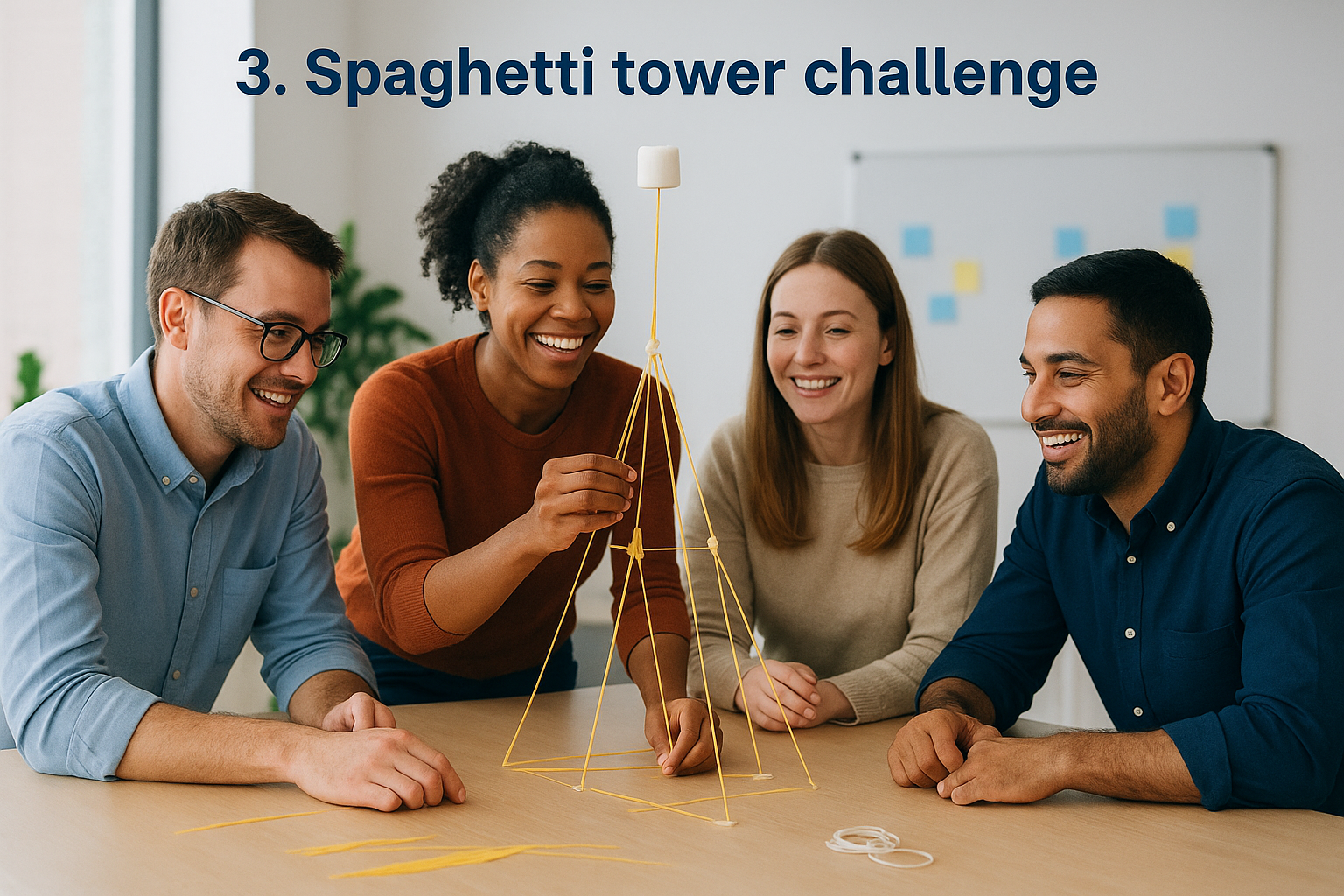
Teams that build early and test often beat teams that plan until the clock runs out.
How it works
Each team gets 20 sticks of uncooked spaghetti, one yard of tape, one yard of string, and one marshmallow. The marshmallow must sit on top, and the tower must stand on its own, not taped to the table. Run it like this:
- Split the group into teams of four or five.
- Hand out identical kits and start an 18 to 20 minute timer.
- Call time and measure from table to the top of the marshmallow.
- Debrief before announcing the winner, so the lesson lands first.
Group size, time and cost
Keep the logistics simple:
- Group size: 8 to 25 people in teams of four or five.
- Time: about 30 minutes total, with the build plus a 10 to 12 minute debrief.
- Cost: roughly $5 per team for supplies.
Who it suits and what to watch
This works well for project teams and cross-functional groups who need to practice moving from talk to action. Ask when each team first tested the marshmallow’s weight. Teams that waited until the last minute usually watched the tower collapse, and that is a lesson about delayed feedback they will recognize from real projects.
Be careful that it does not turn into a pure race. Hand out a second round with a ten-minute limit and a rule that everyone must touch the structure. The second round is where teams show what they learned.
4. Back-to-back drawing
Back-to-back drawing shows how much gets lost between what you say and what the other person hears. It needs only paper, pens, and printed pictures, so it is one of the cheapest communication activities for teams.
The gap between what the speaker said and what the listener drew is the same gap that causes handoff errors at work.
How it works
Pairs sit back to back. One person describes a picture without naming it, and the other draws what they hear. Then you compare. Follow these steps:
- Print simple images such as a house, a bicycle, or a few overlapping shapes.
- Pair people across departments when you can.
- Round one: the listener may not ask questions. Round two: questions are allowed, with a new image and swapped roles.
- Compare drawings with the originals and ask what changed between rounds.
Group size, time and cost
The numbers are modest:
- Group size: 6 to 20 people in pairs. It also works with just two.
- Time: about 20 minutes with both rounds.
- Cost: free beyond paper, pens, and a printer.
Who it suits and what to watch
Use it with teams that pass work between functions, such as sales to operations or design to engineering. The comparison between round one and round two makes a strong point about two-way questions. Teams usually draw better in round two, and the debrief practically runs itself.
Keep the images simple. A complex picture frustrates people and turns the game into a drawing contest. If you suspect a pair is uncomfortable, let them choose a shape instead of a scene.
5. Company trivia
Company trivia turns what your people know about the business into a friendly contest. It is one of the best indoor options for large groups because teams run in parallel and one host can manage everything.
Good trivia teaches new hires the company story while letting veterans show off.
How it works
You write the questions, split people into teams, and keep score. Questions about history, products, customers, and light coworker facts all work. Set it up this way:
- Write 30 to 40 questions in rounds of eight to ten, mixing easy and hard.
- Build teams of four to six and mix tenures so new hires are not stranded.
- Read each question aloud and give teams 30 seconds to write an answer.
- Swap papers to mark, tally the scores, and keep a visible scoreboard.
Group size, time and cost
Plan for:
- Group size: 8 to 60 people in teams of four to six.
- Time: 30 to 60 minutes.
- Cost: free to run. Small prizes are optional.
Who it suits and what to watch
Use trivia after an acquisition, a hiring wave, or a reorg, when people need a shared picture of the company. It also suits hybrid groups, because teams can play on a video call with a shared slide deck.
Skip questions that are too personal or that embarrass anyone. Avoid obscure details only one executive would know. Aim for questions that half the room can answer, so every team scores.
6. Indoor scavenger hunt
An indoor scavenger hunt sends teams around your building to complete tasks and collect items. It is a strong choice when you want people to meet colleagues outside their usual circle.

Put people on teams with strangers, and the hunt does the introductions for you.
How it works
Give each team a list of tasks with point values and a time limit. Tasks should push them into areas they rarely visit. Here is the plan:
- Write 15 to 20 tasks. Examples: find the oldest product brochure, photograph the team in front of the loading dock, or get a signature from someone in another department.
- Form teams of four or five with people from different floors.
- Set a 45 to 60 minute limit and a clear meeting point.
- Tally points and ask each team for the one thing they learned about the building or the company.
Group size, time and cost
The basics are:
- Group size: 8 or more people in teams of four or five. It scales to large groups.
- Time: 45 to 90 minutes.
- Cost: free.
Who it suits and what to watch
Choose this for multi-department groups, new offices, or companies recovering from a merger where people still sit in tribes. It forces conversations that a meeting never would.
Set boundaries. Tell teams to stay out of areas where people are working with customers or confidential material. Get consent before photos, and give people an alternate role, such as navigator or scorekeeper, if walking the building is hard for them.
7. Barter puzzle
The barter puzzle gives each team a jigsaw puzzle, then mixes a few pieces from each puzzle into other teams’ piles. Teams have to negotiate to finish. It turns a quiet puzzle into a lesson in trading and persuasion.
Teams that share what they need early finish faster than teams that guard their pieces.
How it works
Every team starts with a different puzzle of equal difficulty. Some pieces are missing, and those pieces sit with rivals. Run it as follows:
- Pick puzzles of 100 to 300 pieces so that bartering, not assembling, takes the time.
- Pull ten or so pieces from each box and distribute them to other teams.
- Tell teams they may trade pieces, offer favors, or swap team members, but every decision must be made as a team.
- The first team to finish wins. Stop the clock after 30 to 45 minutes if nobody does.
Group size, time and cost
Here is the budget:
- Group size: 6 to 30 people in teams of three or four. You need at least three teams for the trading to get interesting.
- Time: 30 to 60 minutes.
- Cost: roughly $10 to $20 per puzzle. You can reuse them.
Who it suits and what to watch
Use it with sales, procurement, and cross-functional teams that negotiate every day. The debrief question is simple: when did you ask for help, and when did you wait? You will hear who treated other teams as partners and who treated them as threats.
Count the pieces in each box before you start. One lost piece can sink a team and turn the exercise into frustration instead of strategy.
8. Murder mystery
A murder mystery gives your team a fictional crime to solve, with roles, clues, and a vote. It is theatrical, which makes it a good fit for social teams and end-of-year events.
The mystery is a disguise. What you are really watching is who asks questions and who shares information.
How it works
A facilitator narrates the crime. Each person gets a role, such as townsperson, detective, witness, or culprit, and the group questions each other to find the guilty party. Follow these steps:
- Choose a host, or buy a ready-made kit that includes role cards and clues.
- Hand out roles in sealed envelopes so nobody knows who is guilty.
- Run two or three rounds of questioning, with a few minutes of open conversation in each.
- Call a vote, reveal the culprit, and spend five minutes on how the group shared and tested information.
Group size, time and cost
Keep these in mind:
- Group size: 8 to 20 people.
- Time: one to two hours, depending on the script.
- Cost: free if you write it yourself. Kits and hosted events cost extra, so check prices with the provider.
Who it suits and what to watch
This is a good pick for established teams that already feel comfortable together. It breaks up a long offsite day and gives people a shared story to joke about later.
Some people hate acting. Give them observer or detective roles with plenty to do and little to perform. Avoid scripts with edgy themes that could make anyone uncomfortable at work.
9. Blindfold minefield
The blindfold minefield pairs a guide with a blindfolded partner who must cross a floor of obstacles using only spoken directions. It is a short, vivid lesson in clear instructions and building trust in a team.
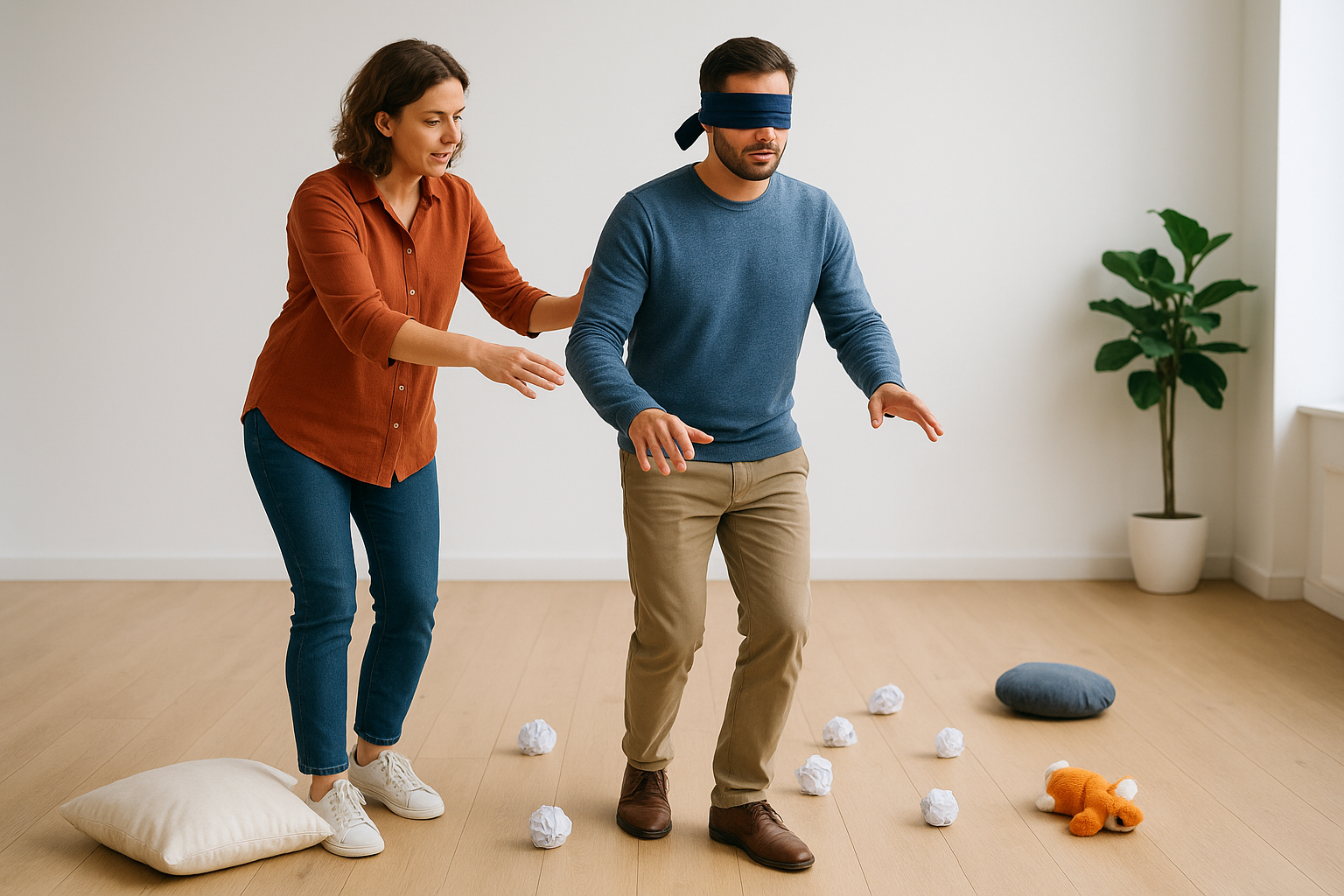
The guide learns that "a little to the left" means something different to every listener.
How it works
You scatter soft objects across a room and have pairs cross it one at a time or in waves. Set it up safely:
- Clear the floor and use only soft obstacles such as pillows, paper balls, and stuffed toys.
- Form pairs. One partner is the guide, and the other walks with a blindfold or closed eyes.
- The guide may speak but not touch. The walker may not talk.
- Swap roles and rearrange the obstacles so the second round is not memorized.
Group size, time and cost
The details:
- Group size: 6 to 20 people in pairs.
- Time: 15 to 20 minutes.
- Cost: free if you borrow items from around the office.
Who it suits and what to watch
Use it with teams where instructions get lost, such as managers and their reports, or project leads and contributors. Ask the guides what they would say differently, and ask the walkers what made them feel safe. The answers usually map neatly onto how people give and receive direction at work.
Make it optional and offer a role for everyone. Some people cannot walk blindfolded because of vision, balance, or mobility. Let them guide, observe, or place the obstacles.
10. Flip the tarp
Flip the tarp asks a team to turn a tarp over while everyone stays standing on it. It is quick, physical, and funny, which makes it a good energy boost in the middle of a long meeting day.
The teams that finish first are the ones that pick one voice and trust the plan.
How it works
The team stands on a small tarp or blanket and has to flip it without anyone touching the floor. Here is how to run it:
- Lay one tarp per team on a clear, non-slippery floor, preferably carpet.
- Have each team stand on it with all feet on the fabric.
- Give the goal: flip it completely, with nobody stepping off.
- Start with a larger tarp, then use a smaller one for a second round.
Group size, time and cost
Expect:
- Group size: 4 to 8 people per tarp. Run several tarps at once for a bigger group.
- Time: 10 to 15 minutes.
- Cost: under $15 per tarp.
Who it suits and what to watch
Choose it for small, tight teams that need a laugh and a shared win. A debrief of just three minutes is enough. Ask how the team decided on a plan and who gave the instructions.
Watch for physical contact and balance. Skip it on polished floors, and let anyone opt out into a coach role. Remind people that touching is incidental, not required.
11. Service build for a local nonprofit
A service build has teams assemble kits or items for a local charity. It combines teamwork with purpose, which many employees find more meaningful than a game.
People bond fastest when the work in front of them matters to someone else.
How it works
You partner with a nonprofit that tells you exactly what it needs, then set up stations and targets. Use this plan:
- Ask the nonprofit what items it can use, such as hygiene kits or care packages, and how many.
- Buy or collect the materials and set up one station per team.
- Give each team a quantity target and a time limit, then rotate roles every 15 minutes.
- Deliver the finished items, and ask the nonprofit to send a short note about how they will be used.
Group size, time and cost
Plan for:
- Group size: 8 or more people in teams of two to four.
- Time: 45 to 60 minutes.
- Cost: depends on materials. The nonprofit can usually give you a shopping list.
Who it suits and what to watch
Use it after a stressful quarter, at a year-end event, or whenever you want to give a team a reason to feel proud together. It is a good fit for groups that find competitive games draining.
Confirm in advance that the charity actually wants the items. A build that produces things nobody asked for feels performative. Keep the tone light, and do not ask people for donations beyond what the company provides.
12. Five-minute icebreakers
Five-minute icebreakers fit into the start of any meeting. They cost nothing and need no prep, so they are the easiest way to build team habits weekly instead of once a year.
A five-minute habit repeated every week does more than a once-a-year event.
How it works
Rotate three simple formats so they stay fresh:
- Two truths and a lie: each person shares three statements, and the group guesses the lie.
- Lucky penny: pull a coin from a hat and tell a short story from the year stamped on it. If the year is before you were born, draw again.
- One-word check-in: everyone writes one word about how they feel about the meeting’s topic, and you read them aloud.
Group size, time and cost
The figures:
- Group size: 3 to 20 per round. Split larger groups into pods of eight.
- Time: 5 to 10 minutes.
- Cost: free.
Who it suits and what to watch
These fit weekly team meetings, onboarding sessions, and kickoffs with new members. The one-word check-in is especially useful before a hard conversation, because it shows you the mood in seconds.
Keep every round optional and low-stakes. Skip questions that push people to disclose personal details they would rather keep private. Change the format every few weeks, or the routine becomes a chore.
How to choose and debrief any indoor activity
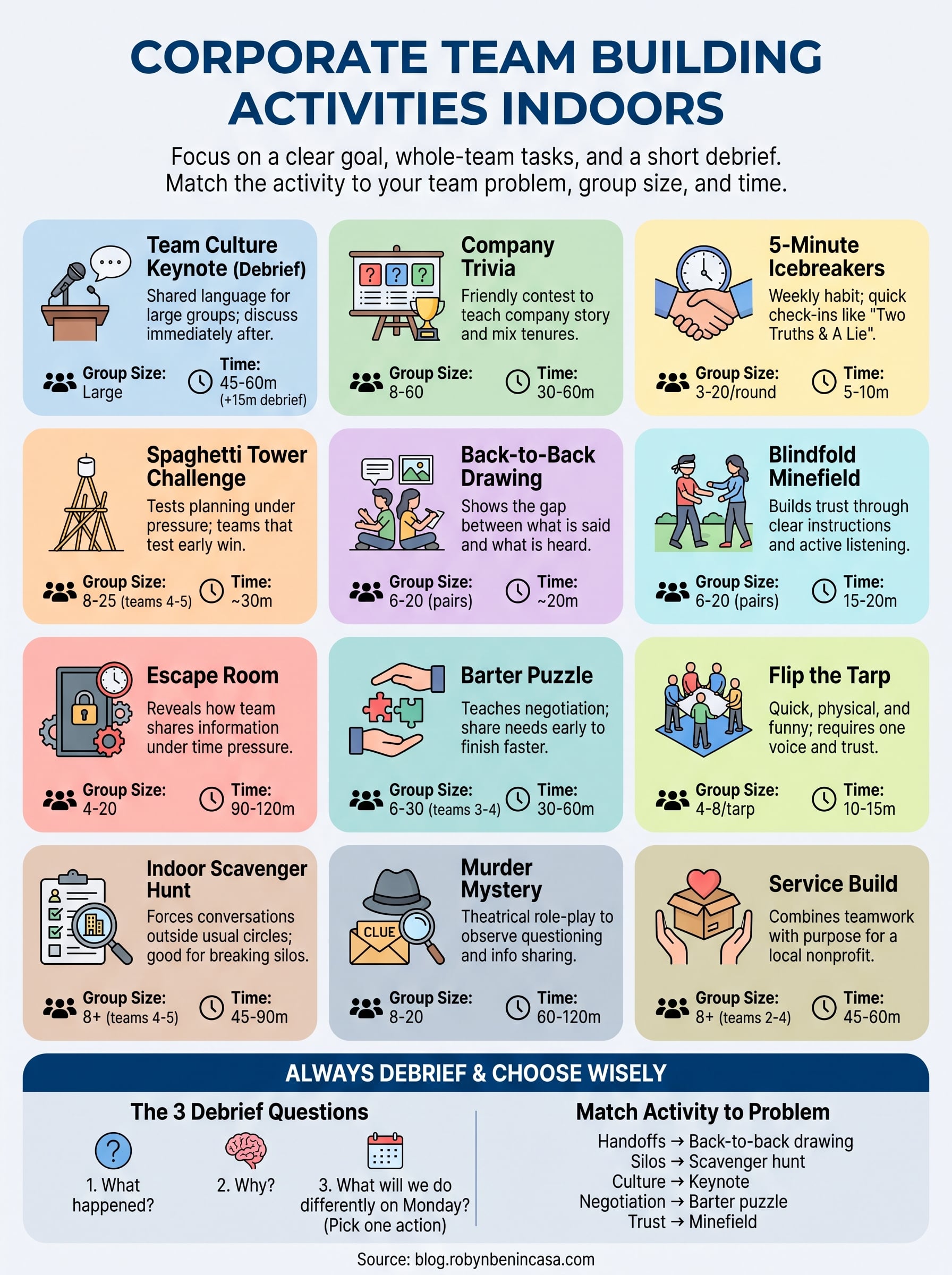
Pick by group size, available time, and the one team problem you want to surface, then run a short debrief. The best indoor team building activities for corporate employees are the ones where the activity exposes a real work habit and the debrief ties it back to Monday.
Choose the activity for the problem you have, not for the game that looks fun.
Comparison by size, time and budget
This table sets the 12 formats side by side:
| # | Activity | Group size | Time | Budget |
|---|---|---|---|---|
| 1 | Culture keynote | – | 45–60 min plus 15 min debrief | – |
| 2 | Escape room | 4–20 | 90–120 min | Paid, per player |
| 3 | Spaghetti tower | 8–25 (teams of 4–5) | 30 min | About $5 per team |
| 4 | Back-to-back drawing | 6–20 (pairs) | 20 min | Free |
| 5 | Company trivia | 8–60 (teams of 4–6) | 30–60 min | Free, prizes optional |
| 6 | Indoor scavenger hunt | 8+ (teams of 4–5) | 45–90 min | Free |
| 7 | Barter puzzle | 6–30 (teams of 3–4) | 30–60 min | $10–$20 per puzzle |
| 8 | Murder mystery | 8–20 | 60–120 min | Free DIY or paid kit |
| 9 | Blindfold minefield | 6–20 (pairs) | 15–20 min | Free |
| 10 | Flip the tarp | 4–8 per tarp | 10–15 min | Under $15 per tarp |
| 11 | Service build | 8+ (teams of 2–4) | 45–60 min | Varies by materials |
| 12 | Five-minute icebreakers | 3–20 per round | 5–10 min | Free |
Match the activity to the problem
Start with the symptom you see at work, then pick from the matching group:
- Messages get lost in handoffs: back-to-back drawing (4), blindfold minefield (9), spaghetti tower (3).
- Silos between departments: scavenger hunt (6), service build (11), escape room (2).
- Negotiation and trading: barter puzzle (7).
- Shared culture or morale: culture keynote (1), company trivia (5), five-minute icebreakers (12).
- Social bonding and fun: murder mystery (8), flip the tarp (10).
Debrief questions that make it count
Take five to ten minutes after any activity and ask three questions. What happened? Why did it happen that way? What will we do differently on Monday? Write the answers down, pick one action, and name an owner.
The debrief is what separates team building from a nice afternoon. In adventure racing, teams that review a bad leg in the next checkpoint make fewer repeat mistakes. Your team works the same way.
Pick one activity and debrief it
You do not need all 12 activities. Pick one that fits your group size, your time, and the problem you actually see, then spend a few minutes afterward turning what you saw into one action. A culture keynote suits a large group that needs a shared message. A tarp flip or minefield suits a small team that needs trust. A five-minute icebreaker suits everyone else, every week.
If your company needs a stronger starting point for a leadership offsite, sales kickoff, or all-hands, you can book Robyn Benincasa for your next team event and pair her keynote with one of the table debriefs above.