A free speaker bureau is a service that connects clubs, associations, and community groups with speakers who present at no charge. There is no speaker fee, no honorarium, and in most cases no travel bill. You browse topics or speakers, send a request, and the speaker contacts you to confirm the date and details.
Speakers agree to this because a free talk is marketing. It puts them in front of a target audience, builds their reputation, and sometimes leads to paid work. You get an expert for your meeting. They get visibility. Nobody pays, which is why these bureaus work for volunteer-run groups with no program budget.
This article explains why a free speaker bureau is worth using, how to find and book a speaker, how the main bureau types differ, and where free stops being the right choice. Robyn Benincasa is a paid keynote speaker. We will tell you plainly when free is enough and when it is not.
Why a free speaker bureau is worth using
A free speaker bureau gives you expert content at zero cost and takes the hardest part of program planning off your plate: finding someone credible who will show up prepared. For a Rotary club, library, senior center, chamber of commerce, or school group, that is often the difference between a full calendar and a scramble.
What your group gets
Most groups use these bureaus to fill recurring meeting slots. Typical users include:
- Service clubs and chambers of commerce
- Libraries and senior centers
- Schools and parent groups
- Professional associations and nonprofits
- Employee lunch-and-learn programs
Topics usually span business, finance, health, self-improvement, education, and motivation. A bureau also lets you compare several speakers before you commit, which beats cold-emailing strangers.
Why speakers work for free
Every speaker in a free bureau has a reason. Many are consultants, coaches, financial planners, or authors who want local visibility and referrals. New speakers use free talks to build a track record and collect reviews. Experienced speakers keep a few free talks on the calendar because audiences become clients.
That motive shapes what you receive: a useful talk, often with a short mention of the speaker’s work.
A free speaker is not charity. It is a fair trade of your audience’s attention for the speaker’s expertise.
How to find and book a free speaker for your event
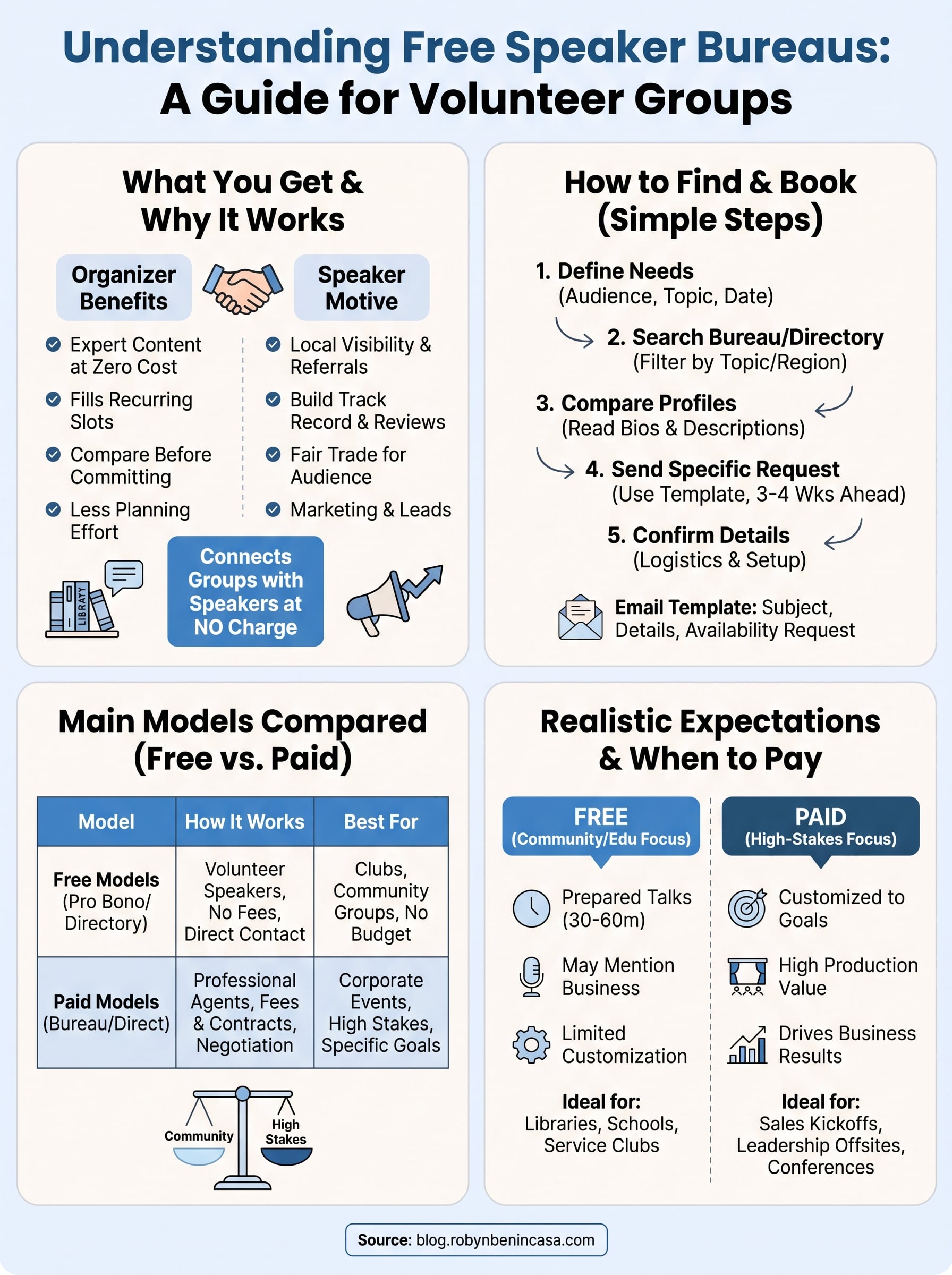
To book a free speaker, search a bureau by topic or region, compare profiles, send a clear request, and confirm the details directly with the speaker. The whole process usually takes a few emails.

The booking steps
- Define your needs. Write down the audience, the topic, the date, and the time slot.
- Search a bureau. Filter by topic, keyword, or location.
- Compare two or three speakers. Read their bios and topic descriptions.
- Submit a request. Use the bureau’s form or contact the speaker directly.
- Confirm the details. Settle date, length, room setup, and technology.
What to put in your request
Speakers say yes faster when the request is specific. Copy and adapt this:
Subject: Speaker request for [Group Name] on [Date]

Hello [Speaker Name],

I organize programs for [Group Name], a group of about [number] [members/employees/residents].
We meet on [date] from [start time] to [end time] at [venue or online platform].

Your talk "[Topic Title]" fits our members well. Would you be available?
We can offer a projector, microphone, and a short introduction from our chair.

Please let me know your availability and any setup you need.

Thank you,
[Your name, role, phone]
Finding one near you
Most pro bono bureaus are regional, so start by searching your city or metro area plus "pro bono speakers bureau." Check that the bureau actually serves your area before you invest time. Online directories with location filters work the same way, and they let you contact speakers directly. If nothing local exists, look at other places to find speakers, such as professional association chapters, community colleges, and chamber programs, which often keep informal speaker lists.
Send the request three to four weeks ahead, and a free speaker becomes easy to book.
Types of free speaker bureaus compared
Not every bureau works the same way, and the difference decides who contacts whom and who pays. Four models cover nearly everything you will find.

| Model | Who pays | How it works | Best for |
|---|---|---|---|
| Pro bono regional bureau | No one | Volunteer speakers list free topics. You submit a request and the speaker follows up. | Clubs and community groups in one area |
| Free online directory | No one (listing is free for speakers) | You search, compare, and contact speakers yourself. | Groups wanting to browse widely |
| Paid speaker bureau | Your organization, through the speaker’s fee | An agent matches you with a professional and handles the contract. | Corporate events with a budget |
| Direct booking | Your organization | You hire the speaker yourself. | Events built around one known speaker |
How a speaker bureau works in general
A speaker bureau sits between two parties who would struggle to find each other. Speakers supply profiles and topics. Organizers supply needs and dates. The bureau handles discovery and matching. Paid bureaus also negotiate fees and contracts, and they earn money through a commission that is typically built into the quoted price. A free bureau skips the commission because no fee changes hands.
Which model to choose
If you run a volunteer group with no budget, start with a pro bono bureau or a free directory. If you have a budget and need a polished, customized keynote, go to a paid bureau or book the speaker directly.
The question is not which bureau is best, but whether your event needs a volunteer or a professional.
What free speakers can and cannot offer
Free speakers can deliver a solid, informative talk on their area of expertise. They cannot promise a customized, high-production keynote built around your company’s goals. Knowing that boundary keeps expectations realistic.
Limits to expect
Free talks commonly run 30 to 60 minutes and follow a prepared presentation. The speaker may mention their business at the end. Customization is limited, and availability depends on volunteers, so popular topics and dates fill up. Ask up front whether the talk is educational or promotional, and whether the speaker takes questions. Most speakers are glad to answer.
When to pay for a speaker
Pay when the talk has to move a business result. A sales kickoff, leadership offsite, or conference keynote needs a speaker who studies your audience and ties the message to your goals. Robyn Benincasa’s keynotes, for example, are built for organizations working on teamwork and culture, and her Why Winners Win keynote runs 30 to 60 minutes. That is a different job from a volunteer’s lunchtime talk. Free fits community programming. Paid fits high-stakes events.
If you are the speaker
To get on a speaker bureau, complete a full profile, list specific talk titles with short descriptions, and describe your audience. Say yes to early free talks, ask each host for a review, and follow up within a day. Reviews and referrals build the track record that bureaus and organizers look for.
Match the speaker to the stakes: volunteers for community meetings, professionals for events that must deliver results.
Booking your next speaker
A free speaker bureau gives volunteer-run groups a practical way to get credible speakers without a budget. Search by topic and region, send a specific request well ahead of time, and agree on the details in writing. Know the trade you are making: the speaker donates the talk, and you give them an audience.
When your event carries more weight, such as a leadership meeting, a sales conference, or a team culture initiative, a paid keynote is the better tool. If that is where you are headed, learn how to hire a keynote speaker and see how a professional speaker can fit your program.