
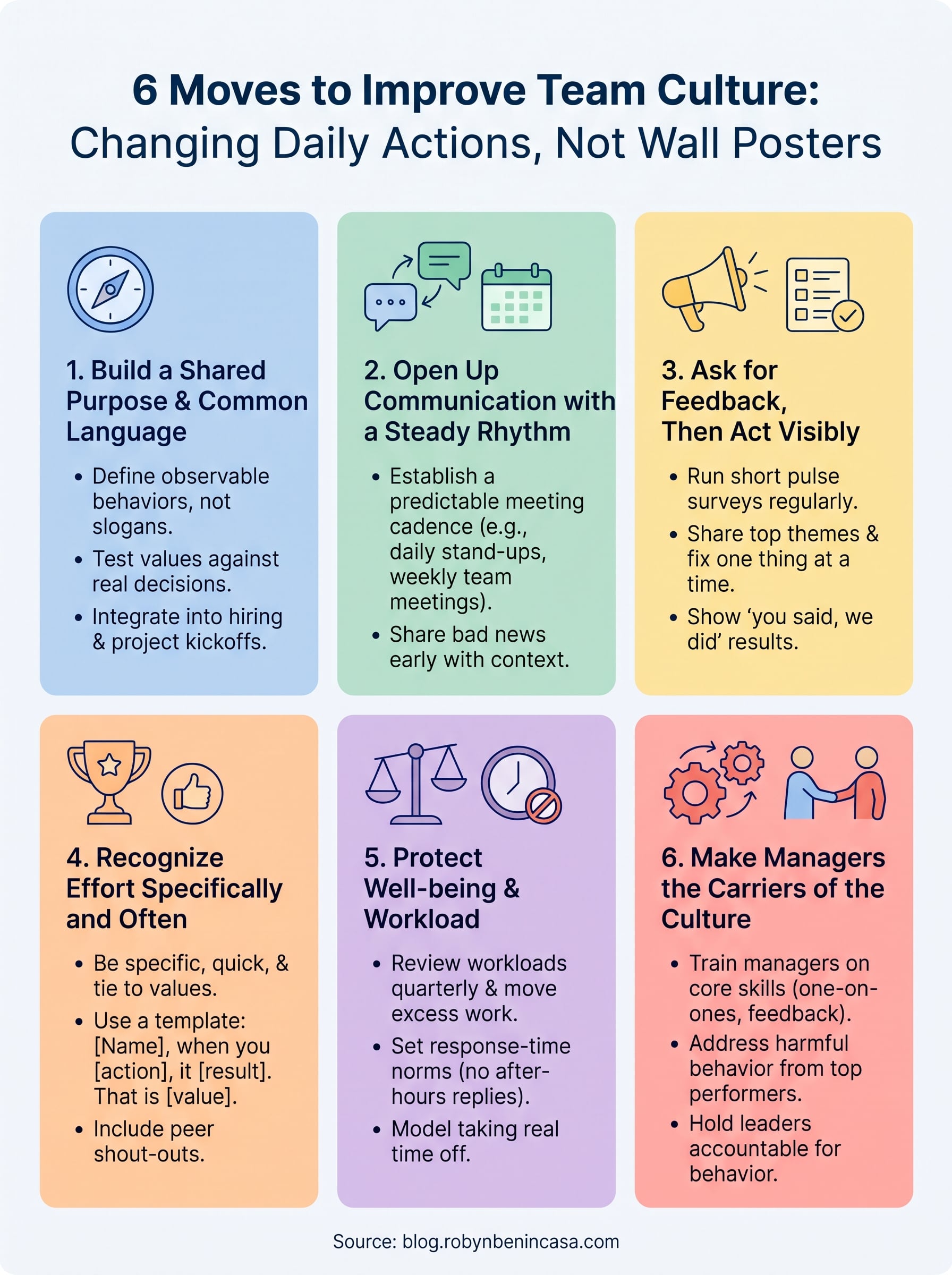
The most reliable way to improve team culture is to change what people do every week, not what the wall poster says. The six moves below do that: a shared purpose, steady communication, real feedback, specific recognition, protected well-being, and managers who model the culture. If your team is new or drifting, start with purpose and communication. If trust is low, start with feedback. If morale is flat, start with recognition and well-being. If your managers are the bottleneck, start with the last item.
Most advice on improving team culture reads like a menu of perks. Pizza Fridays and a trivia night will not fix unclear priorities, silent leaders, or a workload nobody can sustain. Culture is simply how things get done around here, and people read it from what gets rewarded, what gets ignored, and what leaders do under pressure.
This guide draws on the team-culture lessons of Robyn Benincasa, a San Diego firefighter and world champion adventure racer who teaches organizations how to build winning teams. Each of the six ways follows the same format, so you can compare them quickly: why it works, then how to start this month.
1. Build a shared purpose and a common language
A team culture improves fastest when everyone can say what the team is trying to win and how its members agree to treat each other. Start there before you touch perks, rituals, or policies.
Why it works
Values that stay abstract get ignored. Values written as observable behaviors get used, because people can point to them in a meeting. In adventure racing, a team stays together for days of racing, so a shared goal is not optional. Office teams are no different, they just hide the cost of misalignment better.
A value only counts when you can see it in a Tuesday afternoon decision.
How to start
Pick three to five behaviors, not slogans, and test them against real decisions. Then build them into the work:
- Write each value as a behavior, such as "We raise problems early" instead of "Integrity."
- Add one value to every hiring scorecard and every project kickoff.
- Open your weekly meeting by naming one moment where the team lived a value.
- Consider an outside spark. A keynote like Extreme T.E.A.M.W.O.R.K., which runs 45 to 60 minutes and teaches the 8 elements of a winning culture through storytelling and video, can launch the conversation.
Watch out for the one-and-done kickoff. A talk or offsite only works when managers reinforce it in the weeks that follow.
2. Open up communication with a steady rhythm
Better communication comes from a predictable schedule, not from telling people to communicate more. Decide what gets shared, how often, and in which setting.

Why it works
When leaders go quiet during a reorganization, a layoff, or a missed target, gossip fills the gap. People assume the worst when they hear nothing. A set rhythm tells the team that information will arrive, so they stop hunting for it.
Silence from leadership is never neutral, because the team writes its own story.
How to start
Use a simple cadence and keep it for at least a quarter before judging it:
| Rhythm | Format | Purpose |
|---|---|---|
| Daily | 10-minute stand-up or written update | Priorities and blockers |
| Weekly | 30 to 45 minute team meeting | Wins, decisions, what is changing |
| Weekly or biweekly | 30-minute one-on-one | Employee sets the agenda |
| Monthly | Open Q&A with the leader | Hard questions, answered live |
| Quarterly | Goal review | Explain the why behind changes |
Share bad news early, with the reason and the next step. A leader who explains a decision people dislike earns more trust than one who only announces good news.
3. Ask for feedback, then act on it visibly
You improve team culture through feedback only when people see something change afterward. Ask regularly, share what you heard, and fix one thing at a time.
Why it works
Leaders usually guess what the team thinks. Anonymous input surfaces the issues people will not raise in a meeting, such as an unfair workload or a manager who plays favorites. Acting on it proves that speaking up is safe, which makes the next round of feedback more honest.
Asking without acting teaches people that honesty is a waste of time.
How to start
Run a short pulse survey every month or quarter instead of one long annual survey:
- Ask five questions or fewer, such as "What slows you down most?" and "Do you know what success looks like this quarter?"
- Keep responses anonymous and share the top three themes within two weeks.
- Pick one fix, assign an owner, and report back with "you said, we did."
- Add upward feedback so managers hear how they are doing.
The common mistake is collecting data and going silent. A survey with no follow-up does more damage than no survey at all.
4. Recognize effort specifically and often
Recognition works when it is specific, quick, and tied to your values. A vague "great job" feels like a pat on the head, while a precise note shows you noticed.

Why it works
Recognition tells people which behaviors the team actually rewards. When you praise a person for catching an error early, you reinforce the value of speaking up better than any poster could. It also costs almost nothing, which makes it the easiest culture move to repeat.
What you recognize is what you will get more of.
How to start
Use a simple three-part message within 48 hours of the behavior, and copy this template:
[Name], when you [specific action], it [result for the team or customer].
That is exactly what we mean by [team value]. Thank you.
Then build the habit around it:
- Add a two-minute peer shout-out segment to your weekly meeting.
- Celebrate milestones such as work anniversaries and project launches.
- Ask each person how they like to be recognized, since some dislike public praise.
Avoid rewarding only the loudest or highest-revenue people. Quiet contributors who hold the team together deserve a name in the room too.
5. Protect well-being and workload
A healthy team culture needs workloads people can sustain. If your team is stretched, no recognition program will make up for it.
Why it works
Chronic overload, unclear roles, and constant urgency are common causes of burnout, and burnout spreads through a team quickly. Exhausted people stop sharing ideas, stop helping each other, and eventually leave. Protecting capacity is a culture move, not a perk.
A team that is always sprinting is not building culture, it is spending it.
How to start
Begin with honest numbers on who is carrying too much, then set norms leaders actually follow:
- Review workloads each quarter and move work off anyone who is over capacity.
- Set response-time norms, such as no expectation of replies outside working hours.
- Use a weekly check-in question: "What is your capacity this week, from 1 to 10?"
- Model time off. When the manager takes a real vacation, the team believes it is allowed.
Skip the wellness app on top of an impossible workload. Tools help only after the load is fair.
6. Make managers the carriers of the culture
Managers shape team culture more than any program does, so train and measure them. Gallup research attributes about 70% of the variance in team engagement to the manager.
Why it works
Employees judge culture by their direct manager’s behavior, not by the company values page. A manager who handles conflict fairly, admits mistakes, and follows through makes the whole system credible. A manager who tolerates a bullying top performer undoes years of good work in a week.
People copy what leaders do, not what leaders say.
How to start
Treat management as a skill that needs practice, then hold people to it:
- Train new and current managers on one-on-ones, feedback, and conflict resolution.
- Use the upward feedback from item 3 as part of manager reviews.
- Address harmful behavior from high performers quickly and visibly.
- Have leaders go first. Share a recent mistake and what you learned from it.
The usual error is promoting your best individual contributor into management with no preparation. Great performers often need new skills to lead well.
Pick one move and run it for a quarter
You do not need all six at once. Choose the one that matches your biggest gap, run it for a full quarter, and check whether people behave differently. Culture changes through repetition, so a small habit kept up beats a big launch that fades.
If you want an outside voice to help your team commit to a stronger culture, see how Robyn Benincasa helps organizations build winning team cultures. Her keynotes can give your team a shared starting point, and the daily habits above will keep it going.