
The best leadership development training videos are short, free, and built around one idea you can try the same day. If you are a new manager, start with Drew Dudley’s six-minute talk on everyday leadership. If you want your team to speak up, watch Amy Edmondson on psychological safety. If you need to set direction, watch Simon Sinek. If you are preparing for a bigger role, watch Roselinde Torres. If you want to change how you run meetings, watch Itay Talgam.
Most searches for this topic return hour-long lectures and motivational montages. They feel good for ten minutes and change nothing on Monday. I picked these five on three tests. Each is free, each runs about 20 minutes or less, and each teaches a behavior you can name and practice. Search the title and speaker on YouTube or TED’s site to find it.
Each entry covers what the video teaches, who it suits, and how to use it with a team. That last part comes from experience. Robyn Benincasa, a world champion adventure racer and longtime San Diego firefighter, builds her keynotes around stories and video clips that start team conversations. A clip only develops leaders when people discuss it afterward.
1. Simon Sinek: How great leaders inspire action
Simon Sinek’s TED talk is the best starting point for leaders who must explain why their team exists. It runs about 18 minutes and is free.

What it teaches
Sinek introduces the Golden Circle: why, how, and what. Most organizations communicate from the outside in, starting with what they sell. Sinek argues that great leaders start from the inside, with the purpose that makes people care. He backs this with Apple, the Wright brothers, and Martin Luther King Jr., who gave a speech about a dream rather than a plan.
- Speaker: Simon Sinek, author and leadership speaker
- Format: TEDx talk, about 18 minutes
- Core idea: People follow a clear purpose before they follow a product or a plan
Leaders earn commitment by explaining why the work matters before they explain what to do.
Who it suits and how to use it
This video suits leaders who must set direction, such as new team leads, department heads, and founders. It also helps anyone whose team follows instructions without understanding the goal.
After watching, ask each person to write one sentence that begins "We do this work because…" for a current project. Compare the answers. Mismatched answers show you where your purpose is unclear, and that gap is the real lesson.
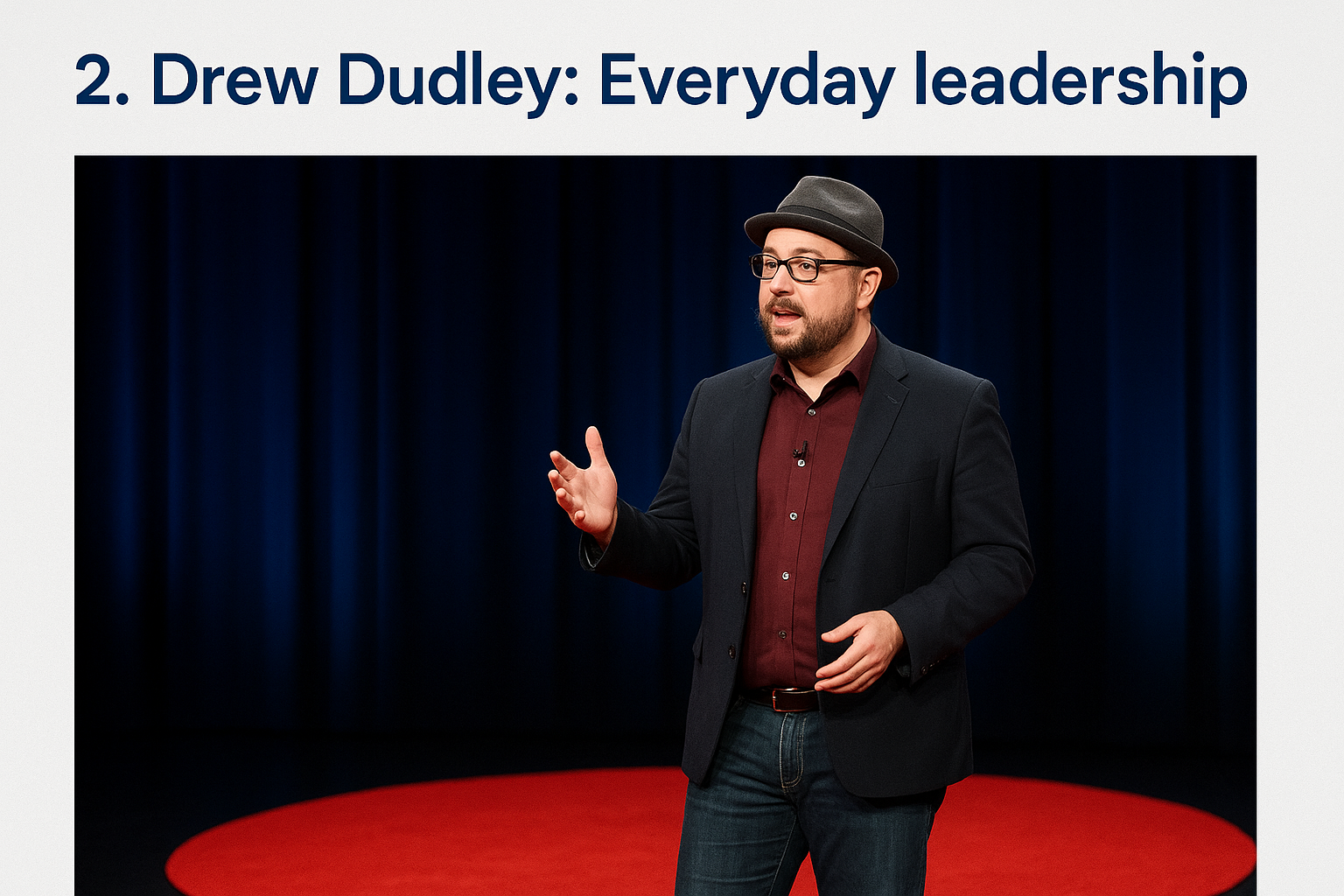
2. Drew Dudley: Everyday leadership
Drew Dudley’s TEDx talk is the best short leadership video for students and first-time managers. It runs about six minutes, so you can use it in the first five minutes of a meeting.
What it teaches
Dudley argues that we make leadership too big. We picture a title or a grand achievement, so ordinary people dismiss themselves as leaders. He tells the story of a small act, a lollipop moment, that someone remembered for years while he had forgotten it. His point is that leadership is a series of small moments in which you make someone’s day better.
- Speaker: Drew Dudley, leadership educator
- Format: TEDx talk, about six minutes
- Core idea: Leadership is built from everyday moments, not from rank
You do not need a title to lead, only a willingness to act in the small moments.
Who it suits and how to use it
It suits students, early-career staff, and new managers who do not yet see themselves as leaders. It also works for teams that wait for permission to take initiative.
Play it at the start of a team meeting. Then ask everyone to name one person who made their work easier this month. Have them tell that person directly. The exercise takes ten minutes and builds a habit of recognition that no policy can order.
3. Roselinde Torres: What it takes to be a great leader
Roselinde Torres gives you the most practical self-assessment in this list. Her TED talk runs about nine minutes and turns leadership development into three questions you can answer today.
What it teaches
Torres draws on years of watching leaders at work. She says the leaders who last ask different questions than the ones who stall. She boils them down to three:
- Where are you looking to anticipate change?
- How diverse is your network?
- Are you courageous enough to abandon the past?
Each question is a habit. The first is about looking outside your own industry and desk. The second is about who you spend time with. The third is about letting go of methods that once earned you success.
Great leaders spend their time looking forward, widening their networks, and dropping what no longer works.
Who it suits and how to use it
This talk suits mid-career managers preparing for senior roles. It also suits executives who suspect their calendar has become too internal.
Run the three questions as a personal audit. Check your calendar for the last month. How many hours went to people outside your function? How many to learning about changes in your market? Write down one habit to drop. Review it with a peer or mentor in 30 days.
4. Amy Edmondson: Building a psychologically safe workplace
Amy Edmondson’s talk is the best video for leaders whose teams stay quiet in meetings. It runs about 11 minutes and explains why silence is expensive.
What it teaches
Edmondson is a Harvard Business School professor who studies teams. She defines psychological safety as a shared belief that you can speak up with ideas, questions, or mistakes without being punished. Her early research in hospitals found that better teams appeared to report more errors, because people felt safe saying so. In the talk she offers three moves for leaders: set the stage, invite participation, and respond productively.
- Speaker: Amy Edmondson, Harvard Business School professor
- Format: TEDx talk, about 11 minutes
- Core idea: Teams learn and perform when people can speak up safely
A team that cannot admit mistakes cannot learn from them.
Who it suits and how to use it
It suits team leads, project managers, and executives who want honest information. It matters most when your team is under pressure, because that is when people stop talking.
Use her three moves in your next meeting. Open by saying the work has real uncertainty. Ask a specific question such as "What are we missing?" Then thank the first person who disagrees before you respond to the content. Small signals decide whether people speak up next time.
5. Itay Talgam: Lead like the great conductors
Itay Talgam’s TED talk is the best pick if you want to see leadership styles in action. It runs about 20 minutes, the longest in this list, and it rewards the time.
What it teaches
Talgam, a conductor and leadership teacher, shows clips of famous conductors at work. Each leads an orchestra differently. Some control every gesture, and others give musicians room to contribute and respond. He uses the contrast to ask how much space a leader gives people to bring their own skill to the work.
- Speaker: Itay Talgam, conductor and leadership teacher
- Format: TED talk, about 20 minutes
- Core idea: Leadership style decides how much of your team’s talent you can use
The way you lead decides how much of your team’s talent ever reaches the work.
Who it suits and how to use it
This talk suits managers who tend to micromanage, and teams that feel they are executing instructions rather than contributing. It also works as a discussion starter in leadership workshops because everyone sees the same clips.
After watching, ask the group which conductor your last team meeting most resembled. Then ask what you could hand over without losing quality. Pick one decision to delegate completely for a month and review the result.
Start with one video and one habit
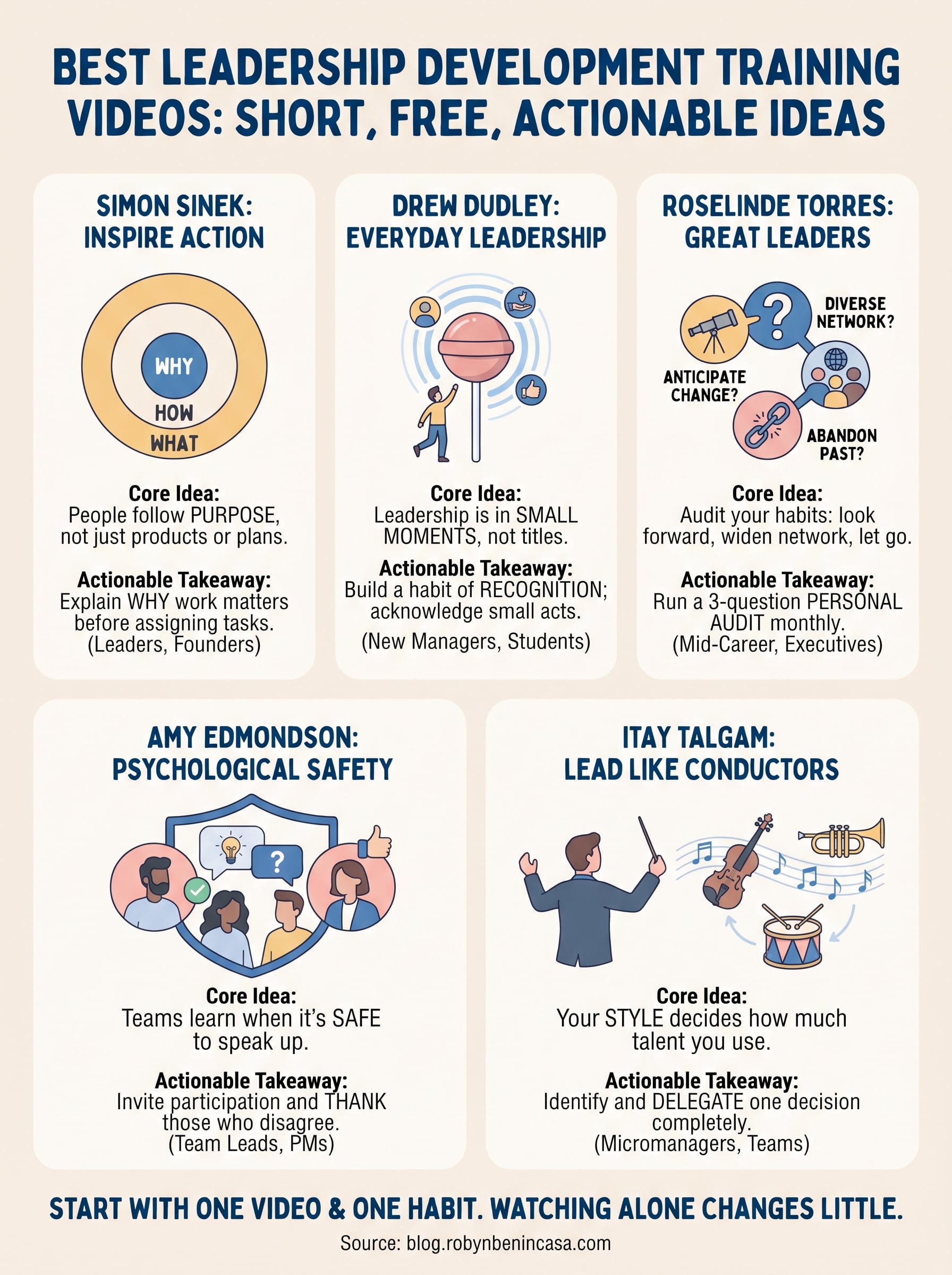
The five videos solve different problems. Sinek gives you purpose, Dudley gives you permission, Torres gives you a self-audit, Edmondson gives you trust, and Talgam shows you your style. Choose the one that matches your biggest gap, then act on it before you watch another.
Watching alone changes little. The value comes from the conversation and the habit that follow. If you want more practical thinking on building a winning team culture, read Robyn Benincasa’s leadership and team-building articles.