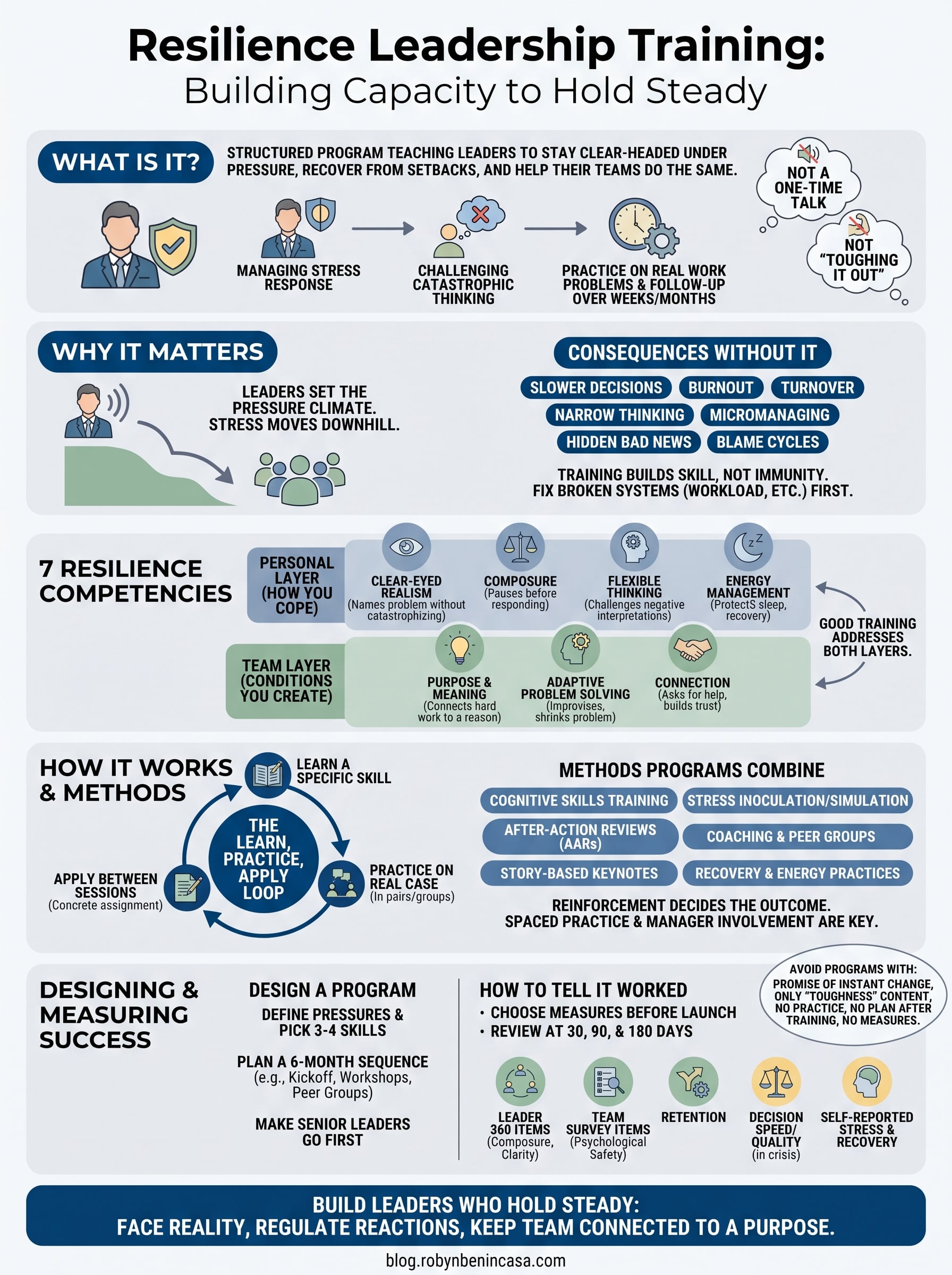
Resilience leadership training is a structured program that teaches leaders to stay clear-headed under pressure, recover from setbacks, and help their teams do the same. It pairs skill instruction, such as managing a stress response and challenging catastrophic thinking, with practice on real work problems and follow-up over weeks or months. A one-time motivational talk is not training, and a leader who simply "toughs it out" is not resilient.
This guide covers why resilience matters in the person at the top of a team, the qualities and skills that training builds, the methods programs use, and how to design or buy one. You will also see how to tell whether leadership resilience training changed anything, so you can defend the budget with evidence instead of enthusiasm.
The perspective here comes from the field. Robyn Benincasa spent more than two decades as a San Diego firefighter and led adventure racing teams through multi-day, nonstop world championship races. In both settings, the leader’s reaction to a setback set the team’s reaction. That pattern shapes everything below.
Why resilience leadership training matters
Resilience leadership training matters because a leader’s reaction to pressure spreads to everyone who reports to them. Organizations that skip it pay in slower decisions, burnout, and turnover. The effect is large because one manager has so much influence over how a team experiences work.
Leaders set the pressure climate
Teams watch their leader first when something goes wrong. If you go quiet, assign blame, or flood the channel with urgent messages, your team copies that behavior within days. If you stay specific and steady, they tend to do the same. Gallup’s research puts numbers on this influence: managers account for about 70% of the variance in team engagement. Its survey of followers in 52 countries found that people want hope, trust, compassion, and stability from leaders. Every one of those is hard to deliver while you are depleted.
Think of it as a transmission problem. Stress moves downhill. A leader who has practiced skills for interrupting their own stress response stops the transfer at the source, which is far cheaper than repairing the damage across a department later.
What goes wrong without it
Unprepared leaders fail in predictable ways under sustained pressure. You can usually spot these patterns before they show up in turnover numbers:
- Narrow thinking. Leaders fall back on the old playbook and stop asking for other views, exactly when new views matter most.
- Micromanaging or disappearing. Anxious leaders either grab every decision or avoid the team altogether.
- Hidden bad news. When people fear the reaction, they delay reporting problems, so issues reach the leader later and larger.
- Blame cycles. Energy goes into assigning fault instead of fixing the problem.
- Leader burnout. The person holding the team together runs out of reserves and leaves, or stays and checks out.
What training can and cannot fix
Resilience training builds personal capacity, but it cannot repair a broken system. If your leaders are overloaded because three roles were cut and the targets stayed the same, a breathing technique will not help. Fix workload, unclear priorities, and staffing first. Then use training for what remains: how a person interprets and responds to difficulty.
Reviews of workplace resilience programs generally report modest gains in well-being and coping. Set expectations accordingly. You are building a skill, not installing immunity.
Resilience training builds a leader’s capacity to respond, but it never replaces fixing the conditions that cause the overload.
What resilient leaders do differently
A resilient leader accepts the facts of a hard situation, regulates their own reaction, and keeps the team moving toward a purpose. That is what resilience leadership means in practice. It works on two layers, personal and team, and the skills fall into seven groups you can teach and observe.

Two layers: personal and team
The personal layer covers how you cope, recover, and keep your judgment under strain. The team layer covers the conditions you create so that the group can absorb shocks: clear roles, safety to raise problems, and a shared sense of why the work matters. Most programs train only the first layer. Good leadership resilience training addresses both, because a calm leader with a fearful team still has a fragile team.
Resilience is also not stoicism. Leaders who hide every worry teach their teams to hide theirs. A resilient leader says "this is hard" out loud and then moves to the next action. That honesty is a skill you can practice, not a personality trait you either have or lack.
Seven competencies you can train
There is no single official list, so treat this as a practical working model. It builds on Diane Coutu’s widely cited Harvard Business Review research, which identified acceptance of reality, a sense of meaning, and the ability to improvise as the core of resilience. The other four competencies add what leaders specifically need. If you want a short version, the qualities are realism, composure, purpose, adaptability, and connection.
| Competency | What it looks like | How training builds it |
|---|---|---|
| Clear-eyed realism | Names the problem in plain words, without minimizing or catastrophizing | Pre-mortems, scenario drills, honest status reviews |
| Composure | Notices a stress reaction and pauses before responding | Breathing and reset techniques, rehearsal under pressure |
| Flexible thinking | Challenges "this is a disaster" or "this is all my fault" interpretations | Learning to spot thinking traps and test them against facts |
| Purpose and meaning | Connects hard work to a reason the team cares about | Values and purpose exercises, story practice |
| Adaptive problem solving | Improvises with what is available and shrinks the problem to a next step | Constraint-based case exercises, after-action reviews |
| Connection | Asks for help, builds trust, keeps the team close | Peer groups, feedback practice, team norms |
| Energy management | Protects sleep, breaks, and recovery for self and team | Recovery planning, boundary setting, modeling rest |
The first three are about how a leader thinks, the next three about how a leader acts with others, and the last one keeps the whole system running over months instead of days.
An example of resilient leadership in action
Picture a regional sales director whose team loses its largest account in the last week of the quarter. A low-resilience response is easy to imagine: a sharp email to the account owner, a late-night spiral, and a vague message to the team that "we need to push harder."
A resilient response looks different. The director states the loss plainly to the team the same day. She takes ten minutes before replying to the executive team. She separates what is controllable (two pipeline deals, one renewal) from what is not. She sets a 48-hour plan, checks on the account owner personally, and schedules a review after the quarter closes.
The same logic applies on a multi-day adventure race. At the worst hour, the leader’s job is to say what is true, shrink the problem to the next checkpoint, and keep the team together.
Resilient leaders tell the truth about the situation, steady themselves first, and then give the team the next clear step.
How resilience training for leaders works
Resilience training for leaders works by teaching a small set of mental and behavioral skills, having leaders practice them on real situations, and reinforcing them over time until they become default responses. The sequence matters more than the topic list.
The learn, practice, apply loop
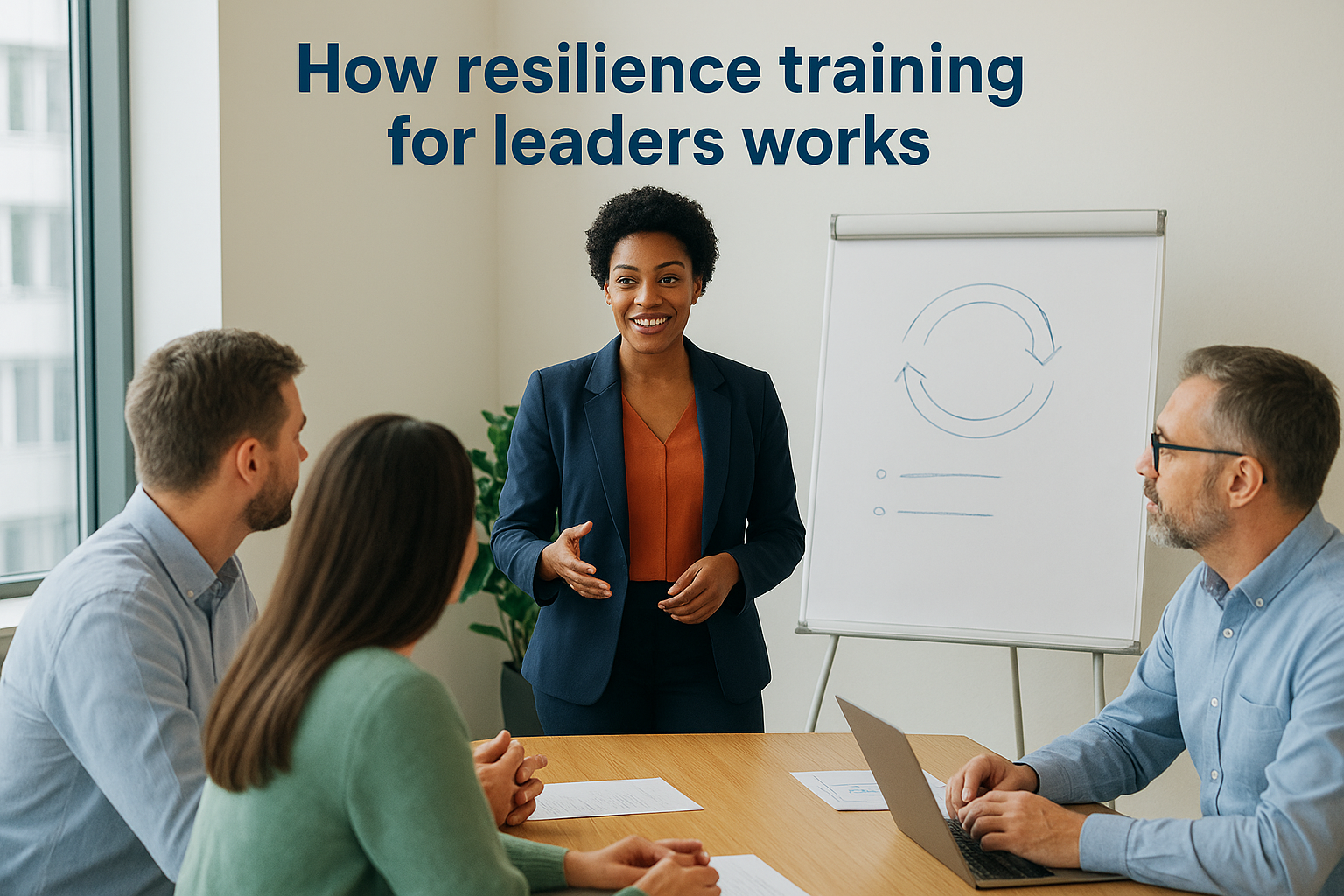
Most effective programs run the same three-part loop. First, leaders learn a specific skill in a workshop, for example how to catch a thinking trap such as assuming a setback will last forever. Second, they practice it on a real case from their own work, usually in pairs or small groups where someone can challenge their interpretation. Third, they apply it between sessions with a concrete assignment and report back at the next meeting.
This is close to how the U.S. Army’s Master Resilience Training operates. It builds on the University of Pennsylvania’s Penn Resilience Program and teaches skills such as spotting thinking traps, putting problems in perspective, and responding in real time. You do not need a military budget to use the structure. You need skills that are specific, practice that is realistic, and a reason to use both next week.
Methods programs combine
Few programs use only one method. These are the ones you will see most often, and what each is best for:
| Method | What leaders do | Best for |
|---|---|---|
| Cognitive skills training | Learn to spot and challenge unhelpful interpretations of events | Composure and flexible thinking |
| Stress inoculation and simulation | Rehearse a crisis in a tabletop or scenario exercise at controlled difficulty | Decision quality under pressure |
| After-action reviews | Debrief what was expected, what happened, why, and what to change | Learning from setbacks |
| Coaching and peer groups | Work through live problems with a coach or a small group of peers | Application and accountability |
| Story-based keynotes | Hear real accounts of adversity and how teams got through it | Shared language and kickoff energy |
| Recovery and energy practices | Plan sleep, breaks, and boundaries, then model them for the team | Sustaining performance over months |
A solid design uses at least three of these. A keynote alone builds motivation but rarely builds skill. A skills workshop without peer follow-up tends to fade.
Why reinforcement decides the outcome
A familiar pattern: a team leaves a good program energized, and three or four weeks later the old habits are back. That is not a failure of motivation. It is how skills decay without use.
Plan reinforcement from the start. Short weekly practices of about ten minutes, monthly peer sessions, and managers who ask "which skill did you use this week?" keep the learning alive. Spaced practice beats a single intensive day, and manager involvement beats good intentions.
Training changes leaders only to the extent that the skills are used again within the first month.
How to design a program for your leaders
To design a program, start with the pressures your leaders actually face, choose three or four skills to target, and build a six-month sequence that mixes sessions with practice on the job. Trying to cover all seven competencies at once is the most common reason programs feel thin.
Define the pressures and pick the skills
Interview eight to ten leaders across levels and ask what has been hardest in the last year. A reorganization, a missed target, an acquisition, or a technology shift each calls for a different emphasis. Leaders in the middle of a merger may need connection and realism most. Leaders facing constant disruption may need adaptive problem solving and energy management.
Then pick three or four competencies from the seven and write one observable behavior for each. "Pauses before replying to bad news" is observable. "Becomes more resilient" is not. Observable behaviors give you something to teach, coach, and measure.
A six-month sequence, worked through
Here is a sequence for an organization with 150 leaders. Cohorts of 25 give you six groups.
| Component | Format | Time per leader |
|---|---|---|
| Kickoff keynote | All leaders together, one session | 1 hour |
| Skills workshops | Two half-day sessions per cohort | 8 hours (2 × 4) |
| Peer practice groups | One session per month for six months | 6 hours (6 × 1) |
| Total | 15 hours over six months |
That is about 2.5 hours per leader per month, which is realistic even for busy leaders. For the organization it means one kickoff session, 12 workshop sessions (6 cohorts × 2), and monthly peer groups running throughout. Add a ten-minute weekly practice that each leader runs on their own, and you have the reinforcement the previous section called for.
Make senior leaders go first
Put the executive team through the program before everyone else, or at least alongside the first cohort. When senior leaders visibly use the language, such as saying "I’m in a thinking trap on this one," the rest of the organization sees that the skills are for real work, not a side project. It also exposes system problems that executives can fix, which protects you from the trap of training people to cope with conditions that should change.
A program that senior leaders skip teaches everyone else that resilience is optional.
How to choose a program or provider
Choose a program by checking whether it teaches specific skills, includes practice on real work, plans reinforcement, and defines how it will measure results. If a provider cannot show you these four things, keep looking, however polished the pitch is.
Questions to ask any provider
Use these questions in a first call. Good providers answer them without hesitation:
- Which specific skills will my leaders be able to demonstrate afterward?
- How much of each session is practice on our own situations versus presentation?
- What happens in the 30, 60, and 90 days after the last session?
- How do you involve the participants’ own managers?
- What do you measure, and how do you share it with us?
- How do you tailor the content to our industry and our pressures?
- What do you say to leaders when the real problem is workload, not mindset?
The last question is the most revealing. A provider who says every problem is a mindset problem is selling something other than training.
Where a keynote fits
A keynote is a strong opener, not a full program. It gives a whole group of leaders the same stories and vocabulary on the same day, and it builds energy for the work that follows. Two of Robyn Benincasa’s keynotes map to resilience goals. Inspiring Greatness through G.R.I.T. (45 to 60 minutes) is built for teams facing adversity, tough years, or stretch goals, and it shows where real grit comes from: connection. Adapt, Overcome, and Win as One (45 to 60 minutes) fits organizations moving through disruption, such as AI transformation or an industry shift.
Use either as the kickoff in the sequence above, and let workshops and peer groups carry the skill-building. Be wary of any speaker, including this one, who claims a single hour can change how leaders behave for years.
Red flags to avoid
Walk away or ask hard follow-ups when you see any of these:
- A promise of lasting change from one session
- Content that is only about toughness, grit, or "pushing through"
- No practice on participants’ real situations
- No plan for the weeks after training
- No measures, or measures limited to a happy-sheet rating at the end of the day
How to tell whether the training worked
You can tell whether resilience training worked by choosing a few measures before launch and comparing them at 30, 90, and 180 days. Satisfaction scores right after a workshop tell you whether people enjoyed it, not whether they changed.
Choose measures before launch
Pick four or five indicators that connect to the behaviors you trained. Baseline each one before the first session:
- Leader 360 items on composure and clarity under pressure, rated by direct reports
- A team survey item such as "People on my team can raise bad news without fear," as a read on psychological safety
- Retention among participants and in their teams over the following year
- Decision speed or quality in a crisis exercise run before and after
- Self-reported stress and recovery, kept confidential and used for trends, not for evaluation
No single number proves the program worked. Together they show a pattern. Expect the self-reported and 360 measures to move first, and retention to lag by months.
Review at 30, 90, and 180 days
At 30 days, ask whether leaders are still using the skills at all. If usage has dropped, add reinforcement before anything else. At 90 days, check the 360 and team survey items against baseline. At 180 days, look at the harder outcomes and decide what to change in the next cohort.
Share the results with participants. Leaders who see that the organization is tracking behavior, not just attendance, take the practice more seriously. And if a measure does not move, treat that as information about the design, not as a verdict on the people.
Measure the behaviors you trained at three checkpoints, because satisfaction scores prove only that the session was pleasant.
Build leaders who hold steady
Resilience leadership training teaches leaders to face reality, manage their own reactions, and keep a team connected to a purpose. It works when it targets a few specific skills, uses practice on real problems, reinforces them for months, and is measured honestly. It fails when it is a single inspirational day or a way to ask people to absorb problems the organization should fix.
Start small. Pick one pressure your leaders face right now, choose three skills that address it, and build the six-month sequence around them. If you want a live opener that gets your leaders talking about adversity and teamwork in the same language, explore Robyn Benincasa’s keynote Inspiring Greatness through G.R.I.T. and see whether it fits the pressure your organization is under.